
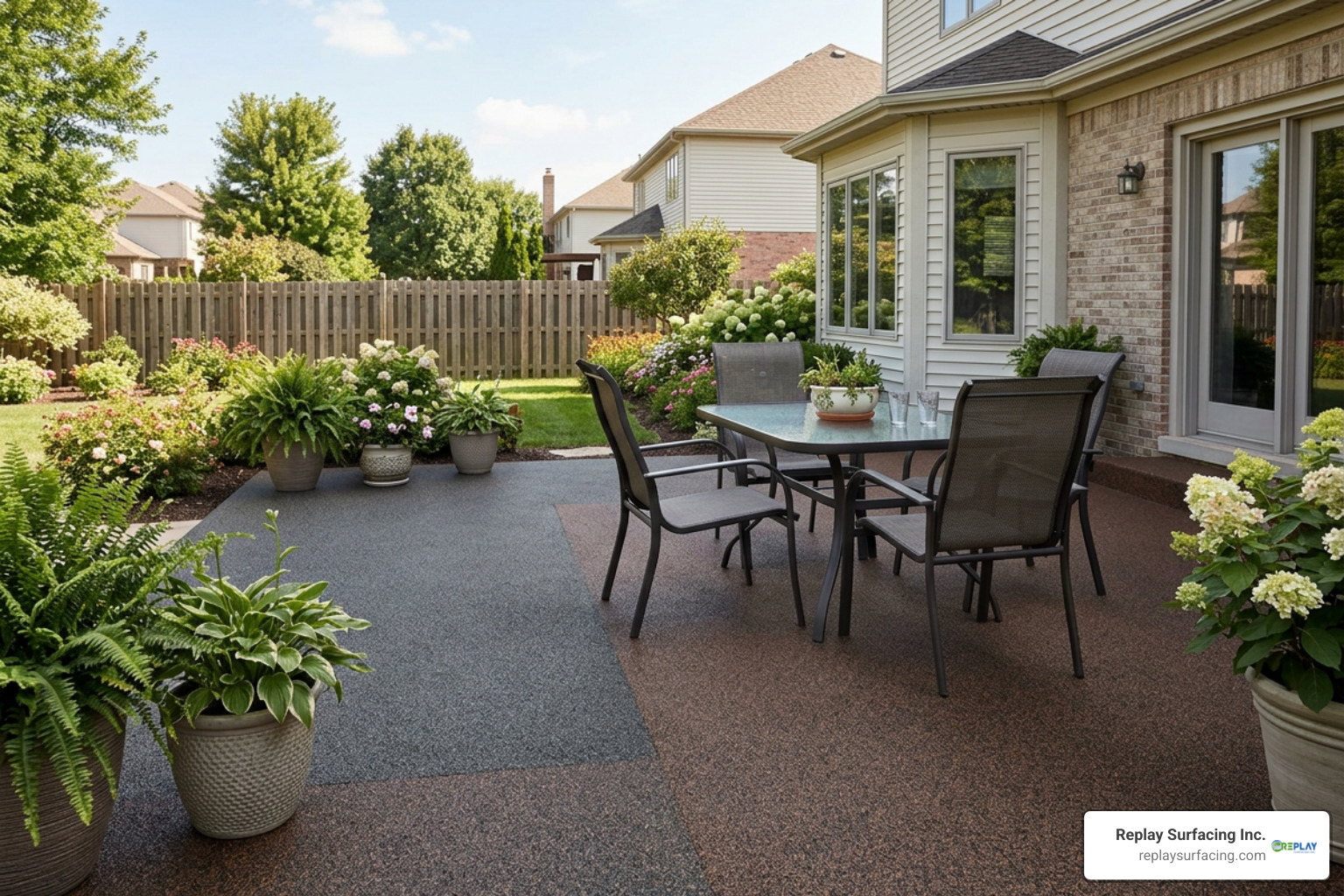
Outdoor Rubber Flooring in Charlotte, NC: A Durable, Safer Surface for Outdoor Spaces
Outdoor rubber flooring in Charlotte, NC is a resilient surface made for spaces that need better traction, impact protection, and weather resistance than hard concrete, asphalt, or bare ground. It is commonly used for playgrounds, patios, pool decks, sports areas, walkways, and balconies – especially where safety, low upkeep, and long-term value matter.
| What it offers | Why it matters outdoors |
|---|---|
| Cushioned surface | Helps reduce impact from falls and standing fatigue |
| Wet-weather traction | Can provide more grip than many hard surfaces when rain or pool water is present |
| All-season durability | Built to handle sun, rain, snow, and changing temperatures when properly installed |
| Recycled-material options | Many products use recycled tire rubber, turning waste into useful surfacing |
| Lower lifetime upkeep | May cost more upfront than some basic surfaces, but can reduce repairs and replacement over time |
For an eco-conscious facility manager, the central question is not simply whether rubber costs more per square foot. It is whether its safety, durability, drainage, appearance, and maintenance needs make it the smarter investment for a high-use outdoor space. Outdoor rubber flooring can last 20 years or more in the right application, but product type, base preparation, UV exposure, and installation quality all affect that result.
I am Landon Olson, operator of Replay Surfacing Inc., with a mechanical engineering background and experience in manufacturing, sustainability, and safety surfacing. At Replay Surfacing, I help turn scrap tires into durable outdoor rubber flooring in Charlotte, NC and other recycled-rubber surfaces designed for safer, longer-lasting community spaces.
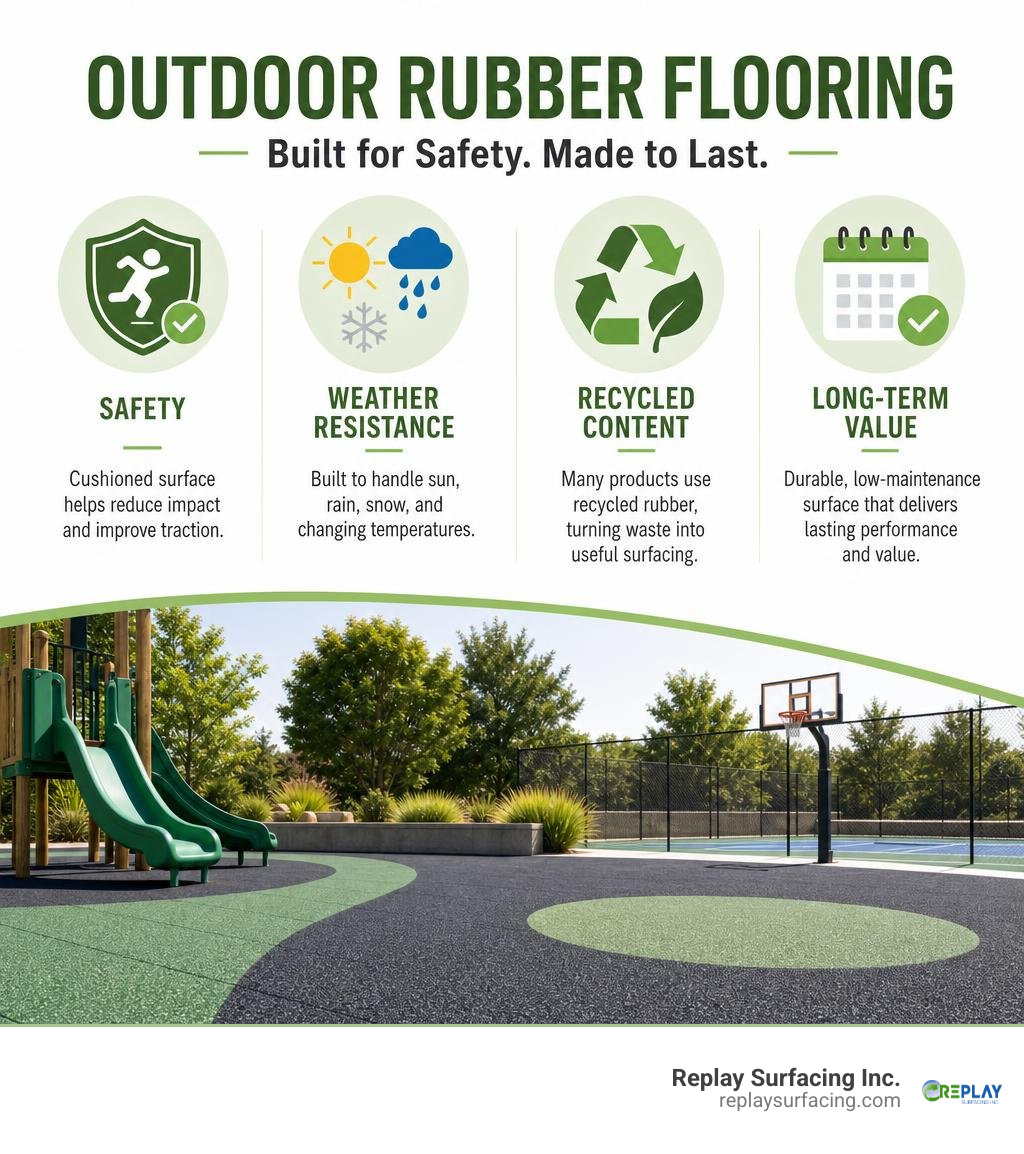
Key Benefits and Applications of Outdoor Rubber Flooring

When upgrading outdoor recreational spaces or backyards across communities like Charlotte, NC, Raleigh, NC, or Sanford, NC, traditional materials such as concrete, brick pavers, or wood decking often fall short. They crack under pressure, splinter over time, or create severe slip hazards when damp. Outdoor rubber flooring steps in to solve these headaches by combining incredible cushion with rugged weather resistance.
The most noticeable benefit of rubber surfacing is its remarkable impact absorption. Studies show that rubber surfaces absorb up to 90% of impact energy and can reduce impact force by up to 40% compared to solid concrete. That means less joint stress for athletes running drills and far softer landings for energetic kids who leap off swing sets. For families wanting a safer backyard setup, installing durable backyard rubber flooring that kids and parents love turns a hard patio into a soft, secure play area.
Beyond injury prevention, rubber flooring excels in thermal comfort. During hot summers or humid afternoons in Charlotte, NC and Raleigh, NC, unshaded concrete and asphalt become scorching hot. High-quality outdoor rubber surfaces can lower surface temperatures by up to 20°F compared to traditional asphalt under direct sunlight, helping prevent painful bare-foot burns around pool decks and patios.
Finally, rubber flooring delivers exceptional long-term financial value. While wood rots and concrete spalls, rubber resists chipping, cracking, and biological decay. With an expected lifespan exceeding 20 years, choosing rubber can cut long-term replacement and repair expenses by as much as 50% compared to high-maintenance timber or standard pavement.
Common Uses Across Residential and Commercial Spaces
Whether we are outfitting a municipal park in Raleigh, NC, or a residential backyard in Charlotte, NC, outdoor rubber flooring offers versatile solutions across diverse environments:
- Playgrounds & Play Parks: Providing soft, impact-tested landings underneath play towers, swings, and climbing walls.
- Residential Patios & Decking: Resurfacing tired, weathered concrete slabs or wooden decks to build comfortable outdoor entertainment lounges.
- Outdoor Athletic Courts & Gyms: Creating heavy-duty surfacing for basketball courts and fitness spaces. Discover how we build robust courts with our specialized rubber flooring for sports courts that can take a beating.
- Pool Decks & Splash Pads: Giving wet feet maximum grip to dramatically cut down on dangerous slips near water.
- Garden Walkways & Pathways: Crafting flexible, weed-free walking tracks through gardens and parks using a clean recycled rubber outdoor walkway.
Types of Outdoor Rubber Flooring: Tiles, Rolls, and Mats
Selecting the right form factor is essential for getting the performance you need. Outdoor rubber comes in three primary styles, each tailored to specific uses:
- Interlocking Tiles: Modular tiles (often 24×24 inches) snap together effortlessly. They feature molded channels on the underside to allow water drainage. These are ideal for patios, residential play zones, and balconies. Check out our comprehensive guide on the ultimate guide to rubber yard tiles for patios and playgrounds to explore design options.
- Heavy-Duty Rolls: Sheet rubber rolls come in large, continuous lengths. Because they have minimal seams, rolls work brilliantly for sprawling commercial outdoor gyms or large, flat sports grounds. However, they require careful subfloor gluing and precise edge trimming.
- Standalone Rubber Mats: Thick, heavy rubber mats offer targeted surface protection without requiring full-room coverage. They are ideal beneath high-wear playground equipment like slide exits or under outdoor power racks. You can also explore options like an outdoor interlocking rubber pathway materials 24 x 24 inches setup for modular pathways, or read our overview on tough-as-nails outdoor rubber mats that wont quit.
| Flooring Format | Best Applications | Installation Difficulty | Drainage Capability | Main Advantage |
|---|---|---|---|---|
| Interlocking Rubber Tiles | Patios, Playgrounds, Walkways | Moderate (DIY-Friendly) | Excellent (molded underside channels) | Easy spot-repair and simple modular layout |
| Rubber Rolls | Large Athletic Facilities, Gyms | High (Requires Adhesives) | Moderate (Requires sloped subbase) | Seamless finish over large areas |
| Standalone Mats | High-impact drop zones, Swing sets | Very Easy (Drop-in place) | Good (Direct surface runoff) | Heavyweight stability without full installation |
For custom landscapes, explore our guide on how to choose the best outdoor play yard flooring for your garden or read our deep dive on an outdoor oasis exploring rubber mats for play parks and beyond.
Weather Resistance, Safety Standards, and Drawbacks
Outdoor materials face harsh conditions year-round. During heavy downpours that test surface drainage, or cold winter spells that subject materials to freeze-thaw cycles, outdoor rubber flooring stands up to these weather extremes exceptionally well.
Rubber naturally resists water absorption. When temperatures plummet below freezing, moisture inside rigid materials expands and causes cracks. Rubber, by contrast, retains its flex, allowing it to withstand sub-zero freeze-thaw cycles without fracturing. For sun-drenched regions like Sanford, NC, or Raleigh, NC, modern rubber flooring utilizes UV-stabilized binder formulations to minimize fading and degradation caused by solar radiation.
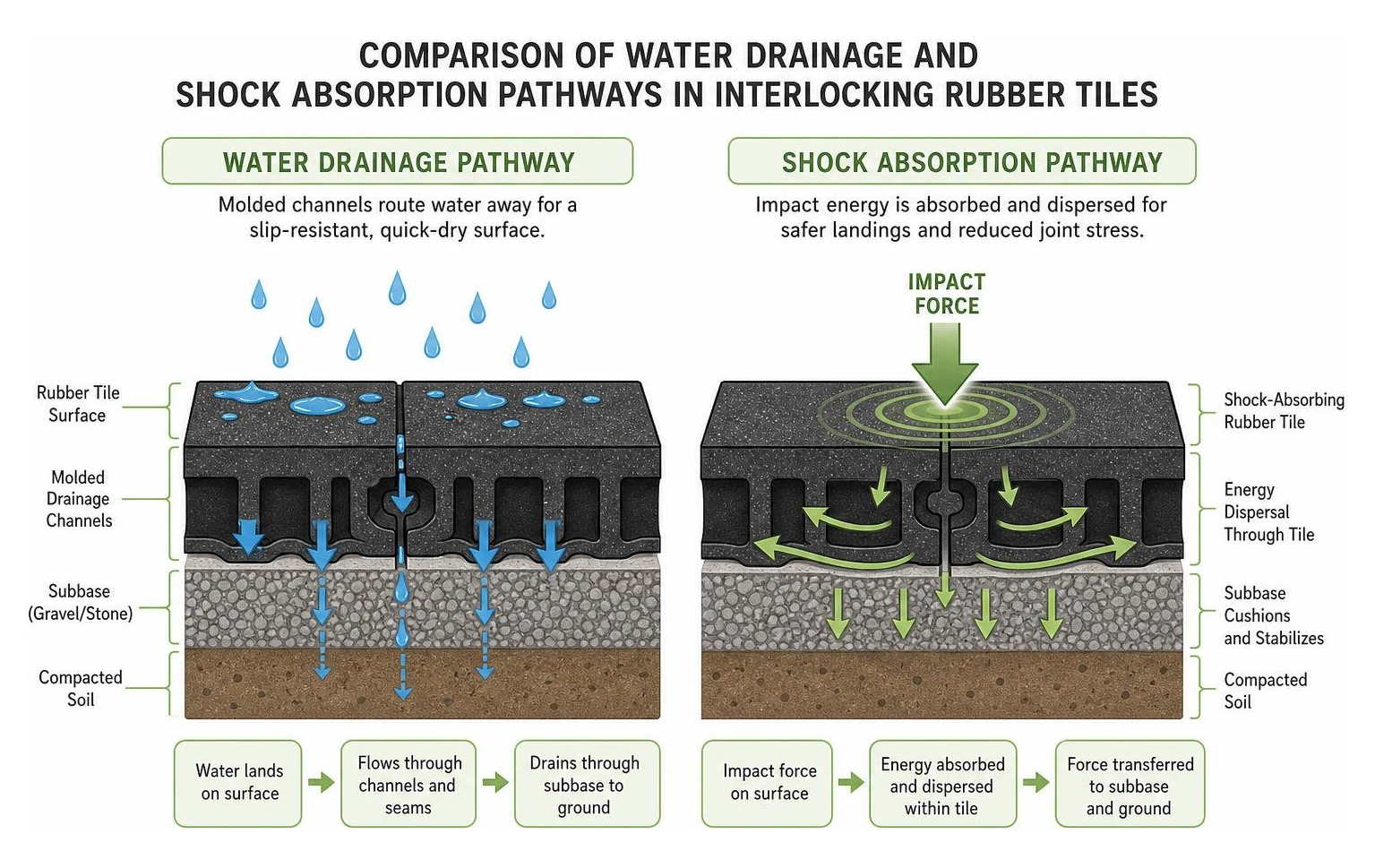
Slip Resistance and Impact Absorption Standards
Slips and falls on wet surfaces cause thousands of outdoor injuries every year. Rubber flooring provides high natural friction, delivering reliable wet traction that reduces slip-and-fall injuries by up to 70% in wet conditions compared to concrete or smooth ceramic tiles.
When installed in public play areas or athletic zones, safety compliance is paramount. Commercial rubber surfacing meets strict standards:
- ASTM F1292: Validates critical fall-height safety, ensuring that falls from high playground equipment do not result in critical head trauma. In fact, research demonstrates that rubber tiles reduce the risk of head injuries by 60% compared to bare grass or packed earth.
- ASTM C1028: Measures the static coefficient of friction to verify slip resistance in wet and dry conditions.
- ADA Accessibility: Poured-in-place rubber and smooth interlocking tiles offer stable, flat pathways that allow easy wheelchair access.
For broader public-playground planning guidance, the U.S. Consumer Product Safety Commission publishes a Public Playground Safety Handbook that facility teams can use alongside site-specific surfacing specifications and fall-height testing requirements.
For detailed playground safety insights, read about our rubber flooring for playgrounds and see how we create outdoor rubber play surfaces a soft landing for every fall.
Maintenance and Drawbacks of Outdoor Rubber Flooring
While outdoor rubber flooring is remarkably resilient, no surface is completely maintenance-free. Understanding its few drawbacks helps ensure you get the best performance:
- Initial Rubber Odor: Freshly installed recycled rubber flooring has a distinct tire shop smell. Outdoors, this off-gassing dissipates naturally within a few days to two weeks.
- UV Fading: Over years of intense sun exposure, black tire rubber or non-UV-coated granules can shift toward a soft matte gray. Choosing high-grade EPDM top-layers slows color change significantly.
- Drainage Needs: Rubber itself is non-porous (unless configured as porous pour-in-place). If laid over a flat concrete slab without built-in pitch or tile underside channels, water can pool along the surface seams.
To keep your investment looking fresh for decades, follow this simple maintenance checklist:
- Weekly Sweeping: Remove leaves, pine needles, and grit using a soft-bristle broom or leaf blower to prevent organic build-up.
- Rinsing: Hose down the area periodically to clear off dirt and dust.
- Occasional Pressure Washing: Use a mild fan-spray setting (under 1500 PSI) kept at least 12 inches away from the surface to lift stubborn grime.
- Prompt Stain Removal: Clean oil spills or tree sap quickly using warm water and a neutral-pH detergent; avoid petroleum-based solvents that could weaken the rubber binder.
For tailored play park selections, check out our insights on playground perfection finding the right outdoor rubber mats for every space.
Cost Analysis, Installation, and Environmental Impact
When evaluating outdoor rubber surfacing, it helps to balance upfront costs with long-term value. Standard materials like timber or thin concrete might seem cheaper initially, but regular staining, sealing, power washing, and crack patching add up fast over time.
Typical pricing for outdoor rubber flooring materials generally ranges from $4 to $14 per square foot, depending on thickness, design density, and color options. Professional installation adds roughly $3 to $8 per square foot depending on ground preparation needs. While this places rubber at a higher starting cost than basic wood deck boards, its 20-year lifespan without costly routine repairs makes it far more economical over time. For an in-depth breakdown of installation variables, refer to our comprehensive rubber surfacing cost ultimate guide.
DIY vs. Professional Installation Process
Can you install rubber flooring yourself? Absolute DIYers can successfully lay interlocking tiles or portable mats over flat concrete, asphalt, or well-compacted crushed stone base beds.
Here is how a standard interlocking tile installation unfolds:
- Subbase Preparation: Clean the underlying concrete slab thoroughly or compact a 3-to-4-inch aggregate base layer if installing directly over dirt.
- Layout Planning: Measure from the center outwards to minimize narrow border cuts along walls or edge restraints.
- Interlocking Assembly: Connect interlocking pins or press male/female tile tabs firmly together using a rubber mallet.
- Edge Trimming: Cut perimeter tiles precisely using a sharp utility knife and a straight edge guide.
However, complex applications—such as large pour-in-place sport surfaces, rolled rubber glue-downs, or public high-fall-height zones—benefit greatly from professional installation teams. Experienced installers ensure proper adhesive bonding, flawless border integration, and seamless drainage slopes.
Environmental Sustainability and Recycled Tire Materials
At Replay Surfacing Inc., sustainability sits at the center of everything we do. Scrap tires pose a major environmental hazard worldwide, filling up landfills or causing toxic industrial fires when discarded improperly.
By recycling vulcanized tire rubber, our manufacturing processes divert over 100 million tires from landfills annually across the United States alone. Transforming these durable automotive tires into soft, resilient outdoor surfaces gives raw materials a valuable second life. Instead of cluttering waste streams, recycled rubber becomes high-performance athletic floors, quiet residential walkways, and soft playground surfaces.
To discover sustainable walkway solutions, check out our guide on permanent mulch recycled rubber outdoor pathway for gardens. You can also learn more about our home design services in the complete guide to residential rubber surfacing and view completed work across our residential projects.
Frequently Asked Questions About Outdoor Rubber Flooring
How long does outdoor rubber flooring last in extreme weather?
High-quality outdoor rubber flooring regularly lasts 20 years or more, even when exposed to harsh environmental shifts. During freezing winter days, rubber easily tolerates repeated freeze-thaw cycles without breaking. In hot, sun-exposed locations across Charlotte and Raleigh, NC, UV-stabilized formulations protect the surface against sun damage and brittleness.
Can outdoor rubber flooring be installed over concrete or dirt?
Yes! Concrete and asphalt provide excellent, flat subbases for rubber tiles, rolls, and mats. However, you should never place rubber flooring directly onto loose soil or uncompacted grass. Loose soil shifts when wet, causing tiles to buckle and create tripping hazards. To install rubber over dirt, clear away vegetation, excavate a few inches, and lay a compacted 3-to-4-inch base layer of crushed aggregate gravel first.
Is outdoor rubber flooring hot to step on in direct sunlight?
Like all dark outdoor surfaces, black rubber absorbs solar heat. However, rubber transfers heat far less efficiently than solid concrete or asphalt, meaning it won’t burn skin as quickly. Choosing lighter color blends, EPDM speckled tiles, or shaded areas keeps the surface cooler. On average, light-colored rubber surfaces stay up to 20°F cooler than unshaded dark asphalt.
Conclusion
Choosing the right surface for your outdoor spaces comes down to balancing performance, long-term cost, and safety. While initial installation expenses for outdoor rubber flooring exceed those of raw timber or basic concrete, its unmatched 20-year durability, fall protection, slip resistance, and low upkeep make it a smart long-term investment.
Whether you are remodeling a residential patio in Raleigh, NC, upgrading a municipal play park in Charlotte, NC, or building a high-impact backyard training area in Sanford, NC, rubber surfacing delivers a soft, resilient foundation that withstands sun, rain, and heavy foot traffic. At Replay Surfacing Inc., we take pride in turning end-of-life tires into clean, functional surfaces designed to protect your family, guests, and community.
Ready to transform your play area or sport court into a safer, low-maintenance outdoor space? Explore our custom surfacing designs or get a quote today for your outdoor rubber flooring for basketball court project!