
Why the Right Outdoor Rubber Playground Surface Could Prevent a Trip to the ER
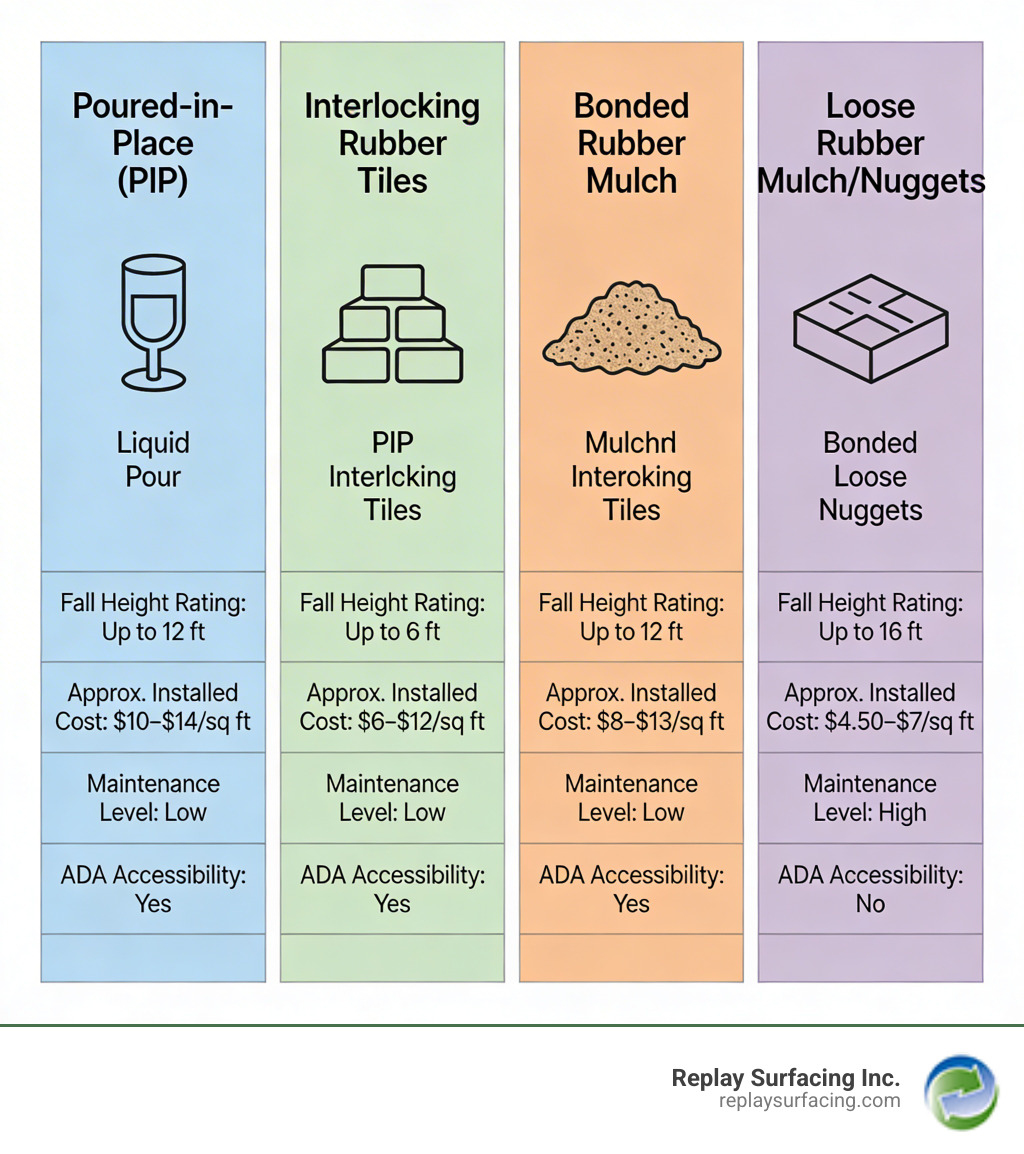
Outdoor rubber playground surface options come in four main types, each suited to different budgets, safety needs, and maintenance preferences:
| Surface Type | Best For | Fall Height Rating | Approx. Cost (installed) |
|---|---|---|---|
| Poured-in-Place (PIP) | Permanent, seamless installs | Up to 12 ft | $10–$14/sq ft |
| Interlocking Rubber Tiles | DIY-friendly, modular setups | Up to 6 ft | $6–$12/sq ft |
| Bonded Rubber Mulch | Natural look, unitary surface | Up to 12 ft | $8–$13/sq ft |
| Loose Rubber Mulch/Nuggets | Budget-friendly, loose-fill | Up to 16 ft | $4.50–$7/sq ft |
Every year, roughly 200,000 children end up in emergency rooms across the United States due to playground injuries. More than half of those injuries come from falls — not from broken equipment, but from what the child lands on.
That’s not a small problem. It’s a preventable one.
The surface beneath playground equipment is the last line of defense between a child and a serious injury. Concrete and asphalt offer zero protection. Grass wears down to hard dirt or muddy patches. But rubber surfacing — whether poured, tiled, bonded, or loose-fill — is specifically engineered to absorb impact, reduce injury risk, and keep children safer at play.
Beyond safety, today’s rubber playground surfaces also address real concerns for facility managers: ADA accessibility, low maintenance, long lifespan, and sustainability through recycled tire materials.
I’m Landon Olson, operator of Replay Surfacing and a mechanical engineer with an MBA, and I’ve spent my career turning scrap tires into high-performance outdoor rubber playground surface solutions for communities across North America. In the sections ahead, I’ll walk you through everything you need to choose the right surface for your space.
Basic outdoor rubber playground surface glossary:
Types of Outdoor Rubber Playground Surface Options
Choosing the right outdoor rubber playground surface depends on your specific needs, whether you are managing a municipal park in Charlotte, NC, a daycare in Nashville, TN, or a backyard in Tucson, AZ. Here is a breakdown of the primary systems we install.
Poured-in-Place (PIP) Rubber
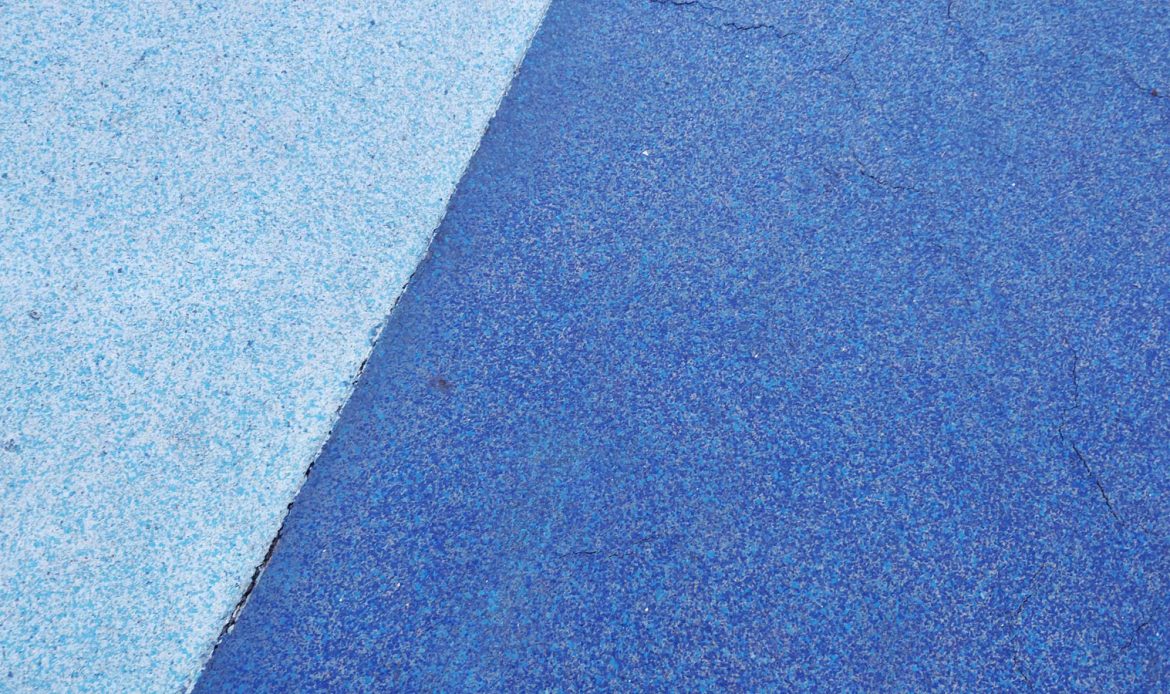
Often referred to as “wet pour,” this is the gold standard for commercial playgrounds. It consists of two layers: a thick base layer made of recycled SBR rubber (tire buffings) and a vibrant top “wear layer” of EPDM granules. Because it is mixed and poured on-site, it is completely seamless, eliminating trip hazards and allowing for intricate designs like school logos or colorful patterns. For more details, check out our more info about epdm wet pour surfacing.
Interlocking Rubber Tiles
If you are looking for a modular solution, details on interlocking outdoor playground tiles might be the answer. These heavy-duty tiles are typically 2.5 inches thick and use a pin or QuadBlock connector system. They are popular in Connecticut and Indiana for their ease of installation over hard surfaces like concrete patios.
Bonded Rubber Mulch
This system provides the rustic aesthetic of wood mulch but without the mess. It consists of larger rubber shreds bonded together with a polyurethane binder to create a “unitary” or solid surface. It doesn’t blow away or get kicked into shoes, making it a low-maintenance favorite. See our guide to bonded rubber bark for more on this natural-looking option.
Loose-Fill Rubber Nuggets
For those on a tighter budget, loose rubber mulch offers incredible impact protection. When installed at a 6-inch depth, it can protect against falls from up to 16 feet! While it requires occasional raking to maintain even depth, the benefits of loose rubber mulch include excellent drainage and high durability.
Comparison Table: Rubber Surfacing at a Glance
| Feature | Poured-in-Place | Rubber Tiles | Bonded Mulch | Loose Mulch |
|---|---|---|---|---|
| Durability | High (10+ years) | High | Medium-High | Very High |
| Maintenance | Very Low | Low | Low | Moderate (Raking) |
| Installation | Professional | DIY-Friendly | Professional | Easy |
| Customization | Unlimited | Pattern-based | Color blends | Standard colors |
Safety Standards and Critical Fall Height Ratings
Safety isn’t just a buzzword; it’s a measurable metric. When we talk about an outdoor rubber playground surface, we measure its effectiveness through Critical Fall Height. This is the maximum height from which a child could fall and theoretically avoid a life-threatening head injury.
To meet CPSC Playground Surfacing Guidelines, a surface must comply with ASTM F1292. This standard uses two technical measurements:
- G-max: Measures the maximum acceleration (shock) of an impact. It must stay below 200.
- HIC (Head Injury Criteria): A calculation of the duration of that impact. It must stay below 1,000.
Our shock-absorbing playground surfaces are specifically designed to keep these numbers low. We also ensure our products are IPEMA certified, providing third-party verification that our surfaces meet these rigorous ASTM F1292 Standards.
Best Base Surfaces for Outdoor Rubber Playground Surface Longevity
A surface is only as good as what lies beneath it. In our service areas like Raleigh and Sanford, NC, we often deal with clay-heavy soils that require careful preparation.
- Concrete & Asphalt: The most stable bases. They provide a permanent foundation but require a 2% minimum slope for drainage.
- Compacted Crushed Stone: A more affordable alternative that allows for natural water percolation.
- Drainage Requirements: For government projects, we often follow UFGS-32 18 16.13 specifications, which require a percolation test of at least 1 inch every 3 hours.
Proper base preparation prevents the “puddling” that can lead to mold or surface degradation. Explore our rubber ground cover options to see how different bases affect your choice.
Designing an Accessible Outdoor Rubber Playground Surface
Every child deserves to play. The Americans with Disabilities Act (ADA) requires that playground surfaces be accessible to wheelchairs and those with mobility aids.
Under ASTM F1951, surfaces like poured-in-place rubber and tiles are the gold standard for accessibility because they are firm and stable. Unlike sand or gravel, a wheelchair can easily glide across a rubber surface.
Beyond function, we love using colored rubber surfaces for playgrounds to create inclusive designs. In Columbia, SC, we’ve used custom color patterns to define “quiet zones” for children with sensory sensitivities or to mark safe pathways.
Installation and Maintenance for Lasting Durability
Whether we are installing a new park in Beaverton, OR or Lake Charles, LA, the process remains focused on precision.
- Site Prep: Clearing debris and ensuring a level subbase.
- Geotextile Fabric: Laying a barrier to prevent weeds and keep the rubber from mixing with the soil.
- Mixing: Combining rubber granules with high-quality polyurethane binders.
- Curing: Most surfaces require 24–48 hours to dry, depending on humidity and temperature.
While we recommend professional installation for commercial sites, some homeowners look for DIY playground flooring tips for smaller backyard projects.
Maintenance Tips
- Routine Cleaning: Use a leaf blower for debris or a mild detergent and power washer for deeper cleans.
- Annual Inspections: Check high-traffic areas (like under swings) for thinning.
- Resealing: For PIP surfaces, applying a new wear layer sealant every few years can extend the life of the floor significantly. Check our playground rubber flooring price guide to budget for long-term care.
Environmental Benefits of Recycled Rubber
At Replay Surfacing, our mission is to turn environmental hazards into community assets. Tires are a massive waste problem; they don’t decompose and can become breeding grounds for pests.
By choosing an outdoor rubber playground surface, you are participating in a circular economy. We take post-consumer tires and transform them into non-toxic, UV-stable safety surfacing. This process significantly reduces the carbon footprint compared to manufacturing virgin plastics. For more on our commitment to the planet, read our eco-safety rubber playground surfacing guide.
Using recycled rubber mulch benefits the environment by keeping millions of tires out of landfills in states like Indiana and Connecticut every year.
Frequently Asked Questions
How much does rubber playground surfacing cost per square foot?
The price varies wildly based on the system. Loose-fill rubber is the most affordable at $4.50–$7 per sq ft, while premium poured-in-place can range from $10–$14 per sq ft. While the initial cost of PIP is higher, the long-term ROI is excellent because it requires far less daily maintenance than wood mulch. You can find a deeper dive in our article understanding rubber playground surfacing costs.
How long do rubber playground surfaces last?
With proper care, a high-quality rubber surface can last 10 to 15 years. In hot climates like Tucson, AZ, UV stability is key to preventing fading. In Nashville, TN, surfaces must withstand freeze-thaw cycles. Our surfaces are engineered to handle these extremes without cracking or peeling.
Is rubber mulch a safe surface for children and pets?
Yes! Our rubber mulch is 99.9% metal-free and non-toxic. It is also resistant to pet claws, making it a great option for multi-use community spaces. One common question is: is rubber mulch a safe surface? The answer is a resounding yes, provided you buy from a certified recycler like us who ensures no hazardous wires or contaminants remain in the mix.
Conclusion
Investing in a high-quality outdoor rubber playground surface is an investment in the safety and joy of your community. Whether you are in Charlotte, Indianapolis, or Nashville, Replay Surfacing Inc. is here to help you navigate the technical standards and design possibilities of modern rubber flooring.
By recycling tires into sustainable play solutions, we aren’t just building playgrounds—we’re building a safer, greener future for the next generation. Ready to transform your play area?