
Essential Types of outdoor flooring playground Materials
When we look at designing a safe play space, the foundation is everything. At Replay Surfacing, we specialize in transforming recycled tires into high-performance safety surfaces. Whether you are building a backyard oasis in Charlotte, NC, or a community play area in Tucson, AZ, the material you choose dictates the safety, aesthetic, and longevity of the project. By repurposing rubber that would otherwise end up in landfills, we provide a sustainable solution that protects both children and the environment.
Selecting the right outdoor flooring playground involves balancing your specific needs for fall protection with your budget. We’ve developed a comprehensive Playground Surfaces Guide to help navigate these choices, but let’s look at the heavy hitters in the industry today.

Rubber Tiles and Poured-in-Place Rubber
If you are looking for a “set it and forget it” solution, rubber tiles and poured-in-place (PIP) rubber are the gold standards. These materials are engineered to withstand heavy foot traffic while maintaining their shock-absorbing properties over many years.
Rubber Tiles: These are incredibly popular for both residential and commercial use because they offer consistent shock absorption across the entire surface. Many of our clients in Nashville, Tennessee prefer Nashville Playground Surfacing options like interlocking tiles because they are DIY-friendly and provide a clean, geometric look.
- Pros: Easy to replace a single tile if damaged, excellent drainage, and available in various thicknesses (from 2.25″ for a 4-foot fall rating to 4.25″ for a 10-foot rating). They are also ideal for smaller backyard footprints where a professional crew might not be necessary.
- Cons: Visible seams can occasionally collect debris, though regular maintenance with a leaf blower easily solves this.
Poured-in-Place (PIP) Rubber: This is a seamless, two-layer system consisting of a “cushion layer” made of clean recycled tire rubber and a “wear layer” of EPDM granules. For those in Columbia, SC, Poured In Place Rubber Surfacing is often the top choice for municipal parks because it is ADA-compliant and allows for custom designs like hopscotch grids, school logos, or vibrant multi-color patterns.
- Pros: No seams (no trip hazards), highly customizable, and porous for quick drying after a rainstorm. It provides a smooth surface that is accessible for wheelchairs and strollers.
- Cons: Typically requires professional installation to ensure the chemical binders cure correctly and the surface is perfectly level.
Artificial Turf and Rubber Mulch
For a more “organic” look without the headache of mud, splinters, or constant mowing, turf and mulch are excellent contenders for modern gardens.
Artificial Turf: In desert climates like Tucson, Arizona, maintaining natural grass is an uphill battle against the heat and water costs. Tucson Playground Surfacing often utilizes artificial turf with a dedicated “shock pad” underneath to ensure safety.
- Safety Note: Turf alone has a very low fall height rating. To meet safety standards, you must install a foam padding layer beneath the green blades to protect against impact injuries.
Rubber Mulch: If you want the best “bang for your buck” regarding fall height, rubber mulch is the winner. It doesn’t decompose like wood mulch and won’t attract pests or termites. We offer the Best Rubber Mulch For Sale for those who want a loose-fill look that stays put even during heavy winds.
- Pros: Exceptional shock absorption (up to 17 feet at a 6-inch depth), eco-friendly (made from 100% recycled tires), and doesn’t freeze or rot. It is also available in various colors to match your garden’s landscape.
- Cons: Needs occasional raking to maintain even depth in high-traffic areas like the bottom of slides or under swings.
Safety Standards and Critical Fall Height Ratings
Safety isn’t just a buzzword; it’s a measurable metric that defines the quality of our work. When we install outdoor flooring playground surfaces in Connecticut or Indiana, we strictly adhere to ASTM F1292 standards. This rigorous testing protocol measures the “G-max” (the peak acceleration of an impact) and the “Head Injury Criterion” (HIC) to ensure a child won’t suffer a life-threatening head injury from a fall.
The “Critical Fall Height” is the maximum height a child can fall from equipment onto the surface without sustaining a critical injury. Understanding this rating is vital for any parent or facility manager. For example, a surface with a high G-max score is too hard and won’t absorb enough energy, while a low HIC score indicates a safer, more forgiving landing.
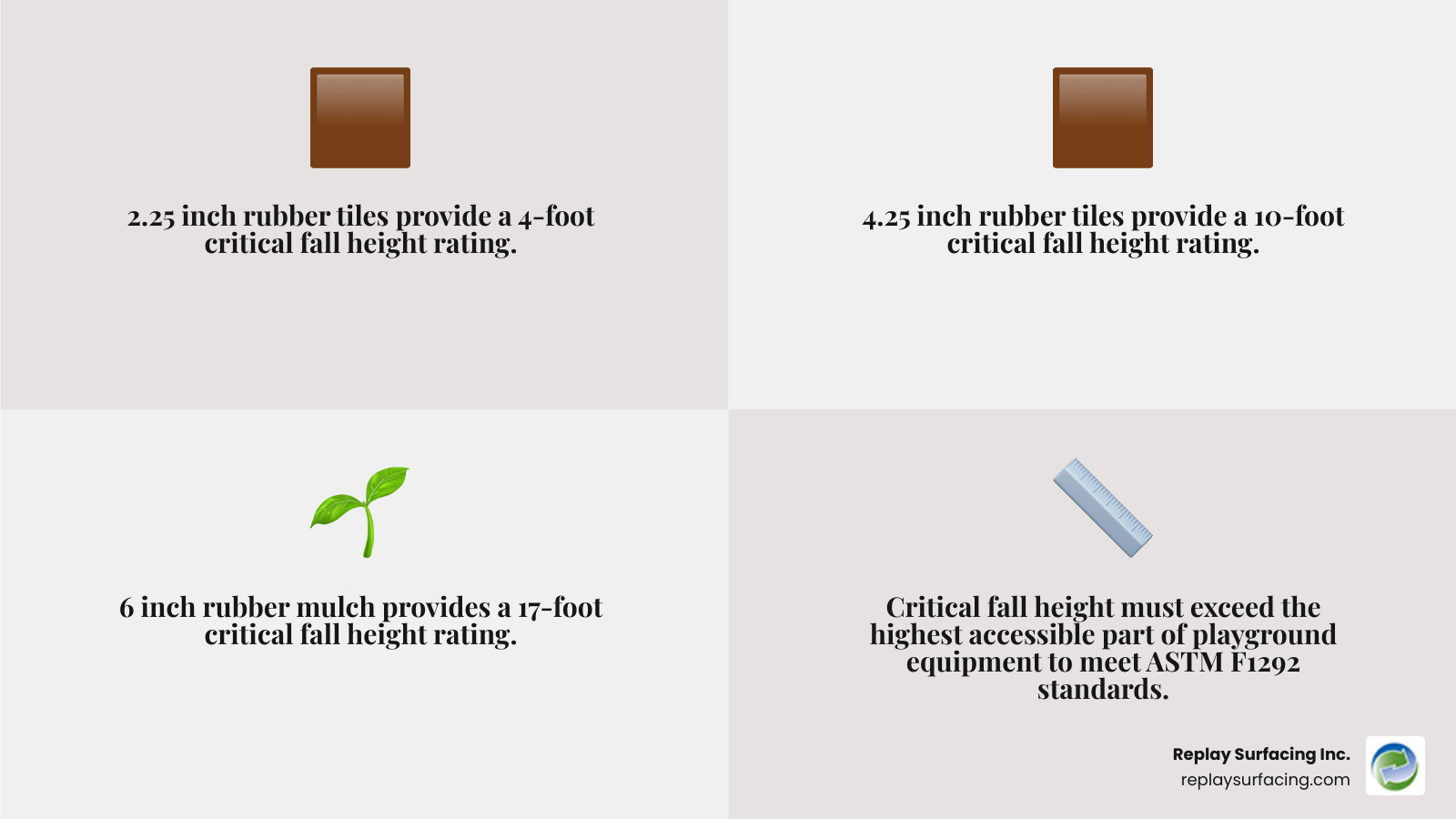
When choosing your flooring, always measure the highest accessible part of your playground equipment—this is usually the top of the slide or the monkey bars. If your slide platform is 6 feet high, your flooring must be rated for at least 6 feet to be compliant. In Connecticut, Connecticut Playground Surfacing regulations often require IPEMA (International Play Equipment Manufacturers Association) certification. This certification provides peace of mind that the manufacturer’s safety claims have been third-party verified through independent laboratory testing.
Installation and Surface Preparation
A playground surface is only as good as the ground beneath it. Whether you are in Raleigh, NC or Sanford, NC, skipping sub-base preparation is the fastest way to ruin your investment. Proper preparation ensures that the surface remains level, drains correctly, and doesn’t shift over time.
Preparing the Sub-base for outdoor flooring playground
Most high-quality outdoor flooring playground systems require a flat, stable base to perform correctly. In regions like Raleigh, the soil can often be heavy with clay, which requires specific attention to drainage.
- Excavation: Remove grass, roots, and about 3-6 inches of dirt to create a clean slate.
- Compaction: Use a plate compactor to ensure the ground is firm and won’t settle unevenly after the first heavy rain.
- Drainage: For areas like Charlotte, North Carolina, Charlotte Playground Surfacing experts recommend a layer of compacted crushed stone or gravel. This allows water to move away from the play area rather than pooling under your rubber tiles.
- Weed Barrier: Lay down professional-grade landscape fabric. This prevents weeds from poking through your tiles or mulch, which can compromise the integrity of the surface.
While it is possible to install some tiles over existing concrete or asphalt, you should never install them directly over loose “raw” dirt or un-mowed grass. Over time, the organic matter will decompose, causing the surface to become uneven and creating dangerous trip hazards.
Professional vs. DIY Installation
We love a good weekend warrior project! If you’re looking at Diy Playground Flooring, interlocking rubber tiles are your best friend. They often use a dowel or “puzzle” system that requires no messy glues and can be installed with basic hand tools.
However, for larger projects, public parks, or seamless poured rubber, we highly recommend Playground Safety Surfacing Installers. In Raleigh, Raleigh Playground Surfacing pros have the specialized mixers, heavy-duty rollers, and precision trowels needed to ensure a smooth, durable finish. Professional installation also ensures that the chemical binders are mixed at the correct ratios for your specific local climate, preventing the surface from peeling or cracking prematurely.
Maintenance and Durability in Diverse Climates
One of the primary reasons we focus on recycled tire rubber is its incredible resilience against the elements. Rubber is naturally flexible, allowing it to expand and contract without breaking. Whether it’s the high humidity and salt air of Lake Charles, Louisiana or the freezing winters and heavy rains in Beaverton, Oregon, our rubber products are built to last.
- Cleaning: Most surfaces just need a leaf blower to remove debris or a garden hose to wash away dust. For stubborn dirt or spills on tiles, a mild soap like Dawn and a soft brush will do the trick. It is important to avoid petroleum-based cleaners, as they can chemically break down the rubber binders.
- UV Stability: Quality rubber flooring is treated with UV stabilizers during the manufacturing process. This is crucial for areas like Tucson, where the intense sun can cause inferior materials to become brittle or fade. Our EPDM wear layers are designed to retain their vibrant color for years.
- Lifespan: A well-maintained poured-in-place surface or rubber tile system can easily last 12 to 15 years. This longevity makes it a much more sustainable choice than wood mulch, which requires constant replenishment.
If you are concerned about the long-term investment, check out our guide on How Much Does Playground Flooring Cost to see how the durability of rubber saves money over time. By choosing a permanent surface, you eliminate the annual cost of hauling and spreading new wood chips, which can add up to thousands of dollars over the life of the playground.
Frequently Asked Questions about outdoor flooring playground
Can playground flooring be installed over grass?
Technically, yes, but we don’t recommend it as a permanent solution for several reasons. If you put rubber tiles directly on grass, the grass will die and rot, leading to an unstable and smelly sub-base. Furthermore, the ground will settle unevenly, causing the tiles to shift and separate, which creates trip hazards. For a successful Diy Playground Rubber Flooring project, it is always better to remove the sod and use a compacted gravel base or at least a very flat, hard-packed dirt surface with a professional weed barrier.
How much does playground flooring cost per square foot?
Pricing varies significantly based on the material, the depth required for safety, and your location.
- Rubber Mulch: $2 – $4 per sq ft (material only). This is the most budget-friendly option for high fall heights.
- Rubber Tiles: $5 – $10 per sq ft. The price increases with the thickness of the tile.
- Artificial Turf: $3 – $8 per sq ft (plus the cost of the essential safety padding).
- Poured-in-Place: Often requires a custom quote because the labor involved in mixing and troweling varies by site accessibility and design complexity.
For a detailed breakdown of these costs, see our Playground Rubber Flooring Price Complete Guide.
What is the typical lifespan of rubber surfacing?
When you choose Recycled Rubber Playground Flooring, you are investing in a product designed to withstand the elements. In our experience across Nashville and Columbia, you can expect 10-15 years of life with minimal maintenance. The “wear layer” of poured rubber may eventually need a “roll coat” of binder every few years to keep it looking fresh and to prevent granulation, but the structural integrity of the cushion layer remains solid for over a decade. This makes it one of the most cost-effective safety solutions available today.
Conclusion
At Replay Surfacing Inc., we believe that every child deserves a safe place to play and every piece of waste deserves a second life. By choosing an outdoor flooring playground made from recycled tires, you are making a choice that is good for your family and the planet. From the rainy parks of Connecticut to the sunny yards of Tucson, we are proud to provide sustainable, customizable, and—most importantly—safe surfaces.
Ready to transform your garden into a safe haven? Explore our residential services to find the perfect fit for your next project.