

Primary Applications and Performance Requirements
Durable walkway mats are selected by matching the material to the site’s primary demands: heavy-duty recycled rubber for impact absorption and mud scraping, open-grid PVC for wet drainage zones, and woven PET for roll-out terrain access. Every property—from busy commercial hubs in Charlotte, NC and Raleigh, NC to outdoor recreational facilities in Tucson, AZ—faces distinct environmental challenges. Pedestrian safety depends on establishing reliable traction across high-traffic transition zones. When rain soaks an entryway or loose sediment covers an outdoor trail, untreated pathways quickly turn hazardous.
Walkway matting mitigates these risks across several critical settings:
- Commercial Building Entrances: High-foot-traffic doorways require scraping systems to remove moisture, grit, and mud before visitors reach polished interior floors.
- Industrial & Rooftop Access Routes: Maintenance crews traversing flat commercial roofs in places like Columbia, SC or Nashville, TN need non-penetrating paths that protect waterproofing membranes while offering wind-tested grip.
- Barefoot & Wet Zones: Splash pads, public pools, and recreational locker rooms demand hygienic surfaces that prevent slips without irritating bare skin.
- Temporary Events & Construction Sites: Outdoor festivals and construction corridors in Beaverton, OR or Lake Charles, Louisiana need rapid-deployment ground protection over damp turf, sand, or gravel.
To ensure long-term performance, facility planners rely on standardized slip-resistance and safety certifications:
- ASTM F 1677: Measures the static coefficient of friction (COF) across wet and dry surfaces; ratings of 0.6 to 1.0 indicate excellent traction.
- DIN 51130: European standard evaluating slip resistance on oily or wet commercial surfaces using ramp incline testing (yielding R-ratings from R9 to R13 alongside V-ratings like V10 for fluid displacement).
- DIN 51097: Measures barefoot slip resistance in wet environments, where Classification C represents the highest traction performance.
- EN 1177 (2018): Establishes Critical Fall Height (CFH) standards for impact attenuation, verifying that the mat absorbs kinetic energy to minimize injury during falls.
Entrance and High-Traffic Corridor Safety
Entrance corridors take a continuous beating from foot traffic, rolling carts, luggage, and heavy maintenance equipment. Effective entrance systems use coarse scraping ribs and open grids to capture particulate debris beneath the walking surface rather than letting it grind across floor finishes.
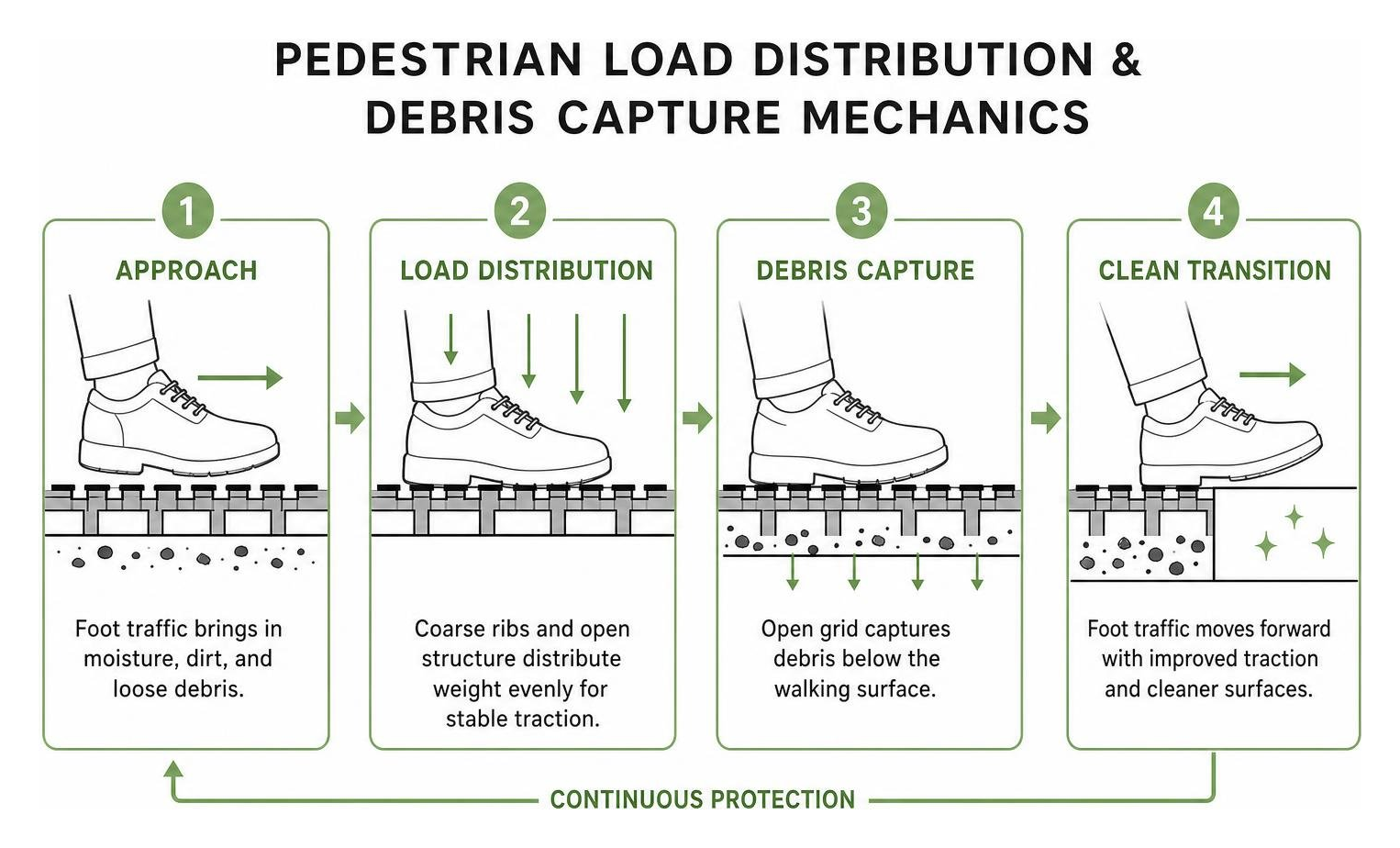
Durability under heavy rolling loads is essential. Under ASTM F 2753 testing, high-performance matting systems withstand over 1,000 cycles at a 1,000 lb load without structural deformation. For property managers seeking long-term resilience, protecting high traffic patios and walkways with heavy duty rubber mats delivers superior load distribution, preventing subfloor gouging while containing outside dirt.
Specialized Outdoor and Recreational Environments
Outdoor applications require materials that endure intense regional weather variations—from humid summers in Sanford, NC and Louisiana to freezing winter spells in Connecticut and Indiana. In desert climates like Tucson, standard vinyl or low-grade plastics can become brittle under UV radiation or scorching under direct sunlight.
For beach access points, municipal splash pads, and wave pool surrounds, mats must offer thermal insulation so barefoot patrons can walk safely over hot substrates. Mats engineered with channelled underbars provide rapid drainage so water never pools underfoot.
When installed over soft grass or loose gravel, portable roll-out systems provide ADA/ABA-compliant wheelchair accessibility. Furthermore, loose-laid roof walkway systems feature aerodynamic open structures capable of handling 60 mph winds under field conditions and up to 94 mph in controlled laboratory testing without shifting.
Key Types and Materials of Walkway Mats
Selecting the right material determines how well a pathway handles moisture, heavy equipment, UV exposure, and routine sanitizing.
| Mat Material Category | Common Thickness | Slip Resistance Certifications | Typical Weight | Expected Lifespan | Primary Best-Fit Application |
|---|---|---|---|---|---|
| Heavy-Duty Natural & Recycled Rubber | 20 mm – 23 mm (3/4″ – 7/8″) | EN 1177 (Impact), ASTM F 1677 (~0.8+) | 8.0 – 8.4 kg/m² (Heavy) | 7 – 12+ Years | Construction routes, festival turf protection, industrial corridors |
| Two-Layer Open-Grid Flexible PVC | 10 mm – 14 mm (3/8″ – 9/16″) | DIN 51130 R10–R11, V10; ASTM F 1677 (0.6/0.6) | 5.0 – 8.0 kg/m² (Moderate) | 5 – 10 Years | Narrow building entries, flat roof access paths, sloped barefoot decks |
| Woven Recycled PET Polyester | 3 mm – 6 mm (1/8″ – 1/4″) | ADA / ABA Traction Compliant | 1.5 – 3.0 kg/m² (Light/Portable) | 10+ Years | Sand dunes, beach boardwalks, temporary event accessibility routes |
Heavy-Duty Rubber and Recycled Polymer Mats
Rubber remains an industry benchmark for heavy-duty shock absorption, traction, and physical durability. Manufactured from natural rubber or vulcanized tire crumb, these mats provide exceptional elasticity and noise dampening. Because rubber naturally grips damp concrete, asphalt, and compacted soil, it resists shifting even without mechanical anchors.
Thicker 20 mm to 23 mm rubber rolls provide integrated mud-scraping apertures that let mud, slush, and gravel drop safely away from shoe treads. They also meet EN 1177:2018 impact standards to protect users from falls. For outdoor facilities, municipal parks, and commercial properties, choosing durable recycled rubber walkways turns scrap tires into long-lasting, weather-resilient paths. Facilities needing flexible, modular layouts can also use interlocking rubber pathway tiles to reconfigure entry sizes or pathway widths as foot-traffic patterns change.
Flexible PVC Grid and Roll-Out Polyester Matting
Extruded polyvinyl chloride (PVC) matting uses an open, two-layer welded grid that channels liquids away horizontally and vertically. Flexible PVC remains stable across a wide temperature range of -9°F to +140°F (-23°C to +60°C), preventing cracking during freezing winters in Connecticut or warping during hot summers in Columbia, SC.
PVC systems often feature diamond-cut embossed ribs or cross-directional treads. This structure provides certified R11 slip resistance while absorbing footstep noise in echoing commercial corridors.
For soft terrain like coastal sand or parkland turf, roll-out woven recycled PET (polyethylene terephthalate) matting provides an ultra-durable, wood-grain aesthetic path. Derived from 100% post-consumer plastic bottles, woven PET resists rot, termites, and UV breakdown while providing a firm, continuous roll-out path for wheelchairs and strollers.
Installation Methods, Drainage, and Site Adaptability
Walkway mats adapt to project requirements across facilities in Charlotte, NC, Raleigh, NC, and Beaverton, OR through three primary installation methods:
- Surface-Mounted: The mat rests directly on existing flooring. Tapered PVC or rubber transition ramps are attached to the perimeter using cold-welding adhesive to prevent tripping and provide smooth wheelchair access.
- Recessed Mat Wells: The mat sits flush inside a shallow depression in concrete or tile. Aluminum R-frames or U-channels line the perimeter, creating a seamless, zero-lip architectural transition.
- Loose-Laid & Ground-Anchored: The roll is deployed directly across roofs, decks, or outdoor turf without glues. For soft earth or sand, installers secure the mat through reinforced perimeter eyelets using stainless steel ground spikes.
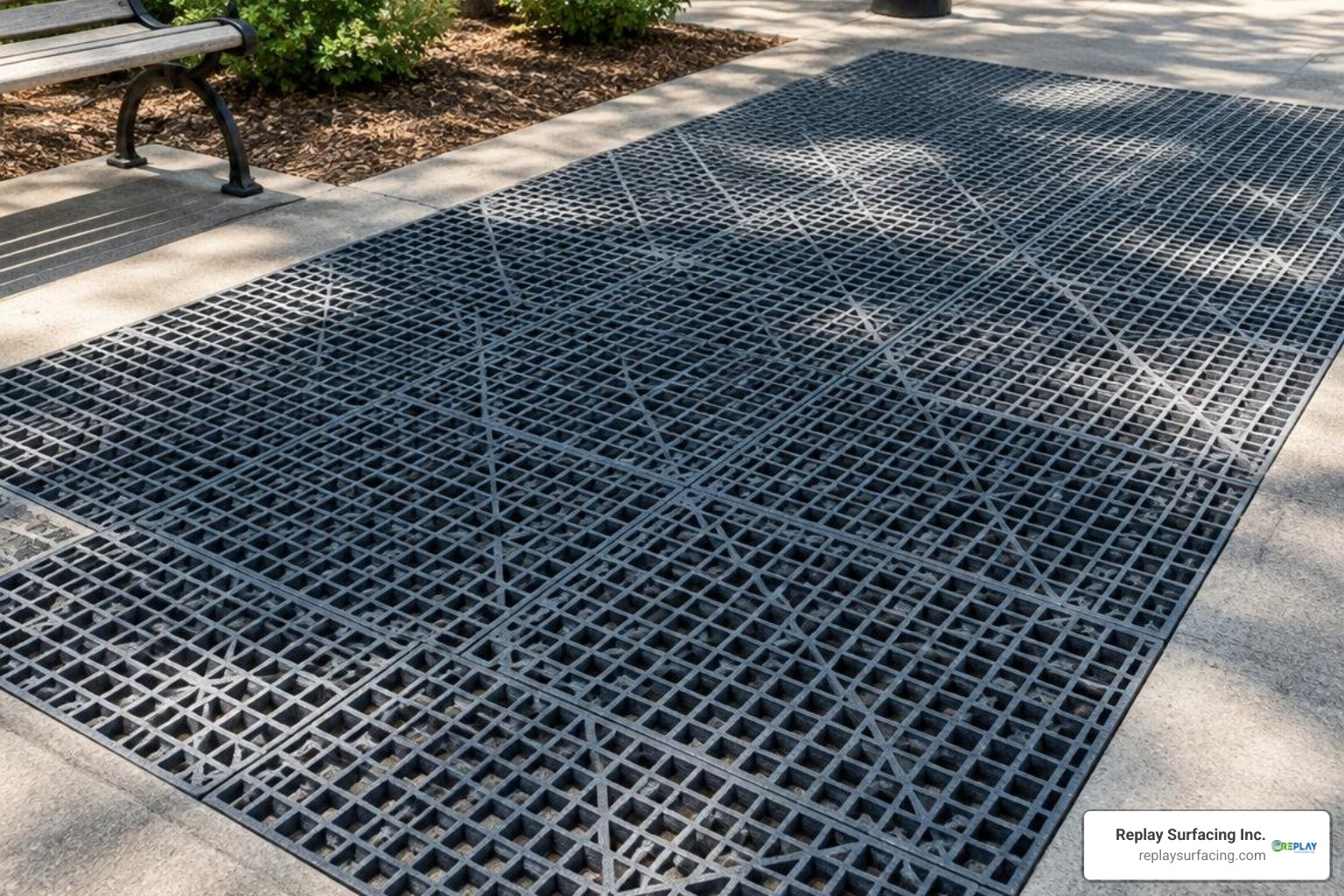
Subfloor leveling is crucial for any permanent or semi-permanent installation. Unlevel subfloors cause pooling beneath the matting grid, reducing drainage efficiency. Property developers across Nashville, TN, Columbia, SC, and Lake Charles, Louisiana looking for continuous, non-shifting ground safety often choose permanent recycled rubber outdoor pathways to eliminate standing water and seam separation entirely.
Drainage and Debris Trapping Capabilities in Walkway Mats
Standing water creates hydroplaning hazards on smooth floors. Modern walkway systems solve this with open-grid geometry that achieves a DIN 51130 V10 drainage rating.
Unlike flat mats that force water to sit on the walking surface, two-layer grids elevate foot traffic above the substrate. Channelled underbars provide four-way water dispersal, letting heavy rainfall, pool splash-out, and melting snow flow quickly toward floor drains. Integrated mud-scraping holes also strip sticky soil from work boots, trapping dirt beneath the surface until routine maintenance.
How to Choose Walkway Mats for Slopes, Roofs, and Uneven Ground
Slopes, ramps, and non-rigid subgrades require specific structural mat features:
- Inclined Ramps and Pool Approaches: Sloped walkways require cross-directional top ribs that bite into shoe soles or bare feet, preventing backward slipping on wet grades.
- Commercial Flat Roofs: Matting must distribute foot traffic evenly across wide ribs to prevent punctures to delicate EPDM, TPO, or modified bitumen membranes. The open grid prevents wind uplift by allowing air to pass through freely.
- Uneven Ground & Sand Dunes: Flexible roll-out matting conforms to dips, rises, and grade changes without buckling or snapping, providing a firm surface across irregular terrain.
Frequently Asked Questions About Walkway Safety and Maintenance
What slip resistance ratings should commercial walkway matting have?
Commercial mats should meet or exceed an ASTM F 1677 static coefficient of friction (COF) of 0.6 for both wet and dry conditions; heavy industrial or wet settings in humid regions like Lake Charles, LA or Sanford, NC perform best at 0.8 to 1.0. For European standards, seek DIN 51130 ratings of R10 or R11 for general commercial footwear, paired with a V10 fluid drainage rating. For wet barefoot zones like locker rooms, splash pads, and municipal pool decks in Tucson, AZ, specify DIN 51097 Classification C to ensure maximum slip resistance.
How do surface-mounted and recessed installations compare?
Recessed installations sit flush with adjacent flooring inside an architectural well, eliminating edge transitions, maximizing debris capacity, and delivering a clean finish. However, they require recessed floor framing during construction. Surface-mounted installations lay directly on top of finished floors and use beveled transition ramps around the edges to prevent tripping and maintain ADA accessibility. Surface mounting requires no floor cutting and installs quickly in retrofits.
What is the recommended cleaning process to extend mat lifespan?
Regular cleaning preserves traction by preventing grit from clogging the drainage channels:
- Daily / Weekly: Sweep surface debris with a stiff-bristled brush or clean with a commercial vacuum.
- Deep Cleaning: Roll or lift the matting to sweep out trapped dirt from the subfloor. Wash the matting using cold water or a pressure washer (up to 1,000 psi). For hygienic barefoot zones across athletic facilities in Connecticut or Indiana, use a mild alkaline sanitizing solution or steam clean at 212°F.
- Safety Compliance: Verify that cleaning detergents comply with REACH and local environmental standards to prevent premature polymer breakdown.
Conclusion
Selecting the right walkway matting protects visitors, preserves subfloors, and prevents costly slip-and-fall injuries. By matching material properties—whether resilient natural rubber, self-draining PVC grids, or recycled PET polymers—to site conditions, facility managers ensure long-lasting performance.
Prioritizing environmental sustainability is just as vital. High-grade matting options engineered from recycled materials help facilities qualify for LEED IEQ Credit 5 by capturing indoor pollutants while maintaining low volatile organic compound (VOC) emissions (≤ 0.5 mg/m³). At Replay Surfacing Inc., we recycle scrap tires into premium surfacing solutions across our service communities in Charlotte, Raleigh, Sanford, Columbia, Tucson, Beaverton, Lake Charles, Nashville, Indiana, and Connecticut. Transform your property with high-traction, sustainable safety by exploring our advanced outdoor walkway mats today.