

Safety Mats for Outdoor Play Areas in Raleigh, NC: Are They Worth It?
Safety mats for outdoor play areas are one of the smartest investments you can make for any playground — residential or commercial. They cushion falls, resist slipping, and hold up through rain, heat, and heavy use.
Quick answer — the best safety mats for outdoor play areas by type:
| Mat Type | Best For | Typical Thickness | Fall Height Protection |
|---|---|---|---|
| Interlocking rubber tiles | Full playground coverage | 2.25″ – 5″ | 4 ft – 10 ft |
| Heavy-duty wear mats | Under swings and slide exits | 1″ – 2″ | High-traffic spot protection |
| Thick rubber tiles | Tall climbing structures | 2.75″ – 5″ | Up to 10 ft (ASTM rated) |
| Grass-look rubber mats | Blending into natural spaces | 16mm – 23mm | Up to ~10 ft (EN 1177) |
Every year, thousands of children are injured on playgrounds — and the surface beneath them is often the deciding factor between a stumble and a serious injury. Loose-fill materials like sand and wood chips were once the standard, but they come with real problems: they trap insects, displace under heavy use, and demand constant raking and topping up. Flat rubber mats sidestep all of that.
This guide compares the most popular options so you can make a confident, informed choice — whether you manage a school playground in Raleigh, NC, a community park in Charlotte, or a backyard swingset.
I’m Landon Olson, operator of Replay Surfacing Inc. and a mechanical engineer with an MBA, and I’ve spent my career turning recycled scrap tires into high-performance safety mats for outdoor play areas across North America. I’ll walk you through everything you need to compare products clearly and choose the right surface for your space.
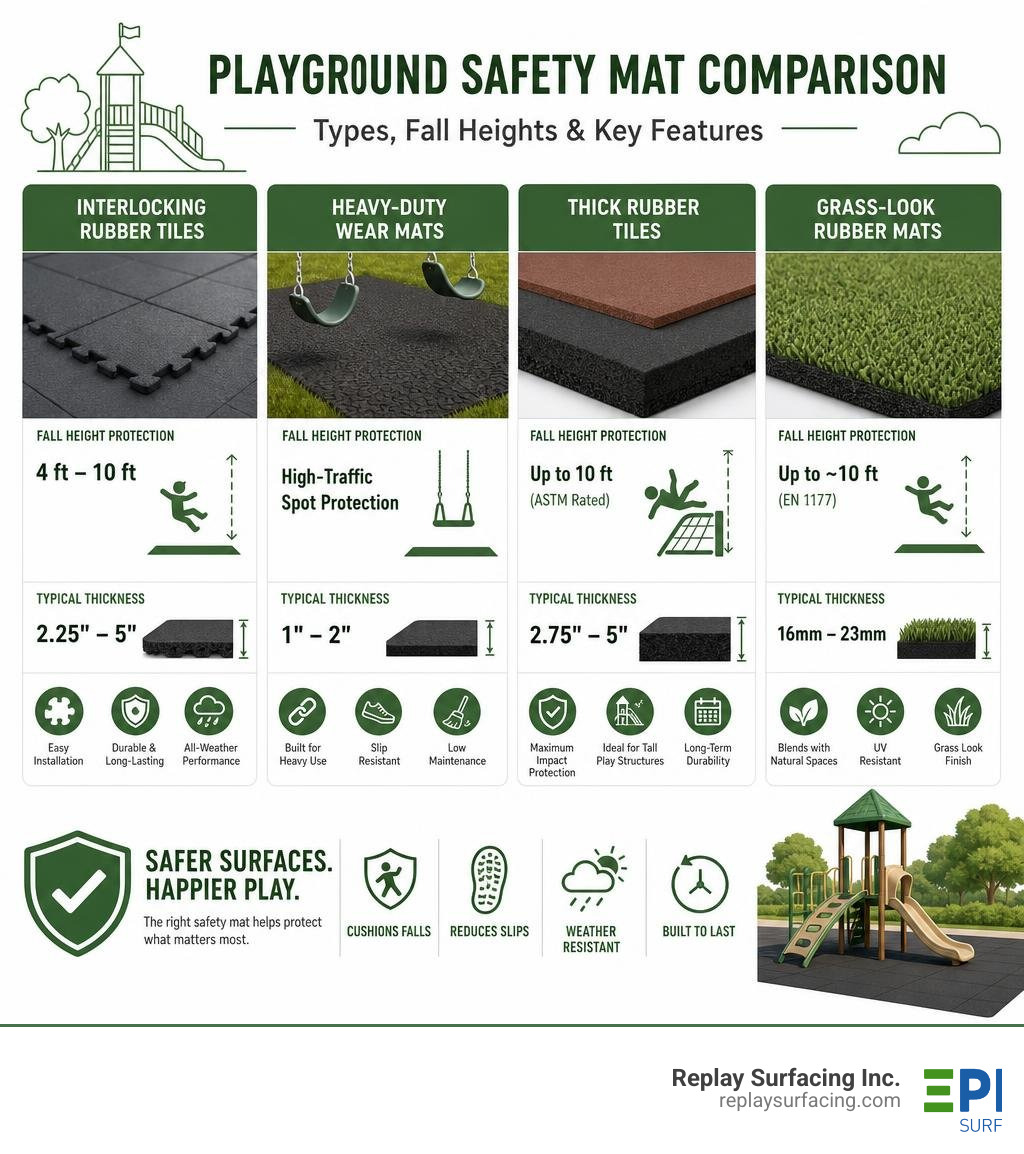
Safety mats for outdoor play areas word guide:
Why Choose Safety Mats for Outdoor Play Areas?
When looking at backyard play areas or public parks, safety is always the primary concern. Statistically, falls to the ground account for the vast majority of playground-related injuries. This is where safety mats for outdoor play areas play a critical role. By providing a reliable, shock-absorbing cushion, they significantly lower the risk of severe head trauma and fractures.
Safety surfacing is evaluated using the “critical fall height” standard. This standard measures the maximum height from which a child could fall onto the surface without sustaining a life-threatening head injury. In the United States, these metrics are strictly governed by ASTM standards (such as ASTM F1292). For instance, a 2.25-inch thick rubber tile is typically rated to protect against falls from up to 4 feet, while a 5-inch thick tile can absorb the impact of a 10-foot fall.
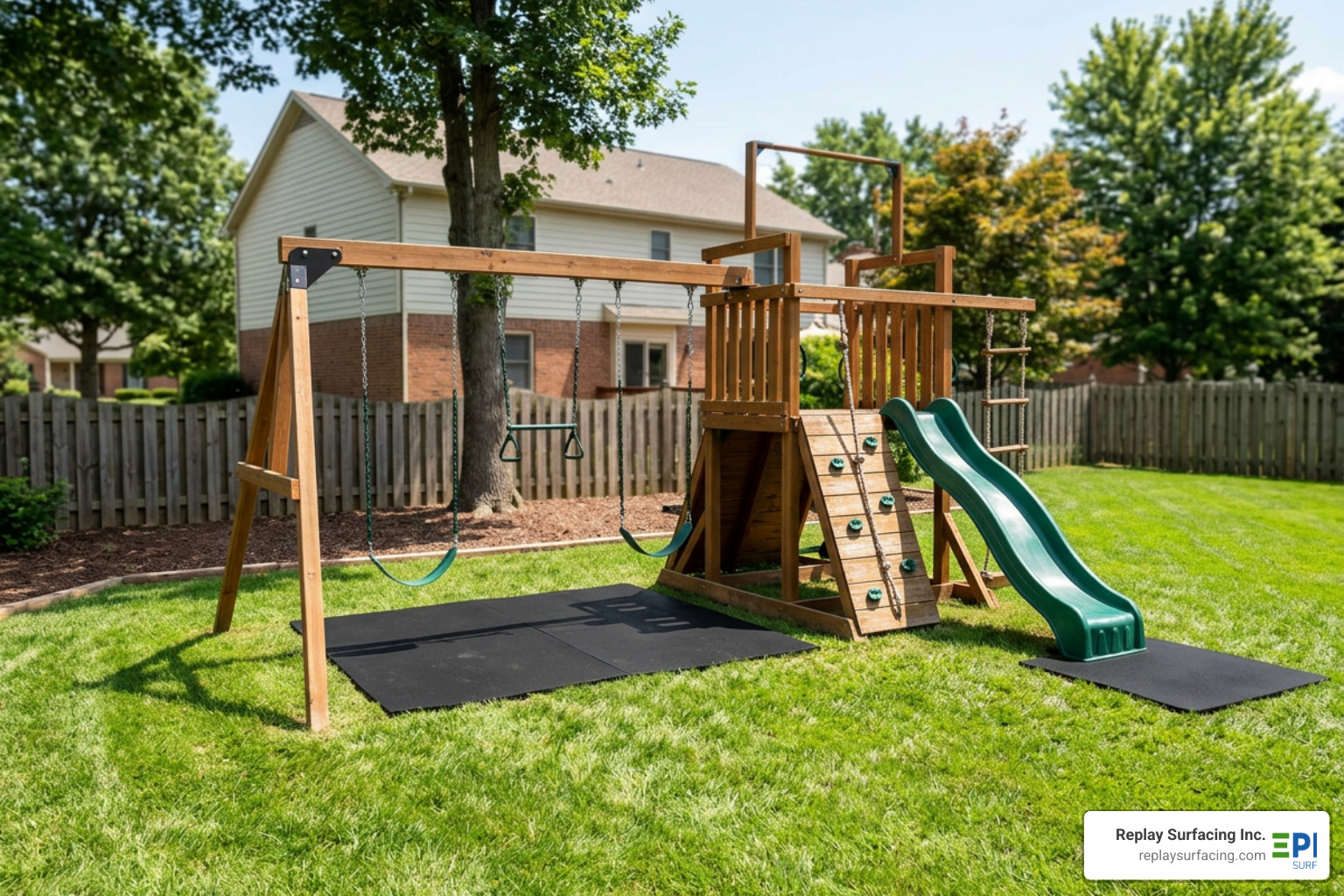
Beyond immediate fall protection, rubber mats are highly durable and weather-resistant, which is essential given the diverse climates across our service areas:
- Tucson, AZ: In the intense desert heat, loose-fill materials dry out, blow away, and offer little protection. High-quality rubber mats remain stable, though they can experience minor “color ambering” under relentless UV exposure.
- Beaverton, OR & Connecticut: In wet, rainy climates, standard turf can turn into a muddy swamp. Rubber safety mats feature built-in drainage channels (often with a studded underside) that allow rainwater to flow freely, keeping the surface slip-resistant and ready for play immediately after a storm.
- Charlotte, NC & Columbia, SC: The humid summers in the Carolinas can cause wood chips to decay and harbor mold, mildew, and insects. Rubber mats do not rot, decompose, or attract pests, ensuring a clean and hygienic play area year-round.
To dive deeper into the engineering of these surfaces, check out our comprehensive guide: Safety First A Parents Guide to Playground Surfacing.
Comparing Rubber Mats to Loose-Fill Surfacing
For decades, loose-fill materials like sand, wood chips, and pea gravel were the default choices for play areas because of their low upfront cost. However, when you look at long-term maintenance, safety, and accessibility, flat rubber mats are the superior choice.
To help you compare, we have broken down the key differences between these materials:
| Feature | Rubber Safety Mats | Wood Chips / Mulch | Play Sand | Pea Gravel |
|---|---|---|---|---|
| Initial Cost | Moderate to High ($5 – $8/sq. ft.) | Low | Low | Low |
| Maintenance | Very Low (occasional sweeping/hose) | High (requires raking, topping up) | High (raking, animal waste removal) | High (constant raking, sweeping back) |
| Insect/Pest Risk | None | High (harbors bugs, mold) | High (acts as a litter box) | Low |
| Displacement | None (stays locked in place) | High (kicked out under swings) | High | High |
| ADA Accessibility | Excellent (firm, stable surface) | Poor (difficult for wheelchairs) | Poor | Very Poor |
| Lifespan | 10 to 20+ Years | 1 to 3 Years (decays) | Indefinite (but gets dirty) | Indefinite (disperses) |
Loose-fill materials naturally displace during play, a problem known as “kick-out.” This is especially common under swings and at slide exits, which quickly creates deep mud holes or exposes the hard concrete footings beneath. Keeping loose-fill safe requires constant manual raking and expensive annual top-ups.
Additionally, loose-fill surfaces are highly prone to trapping dirt, leaves, and insects, making them difficult to keep clean. In places like Columbia, SC, and Sanford, NC, where local playground safety standards are strictly enforced, maintaining consistent impact protection is critical. Rubber mats do not shift, meaning they provide the exact same level of cushioning on day one as they do in year ten.
For more details on making the right choice for your play space, explore The Safe Zone Everything About Choosing the Right Playground Safety Mats.
Types of Outdoor Playground Mats and Fall Height Ratings
Selecting the right safety surfacing requires matching the thickness and design of the mat to the fall height of your play equipment. If your climbing frame has a deck height of 6 feet, your surfacing must be certified to absorb a fall from that exact height.
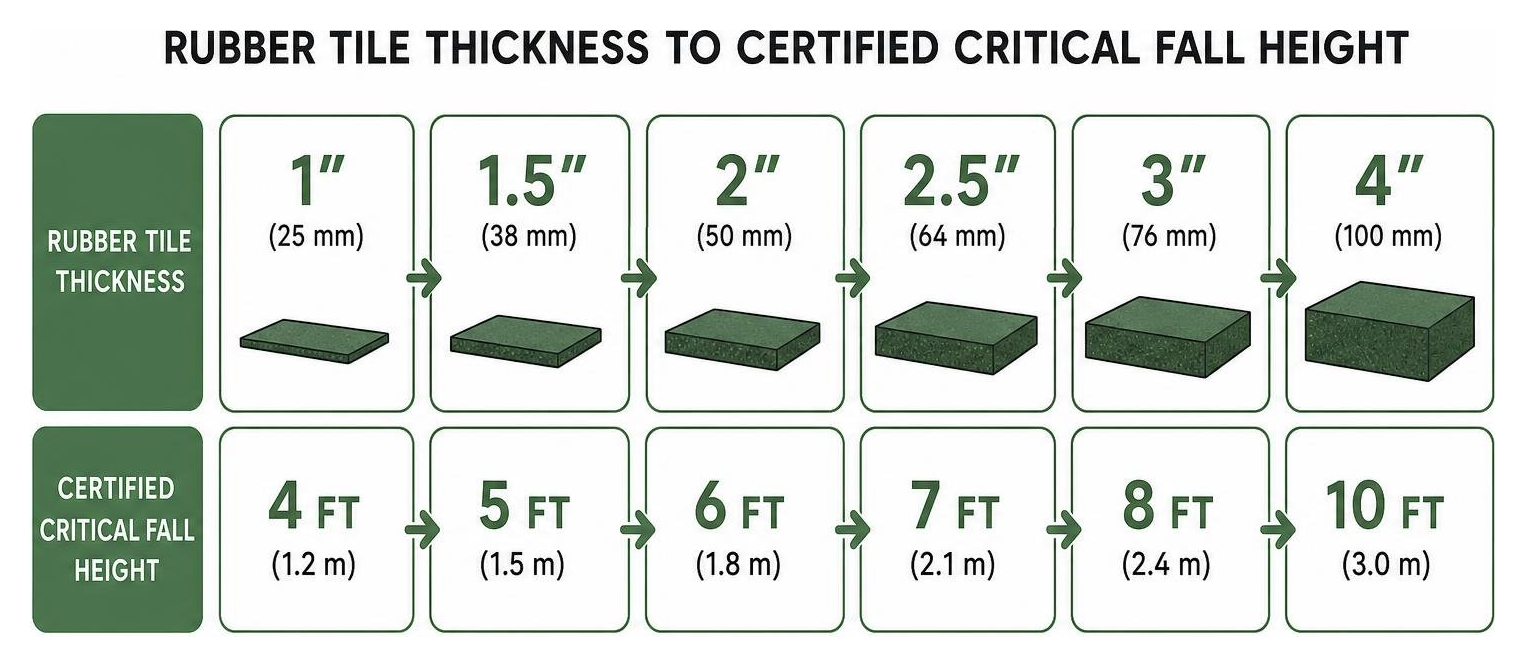
Understanding the different formats of outdoor playground mats and tiles makes it easier to design a safe, low-maintenance playground. For a broader look at your options, read Enhance Safety with Rubber Playground Mats.
Interlocking Safety Mats for Outdoor Play Areas
Interlocking rubber tiles are perfect for full-coverage playground designs. These modular tiles feature puzzle-like edges or a built-in pin-connector system, allowing them to lock together securely without messy, expensive adhesives.
This interlocking design creates a “floating floor” effect that naturally expands and contracts with seasonal temperature shifts — whether during a freezing winter in Connecticut or a humid summer in Nashville, TN. Because they require no glue, they are highly popular for DIY backyard installations. Learn more in our Interlocking Playground Mats Ultimate Guide.
Heavy-Duty Wear Mats for Outdoor Play Areas
If you already have a loose-fill playground (like wood chips or rubber mulch) but want to stop maintenance headaches, wear mats are the perfect solution. These heavy-duty, straight-edge mats are placed in high-traffic zones — specifically under swingsets and slide exits — to prevent kids from kicking away the loose surfacing.
Using wear mats keeps the fall protection consistent in high-impact areas and prevents muddy ruts from forming. Check out our heavy-duty options at Playground Mats for Sale.
Thick Rubber Tiles for High Fall Heights
For tall play structures, jungle gyms, and high slides, thick rubber safety tiles are essential. These tiles range from 2.75 inches to over 4 inches in thickness to meet demanding ASTM F1292 standards for fall heights up to 10 feet.
These premium tiles are engineered with a waffle-patterned or studded underside to maximize shock absorption while allowing water to drain quickly. Browse our high-impact options at Soft Fall Rubber Mats.
Professional Installation and Maintenance Guide
While installing interlocking rubber tiles is a highly manageable DIY project, larger or commercial spaces often benefit from professional installation to guarantee safety compliance.
Subbase Preparation
The secret to a long-lasting rubber play surface is the ground beneath it. Rubber tiles can be installed over hard surfaces like concrete or asphalt, or over a compacted aggregate base (such as crushed stone). The subbase must be level, stable, and have a slight slope (at least 1.5%) to ensure proper water drainage.
The Installation Process
- Acclimatize the Tiles: Lay the tiles out in the play area for at least 24 hours before installing. Ideally, install them when temperatures are between 5°C and 17°C (41°F to 62°F). Installing them in direct, hot sunlight can cause the rubber to expand, leading to gapping once the weather cools.
- Connect the Tiles: If using an interlocking pin system, simply push the plastic connector pins into the pre-drilled slots on the side of one tile, align it with the adjacent tile, and tap them together with a rubber mallet.
- Trim to Fit: Use a heavy-duty utility knife, jigsaw, or circular saw with a wood-cutting blade to trim tiles around slide legs, swing frames, and borders.
- Secure the Perimeter: For permanent installations, apply a single-component polyurethane adhesive around the outer edge tiles to keep the entire system locked in place.
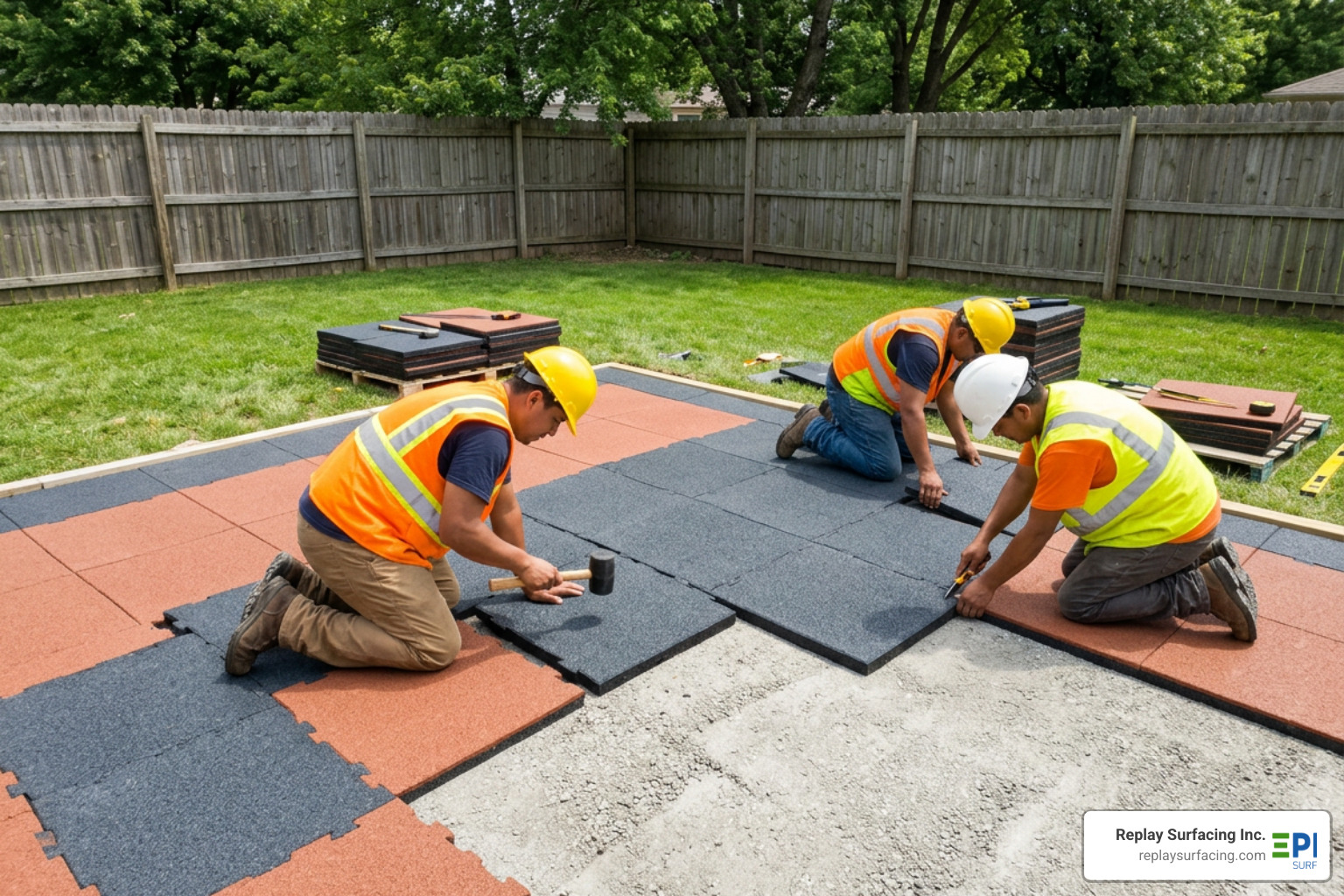
Long-Term Maintenance
Maintaining rubber safety mats is incredibly simple compared to loose-fill materials. For routine cleaning, simply sweep away leaves, twigs, and loose dirt with a broom, or wash the surface down with a garden hose.
In humid areas like Indiana or Lake Charles, LA, an occasional wash with a mild, eco-friendly detergent will prevent any moss or algae buildup, keeping the surface clean, slip-resistant, and ready for play.
For professional assistance, visit our directory of Playground Safety Surfacing Installers.
Frequently Asked Questions about Safety Mats
Can you install safety mats for outdoor play areas directly over grass or dirt?
Yes, you can install rubber playground tiles over grass or dirt, but proper ground preparation is key. Simply laying tiles over uneven lawn will lead to settling, causing the tiles to shift and create trip hazards over time.
To do it right, remove the top layer of sod, level the soil, and lay down a geotextile weed barrier. Adding a thin, compacted layer of crushed stone or utilizing a plastic ground grid provides a perfectly flat, stable foundation. This prep work completely eliminates mud and ensures your playground is ready to use right after a heavy rain. Read more in our guide on Playground Ground Cover Rubber Mat.
How do you clean and maintain outdoor rubber playground mats?
Cleaning rubber play mats is quick and easy:
- Weekly: Use a leaf blower or outdoor broom to clear away leaves, pine needles, and loose dirt.
- Monthly: Hose down the mats with water to rinse away dust and mud.
- Deep Cleaning: For stubborn dirt or bird droppings, scrub the area with a soft-bristle brush and a mixture of water and mild dish soap. Avoid harsh petroleum-based cleaners, as they can degrade the rubber over time.
For more maintenance tips, check out Playground Mats Ready for Outdoor Fun.
Are rubber playground mats ADA compliant and wheelchair accessible?
Yes! One of the greatest advantages of rubber safety mats over loose-fill materials is their accessibility. According to ADA standards, playground surfaces must remain firm and stable enough to support wheelchairs, strollers, and mobility aids.
While wheelchairs quickly sink into sand or loose wood chips, flat rubber mats and interlocking tiles provide a smooth, stable surface that allows all children to play together. To ensure complete accessibility, be sure to install matching beveled rubber ramp edges along the perimeter of your play area. Learn more about selecting compliant surfacing at How to Choose the Perfect Playground Safety Mat.
Conclusion
Creating a safe, sustainable, and fun play space does not have to be a headache. At Replay Surfacing Inc., we are proud to support the circular economy by recycling scrap tires into premium, high-performance rubber surfacing. By transforming an environmental hazard into durable, impact-absorbing safety mats, we help families and communities build beautiful play areas that stand up to the elements and protect what matters most.
Whether you are looking to upgrade a backyard swingset in Beaverton, OR, lay down durable surfacing in the heat of Tucson, AZ, or design an ADA-compliant school playground in Raleigh, NC, we have the experience and products to help you build a safer play space.
Ready to find the perfect surface for your project? Explore Residential Surfacing Solutions and get in touch with our team today!