
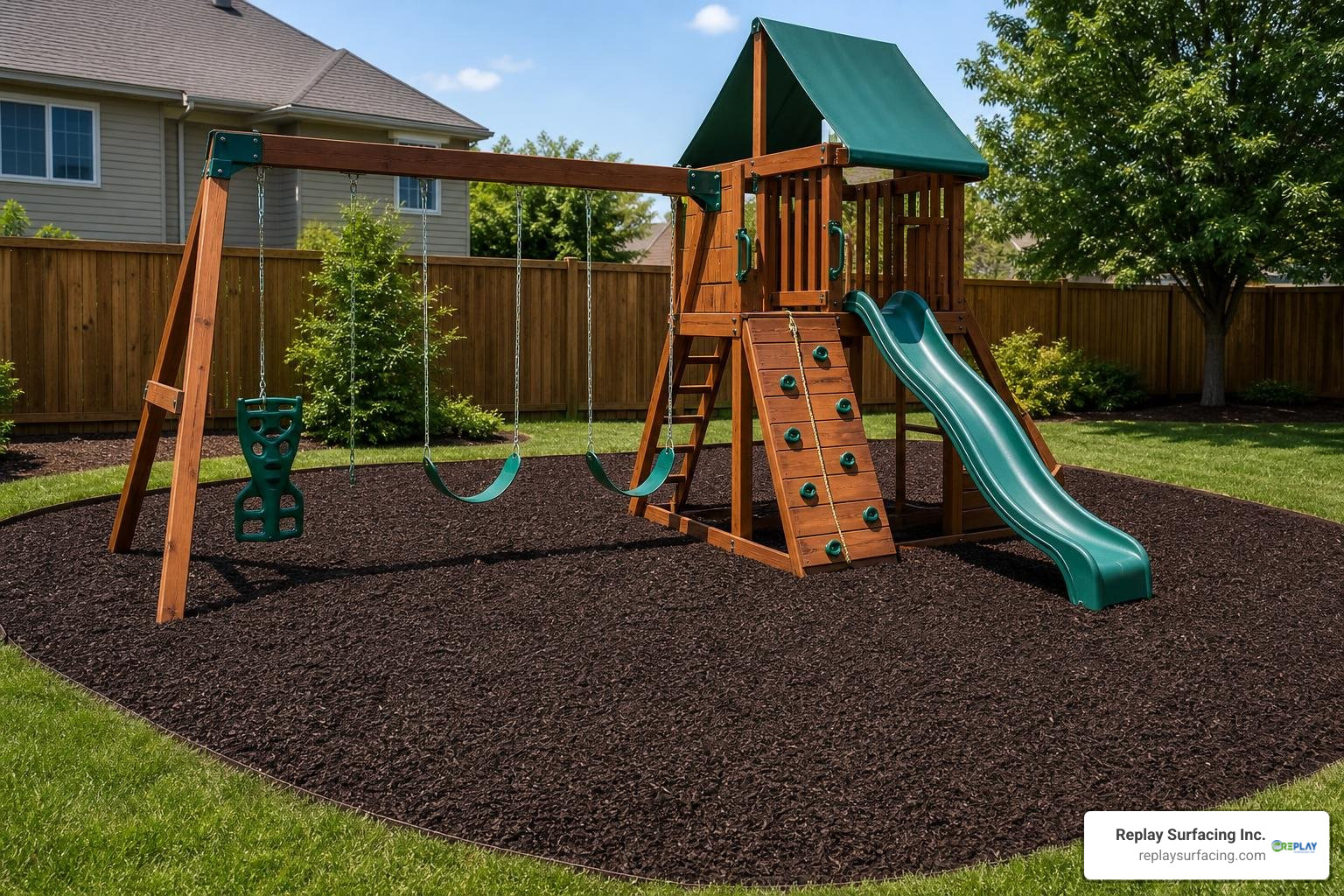
Rubber Mulch for Swingsets in Charlotte, NC: Why Every Backyard Needs the Right Surface Beneath It
Rubber mulch for swingsets in Charlotte, NC is one of the smartest safety upgrades you can make for a backyard play area. Here’s a quick look at why it works — and what to expect:
| Question | Quick Answer |
|---|---|
| Is it safe? | Yes — it cushions falls and meets CPSC playground safety guidelines |
| How deep should it be? | At least 6 inches for falls up to 12 feet |
| How long does it last? | Up to 20 years — no annual replacement needed |
| Is it low maintenance? | Yes — resists pests, rot, and heavy rain |
| Is it eco-friendly? | Yes — made from recycled scrap tires |
Kids fall. That’s just part of playing. But what they land on makes all the difference between a scare and a serious injury.
Traditional surfaces like sand, wood chips, and pea gravel can pack down over time, losing their cushioning. They wash away, attract pests, and need constant topping up. Rubber mulch doesn’t.
Rubber mulch is made from recycled tires — a material that holds its shape, stays in place, and keeps performing year after year. It’s heavier than wood mulch, so it doesn’t scatter in the wind or wash away in the rain. And because it doesn’t decompose, it won’t turn into a muddy mess after a storm.
For eco-conscious parents and facility managers, it checks a lot of boxes: safe, durable, low-maintenance, and sustainable.
I’m Landon Olson, operator of Replay Surfacing and a mechanical engineer with an MBA, and I’ve spent my career turning recycled rubber into high-performance surfacing solutions — including rubber mulch for swingsets across residential and commercial play areas. In this guide, I’ll walk you through everything you need to choose, install, and maintain the right surface for your swingset.
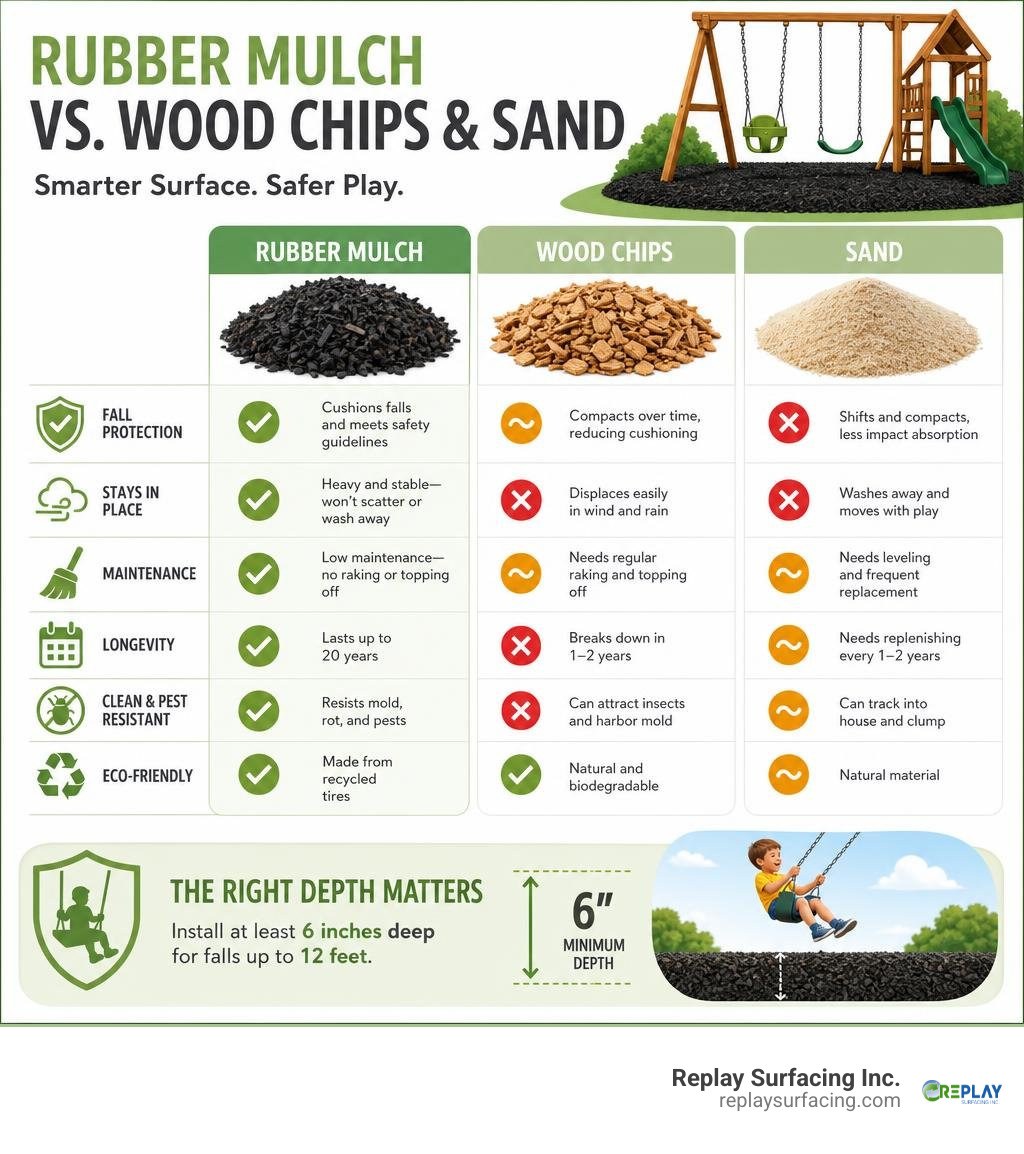
Rubber mulch for swingsets definitions:
Why Choose Rubber Mulch for Swingsets?
When you design a play area, the surface beneath the equipment is just as important as the swings and slides themselves. In fact, according to safety statistics, the vast majority of playground injuries are caused by falls to the ground. This is where choosing rubber mulch for swingsets becomes a game-changer for backyard safety.
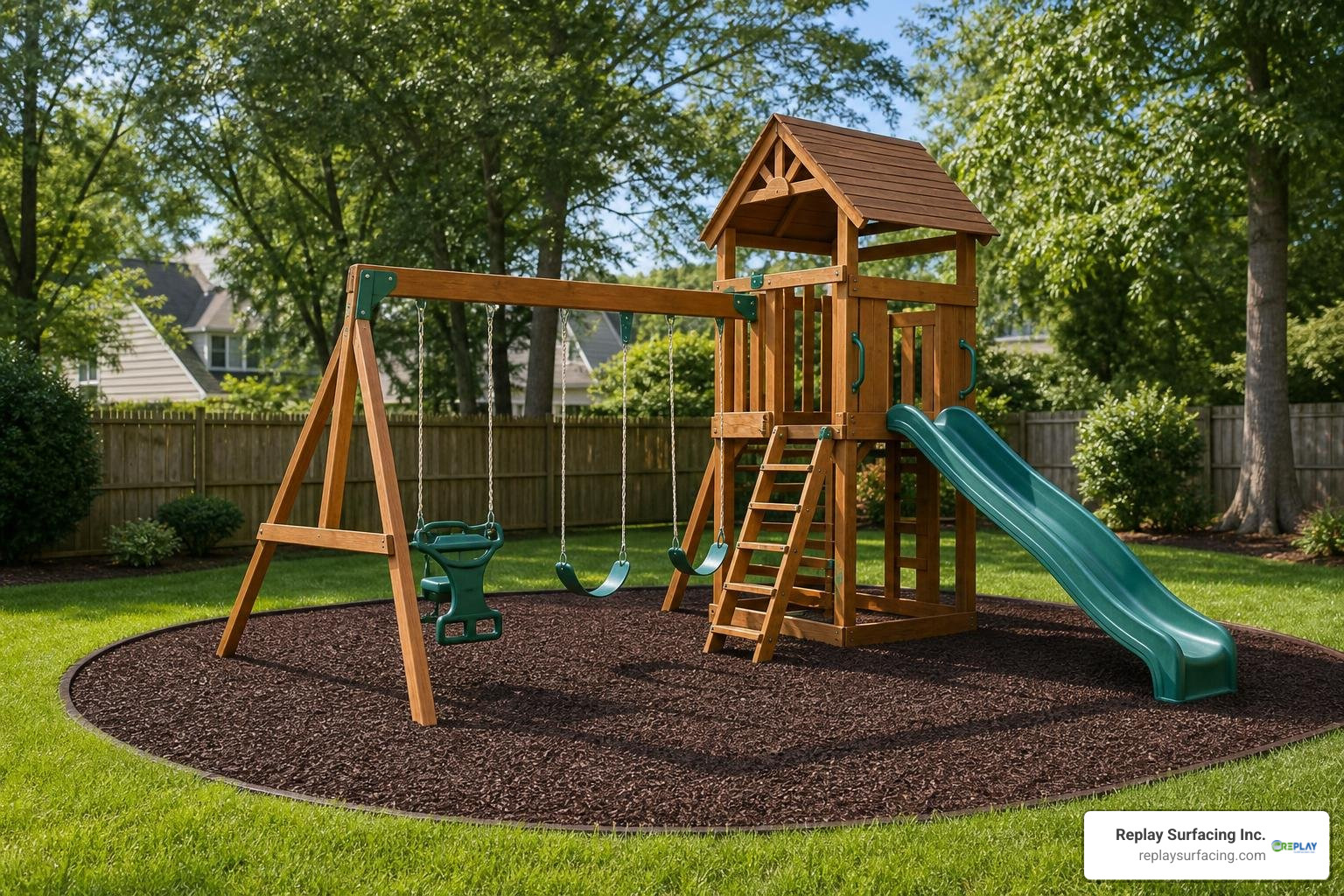
At Replay Surfacing, we manufacture our rubber products by recycling scrap tires, transforming what would otherwise be environmental waste into a highly protective, durable, and customizable play surface. This process removes the steel wire from the tires, leaving behind clean, springy rubber nuggets that excel at absorbing impact.
When a child falls from a swing or a climbing wall, the rubber particles compress, spreading the force of the impact and significantly lowering the risk of severe head trauma or broken bones. This exceptional shock absorption is why rubber mulch easily meets and exceeds the CPSC Playground Safety Guidelines.
Unlike wood mulch, which compacts into a hard, cement-like surface over time, rubber mulch remains loose and springy. If you are wondering whether this material is the right fit for your home or facility, reading our guide on is rubber mulch a safe surface for your childs playground will help clarify how it stacks up against other safety standards.
The Advantages of Rubber Mulch Over Traditional Surfacing
To truly appreciate the value of rubber mulch, it helps to compare it directly to traditional materials like wood chips, sand, and pea gravel. While the initial cost of wood or sand may seem lower, the long-term maintenance, safety hazards, and replacement cycles tell a very different story.
| Performance Feature | Rubber Mulch | Wood Chips / Mulch | Play Sand | Pea Gravel |
|---|---|---|---|---|
| Fall Protection | Excellent (Cushions falls up to 12 ft at 6 inches) | Moderate (Compacts quickly, reducing safety) | Poor (Compacts when wet or frozen) | Poor to Moderate (Displaces easily, hard surface) |
| Lifespan | Up to 20 years | 1 to 2 years (Decomposes rapidly) | Indefinite (But easily contaminated) | Indefinite (But migrates into lawns) |
| Maintenance | Very low (Occasional raking, no annual top-offs) | High (Annual replacement and frequent raking) | High (Requires weeding, tilling, and cleaning) | High (Needs constant raking and containment) |
| Weather Resistance | Excellent (Doesn’t freeze, rot, or wash away) | Poor (Absorbs water, rots, freezes solid) | Poor (Freezes solid, retains moisture) | Moderate (Can wash away in heavy downpours) |
| Pest Attraction | None (Does not attract insects or rodents) | High (Attracts termites, ants, and pests) | High (Acts as a litter box for neighborhood cats) | Low (But can hide buried debris) |
| Wind & Water Displacement | Low (Heavy enough to stay in place) | High (Floats away in rain, blows in wind) | High (Blows away, easily tracked into homes) | Moderate (Displaces under high-traffic zones) |
As shown above, rubber mulch outperforms traditional materials across every major category. Over time, wood chips rot, splinter, and decay, requiring you to buy and shovel new material year after year. Sand gets wet, packs down hard, and becomes a giant litter box for local neighborhood animals. Pea gravel is notorious for migrating out of the play area and into your lawn, turning your lawnmower into a dangerous projectile launcher.
By choosing rubber mulch, you gain peace of mind. For a deeper look at these comparisons, check out our article on the advantages of playground rubber mulch safety maintenance and durability.
Selecting the Best Rubber Mulch for Swingsets
Not all rubber mulch products are created equal. When shopping for your backyard in Raleigh, NC, Tucson, AZ, or Beaverton, OR, you want to make sure you are buying a product specifically designed for children’s play areas.
First, look for products that use non-toxic, high-quality dyes. Cheap rubber mulch can bleed color onto children’s clothes, hands, and shoes, or wash off into your soil during a heavy downpour. Premium rubber mulch features baked-on, non-toxic color coatings that resist fading from intense UV rays—whether you live in sunny Tucson, Arizona, or Lake Charles, Louisiana.
Second, always verify that the product is IPEMA (International Play Equipment Manufacturers Association) certified. This certification guarantees that the mulch has been independently tested and meets ASTM safety standards for impact attenuation. To help you navigate your options, we have compiled the best rubber mulch for playground criteria to look out for, as well as a playground certified rubber mulch complete guide to ensure your purchase is fully certified and safe.
Depth, Cost, and Lifespan Requirements
Planning a swingset area requires more than just buying a few bags of mulch. You need to calculate the correct depth for safety, budget for the initial investment, and understand the long-term savings.
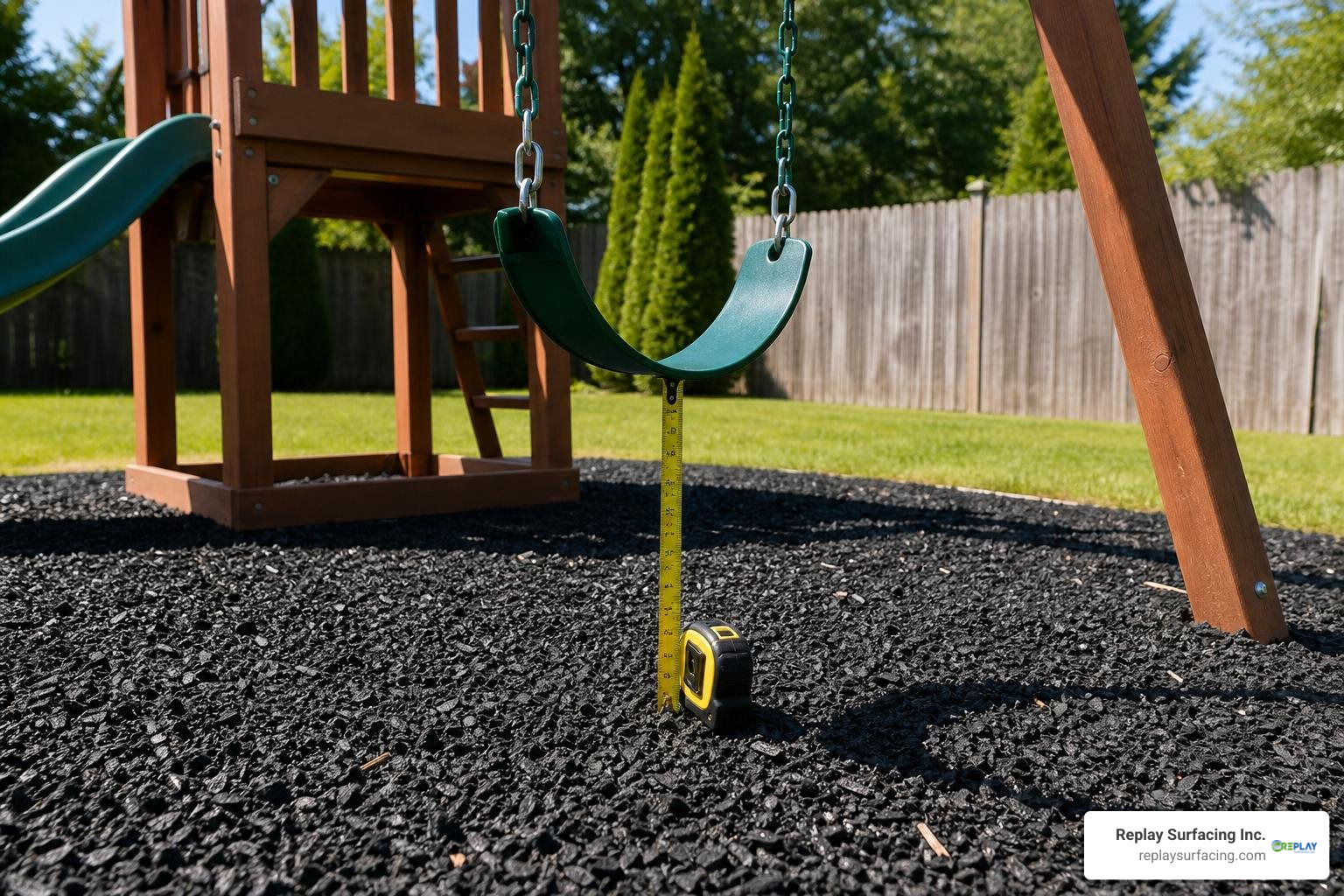
Determining the Right Mulch Depth
The depth of your rubber mulch is the single most critical factor in preventing fall injuries. If the layer is too thin, it won’t provide enough shock absorption when a child falls from the highest point of the swingset.
For residential backyards, we highly recommend maintaining a minimum depth of 6 inches of rubber mulch. At this depth, rubber mulch provides certified fall protection for fall heights of up to 12 feet. This is more than enough for almost all residential swingsets and climbing structures.
If you are dealing with smaller playsets designed for younger toddlers, you might get away with a 3-to-4-inch depth (which protects against falls up to 5 feet), but a 6-inch depth is the gold standard for long-term safety as your kids grow. For a detailed breakdown of depth requirements based on different equipment heights, read the definitive guide to rubber mulch depth playground requirements and consult our rubber chips for playgrounds guide.
Cost and Lifespan Expectations
Let’s address the elephant in the room: the upfront cost. Yes, buying rubber mulch for swingsets is more expensive initially than buying standard wood mulch. However, it is a classic case of investing upfront to save significant money, time, and labor down the road.
Because rubber is non-biodegradable, it does not decompose. It won’t break down into soil, rot, or blow away. This gives high-quality rubber mulch an incredible lifespan of up to 20 years.
Think about the math: if you install wood mulch, you must top it off or completely replace it every 1 to 2 years because of decomposition, compaction, and washouts. Over a 10-to-20-year period, the cost of buying wood mulch repeatedly—not to mention the grueling labor of shoveling and hauling it every spring—far exceeds the one-time cost of rubber mulch.
When you choose our loose rubber mulch, you are making a one-and-done investment that keeps your play area looking pristine and staying safe for decades.
Installation and Maintenance Best Practices
Proper installation is key to ensuring your rubber mulch performs beautifully and drains efficiently. Whether you are in rainy Beaverton, Oregon, humid Sanford, North Carolina, or Connecticut, following these steps will guarantee a successful setup.
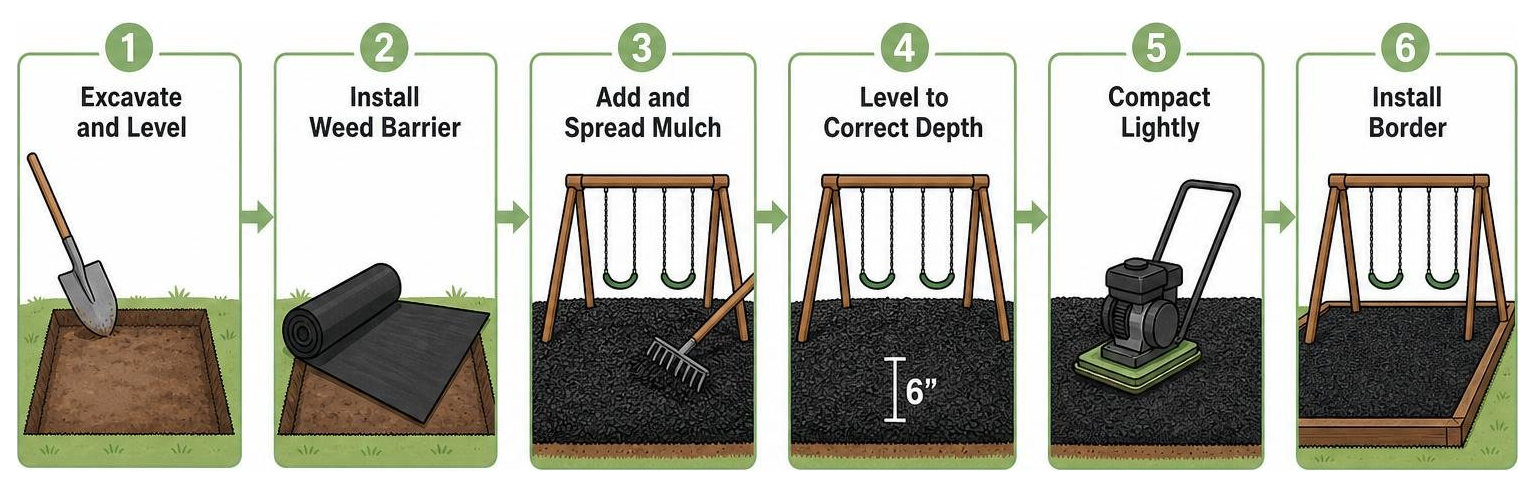
Installation Tips for Rubber Mulch for Swingsets
Before you pour a single bag of mulch, you need to prepare the ground. Here is the step-by-step process we recommend:
- Clear and Level the Area: Remove any existing grass, weeds, rocks, and roots. If you are installing on a slope or uneven ground under a swingset, take the time to grade and level the area. This prevents the mulch from shifting down-slope over time.
- Build a Sturdy Border: You must contain loose rubber mulch. Install a durable border around the perimeter of the play area using timber, rubber borders, or concrete curbing.
- Lay Down Heavy-Duty Weed Barrier: Lay a commercial-grade, woven geotextile fabric over the soil. This fabric serves two crucial purposes: it prevents weeds from growing up through your mulch, and it keeps the rubber mulch from sinking into the dirt sub-base over time.
- Spread the Mulch Evenly: Pour your rubber mulch into the contained area and rake it to your desired depth (ideally 6 inches).
For more in-depth advice on preparing your site, read our guides on installing rubber mulch and setting up rubber mulch for playset areas.
Maintenance and Environmental Considerations
One of the greatest benefits of rubber mulch is how little maintenance it requires. Because rubber is heavier than wood, it stays put during heavy rainstorms and windy days, making it ideal for storm-prone regions like Lake Charles, Louisiana, or Charlotte, North Carolina.
To keep it looking its best, simply rake high-use areas (like under the swings and at the bottom of slides) occasionally to redistribute the mulch where kids push it away with their feet.
From an environmental and health perspective, parents often ask about safety. High-quality rubber mulch is completely non-toxic. It does not leach harmful chemicals into the soil or groundwater, meeting stringent EPA safety standards. In fact, studies by the EPA on tire recycling and playground surfacing have consistently shown that recycled rubber mulch is a safe, non-hazardous option for children’s play areas. It is truly a playground-safe mulch that protects both your children and your local environment.
Frequently Asked Questions About Swingset Surfacing
Does rubber mulch get too hot in the summer?
Like any surface exposed to direct sunlight—including sand, asphalt, and wood—rubber mulch will absorb heat on hot summer days. However, you can easily manage this. If you live in hot climates like Tucson, AZ, or Columbia, SC, we recommend choosing lighter colors (like redwood or tan) rather than black, as lighter colors retain less heat. Placing your swingset in a partially shaded area or using shade sails also keeps the surface perfectly comfortable for barefoot play.
Does rubber mulch attract pests or termites?
No! Unlike wood mulch, which is a prime food source and nesting ground for termites, carpenter ants, and rodents, rubber has zero nutritional value to pests. It does not decay or retain the organic moisture that insects crave. Choosing rubber mulch keeps your play area clean and insect-free, protecting both your kids and the nearby wooden structures of your home or swingset.
Is rubber mulch safe for dogs and pets?
Yes, high-quality rubber mulch is safe for pets. It is non-toxic, so if your dog walks on it, they won’t be exposed to harmful chemicals. Because the rubber nuggets are heavy and dry quickly, they don’t hold onto pet waste odors the way wood or sand does, and they won’t track mud into your house after a rainy day in Indiana or Nashville, TN.
Conclusion
When it comes to protecting your children during outdoor play, you shouldn’t have to compromise. Rubber mulch for swingsets offers the perfect combination of unmatched fall protection, long-term durability, and incredibly low maintenance.
At Replay Surfacing Inc., we are proud to transform recycled tires into premium, eco-friendly playground surfacing solutions. Whether you are located near our branches in Charlotte, NC, Columbia, SC, Raleigh, NC, Sanford, NC, Tucson, AZ, Connecticut, Indiana, Nashville, TN, Beaverton, OR, or Lake Charles, LA, we are here to help you build a safer, more beautiful play space.
Ready to upgrade your backyard with a surface that lasts? Transform your play area with Replay Surfacing Play Yard Rubber Mulch today!