
Why Choosing the Right Playground Rubber Safety Flooring in Charlotte, NC Matters
Playground rubber safety flooring in Charlotte, NC is one of the most important decisions you’ll make for any play space — and the right choice can mean the difference between a serious injury and a safe landing.
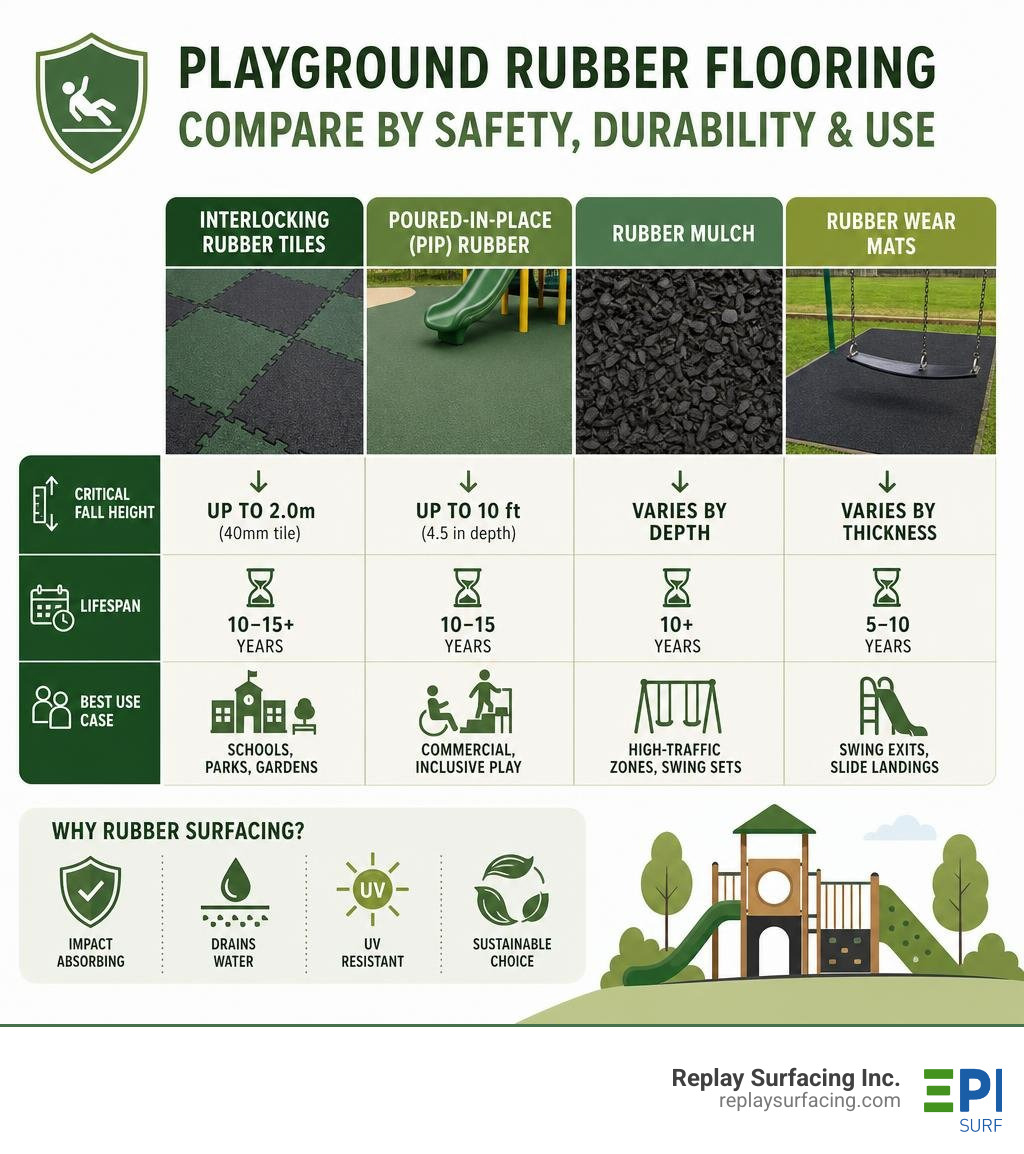
Here’s a quick look at the most durable options to help you decide fast:
| Flooring Type | Best For | Critical Fall Height | Lifespan |
|---|---|---|---|
| Interlocking Rubber Tiles | Schools, parks, gardens | Up to 2.0m (40mm tile) | 10-15+ years |
| Poured-in-Place (PIP) Rubber | Commercial, inclusive play | Up to 10 ft (4.5 in depth) | 10-15 years |
| Rubber Mulch | High-traffic zones, swing sets | Varies by depth | 10+ years |
| Rubber Wear Mats | Swing exits, slide landings | Varies by thickness | 5-10 years |
Every year, falls are the leading cause of playground injuries. Yet the surface underneath the equipment is often an afterthought. Concrete cracks. Wood chips splinter. Asphalt offers no cushioning. Rubber changes all of that.
Modern rubber surfacing absorbs impact, drains water, resists UV degradation, and — crucially — stays put under heavy use. For eco-conscious facility managers, it also closes the loop on scrap tire waste, turning a pollution problem into a safety solution.
I’m Landon Olson, operator of Replay Surfacing Inc., and my background in mechanical engineering and sustainability has shaped my focus on playground rubber safety flooring in Charlotte, NC that performs as hard as it protects. In the roundup below, I’ll walk you through the most durable options on the market so you can choose with confidence.
Quick look at playground rubber safety flooring:
Evaluating Playground Rubber Safety Flooring: Types and Comparisons
When designing a play space, selecting the right material involves balancing initial installation costs against long-term maintenance, safety requirements, and local climate factors. From the high-heat environments of Tucson, Arizona, to the heavy rain zones of Beaverton, Oregon, different materials perform uniquely under environmental stress.
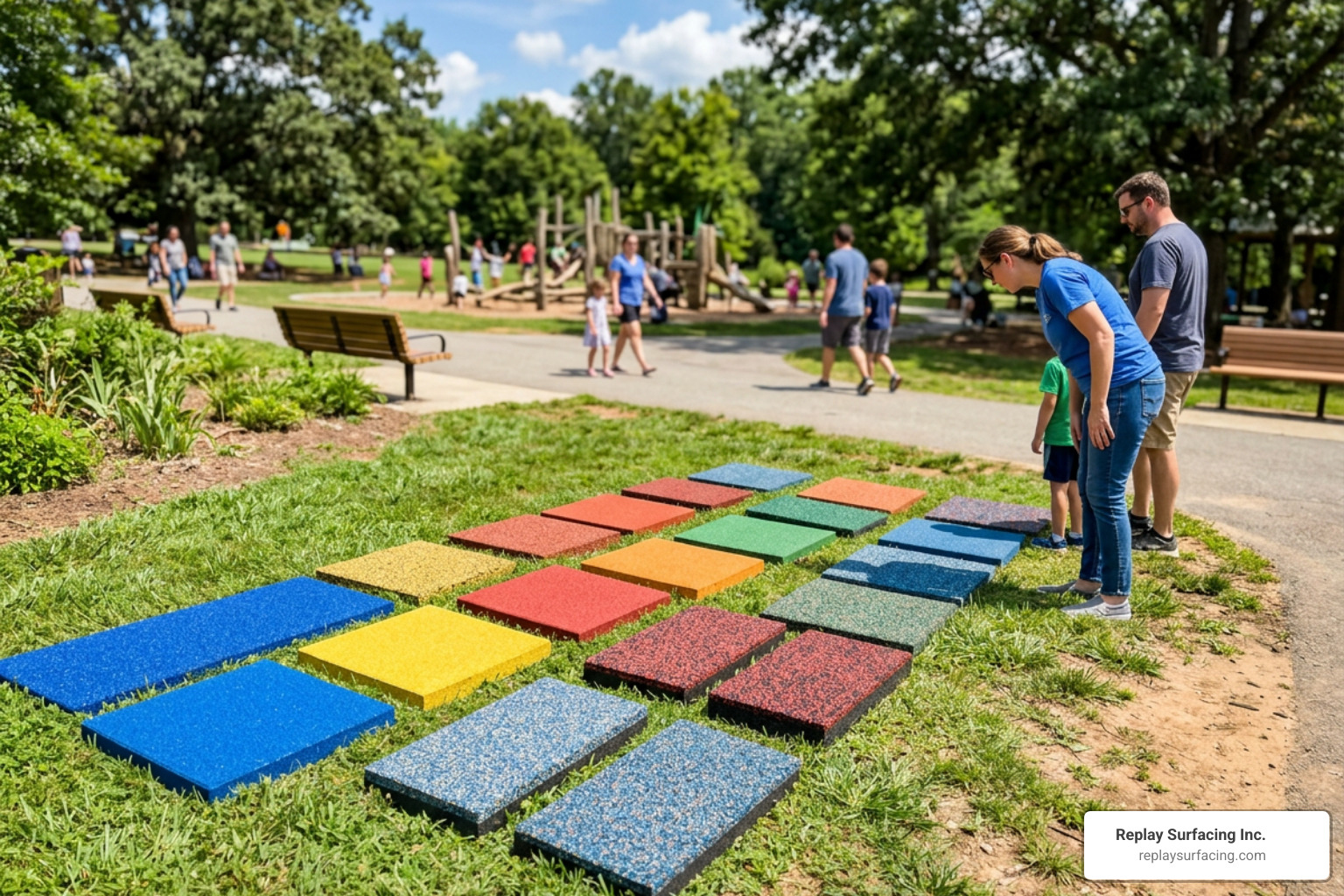
To help you evaluate your options, we have compiled a detailed comparison of the primary types of playground surfacing:
| Surfacing Type | Safety & Fall Protection | Initial Cost | Installation Complexity | Long-Term Maintenance |
|---|---|---|---|---|
| Interlocking Rubber Tiles | High (consistent, certified thickness up to 10-foot fall rating) | Moderate to High | Low to Moderate (DIY-friendly with dowel/interlocking systems) | Low (easy to replace individual damaged tiles) |
| Poured-in-Place (PIP) Rubber | Excellent (seamless, highly shock-absorbent, customized thicknesses) | High | High (requires professional mixing and hand-troweling) | Low to Moderate (requires periodic roll-coating; repair patches visible) |
| Rubber Mulch | Very High (excellent impact attenuation at proper depths) | Moderate | Low (requires containment border and manual spreading) | Moderate (requires routine raking, leveling, and debris removal) |
| Rubber Wear Mats | High (focused protection for high-impact localized zones) | Low | Low (simple lay-flat placement over existing loose-fill) | Very Low (extremely durable; deters soil erosion) |
| Artificial Turf with Cushioning | Excellent (when paired with certified foam underlayment pads) | High | High (requires sub-base prep, padding, turf stretching, and infill) | Low to Moderate (requires occasional brushing and sanitizing) |
To dive deeper into how these materials hold up over time under different weather conditions, read our Best Playground Flooring Ultimate Guide.
For commercial projects, schools, and municipal parks, understanding these trade-offs is crucial. While loose-fill options like wood chips or even rubber mulch are cost-effective initially, they require continuous raking and top-offs to maintain their safety ratings. In contrast, unitary surfaces like tiles and poured-in-place rubber stay securely in place, offering consistent protection year-round.
Interlocking Rubber Tiles vs. Poured-in-Place (PIP) Rubber
Two of the most popular unitary surfaces for high-traffic playgrounds are interlocking rubber tiles and poured-in-place (PIP) rubber. While both provide exceptional shock absorption, they differ significantly in design, installation, and long-term repairability.
Interlocking rubber tiles are pre-fabricated, modular blocks (typically 2×2 feet or 1×1 meter) made from recycled SBR rubber buffings bound with a polyurethane binder. Many high-quality tiles feature a premium EPDM top wear layer for enhanced UV protection and color vibrancy. The major advantage of tiles is their modularity. If a single tile is damaged by vandalism or localized wear—such as under a heavy swing—it can be unlinked and replaced without disturbing the rest of the playground.
On the other hand, Poured in Place Rubber Surfacing is mixed on-site and hand-troweled over a prepared sub-base to create a completely seamless, joint-free play surface. PIP consists of two distinct layers: a thick, shock-absorbing base cushion layer made of clean, recycled tire SBR rubber, and a durable, 0.5-inch top wear layer composed of EPDM granules or specialized blends.
Because PIP is seamless, it eliminates tripping hazards and prevents weeds or dirt from collecting in joints. This makes it a highly popular choice for inclusive play areas. However, because it is a continuous surface, localized repairs require cutting out the damaged section and pouring a new batch of rubber. This patch will often have a visible seam and slight color variation due to natural weathering of the surrounding area.
To learn more about the differences in performance and structure, check out our comprehensive guide on Playground Rubber Flooring.
Rubber Mulch and Wear Mats for High-Traffic Zones
For projects that require a more natural aesthetic or have budget constraints, loose-fill rubber mulch combined with heavy-duty rubber wear mats is an incredibly effective system.
Rubber mulch is made from 100% recycled passenger car and truck tires, processed to remove all steel wire. Unlike wood mulch, rubber mulch does not rot, compress, absorb water, or attract pests. It also stays cooler in high temperatures and does not blow away easily. However, children playing and high winds will inevitably displace loose mulch over time. This is especially true in high-impact zones, such as directly under swings and at the exit slides.
To solve this issue, specifiers use solid Rubber Playground Mats (often called wear mats) placed directly on top of or embedded within the mulch. These heavy-duty mats disperse the force of landing feet, preventing the mulch from being kicked away and exposing the hard sub-base underneath.
By strategically placing wear mats in high-traffic zones, you ensure that the safety surface always meets the required fall protection standards without requiring daily maintenance. To understand how to plan these protection zones effectively, read The Safe Zone: Everything About Choosing the Right Playground Safety Mats.
Safety Standards, Certifications, and Fall Height Ratings
Safety is the absolute foundation of everything we build. When children are climbing, jumping, and testing their limits, the playground surface must perform reliably under impact.
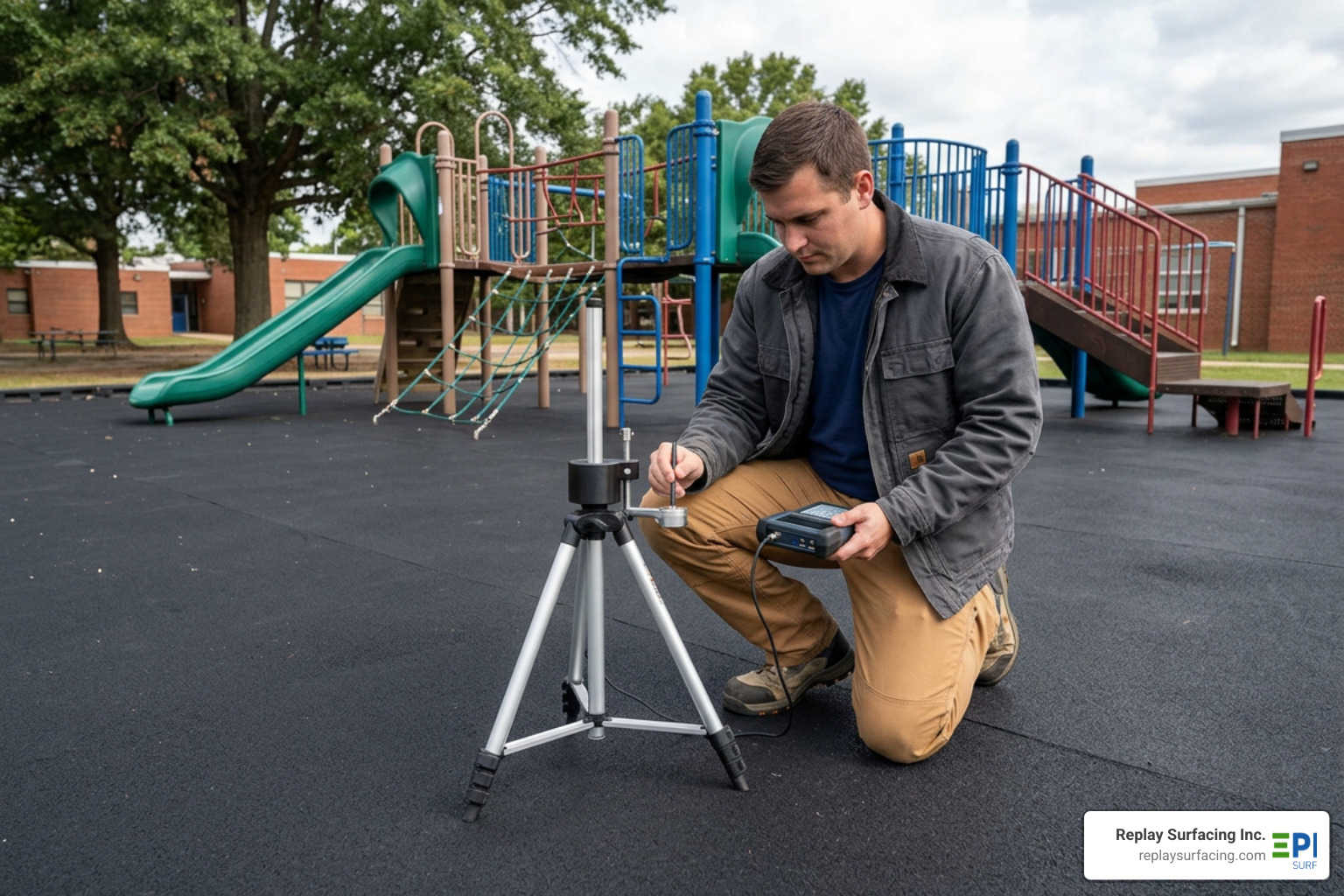
To ensure that your playground complies with local safety codes and insurance mandates, you must understand the key industry standards and certifications. Our detailed resource, Safety First: Understanding Playground Surface Impact Standards, explains the science behind these testing protocols.
In North America, the premier standard for playground surfacing safety is ASTM F1292 (Standard Specification for Impact Attenuation of Surfacing Materials within the Use Zone of Playground Equipment). In Europe and the UK, equivalent standards include EN 1177 and BS EN 1177.
These standards utilize a specialized test instrument—a triaxial accelerometer inside a metal headform—dropped from various heights onto the surfacing material. The test measures two critical metrics:
- G-max: The maximum acceleration experienced during impact (must not exceed 200 Gs).
- Head Injury Criterion (HIC): A measure of the impact severity based on the duration and force of the deceleration (must not exceed 1,000).
Any surface that records a G-max over 200 or an HIC over 1,000 at a specific drop height is considered unsafe for that fall height, as impacts exceeding these thresholds are associated with a high probability of life-threatening brain injuries.
Why Critical Fall Height Dictates Your Playground Rubber Safety Flooring Thickness
The Critical Fall Height (CFH) is defined as the maximum height from which a child could fall onto the surface without sustaining a life-threatening head injury. The CFH of your playground is determined by the highest accessible play component on the equipment (e.g., the height of the slide platform or monkey bars).
Your choice of playground rubber safety flooring thickness must equal or exceed the critical fall height of your equipment. For example:
- Just 4.5 inches of poured rubber provides a surface on which a child can safely land from a 10-foot fall, according to ASTM testing methods.
- Our 30mm rubber tiles are ASTM F1292 tested to provide a critical fall height of 1.5 meters (approx. 5 feet), making them ideal for lower-profile primary school play areas.
- Our 40mm tiles provide a 2.0-meter critical fall height.
- Specialty heavy-duty tiles, such as the 5-inch Sterling Playground Tiles, are rated for a critical falling measurement of 10 feet.
- Conversely, thin modular tiles like the 9/16-inch StayLock or Ergo Matta Perforated Tiles have a 20-inch critical fall height rating, meaning they should only be used for flat ground play zones, sensory paths, or splash pads with no elevated climbing equipment.
Choosing the correct thickness is not just about compliance; it is about custom-tailoring your budget. On a large aggregate base, you can combine different tile thicknesses to create zones with varying HIC values. This keeps your playground surfaces perfectly flush while saving material costs in low-profile areas. Learn more about selecting the right thickness in our guide to Shock Absorbing Playground Surfaces.
Key Certifications for Schools, Councils, and Commercial Playgrounds
For schools, municipal councils, and commercial childcare facilities, proving safety compliance is non-negotiable. When purchasing rubber surfacing, always request official, third-party laboratory test certificates demonstrating compliance with ASTM F1292 or EN 1177.
In addition to impact attenuation, commercial playgrounds in our service areas—such as public parks in Charlotte, NC, or schoolyards in Hartford, CT—must meet strict accessibility guidelines. Poured-in-place rubber and properly installed interlocking rubber tiles are fully wheelchair accessible and comply with the Americans with Disabilities Act (ADA) and ASTM F1951 (Standard Specification for Determination of Accessibility of Surface Systems Under and Around Playground Equipment).
Unlike loose wood mulch, which presents a significant barrier to wheelchairs, crutches, and strollers, unitary rubber surfaces allow children and caregivers of all physical abilities to navigate the play space easily. Furthermore, premium rubber tiles feature an R10 anti-slip rating, ensuring excellent traction in both wet and dry conditions.
Installation, Maintenance, and Environmental Factors
The long-term durability of playground rubber safety flooring depends heavily on how well it is installed and how it responds to local climate conditions.
For a deep dive into the technical details of the installation process, read The Ultimate Guide to Professional Rubber Playground Installation.
Environmental factors vary drastically across our service locations:
- Tucson, AZ: High UV exposure can cause color “ambering” (yellowing) and degradation of low-quality polyurethane binders. We use premium, UV-stable EPDM top layers and aliphatic binders to prevent cracking and fading.
- Beaverton, OR & Lake Charles, LA: High rainfall requires excellent drainage. High-quality rubber tiles and poured-in-place surfaces are highly porous, allowing water to drain straight through the material to the sub-base, preventing standing puddles and mud.
- Connecticut & Indiana: Extreme freeze-thaw cycles can cause rigid surfaces to crack. Our rubber flooring remains flexible and shock-absorbing down to -30°C (-22°F), expanding and contracting with temperature fluctuations without damage.
- North Carolina (Raleigh, Charlotte, Sanford) & Nashville, TN: High humidity and seasonal storms require surfaces that resist mold, mildew, and fungal growth. Our non-porous EPDM wear layers are naturally antimicrobial.
DIY vs. Professional Installation Methods
While some modular options like interlocking tiles can be installed by school maintenance staff or handy homeowners, larger commercial installations—especially poured-in-place rubber—require professional expertise.
For a successful installation, the sub-base preparation is critical. A proper base consists of either a concrete slab, an asphalt layer, or a deeply compacted ballast aggregate base (typically 4 to 6 inches of compacted crushed stone) topped with a geotextile weed barrier.
- DIY Installation (Tiles & Mulch): Interlocking tiles are highly DIY-friendly. They utilize a system of interlocking plastic dowels or connector blocks (such as the Quad Blok system) that secure the tiles together over concrete or compacted gravel. This eliminates the need for full adhesive bonding in temporary or residential settings.
- Professional Installation (PIP & Large Commercial Tiles): Poured-in-place rubber must be mixed on-site using precise ratios of rubber granules and polyurethane binder, then hand-troweled within a strict temperature and humidity window. Mistakes in mixing can lead to premature crumbling, cracking, or soft spots.
To ensure your installation meets safety standards and qualifies for municipal insurance, we highly recommend working with certified professionals. Learn more about our professional installation services at Playground Safety Surfacing.
Customizing Your Playground Rubber Safety Flooring with Colors and Patterns
One of the most exciting aspects of modern rubber safety flooring is the design versatility. Because poured-in-place rubber is hand-troweled and rubber tiles are modular, we can create virtually any color combination, pattern, or theme.
Our design capabilities include:
- Sensory Play Elements: Integrating hopscotch grids, maps, geometric shapes, or alphabet paths directly into the floor.
- 3D Topography: Building interactive 3D elements like gentle hills, tunnels, mounds, or climbing spheres directly into the poured-in-place surface to encourage creative play.
- Custom School & Council Logos: Permanently embedding school mascots, city crests, or sponsor logos into the wear layer using vibrant EPDM colors.
- Safety Zoning: Using contrasting colors (such as bright red or yellow) around high-risk swing zones and slide exits to visually warn children to stay clear of moving equipment.
Frequently Asked Questions about Playground Surfacing
How long does poured-in-place rubber surfacing last?
With proper installation and maintenance, poured-in-place rubber surfacing typically lasts 10 to 15+ years. To maximize its lifespan, we recommend applying a polyurethane roll-coat (rejuvenation coat) every 3 to 5 years, depending on foot traffic and UV exposure. If the top wear layer eventually wears thin, it can be revitalized by pouring a fresh “color cap” or new wear layer directly over the existing base cushion, saving the cost of a full excavation.
Can rubber safety tiles be installed over grass or dirt?
We do not recommend installing rubber tiles directly over raw dirt or active grass. Over time, soil shifts, grass grows through the joints, and rain turns the sub-base into mud, causing the tiles to become uneven and create tripping hazards. For a stable, long-lasting installation, tiles should be laid over a level, compacted aggregate base (such as crushed stone) secured with interlocking pins, or fully adhered to concrete or asphalt.
Is recycled rubber flooring safe for children and the environment?
Yes, high-quality recycled rubber flooring is completely non-toxic and safe for children. It is manufactured from vulcanized SBR rubber from clean passenger tires, bound with non-toxic, moisture-cured polyurethane binders. Our materials are free from lead, heavy metals, and latex, complying with strict environmental regulations. By recycling scrap tires, we prevent millions of waste tires from ending up in landfills or causing tire fires. Learn more about our eco-friendly manufacturing process at Recycled Rubber Playground Flooring.
Conclusion
Selecting the right playground rubber safety flooring is an investment in the safety, accessibility, and longevity of your play space. Whether you opt for the seamless beauty of poured-in-place rubber, the modular convenience of interlocking tiles, or the heavy-duty protection of wear mats, choosing a high-quality rubber surface ensures that your playground remains a safe zone for years to come.
At Replay Surfacing Inc., we are proud to serve communities across Charlotte, NC, Columbia, SC, Raleigh, NC, Sanford, NC, Tucson, AZ, Connecticut, Indiana, Nashville, TN, Beaverton, OR, and Lake Charles, LA. We transform discarded passenger tires into state-of-the-art, impact-absorbing play surfaces that protect children and preserve our environment.
For more information on selecting the perfect safety mats and layout accessories for your project, read The Safe Zone: Everything About Choosing the Right Playground Safety Mats.
Ready to design a safer, more sustainable playground? Explore Replay Surfacing Rubber Mulch Solutions or contact our expert team today for a custom quote!