

Why Rubber Mulch Fall Height Matters More Than You Think
rubber mulch fall height is the maximum distance a child can fall onto a rubber mulch surface without risking a life-threatening head injury. Here’s a quick reference:
| Rubber Mulch Depth (Compacted) | Critical Fall Height Protection |
|---|---|
| 4 inches | Up to 10 feet |
| 5 inches | Up to 12 feet |
| 6 inches | Up to 16 feet |
For comparison: 9 inches of wood mulch protects only up to 7 feet, and 6 inches of sand protects just 5 feet.
Every year, nearly 114,000 children in the United States visit emergency rooms after falling on playground surfaces. Around 5,500 children under the age of four suffer traumatic brain injuries on playgrounds annually. Those numbers are staggering — and largely preventable with the right surfacing.
The surface under playground equipment is one of the most important safety decisions a facility manager can make. Yet it’s also one of the most misunderstood. Many playgrounds still use materials like sand, pea gravel, or wood mulch that simply don’t provide enough impact protection for modern play structures.
Rubber mulch changes that equation dramatically. At just 6 inches of compacted depth, certified rubber mulch can protect children falling from up to 16 feet — more than twice the protection of wood mulch at a greater depth.
I’m Landon Olson, a mechanical engineer and operator of Replay Surfacing, and my background in manufacturing, safety surfacing, and sustainability has given me a deep understanding of how rubber mulch fall height ratings are tested, certified, and maintained in real-world playground environments. In the sections below, I’ll walk you through exactly how to choose, install, and maintain rubber mulch to meet safety compliance standards for your playground.
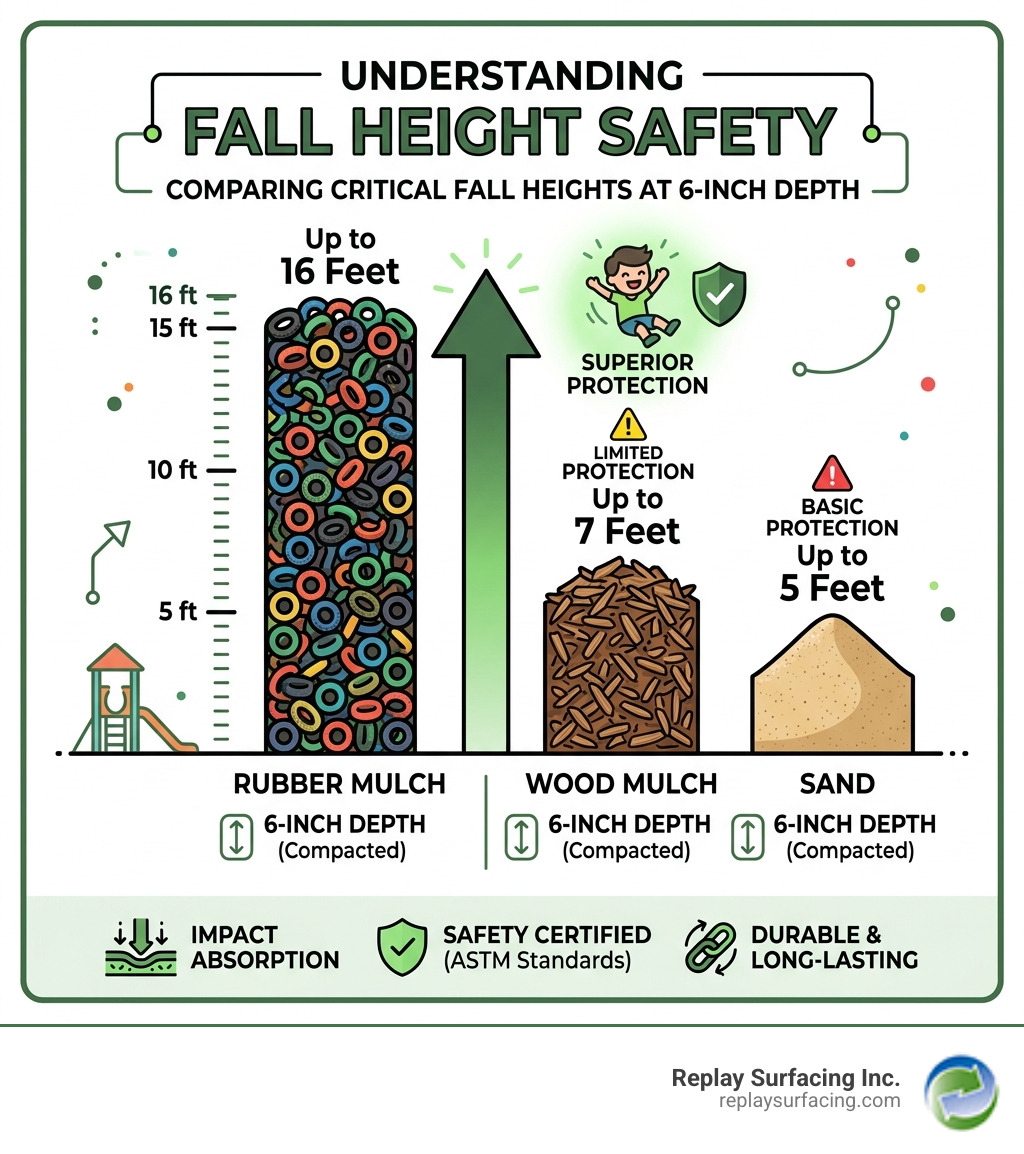
Understanding Critical Fall Height and Playground Safety
When we talk about playground safety, the term “Critical Fall Height” (CFH) is the gold standard. It isn’t just a marketing term; it is a technical measurement defined by ASTM F1292. This standard establishes the impact attenuation performance of playground surfacing. Essentially, it measures how well a surface can “catch” a child and disperse the energy of a fall to prevent life-threatening head trauma.
In the industry, we look at two primary data points: G-max and the Head Injury Criterion (HIC). G-max measures the maximum acceleration (shock) experienced during an impact, while HIC measures the likelihood of a head injury based on the duration of that impact. For a surface to pass, it must stay below a G-max of 200 and an HIC of 1,000.
Think of it like this: falling on concrete is like hitting a brick wall—all that energy goes straight into the body. Falling on playground safe mulch is like landing on a giant, firm pillow that breathes, allowing the energy to spread out and slow down the deceleration.
How Critical Fall Height is Tested
To determine the rubber mulch fall height rating, technicians use an instrumented metal head-form. This “triaxial accelerometer” is dropped from varying heights onto the surfacing material.
- Laboratory Testing: This happens in a controlled environment to establish the base rating of the material at specific depths (e.g., 4, 5, or 6 inches).
- Field Testing: Once we install a surface in a park in Raleigh, NC, or a school in Tucson, AZ, field tests can be performed to ensure the installed depth and local conditions meet the required safety thresholds.
By measuring the deceleration of the head-form upon impact, we can mathematically determine the maximum height from which a child could fall and still be “safe” from a critical head injury. This is vital for playgrounds across our service areas, ensuring that whether you are in Charlotte or Sanford, your equipment is paired with a surface that actually performs.
The Role of IPEMA and ASTM Certifications
You should never take a manufacturer’s word for it when it comes to safety. At Replay Surfacing, we prioritize third-party validation. The International Play Equipment Manufacturers Association (IPEMA) provides a third-party certification service to validate that a product meets ASTM standards.
When evaluating mulch, look for:
- ASTM F1292: The standard for impact attenuation (the “fall” test).
- ASTM F3012: This ensures the loose-fill rubber is virtually wire-free (99.9%), preventing cuts or pokes from leftover tire steel.
- ASTM F1951: This confirms the surface is ADA-compliant, meaning wheelchairs can navigate the surface.
Choosing a certified product is non-negotiable. Non-certified options are a gamble with children’s safety. For a deeper dive, check out our Playground Certified Rubber Mulch Complete Guide.
Why Replay Surfacing’s Rubber Mulch Fall Height Outperforms Other Surfacing Materials
It is a common misconception that all “soft” surfaces are created equal. In reality, the physics of rubber compared to organic materials like wood or sand is night and day.
| Material | Depth | Critical Fall Height |
|---|---|---|
| Replay Rubber Mulch | 6 inches | 12 – 16 feet |
| Wood Chips | 9 inches | 7 feet |
| Engineered Wood Fiber | 9 inches | 6 feet |
| Fine Sand | 9 inches | 5 feet |
| Fine Gravel | 9 inches | 6 feet |
As the table shows, our loose rubber mulch provides superior shock absorbency at shallower depths. While wood mulch decomposes and compresses into a hard mat over time, rubber remains non-compressible. This means it doesn’t lose its “bounce” after a rainy season in Nashville or a hot summer in Arizona.
Certified Rubber Mulch Fall Height Ratings and Standards
Our recycled rubber mulch is engineered to provide tiered protection based on your specific equipment. If you have a standard residential playset, a 3-inch depth might suffice. However, for commercial playgrounds with high decks and long slides, we recommend a 6-inch compacted depth.
At a 6-inch depth, high-quality nugget mulch can achieve a staggering 16-foot fall height rating. This is roughly triple the protection offered by sand and double that of wood mulch. Whether you choose our shredded style or our premium nuggets, you are getting a material that has been tested to the limit. You can learn more in our Best Recycled Rubber Playground Mulch Guide.
Addressing Limitations of Traditional Loose-Fill Options
Traditional materials like wood mulch and sand have significant drawbacks. Wood mulch attracts insects, rots, and requires annual “topping off” because it biodegrades. Sand often hides animal waste and can become as hard as concrete if it gets wet and then dries or freezes.
The biggest issue with these materials is displacement. In “kick-out” areas—like under swings or at the base of slides—wood mulch is easily pushed away, leaving the hard ground exposed. While rubber mulch can also be displaced, its higher density and unique shape help it stay in place better than lightweight wood slivers. More importantly, because it doesn’t rot, the depth you have today is the depth you’ll have in five years, provided you perform basic raking. For more on the safety comparison, see Is Rubber Mulch a Safe Surface for Your Childs Playground.
How to Calculate and Install the Correct Mulch Depth with Replay Surfacing
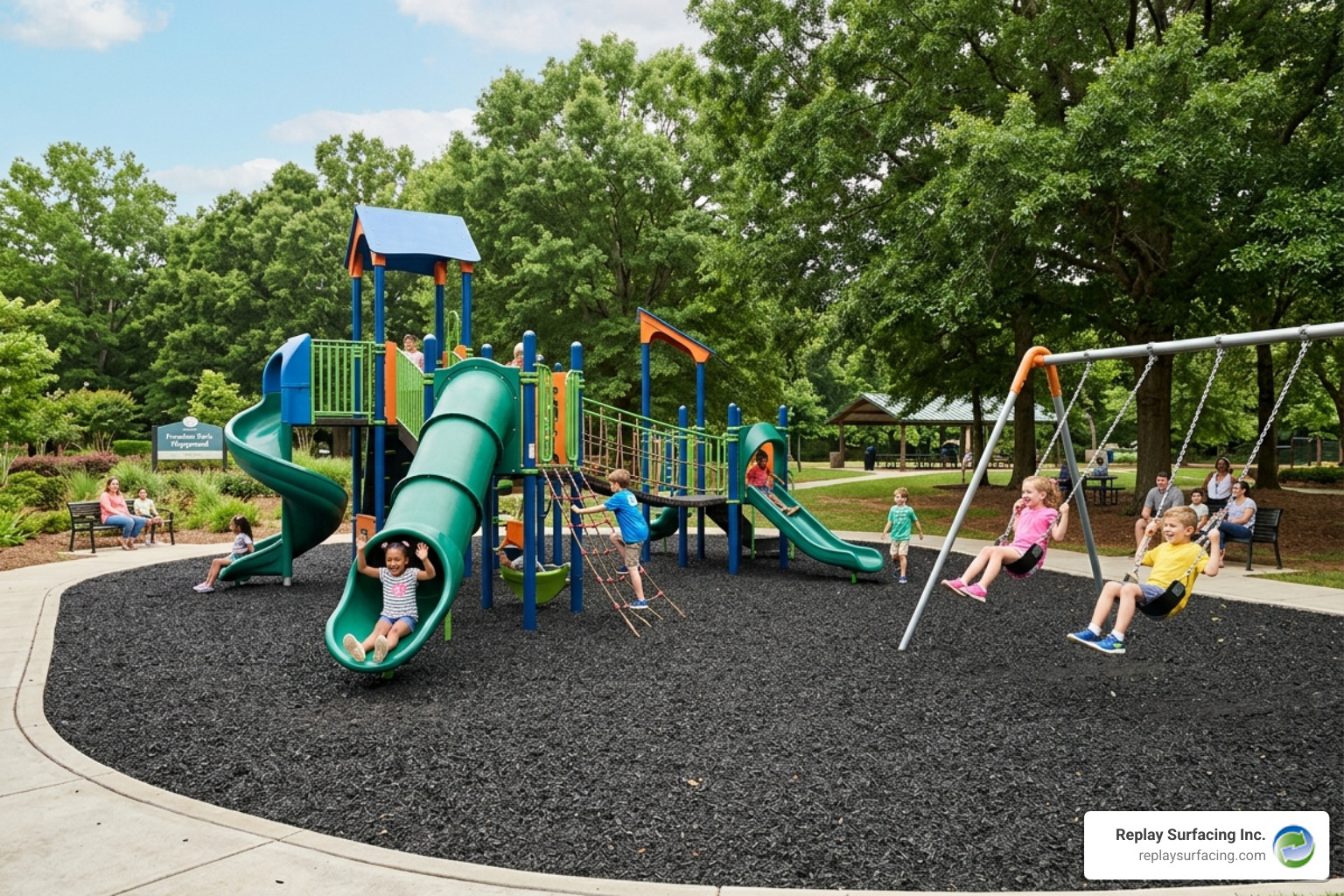
Calculating the right amount of mulch isn’t just about filling a hole; it’s about meeting legal and safety requirements. The required rubber mulch fall height protection is dictated by the highest “designated play surface” on your equipment.
- Residential Use: Typically 3 inches of depth is the baseline for backyard sets.
- Commercial Use: 6 inches is the industry standard for schools and municipal parks to ensure compliance with CPSC guidelines.
Determining Depth Based on Equipment Height
To determine your needs, find the highest point a child can stand on. For a slide, this is the platform, not the top of the hood. For a swing, the fall height is measured from the pivot point (the top bar).
Once you have that height, you must ensure your mulch depth meets or exceeds it. In our service areas like Columbia, SC, and Raleigh, NC, we often recommend a “buffer” depth to account for the inevitable movement of the mulch during play. For more on budgeting for these depths, see our Rubber Mulch Cost Guide 2026.
Achieving Maximum Rubber Mulch Fall Height Through Proper Installation
A safe surface starts with a solid foundation. You can’t just throw rubber mulch over a mud pit and expect it to work perfectly.
- Site Prep: Clear the area of all old surfacing, rocks, and debris.
- Drainage: Ensure the ground is graded so water doesn’t pool. Rubber mulch is permeable, meaning water flows through it. If the water has nowhere to go, it can cause the base to shift.
- Filter Fabric: Lay down a heavy-duty landscape fabric. This keeps the mulch from mixing with the dirt and prevents weeds from popping up.
- Borders: Use secure borders (like our Flex Curbs) to keep the mulch contained.
- Installation: Pour the mulch and rake it to the desired level. We recommend marking a “fill line” on your playground posts to make future inspections easy.
Proper installation ensures that your best rubber mulch for playground stays at the required depth to protect those high-flying kids.
Maintaining Impact Attenuation Over Time for Replay Surfacing Products
One of the best things about rubber mulch is that it is relatively low maintenance, but “low” doesn’t mean “none.” To keep your rubber mulch fall height rating intact, you must manage displacement.
Managing Compaction and Material Displacement
In high-traffic areas, children’s feet act like little shovels, pushing mulch out of the “fall zone.” This is common in Beaverton, OR, and our North Carolina locations where playgrounds are busy year-round.
- Raking: Weekly or bi-weekly raking of high-use areas (under swings and slides) is essential to restore the required depth.
- Swing Mats: We highly recommend installing rubber wear mats under swings. These mats sit on top of or slightly within the mulch to prevent the “trenching” that happens when kids use their feet to stop.
- Moisture Management: Unlike wood, rubber doesn’t absorb water, so it won’t get “waterlogged.” However, proper drainage ensures the area stays clean and the mulch doesn’t float away during heavy rains.
For more maintenance tips, visit Advantages of Playground Rubber Mulch Safety Maintenance and Durability.
Long-term Durability in Different Climates
Whether you are dealing with the intense UV rays in Tucson, AZ, or the damp winters in Connecticut, our rubber mulch is built to last. It is UV-resistant and won’t freeze or crack. In fact, it provides consistent impact protection in temperatures ranging from -15°F to over 100°F.
Our products are specifically designed to meet local safety standards, including those in Ontario and Sacramento, California, as well as the strict guidelines found in North Carolina. Because it’s made from recycled tires, it’s also a non-toxic rubber mulch option that is safe for the environment.
Frequently Asked Questions about Replay Surfacing’s Rubber Mulch Fall Height
What depth of Replay Surfacing rubber mulch is needed for a 10-foot fall?
For a 10-foot fall height, a compacted depth of 4 to 6 inches is recommended. While 4 inches can technically meet the 10-foot requirement in lab settings, we often suggest 6 inches for commercial settings to provide a safety buffer and account for material displacement.
Does Replay Surfacing’s rubber mulch lose its fall height rating over time?
Unlike wood mulch, which rots and loses its shock-absorbing properties, rubber mulch is incredibly stable. As long as you maintain the correct depth by raking, the material itself will retain its impact attenuation for 12 years or more. It does not compact into a hard surface like organic materials do.
Is certified rubber mulch from Replay Surfacing safe for residential use?
Absolutely. In fact, it’s the safest option for backyard playsets. It is non-toxic, clean (no more stained clothes from wood dye or mud), and provides significantly better protection than grass or dirt. For residential sets, 3 inches is a common and effective depth. Check our Rubber Mulch for Playset guide for more info.
Conclusion
At Replay Surfacing Inc., we believe that every child deserves a safe place to play. By recycling tires into high-performance surfacing, we aren’t just cleaning up the environment—we are creating a “safety net” for the next generation. From the playgrounds of Raleigh and Sanford to the parks of Tucson and Nashville, our commitment to safety and sustainability is unwavering.
Choosing the right rubber mulch fall height for your project is an investment in peace of mind. It’s about knowing that when a child slips or jumps, the ground beneath them is engineered to protect them.
Ready to transform your play area? The Ultimate Guide to Rubber Mulch for Playgrounds can help you get started on building a safer, more sustainable future today.