

Why Playground Rubber Mulch Thickness Is a Safety-Critical Decision
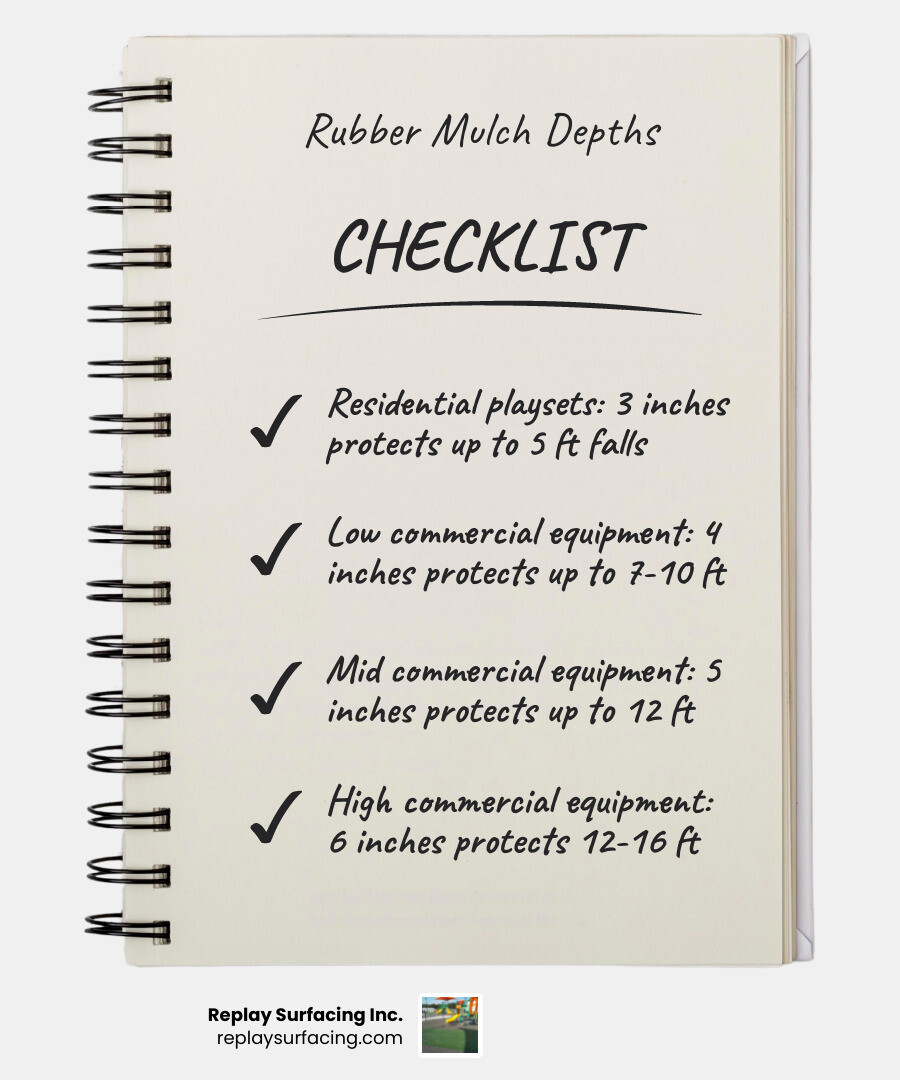
Getting playground rubber mulch thickness right is one of the most important safety decisions you can make for any play area. Here’s a quick-reference guide to recommended depths:
| Setting | Minimum Depth | Max Fall Height Protected |
|---|---|---|
| Landscaping only | 1-2 inches | N/A |
| Residential playset | 3 inches | 5 feet |
| Commercial (low equipment) | 4 inches | 7-10 feet |
| Commercial (mid equipment) | 5 inches | 12 feet |
| Commercial (high equipment) | 6 inches | 12-16 feet |
Nearly 200,000 children in the US visit emergency rooms every year because of falls on playground surfaces — that’s almost one child every three minutes. The right depth of rubber mulch is one of the simplest, most proven ways to reduce that risk.
The problem is that depth recommendations vary by equipment height, who’s using the playground, and which safety standard applies. Too thin, and the surface won’t cushion a fall properly. Too thick, and you’re spending more than you need to.
This guide walks you through exactly how to choose the right depth, calculate how much you need, and install it correctly — whether you’re managing a backyard playset in Charlotte or a municipal park in Tucson.
I’m Landon Olson, a mechanical engineer and the operator of Replay Surfacing Inc., where I’ve spent years applying engineering principles to recycled rubber surfacing solutions — including helping schools, parks, and facility managers across the country get playground rubber mulch thickness right the first time. This guide pulls from both industry safety standards and hands-on installation experience so you can make a confident, informed decision.
Playground rubber mulch thickness helpful reading:
Safety Standards and Fall Height Protection
When we talk about playground rubber mulch thickness, we aren’t just guessing. We rely on rigorous scientific testing and established safety standards. The gold standard in our industry is the ASTM F1292 (American Society for Testing and Materials), which measures impact attenuation. This basically tests how well a surface can cushion a head-first fall without causing a life-threatening injury.
The Consumer Product Safety Commission (CPSC) and the International Play Equipment Manufacturers Association (IPEMA) provide the guidelines we follow to ensure every child in cities like Nashville, TN, or Raleigh, NC, stays safe. The “Critical Fall Height” is the highest point from which a child could fall onto the surface without suffering a critical head injury.
Research shows that rubber mulch is a superhero in this department. While wood chips or sand might require double the depth to achieve the same safety rating, a 6-inch layer of rubber mulch can protect against falls from up to 16 feet. This is why understanding Safety First: Understanding Playground Surface Impact Standards is so vital. By maintaining the correct depth, you are actively preventing traumatic brain injuries, concussions, and fractures. For more technical details on how these materials absorb energy, check out The Science of Soft Landings and Impact Absorbing Mulch.
Determining the ideal playground rubber mulch thickness for your project

Choosing the right playground rubber mulch thickness isn’t a “one size fits all” situation. If you’re in Tucson, AZ, where the sun is relentless, or Beaverton, OR, where rain is a constant companion, your depth needs are primarily dictated by your equipment and the age of the children.
Key factors to consider include:
- Equipment Height: Measure from the highest accessible part of the playset (like the top of a slide or the monkey bars) to the ground.
- User Age: Younger children (under 5) often benefit from slightly deeper layers as their motor skills are still developing, and they are more prone to stumbles.
- Local Regulations: While national standards exist, always check local building codes in areas like Columbia, SC, or Sanford, NC, to ensure full compliance.
According to the Ultimate Guide on GardenerBible, anything less than 2 inches is strictly for aesthetics and won’t provide safety protection. For real safety, you need to start at 3 inches and go up from there.
Residential playground rubber mulch thickness requirements
For a standard backyard playset in Charlotte, NC, we typically recommend a 3-inch depth. Most residential equipment has a fall height of around 5 feet. A 3-inch layer of rubber mulch provides excellent protection for this height and is significantly safer than grass or dirt.
Homeowners often choose this depth because it balances safety with cost. However, if your backyard set features a high tower or a rock wall, you should consider increasing that depth to 4 inches. Rubber Mulch for Playset installations are about peace of mind for parents and protection for kids.
Commercial playground rubber mulch thickness and fall height ratings
Commercial environments—like schools in Lake Charles, Louisiana, or municipal parks in Indiana—face much higher foot traffic and often have taller equipment. For these settings, a 6-inch depth is the industry standard.
A 6-inch compacted layer of rubber mulch is IPEMA certified to protect against falls from 12 to 16 feet. Furthermore, commercial playgrounds must be ADA (Americans with Disabilities Act) compliant. Rubber mulch, when installed at a 6-inch depth (approximately 14 pounds per square foot), provides a firm enough surface for wheelchair accessibility while remaining pliable enough for safety. For a deep dive into these requirements, see our Playground Certified Rubber Mulch Complete Guide.
Calculating Coverage and Quantity for Your Play Area
Now for the math! Don’t worry, we’ll make it easy. To figure out how much rubber mulch you need for your project in Columbia or Nashville, you first need the square footage of your “use zone” (the area under and around the equipment).
The 5% Overage Rule: Always order about 5% more than your calculated total. This accounts for settling, uneven subfloors, and the occasional mulch-throwing contest (we’ve all been there).
Here is a handy coverage chart for a standard 2,000 lb pallet:
| Depth | Coverage per 2,000 lb Pallet |
|---|---|
| 3 inches | ~310 sq. ft. |
| 4 inches | ~230 sq. ft. |
| 6 inches | ~150 sq. ft. |
Most rubber mulch is delivered in 40 lb bags on pallets. If you are calculating in cubic yards, rubber mulch is much denser than wood. You can find more specific measurement tips in our Rubber Mulch Yard Guide 2026 or check the Cost of Rubber Mulch Per Yard to budget your project accurately.
Installation and Maintenance Best Practices
Proper installation is just as important as the playground rubber mulch thickness itself. If you’re installing in a place like Raleigh or Sanford, follow these steps for a surface that lasts:
- Site Prep: Clear the area of rocks, debris, and old wood mulch. You don’t need a degree in construction, but the ground should be relatively level.
- Landscape Fabric: Lay down a high-quality landscape fabric first. This prevents weeds from poking through and keeps the mulch from sinking into the dirt over time.
- Borders: Use sturdy playground borders to keep your mulch contained. Without them, your investment will slowly migrate into the grass.
- Wear Mats: Place rubber wear mats at high-traffic exit points like the bottom of slides and under swings. These prevent “pitting,” where kids’ feet kick away the mulch and reduce the safety depth.
- Maintenance: One of the biggest Advantages of Playground Rubber Mulch Safety, Maintenance, and Durability is how little work it requires. Use a leaf blower to remove stray leaves and occasionally rake the mulch back to an even level.
A pro tip for maintenance: Mark the “full” line on your playground equipment posts. This makes it easy to see at a glance if your playground rubber mulch thickness has dipped below the safe limit. For more details, check our guide on Installing Rubber Mulch.
Conclusion
At Replay Surfacing Inc., we are proud to transform environmental hazards—old tires—into high-performance safety surfaces. Whether we are serving our communities in Charlotte, NC, or Tucson, AZ, our goal is to provide a durable, sustainable, and customizable play environment. Getting your playground rubber mulch thickness right is the foundation of that safety.
If you are still wondering Is Rubber Mulch a Safe Surface for Your Child’s Playground?, the answer is a resounding yes, provided it is installed at the correct depth.
Is rubber mulch toxic for children?
No. The EPA has officially endorsed rubber mulch as a safe and preferable material for playground surfacing. Our products are processed to be 99.9% steel-free and are made from non-toxic materials. The heavy metals and wire found in raw tires are removed during our specialized recycling process, ensuring a clean, safe play surface.
Does rubber mulch attract pests or insects?
Quite the opposite! Unlike wood mulch, rubber does not decompose. This means it doesn’t provide a food source for termites, carpenter ants, or other wood-boring insects. It also resists mold and mildew, making it a much cleaner option for damp climates like Beaverton, OR.
How often should I replenish the mulch depth?
Because rubber doesn’t rot or compact significantly, it rarely needs a full “top-off” like wood mulch does. Most of our products come with a 12-year color warranty. You should perform an annual depth check to ensure high-traffic areas haven’t thinned out, but generally, a well-installed rubber mulch surface will last a decade or more.
For more information on how we can help you with your next project, visit our page on playground surfacing services.