
Why the Right Backyard Playground Flooring in Charlotte Can Prevent Serious Injuries
Backyard playground flooring in Charlotte is one of the most important safety decisions you’ll make for your outdoor play area. The surface under your child’s feet — and under their falls — determines whether a tumble is a minor bump or a trip to the emergency room.
Here’s a quick look at the most common options and what they’re best for:
| Flooring Type | Best For | Fall Height Rating | Approx. Cost/sq ft |
|---|---|---|---|
| Rubber tiles (interlocking) | Durability, easy DIY install | Up to 10 ft | $6-$43+ |
| Rubber mulch (loose-fill) | Budget-friendly, natural look | Up to 12 ft | $2-$5 |
| Artificial turf with pad | Low maintenance, natural feel | Up to 9 ft | $5-$16+ |
| Pour-in-place rubber | Seamless, ADA accessible | Varies by depth | Higher; professional install |
A few things to keep in mind before you choose:
- Safety first: The CPSC recommends at least 12 inches of shock-absorbing material under playground equipment.
- Match the fall height: Your flooring must match the height of your tallest piece of equipment.
- Think long-term: Some surfaces cost less upfront but need more maintenance over time.
Over 200,000 children visit the ER each year for playground-related injuries — and many of those injuries are preventable with the right surface underfoot.
I’m Landon Olson, operator of Replay Surfacing and a mechanical engineer with an MBA, and I’ve spent my career turning recycled scrap rubber into high-performance backyard playground flooring in Charlotte solutions that are safer, greener, and built to last. Let’s walk through the top-rated options available today so you can make the best choice for your family.
Backyard playground flooring in Charlotte terms explained:
Essential Safety Standards for Backyard Playground Flooring in Charlotte
When we talk about safety in our service areas–from the sunny parks of Tucson, Arizona, to the family backyards in Charlotte and Raleigh, North Carolina–we aren’t just talking about a “soft” feel. We are talking about rigorous engineering standards. The primary goal of any backyard playground flooring in Charlotte is impact attenuation, which is a fancy way of saying the floor’s ability to absorb the shock of a fall so your child’s head or limbs don’t have to.
To ensure your home setup is as safe as a professional park in Nashville, Tennessee, or Columbia, South Carolina, you should look for materials that meet ASTM F1292. This is the gold standard for testing the shock-absorbing properties of Playground Surfacing. Additionally, the Consumer Product Safety Commission (CPSC) provides guidelines that every parent should follow. For example, the CPSC mandates that you should never install playground equipment over hard surfaces like concrete, asphalt, or packed earth. Even grass can be deceptively dangerous; once it’s baked under the sun in Sanford, North Carolina, or frozen in a Connecticut winter, it loses its ability to cushion a fall.
Calculating Fall Height Ratings for Backyard Playground Flooring in Charlotte
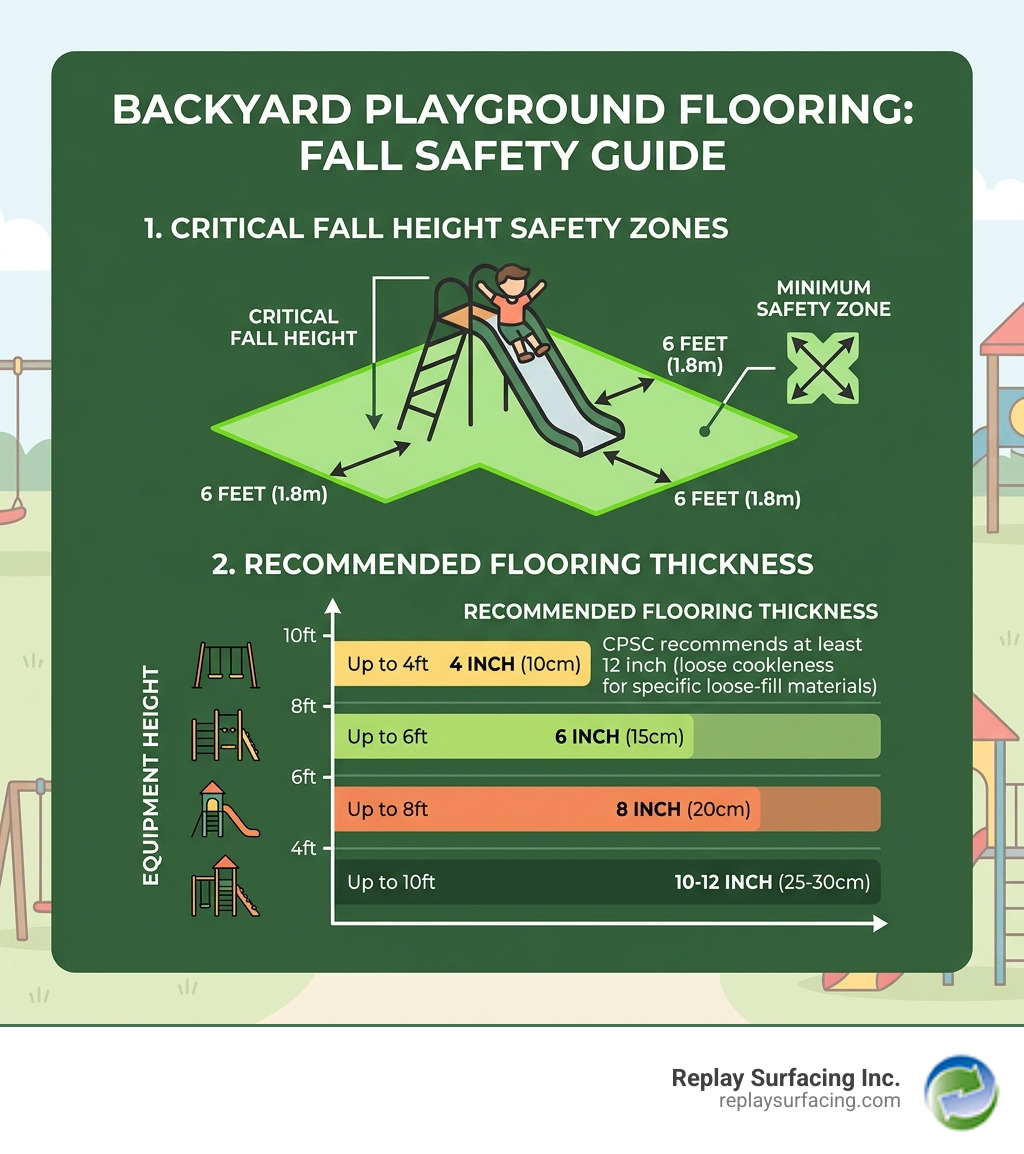
One of the most critical steps in your planning process is determining the “critical fall height” of your equipment. This is the distance between the highest designated play surface (like the top of a slide or the monkey bars) and the ground.
Your backyard playground flooring in Charlotte must have a rating that meets or exceeds this height. For instance, if your playset has an 8-foot high platform, you need a surface certified to protect against an 8-foot fall. We often see parents in Indiana or Beaverton, Oregon, underestimate this, assuming a thin mat is enough. However, safety is about depth and density. For more on this, check out The Safe Zone: Everything About Choosing the Right Playground Safety Mats. Generally, 1-inch tiles might only protect up to a 4-foot fall, while 4.25-inch thick interlocking tiles can handle up to a 10-foot drop.
Weather-Resistant Backyard Playground Flooring in Charlotte for Every Climate
Whether you are dealing with the intense UV rays in Tucson or the high humidity and rain in Lake Charles, Louisiana, your flooring needs to stand up to the elements. High-quality rubber products are naturally UV-resistant, meaning they won’t become brittle or crack after a summer of direct sun.
Water permeability is another huge factor. You want a surface that allows water to drain through rather than pooling on top. This prevents the area from becoming a slip-hazard or a breeding ground for mosquitoes. In places like Raleigh or Nashville, where heavy afternoon thunderstorms are common, porous rubber tiles or loose-fill mulch allow the kids to get back to playing almost immediately after the rain stops. Temperature stability is the final piece of the puzzle; recycled rubber stays cooler than asphalt and won’t freeze into a rock-solid block like wet wood mulch can in colder Connecticut or Indiana winters.
Top-Rated Materials for Your Home Play Area
Choosing the right material often comes down to a balance of budget, aesthetics, and how much “weekend warrior” energy you have for the installation.
| Feature | Rubber Tiles | Rubber Mulch | Artificial Turf |
|---|---|---|---|
| Installation | Easy DIY (Interlocking) | Very Easy (Spread & Rake) | Moderate (Needs Base/Pad) |
| Maintenance | Low (Sweep/Hose) | Moderate (Periodic Raking) | Low (Broom/Rinse) |
| Durability | High (10-15+ years) | High (Does not rot) | Moderate to High |
| Aesthetics | Clean, Modern | Natural, Wood-like | Lush, Green |
For a deeper dive into these options, we recommend our Interlocking Playground Mats Ultimate Guide and our breakdown of the Best Rubber Mulch for Playground.
Durable Rubber Tiles and Interlocking Mats
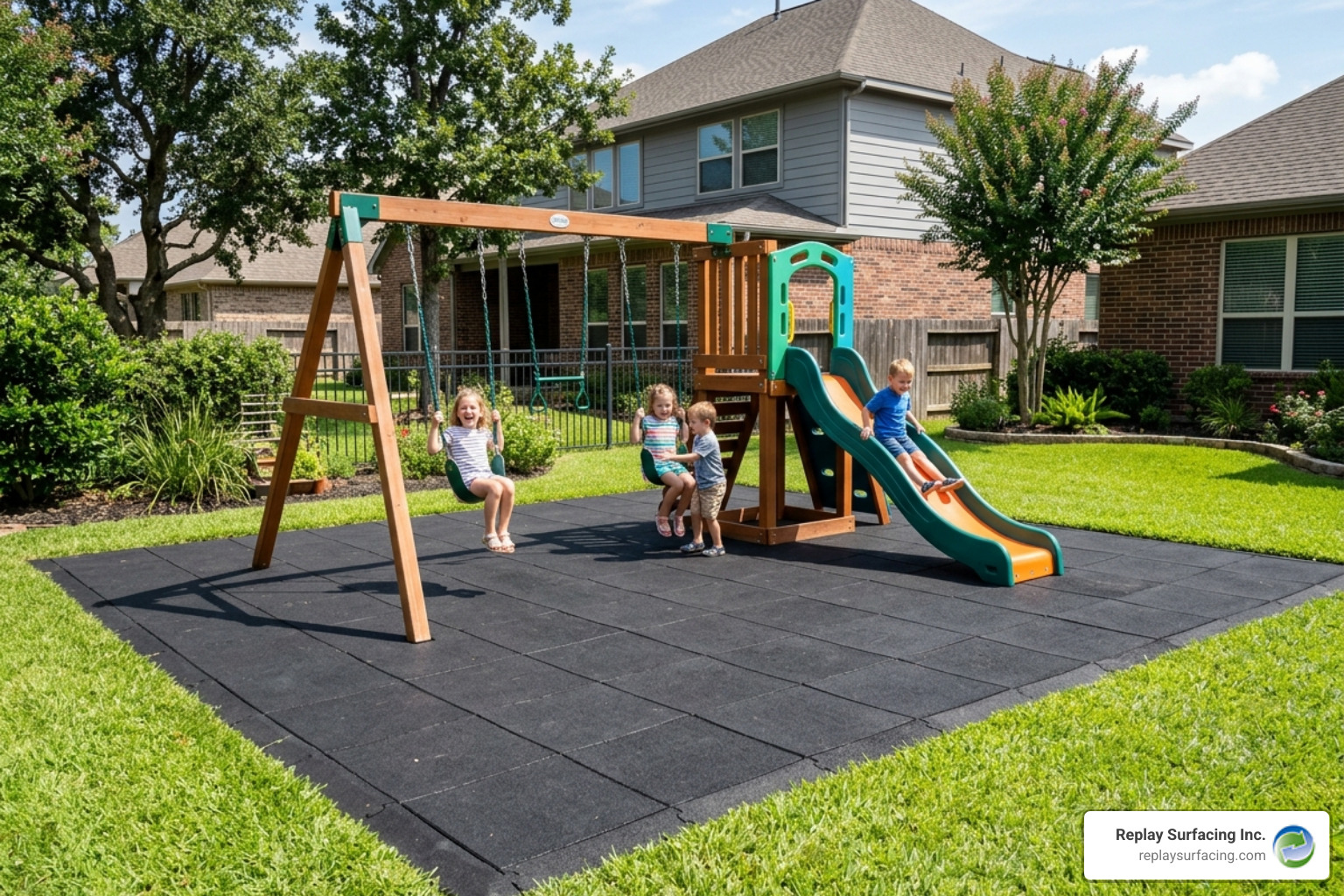
Rubber tiles are a fan favorite for backyard playground flooring in Charlotte because they offer a “finished” look that is incredibly easy to maintain. Most of these tiles are made from recycled tires—a core part of what we do at Replay Surfacing. By transforming old tires into safety flooring, we’re keeping waste out of landfills in our communities from Sanford to Beaverton.
The beauty of interlocking mats is the “built-in alignment foot” and perimeter locking mechanisms found in high-end versions. This prevents the tiles from curling at the edges or separating over time, which can create trip hazards. They are also slip-resistant, even when wet, making them a great choice for poolside play areas. If you’re looking for the right fit for your specific yard, see Playground Perfection: Finding the Right Outdoor Rubber Mats for Every Space.
Loose-Fill Rubber Mulch and Ground Cover
If you prefer a more traditional look without the splinters of wood chips, rubber mulch is the way to go. It’s one of the most economical ways to get a high fall height rating. Because it’s made of 99.9% steel-free recycled rubber, it doesn’t decompose, won’t attract termites, and doesn’t wash away in a heavy downpour like wood mulch might in Columbia or Lake Charles.
One of the best “parent perks” of rubber mulch? It doesn’t get muddy. After a rainstorm in Nashville, your kids can play without coming inside covered in dirt. It also stays put—animals don’t like to use it as a litter box, and it’s heavy enough that it won’t blow away in the wind. For more details on this eco-friendly option, check out our page on Recycled Rubber Mulch.
Installation and Maintenance Guide
Proper installation is just as important as the material itself. You could buy the most expensive backyard playground flooring in Charlotte in the world, but if you put it over an uneven, rocky base, it won’t perform its job.
Step-by-Step DIY Installation Tips
For most homeowners in our service areas, a DIY install is a great weekend project. Here is the general workflow we recommend:
- Measure and Clear: Start by measuring your “use zone”—usually 6 feet in every direction from the equipment. Clear out all grass, rocks, and debris.
- Create a Border: Especially for loose-fill mulch, you need a sturdy border (like timber or plastic curbing) to keep the material contained.
- Lay Landscape Fabric: This prevents weeds from popping up through your new floor and keeps your mulch from sinking into the soil.
- Prepare the Base: For tiles or turf, you’ll want a compacted stone base (like crushed granite) to ensure proper drainage and a level surface.
- Install the Flooring: Lay your tiles in a brick pattern for maximum stability. If using mulch, pour and rake to a consistent depth (usually 3-6 inches depending on fall height needs).
For a more detailed walkthrough, visit our guide on DIY Playground Flooring or Get Down and DIY: Installing Your Playground Floor.
Long-Term Maintenance and Cleaning
One reason we love rubber-based backyard playground flooring in Charlotte is that it’s low-maintenance, but “low” doesn’t mean “no.” To keep your warranty intact and your kids safe, follow these tips:
- Debris Removal: Use a leaf blower or a plastic rake to remove leaves, twigs, and pine needles. This is especially important in wooded areas of Connecticut or the Carolinas.
- Rinsing: A simple spray with a garden hose will remove most dust and dirt. For stubborn spots, a mild detergent and a soft brush work wonders.
- Depth Check: If you have loose-fill mulch, check high-traffic areas (like under swings or at the bottom of slides) once a month. Kids tend to kick mulch away in these spots. You may need to rake it back into place or add Wear and Tear No More: Choosing the Best Mats for High-Traffic Playground Areas to prevent “pitting.”
Frequently Asked Questions about Playground Surfaces
How do I calculate the amount of flooring needed?
To calculate the amount of backyard playground flooring in Charlotte you need, multiply the length of your play area by the width to get the total square footage. Remember to include the “use zone”–the CPSC recommends a 6-foot safety buffer around all equipment. If you are using mulch, you’ll also need to calculate the volume. For example, a 2,000-lb pallet of rubber mulch typically covers about 300 square feet at a 3-inch depth. We always suggest adding a 5% “buffer” to your order for cuts and leveling.
What is the typical cost per square foot for rubber flooring?
The cost varies significantly based on the type and thickness. Loose-fill rubber mulch is often the most budget-friendly, ranging from $2 to $5 per square foot. Interlocking rubber tiles can range from $6 for basic residential versions to over $40 for high-thickness, commercial-grade tiles with advanced locking systems. While the upfront cost of rubber is higher than wood chips, you save money over time because you don’t have to replace it every year.
Are rubber playground surfaces toxic for children?
This is a common concern for parents in our communities. Reputable providers–including us at Replay Surfacing–prioritize non-toxic, lead-free, and BPA-free materials. Most high-quality playground rubber is made from recycled tires that have been thoroughly cleaned and processed to remove steel and contaminants. If you have concerns, look for products that are IPEMA certified, which ensures they meet strict safety and environmental standards.
Conclusion
At Replay Surfacing Inc., we believe that every child deserves a safe place to play and every parent deserves peace of mind. By choosing high-quality backyard playground flooring in Charlotte, you are investing in years of “worry-free” fun. Whether you are in Tucson, Nashville, or anywhere in between, our mission is to transform environmental hazards like old tires into sustainable, customizable, and durable surfaces that protect your family.
Ready to upgrade your backyard? Transform your play area with professional playground surfacing and see how we can help you create the ultimate safe haven for your little ones.