
Why Playground Rubber Flooring Near Me is Essential for Safety
Playground rubber flooring near me is one of the smartest safety investments you can make for any play area – and finding the right option locally doesn’t have to be complicated.
Here’s a quick overview of your main options:
| Type | Best For | Fall Height | DIY Friendly? |
|---|---|---|---|
| Poured-in-Place Rubber | Schools, parks, commercial | Up to 10’+ | No |
| Interlocking Rubber Tiles | Backyards, small areas | Up to 8′ | Yes |
| Rubber Mulch | Budget-conscious, loose-fill | Varies by depth | Yes |
| Rubber Mats/Swing Mats | Targeted zones (swings, slides) | Varies | Yes |
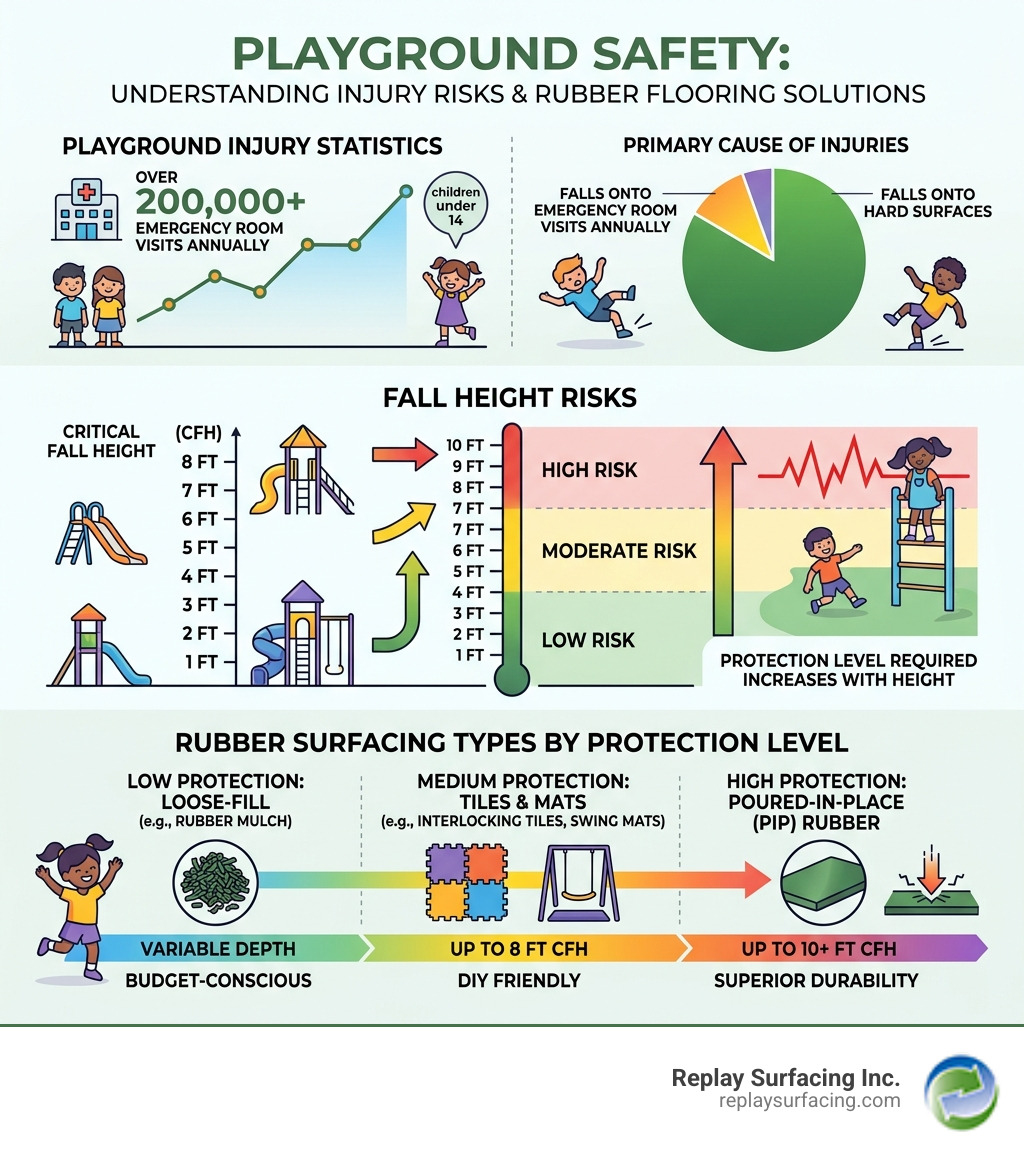
Every year, more than 200,000 children under 14 are treated in emergency rooms for playground-related injuries. Most of those injuries come from falls onto hard or slippery surfaces. The right rubber surface absorbs impact, stays grippy when wet, and holds up through years of heavy use – all while being made from recycled materials.
Whether you’re managing a school, a public park, or a backyard play set, choosing the right surface means balancing safety ratings, budget, and installation requirements.
I’m Landon Olson, operator of Replay Surfacing Inc., where I’ve spent my career turning recycled scrap tires into high-performance playground rubber flooring near me solutions for facilities across North America. With a background in mechanical engineering and sustainable manufacturing, I’ll walk you through everything you need to know to make the right choice.
Learn more about playground rubber flooring near me:
- playground surfaces
- interlocking playground mats
- affordable playground flooring
- ASTM International playground surfacing standards
When we talk about “safety” in a playground setting, we aren’t just talking about preventing scraped knees. We are talking about critical injury prevention. Most playground injuries occur because of falls onto surfaces that simply don’t have the “give” necessary to protect a child’s head or limbs. This is where playground rubber flooring near me becomes a non-negotiable part of your project.
At Replay Surfacing, we see how transforming a hard asphalt or packed-dirt area into a cushioned zone changes the way children play. They feel bolder, and parents feel more at ease. Whether you are in Charlotte, NC, Raleigh, NC, Columbia, SC, Sanford, NC, Tucson, AZ, Connecticut, Indiana, Nashville, TN, Beaverton, OR, or Lake Charles, Louisiana, the goal remains the same: impact attenuation.
The gold standard for this is the ASTM F1292 certification. This standard measures the ability of a surface to reduce the impact of a fall. It specifically looks at “critical fall height” – the maximum height from which a child could fall onto the surface without suffering a life-threatening head injury. If you are looking for local playground surfacing experts, ensuring they understand these metrics is the first step.
The Importance of Impact Absorption
Rubber is a natural elastomer. This means it has a low “compression set” – it can be squished down by a heavy impact and then immediately return to its original shape. This “bounce” is what saves lives. When a child falls, a high-quality rubber surface deforms under the weight, absorbing the energy of the fall rather than reflecting it back into the child’s body.
In places like Nashville, TN, Columbia, SC, and Lake Charles, Louisiana, where community playgrounds see heavy daily traffic, this resilient rubber formula is essential. Unlike concrete or even packed sand, which can become extremely hard over time, rubber maintains its shock-absorbing properties for years. For more details on how these materials work, check out our guide on rubber flooring for playgrounds.
Local Safety Standards and Compliance
Safety isn’t just a suggestion; in many of our service areas like Connecticut, Indiana, Charlotte, NC, and Raleigh, NC, it’s a matter of legal and insurance compliance. We follow strict CPSC (Consumer Product Safety Commission) guidelines and prioritize IPEMA-certified products. You can also review national playground guidance from the U.S. Consumer Product Safety Commission.
Furthermore, ADA (Americans with Disabilities Act) accessibility is a major factor. Traditional wood mulch or sand is incredibly difficult for wheelchairs or walkers to navigate. A unitary surface, like our poured-in-place rubber or interlocking tiles, provides a smooth, firm, yet cushioned path that ensures every child can join the fun. Ensuring compliance in your area means choosing a surface that meets these rigorous national and local standards.
Popular Types of Rubber Playground Surfaces
Choosing the right material often depends on your specific location and the type of equipment you have. A jungle gym in Beaverton, OR, might have different needs than a splash pad in Lake Charles, LA.
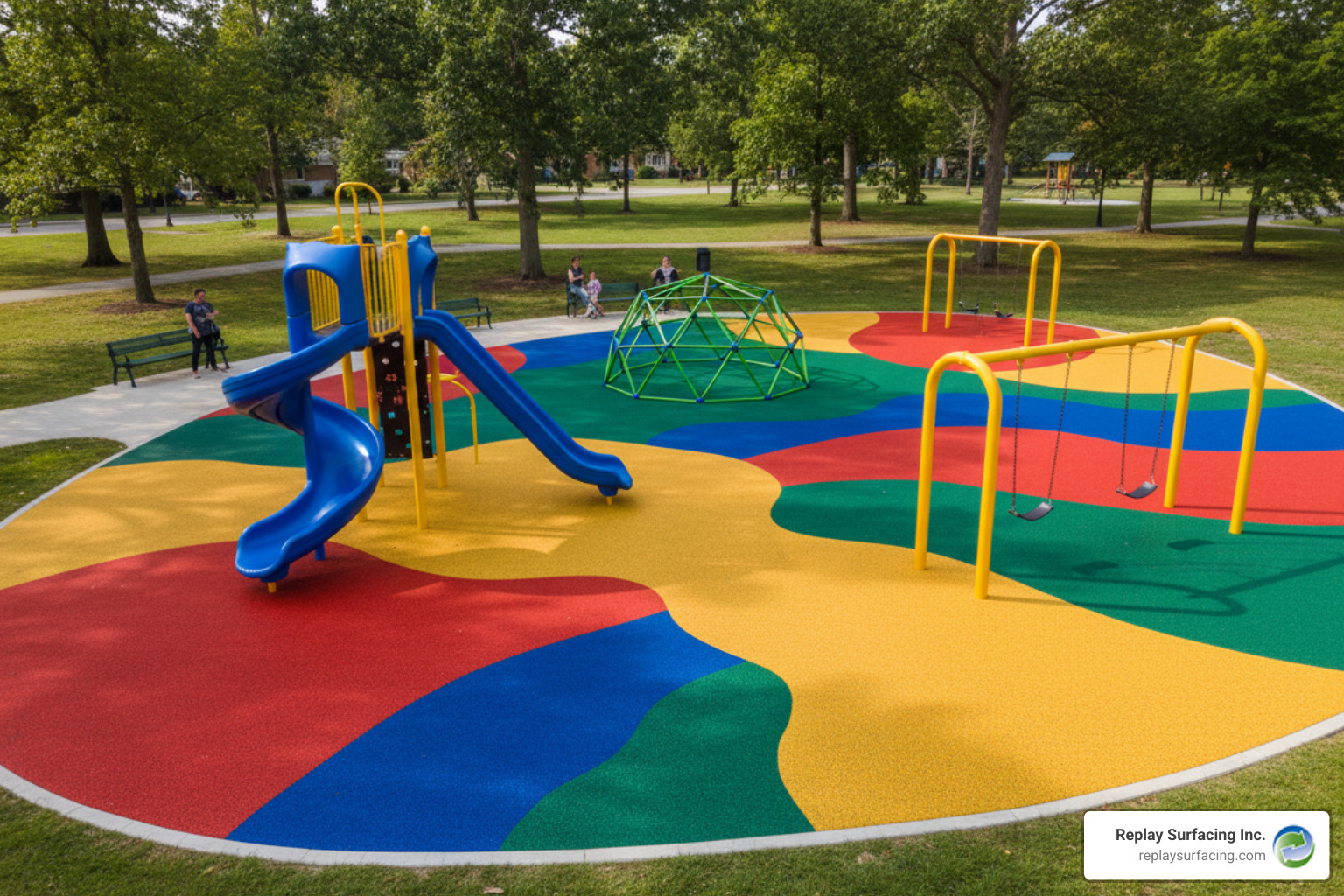
We specialize in several types of surfacing, each with its own set of benefits:
- Poured-in-Place (PIP) Rubber: The “Cadillac” of playground surfacing.
- Interlocking Rubber Tiles: Great for DIYers and modular needs.
- Rubber Mulch: A cost-effective, loose-fill option.
For a deeper dive into these options, see our pages on poured-in-place rubber surfacing and recycled rubber mulch.
Poured-in-Place (PIP) Rubber
Poured-in-place rubber is a dual-layer system. The bottom layer, or “cushion layer,” is typically made of thick, recycled SBR (Styrene-Butadiene Rubber) shreds. The top “wear layer” consists of colorful EPDM (Ethylene Propylene Diene Monomer) granules mixed with a high-quality polyurethane binder.
The result is a seamless, “unitary” surface that can be customized with logos, hopscotch grids, or vibrant patterns. It’s particularly popular in commercial settings in Charlotte, NC, because it requires very little daily maintenance. Explore PIP options for your project to see how custom designs can bring your playground to life.
Interlocking Rubber Tiles
If you’re looking for something a bit more DIY-friendly, interlocking tiles are a fantastic choice. These are often 24″ x 24″ squares that snap together using a dowel or “quad block” system. They are perfect for residential backyards in Sanford, NC, or smaller daycare centers.
Tiles like our Jamboree or Eco-Safety models are rated for specific fall heights (usually 6 to 8 feet). The beauty of tiles is that if one gets damaged, you can simply pop it out and replace it without resurfacing the entire playground. Read our interlocking playground mats ultimate guide for installation tips.
Recycled Rubber Mulch and Mats
For those who prefer the look of traditional mulch but hate the splinters and constant raking, recycled rubber mulch is the answer. It doesn’t rot, it doesn’t attract pests, and it stays in place much better than wood chips.
We also highly recommend heavy-duty rubber mats for “high-wear” areas. Think about the bottom of a slide or under a swing set—these are the spots where kids’ feet constantly dig holes in loose-fill surfacing. Placing a playground mat in these zones prevents “pitting” and ensures consistent safety. Check out our recommendations for the best rubber mulch for playgrounds.
Safety Standards and Fall Height Ratings
Understanding fall height ratings is the most important part of your research. A “critical fall height” is the highest point from which a child can fall onto a surface without sustaining a life-threatening injury.
Most commercial playgrounds require at least a 6-foot fall height rating, but some high-reaching equipment might require protection for up to 8 or 10 feet. We ensure our products meet the ASTM F1292-09 impact attenuation standards. Understanding fall height requirements is vital before you make a purchase.
Residential vs. Commercial Requirements
There is a big difference between a small backyard swing set and a massive public park structure.
- Residential: Usually requires 1.5 to 2 feet of protection for smaller sets, though many parents opt for 6-foot rated tiles for extra peace of mind.
- Commercial: Schools and parks in cities like Raleigh and Nashville must adhere to strict 6-foot (or higher) standards to meet insurance and safety codes.
You can learn more about these distinctions on our playground surfacing page.
Choosing the Right Thickness
Thickness equals protection. It’s a simple rule of thumb.
- 1-inch tiles: Generally rated for a 4-foot fall.
- 2.5-inch tiles: Generally rated for a 6-foot fall.
- 3.5-inch+ tiles: Can protect up to 8 or 10 feet.
If you are installing over a hard surface like concrete or asphalt, you will need thicker material than if you were installing over a compacted stone base. For a complete breakdown, see our best playground flooring ultimate guide.
Installation, Maintenance, and Comparisons
Whether you want to spend a Saturday doing it yourself or hire our professional crews in Charlotte or Tucson, we’ve got you covered.
Professional Installation of Playground Rubber Flooring Near Me
For poured-in-place rubber, professional installation is a must. The process involves precise mixing of rubber granules and binders, followed by a hand-troweled application that ensures a smooth, even finish.
Professional installers also handle the “dirty work” of subfloor preparation. This might involve excavating dirt, laying a compacted gravel base, or ensuring proper drainage. In areas with high rainfall like Connecticut, drainage is key to preventing “buckling” or mold. Find your local professional installation services through our contact page.
Long-Term Maintenance and Durability
One of the best things about playground rubber flooring near me is how little maintenance it needs.
- Cleaning: A leaf blower is usually all you need to remove debris. For a deeper clean, a garden hose and mild soap (like Dawn) work wonders.
- UV Resistance: Our EPDM top layers are designed to resist the harsh sun in Tucson and the fluctuating temperatures in Indiana.
- Avoid Solvents: Never use oil-based cleaners or harsh chemicals, as these can break down the polyurethane binders.
For more maintenance tips, visit our section on recycled rubber playground flooring.
Comparing Rubber to Traditional Materials
Why choose rubber over wood mulch or sand?
- No Splinters: Wood chips are notorious for causing painful splinters.
- Pest Control: Sand can become a giant litter box for local cats. Rubber is unappealing to animals.
- Longevity: Wood mulch rots and needs to be topped off every year. Rubber lasts for a decade or more.
- Accessibility: Rubber is wheelchair friendly; mulch is not.
The benefits of Replay Surfacing rubber go beyond just safety; they extend to the long-term value and usability of your space.
Frequently Asked Questions
Cost of Playground Rubber Flooring Near Me
Pricing varies based on the type of material and the depth required. From large-scale municipal projects in Lake Charles, Louisiana to residential upgrades in Beaverton, OR, we offer solutions for every budget.
- Rubber Mulch: Usually the most economical upfront.
- Tiles: Mid-range, with the added benefit of being DIY-friendly.
- Poured-in-Place: The highest upfront cost but offers the best longevity and lowest maintenance costs over time.
Think of it as an investment in safety and reduced labor. You can browse our playground mats for sale to get an idea of current pricing.
Can rubber flooring be used for indoor applications?
Absolutely! Our rubber tiles and rolls are frequently used in home gyms, daycare centers, and indoor play zones across Indiana and Connecticut. They are non-toxic and provide excellent sound insulation—perfect for keeping the noise of a basement gym from reaching the rest of the house. Learn more about our non-toxic playground tiles.
Is rubber surfacing eco-friendly?
Yes! At Replay Surfacing, our entire mission is built on sustainability. We take old tires—which are environmental hazards—and recycle them into high-quality surfacing. This keeps millions of tires out of landfills and gives them a second life protecting our children. Our EPDM rubber playground options can even help projects in cities like Nashville, TN earn LEED credits.
Conclusion
Choosing the right playground rubber flooring near me is about more than just picking a color. It’s about understanding the safety needs of your specific equipment and the environmental conditions of your local area—whether that’s the heat of Tucson, AZ or the seasonal changes in the Carolinas and Indiana.
At Replay Surfacing Inc., we are proud to offer sustainable, customizable, and incredibly durable solutions that turn recycled tires into safe havens for play. From Charlotte and Raleigh to Nashville and Lake Charles, we are here to help you build a playground that is as safe as it is fun.
Ready to start your project? Whether you are located in Sanford, NC, Columbia, SC, or Beaverton, OR, we are ready to assist. Get a professional quote today and let us help you create the perfect surface for your community.