Affordable Recycled Playground Surfacing in Raleigh, NC Starts With Total Cost
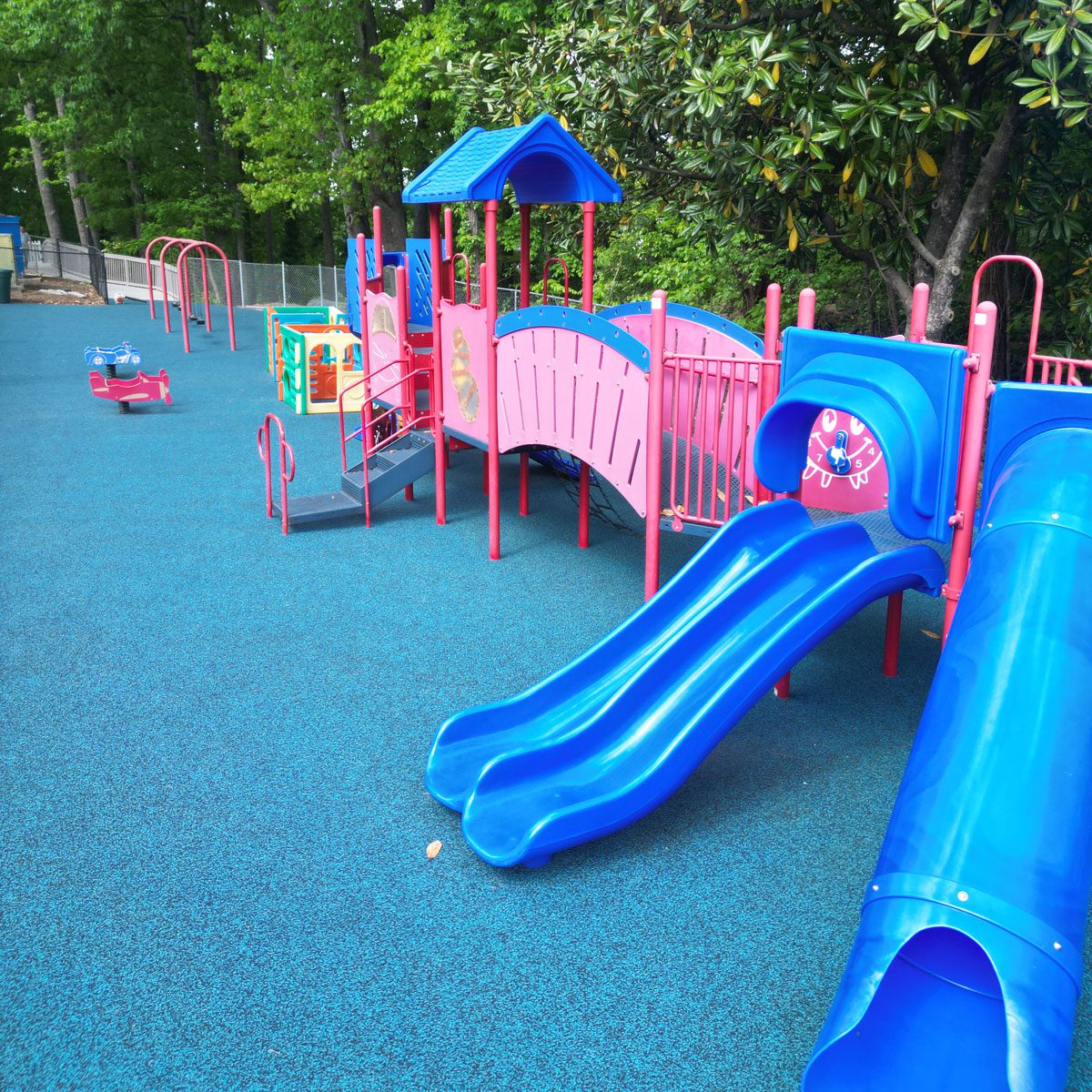
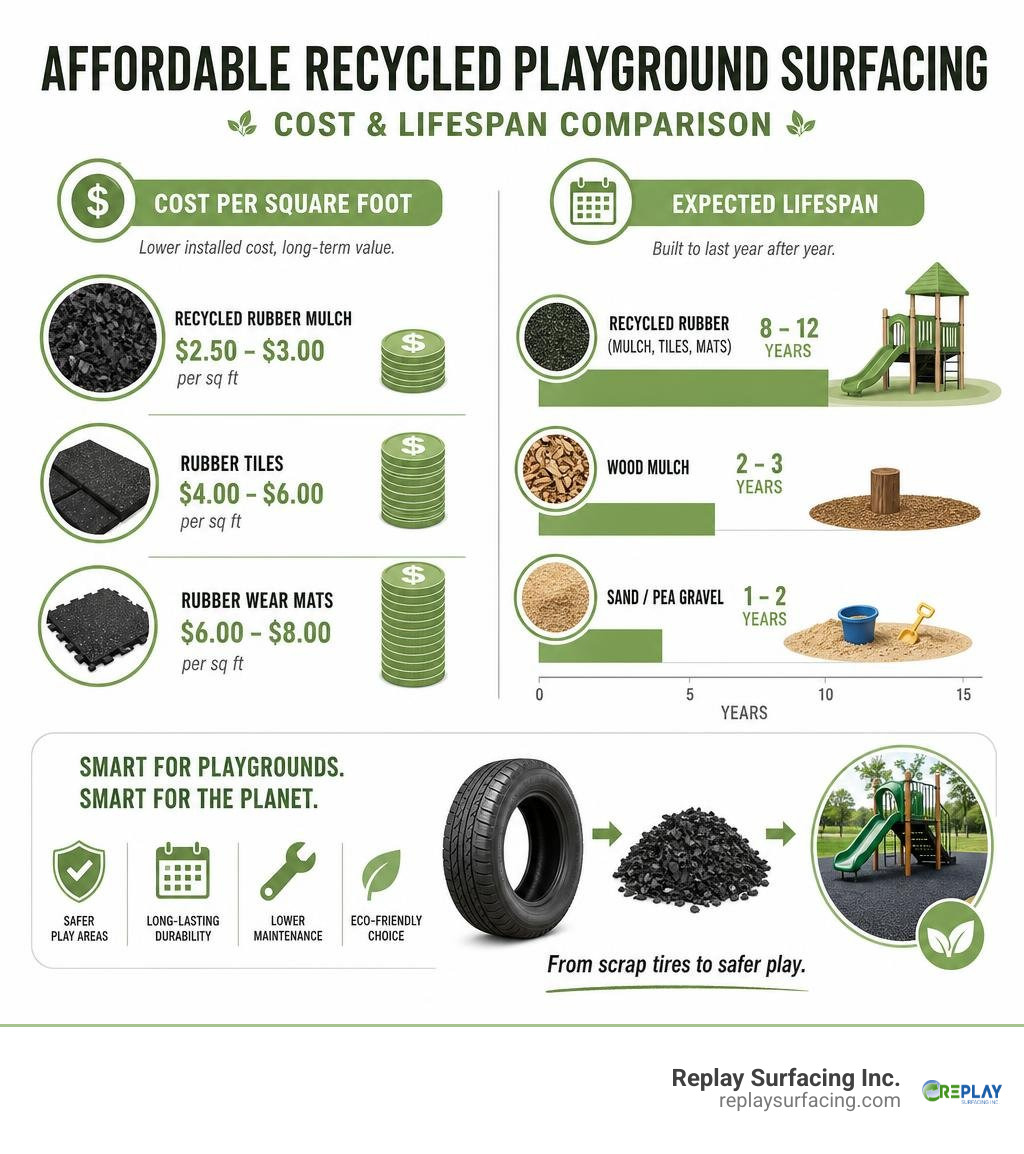
Affordable recycled playground surfacing in Raleigh, NC includes recycled rubber mulch, rubber tiles, and wear mats that help balance fall protection, durability, and budget. For most facilities, recycled rubber mulch is the lowest-cost tire-derived option at about $2.50 to $3.00 per square foot, while tiles and mats can be a practical upgrade for busy swing bays, slide exits, and other high-wear areas.
The key is to compare more than the purchase price. Organic loose-fill surfaces may cost less at installation, but they can lose 20% to 30% of their material each year through displacement and decomposition. Recycled rubber does not decompose, resists insects, and can retain its structure and color for roughly 8 to 12 years with routine care.
For eco-conscious facility managers across Raleigh and our regional service areas, that means fewer replacement deliveries, less downtime, and a useful second life for scrap tires. The best value often comes from matching the surface to the play zone, equipment fall height, drainage needs, and accessibility goals.
I am Landon Olson, a mechanical engineer and MBA with experience in manufacturing, sustainability, and safety surfacing. At Replay Surfacing Inc., I help turn scrap tires into durable products and evaluate affordable recycled playground surfacing in Raleigh, NC through the practical lens of safety, maintenance, and long-term cost.
Easy affordable recycled playground surfacing glossary:
- eco-friendly rubber playground mats
- non-toxic playground tiles
- sustainable playground surfaces Beaverton
Comparing Top Options for Affordable Recycled Playground Surfacing
When evaluating options for affordable recycled playground surfacing, decision-makers often look at how unitized flooring (such as rubber tiles) compares to loose-fill materials (such as recycled rubber mulch or engineered wood fiber). Every surface material presents distinct advantages depending on whether your primary constraint is upfront budget, long-term labor, or critical fall height compliance.
Below is a breakdown comparing common budget-friendly surface materials used across schools, parks, and daycares in our regional locations, including Raleigh, NC, Columbia, SC, and Tucson, AZ:
| Surface Material Type | Average Installed Cost (per sq. ft.) | Expected Lifespan | Fall Protection (at standard depth) | Maintenance Level | Material Loss Rate |
|---|---|---|---|---|---|
| Engineered Wood Fiber (EWF) | $1.50 – $2.50 | 3 – 5 years | Good (requires 9–12 inches) | High (raking & frequent top-ups) | 20% – 30% annually |
| Recycled Rubber Mulch | $2.50 – $3.00 | 8 – 12 years | Excellent (cushions up to 12 ft) | Low to Medium (occasional raking) | Near 0% decomposition |
| Interlocking Rubber Tiles | $8.00 – $14.00 | 10 – 15+ years | Excellent (rated by tile thickness) | Low (sweeping & spot washing) | 0% displacement |
| Poured-in-Place Rubber (PIP) | $12.00 – $18.00 | 10 – 15+ years | Premium continuous cushioning | Low (sweeping & re-topping) | 0% displacement |
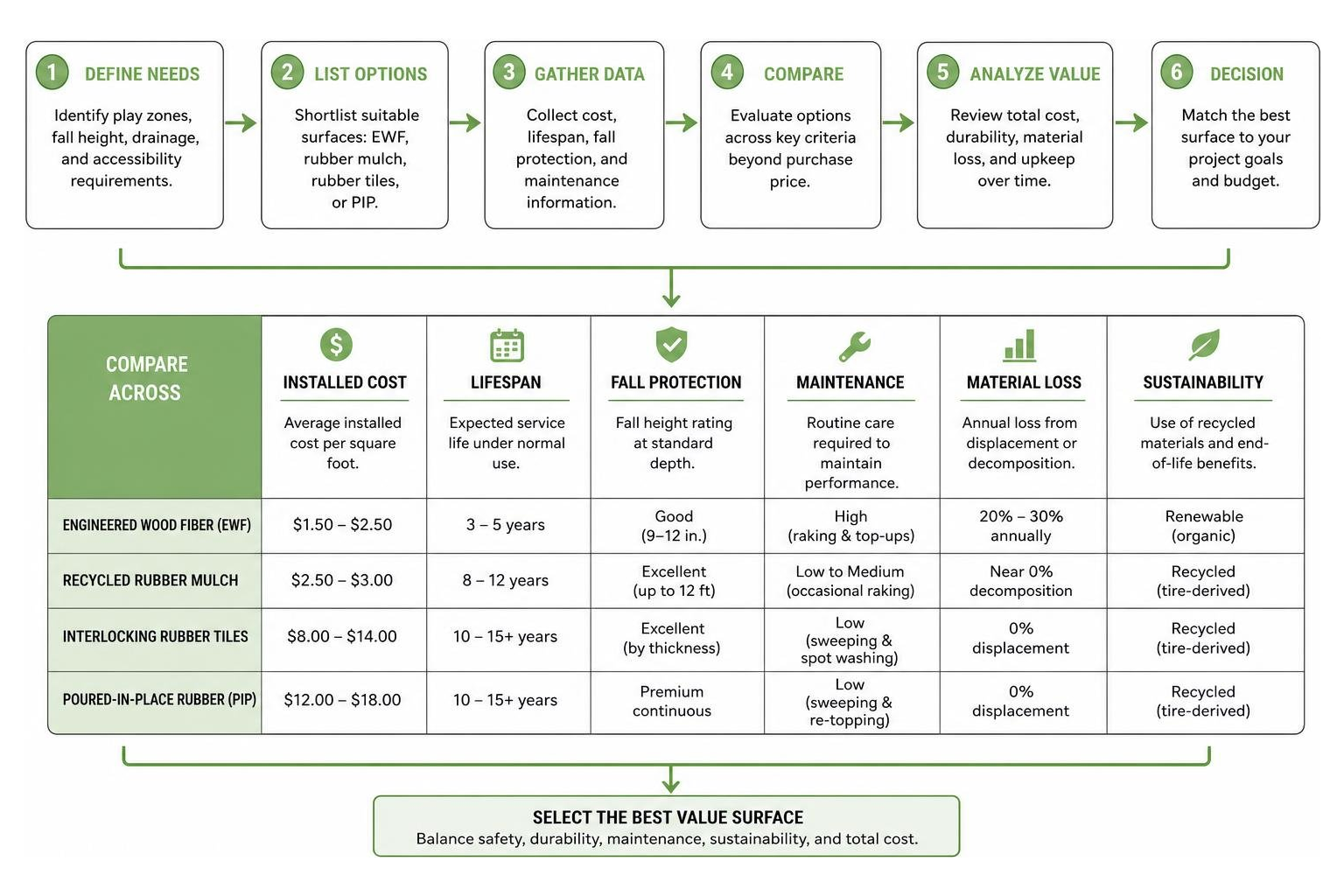
Understanding these baseline figures helps buyers evaluate how affordable recycled playground surfacing performs over time rather than simply choosing whatever product looks cheapest on day one.
Recycled Rubber Mulch: An Affordable Recycled Playground Surfacing Loose-Fill Choice
For project managers seeking low initial material expenses combined with extended durability, recycled rubber mulch is an ideal entry point. Our Best Recycled Rubber Playground Mulch Guide highlights how shredded scrap tires are processed to strip out wire and metal contaminants, leaving behind smooth, resilient rubber nuggets.
Unlike organic bark or engineered wood fiber (EWF), rubber mulch does not decompose, rot, or harbor insects. In humid climates such as Sanford, NC, or Lake Charles, LA, organic wood chips break down rapidly when exposed to rain and soil microbes. This decomposition forces municipalities to order heavy top-ups every 12 to 18 months. Recycled rubber mulch, on the other hand, maintains its volume and color intact for 8 to 12 years.
From a critical fall height safety perspective, loose rubber mulch delivers exceptional shock attenuation. Maintaining a 6-inch depth of loose-fill rubber mulch can cushion falls from equipment heights up to 10 to 12 feet, significantly outperforming standard wood chips at equivalent depths. Because rubber nuggets do not absorb water, they do not freeze into solid chunks during winter months in northern regions like Connecticut or Indiana, preserving shock-absorbing protection year-round.
Interlocking Rubber Tiles: Affordable Recycled Playground Surfacing for High-Impact Zones
While loose-fill rubber mulch offers a lower upfront cost per square foot, certain high-activity zones benefit from unitized surfaces. Our Recycled Rubber Playground Flooring line features solid interlocking rubber tiles designed specifically to withstand relentless foot traffic beneath swing sets, slide exits, and spinning equipment.
In heavy-use public parks in Nashville, TN, or Beaverton, OR, loose-fill materials are constantly kick-scuffed out of place by energetic children. When kids land at the base of a slide or pump their feet under a swing set, loose materials get pushed aside, leaving bare concrete or hard subbase exposed. This creates dangerous fall zones that require daily raking by maintenance personnel.
Interlocking rubber tiles and heavy-duty wear mats solve material displacement entirely. Manufactured from high-density recycled tire rubber, these interlocking tiles lock together securely using specialized pin systems or adhesive bonds. They provide consistent, fall-height-certified impact attenuation right where safety matters most, eliminating kick-outs without requiring staff to push mulch back into place every afternoon.
Initial Upfront Costs vs. Long-Term Maintenance Expenses

Focusing solely on purchase price can lead to hidden costs over a playground’s operational life. A true financial comparison requires calculating the Total Cost of Ownership (TCO) over a 5- to 10-year window.
Initial material costs for loose-fill engineered wood fiber appear low at $1.50 to $2.50 per square foot. However, loose organic materials suffer 20% to 30% material loss annually due to wind, rainwater runoff, drag-out on shoes, and biological decomposition. Over five years, buying 25% to 40% top-up loads, paying freight charges, and paying labor crews to spread new wood fiber quickly pushes the cumulative cost past that of durable tire-derived rubber.
Material Replacement and Annual Maintenance Costs
As detailed in our breakdown of Economical Playground Flooring Options and Costs, recycled rubber products minimize routine operational overhead. Because rubber is non-porous and chemically inert, it does not decay into dirt or foster weed growth from underneath.
Consider the five-year cumulative expenditure for a standard 2,000-square-foot playground area:
- Engineered Wood Fiber: Initial installation (~$4,000) + 4 years of 25% material top-ups and labor (~$4,800) + weekly raking labor (~$3,000) = $11,800 total 5-year investment.
- Recycled Rubber Mulch: Initial installation (~$5,500) + minimal top-ups for wind scatter (~$500) + occasional monthly raking (~$800) = $6,800 total 5-year investment.
By year three, recycled rubber mulch becomes the more economical choice. The long-term wear resistance of processed tire rubber protects municipal budgets across our installation regions, whether in Charlotte, NC, or Tucson, AZ.
Weather Resistance, Drainage, and ADA Accessibility Trade-Offs
When selecting affordable recycled playground surfacing, environmental factors and accessibility mandates play a crucial role. Our comprehensive Recycled Playground Surface Guide outlines how recycled tire compounds withstand aggressive weathering without breaking down.
In sun-drenched locations like Tucson, AZ, raw plastics and low-grade foams quickly degrade and crack under heavy UV exposure. Recycled tire rubber contains built-in industrial carbon black and UV-stabilized polyurethane binders, allowing it to withstand extreme sunlight and ambient temperatures without losing elasticity.
Drainage is another major operational factor. In areas prone to heavy rain, such as Lake Charles, LA, water-logged playgrounds can remain muddy and unusable for days. Recycled rubber mulch does not absorb water, allowing rainwater to drain quickly through the loose nuggets into the subbase. Kids can return to play almost immediately after a storm clears.
For Americans with Disabilities Act (ADA) compliance, solid rubber tiles offer a significant advantage over loose-fill surfaces. Wheelchairs, walkers, and strollers roll smoothly across unitized rubber tiles, whereas loose-fill materials require careful compaction and maintenance to maintain an accessible route to play components.
Cost-Effective Installation and Smart Material Strategies
Achieving true affordability requires smart site prep and efficient material layout. Skipping proper installation practices to save a few dollars upfront often leads to rutting, pooling water, and premature surface failure.

A solid installation starts with subbase preparation. Whether installing loose rubber mulch or unitized tiles, laying down 3 to 4 inches of compacted crushed stone aggregate over a geotextile weed barrier creates a level, fast-draining foundation. This prevents soil intrusion and keeps your recycled rubber clean and firmly supported for years to come.
Zone-Based Material Selection to Optimize Budget
One of the most effective strategies for stretching a playground budget is hybrid or zone-based material selection, as explained in our guide to Understanding Rubber Playground Surfacing Costs.
Rather than using expensive pour-in-place rubber across an entire footprint, facility managers can combine materials based on local traffic patterns and wear levels:
- High-Impact Zones (Swings, Slide Landings, Merry-Go-Rounds): Install heavy-duty interlocking rubber tiles or solid rubber wear mats. These fixed rubber mats absorb hard impacts and eliminate gouging where feet land repeatedly.
- General Play Areas & Walkways: Fill the surrounding open play zones with recycled rubber mulch. This delivers cost-effective fall protection at a fraction of the cost per square foot compared to full-pour rubber surfaces.
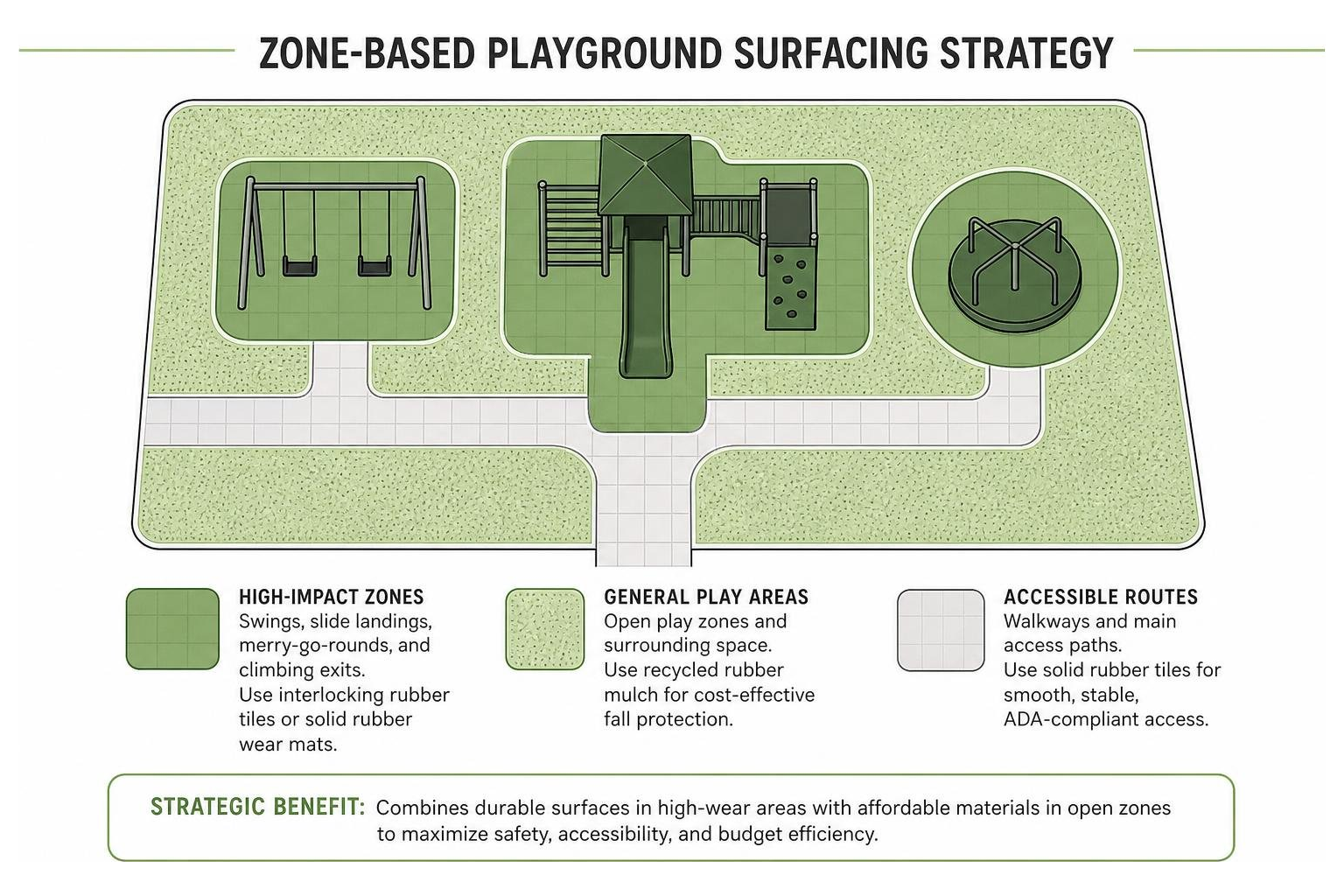
This hybrid setup keeps overall installation costs within tight municipal budgets while providing maximum durability where wear and tear are highest.
DIY vs. Professional Installation Cost Factors
Deciding between DIY setup and professional installation comes down to project scope, safety standards, and regional labor resources across our service areas—from Columbia, SC, to Beaverton, OR, and throughout Connecticut and Indiana.
- Loose-Fill Rubber Mulch (DIY Friendly): Volunteer groups, school PTA committees, or park staff can handle loose rubber mulch installations. Once the excavation, geotextile fabric, and subbase are ready, crews simply dump, rake, and level the rubber mulch nuggets to the specified safety depth. This saves on commercial installation labor costs.
- Rubber Tiles and Poured Surfaces (Professional Recommended): Interlocking rubber tiles require a flat, precisely compacted base to prevent tripping hazards along seam edges. Professional installation teams ensure subbase precision, proper edge anchoring, and full fall-height compliance.
Buying materials in bulk during off-peak winter months is another proven strategy for locking in lower freight and supplier pricing before spring installation rushes begin.
Frequently Asked Questions About Budget Playground Surfaces
What is the cheapest playground surface material to install?
Engineered wood fiber (EWF), sand, and pea gravel feature the lowest initial purchase prices, typically ranging from $1.50 to $2.50 per square foot installed. However, when factoring in annual material loss (20% to 30% per year from displacement and rot), frequent raking, and weed control, recycled rubber mulch ($2.50 to $3.00 per square foot) often proves cheaper within 3 to 4 years due to its 8- to 12-year lifespan and minimal replacement needs.
How thick does recycled rubber surfacing need to be for fall safety standards?
Under ASTM International safety standards for critical fall height compliance, loose-fill recycled rubber mulch is typically installed at a compacted depth of 6 inches to protect against fall heights up to 10 to 12 feet. Interlocking rubber tiles feature engineered thickness ratings (ranging from 1.75 inches to 3.25 inches or more) designed to match specific fall height requirements of elevated play decks and climbing structures.
Are recycled rubber playground surfaces non-toxic and environmentally safe?
Yes. High-quality tire-derived playground surfacing undergoes rigorous processing to remove steel belts, fibers, and contaminants. Non-toxic color coatings and binders encapsulate the rubber granules, locking in pigments and keeping the surface clean. Recycled tire rubber does not leach harmful contaminants into local soil or water tables, making it a safe, eco-friendly surface choice for parks, schools, and daycare facilities.
Conclusion
Choosing affordable recycled playground surfacing is about looking beyond the initial purchase price to find a surface that provides long-term durability, fall safety, and easy maintenance. By transforming scrap tires into high-performance safety surfacing, Replay Surfacing Inc. helps communities, schools, and parks turn environmental waste into durable play areas.
Whether managing a municipal park in Charlotte, NC, upgrading a elementary school play yard in Raleigh, NC, or designing a community play space in Sanford, NC, Columbia, SC, Tucson, AZ, Connecticut, Indiana, Nashville, TN, Beaverton, OR, or Lake Charles, LA, our team provides tailored support, site calculations, and regional installation guidance.
Ready to build a safer, more sustainable play area that fits your budget? Explore Sustainable Playground Surfacing Solutions with Replay Surfacing Inc. today and request a custom quote for your upcoming project.