
Top Sustainable Playground Surfaces Beaverton Options
When we talk about sustainable playground surfaces Beaverton communities can rely on, we aren’t just talking about “green” labels. We are talking about high-performance materials that solve real-world problems. In Beaverton, our projects often center on three primary categories of sustainable surfacing: poured-in-place rubber, bonded rubber, and synthetic grass.
Poured-in-Place Rubber (PIP)
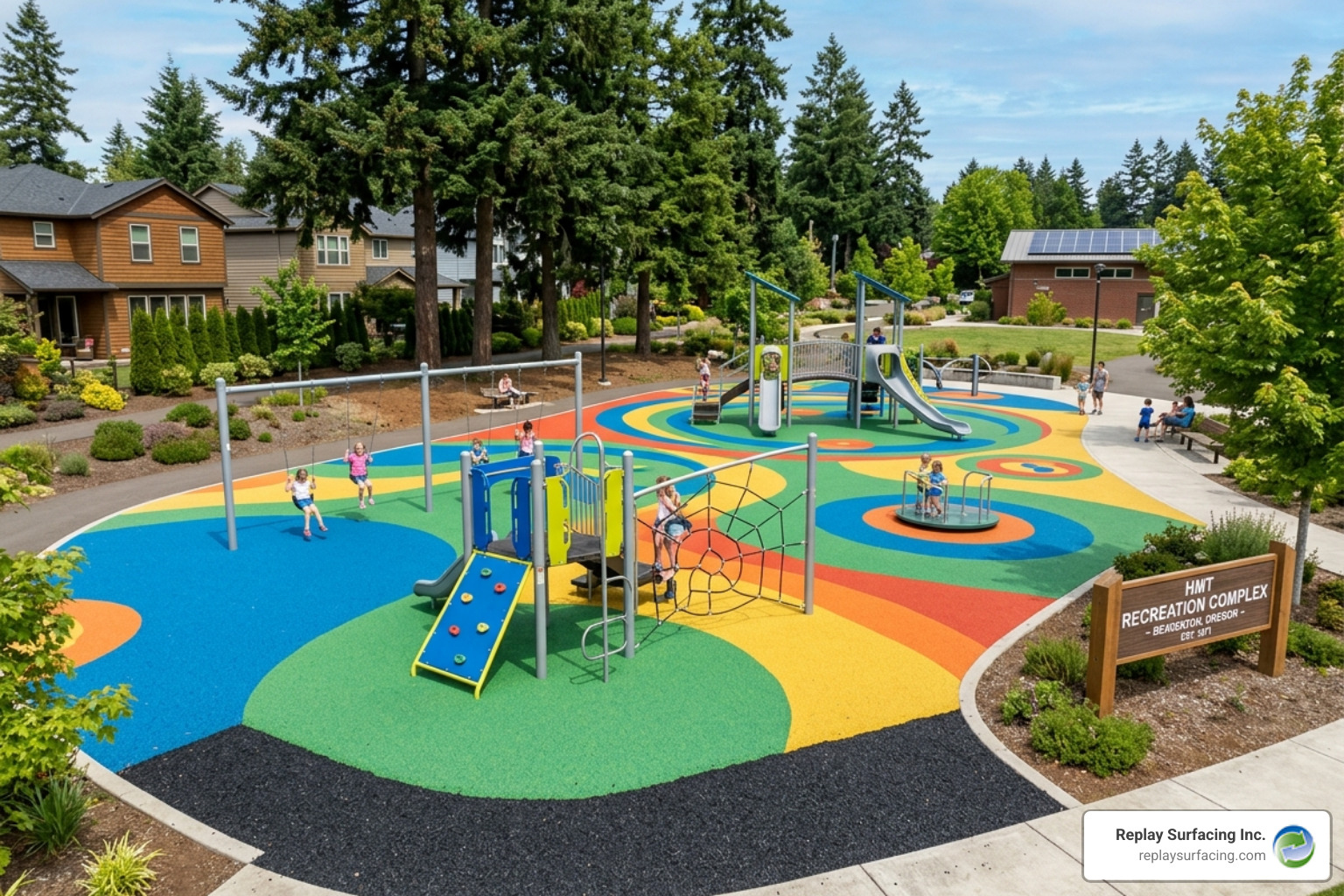
This is the gold standard for modern play areas. It consists of two layers: a base layer of thick, shock-absorbing recycled tire rubber and a top wear layer of colorful EPDM granules or Nike Grind materials. Because it is mixed and “poured” on-site, it creates a seamless, unitary surface that is perfect for wheelchairs and strollers. It’s a top-tier choice for rubber flooring playground surfaces because it stays exactly where you put it—no kicking mulch onto the sidewalk.
Bonded Rubber and Rubber Mulch
For those who prefer a more natural look but want the longevity of recycled materials, bonded rubber is an excellent middle ground. It consists of recycled rubber “nuggets” that are bound together with a specialized polyurethane adhesive. If you are looking for a loose-fill option that provides incredible impact protection, we also offer rubber mulch by the yard. Unlike wood mulch, rubber mulch doesn’t rot, compress, or attract pests like termites.
Nike Grind Integration
Beaverton is famously the home of Nike, and we take great pride in incorporating Nike Grind into our surfacing projects. Nike Grind is composed of recycled athletic footwear and manufacturing scraps. By using these materials, we aren’t just building a playground; we are participating in a local circular economy that keeps shoes out of the landfill and under the feet of playing children.
Benefits of Recycled Rubber for Sustainable Playground Surfaces Beaverton
The environmental math behind recycled rubber is staggering. Discarded tires are a significant environmental hazard; they don’t biodegrade and can become breeding grounds for mosquitoes or fuel for difficult-to-extinguish fires. When we transform these tires into playground flooring, we are giving them a second life that lasts decades.
According to our recycled tires playgrounds guide, using recycled rubber supports a circular economy where waste is viewed as a valuable resource. Beyond the eco-credentials, the safety benefits are backed by scientific research on playground safety standards. Recycled rubber provides superior impact absorption compared to dirt, grass, or asphalt. In fact, falls account for over 70% of playground-related injuries, making these energy-dispersing surfaces a literal lifesaver.
Synthetic Grass and Low-Maintenance Alternatives
In areas where a natural “park” aesthetic is required, artificial turf is a fantastic sustainable alternative. Modern synthetic grass options, like those used in premium artificial playground turf, eliminate the need for gas-powered mowing, chemical fertilizers, and thousands of gallons of water.
For Beaverton schools and childcare centers, we often recommend turf with anti-microbial infill. This keeps the surface hygienic and pet-friendly. It also solves the “Oregon mud” problem. While natural grass turns into a swampy mess by November, synthetic turf stays lush, green, and—most importantly—dry enough for play all year round.
Safety Standards and Climate Resilience in Oregon
In our industry, “sustainable” must also mean “safe.” A surface that falls apart after two years isn’t sustainable for your budget or the environment. That’s why we ensure all our sustainable playground surfaces Beaverton installations meet or exceed the most stringent national standards.
- ASTM F1292: This is the benchmark for impact attenuation. Our surfaces are tested for critical fall heights up to 12 feet (and sometimes higher with specialized base layers), ensuring that if a child falls, the surface absorbs the energy—not the child’s head or limbs.
- IPEMA Certification: This third-party certification ensures that our products consistently meet safety and quality specifications.
- ADA Compliance: Accessibility is a core tenet of sustainability. A playground isn’t sustainable if it excludes members of the community. Unitary surfaces like poured-in-place rubber meet ASTM F1951 standards for wheelchair maneuverability.
We focus heavily on shock absorbing playground surfaces because the data shows that every “minor” bump to the head can have a cumulative effect. By choosing high-quality rubber, you are investing in the long-term neurological health of the children in your community.
Comparison of Common Playground Materials
| Material Type | Sustainability | Fall Height Protection | Maintenance Level | Lifespan |
|---|---|---|---|---|
| Poured-in-Place Rubber | High (Recycled content) | Excellent (Adjustable) | Very Low | 10–20+ Years |
| Rubber Mulch | High (100% Recycled) | Best (Up to 16ft) | Low | 20 Years |
| Engineered Wood Fiber | Medium (Natural) | Good (when deep) | High | 3–5 Years |
| Synthetic Turf | Medium | Excellent (with pads) | Low | 8–12 Years |
| Sand/Gravel | Low | Poor (compacts) | High | N/A |
Weather-Ready Sustainable Playground Surfaces Beaverton
Beaverton’s climate presents unique challenges. We have wet, bone-chilling winters and surprisingly hot, dry summers. A surface that works in Arizona might crack in Oregon, and vice versa.
Our rubber surfacing is designed to be porous. This is critical for the Pacific Northwest. Instead of water pooling on the surface and creating a slipping hazard (or a muddy mess), rain drains directly through the material into the sub-base. This allows play to resume almost immediately after a downpour.
Furthermore, we use UV-resistant binders and EPDM top layers that reflect heat better than traditional asphalt. While any surface can get warm in direct July sunlight, our materials don’t retain heat the way darker, non-porous materials do. For more details on choosing the right material for your specific climate, check out our eco safety rubber playground surfacing guide. Similar high-performance playground surfacing solutions are used in regions where freeze-thaw cycles and heavy precipitation are also a factor.
Customization for Beaverton Community Aesthetics
Sustainability doesn’t have to look boring. In fact, one of the best ways to foster community “ownership” of a park is through custom design. We can incorporate school logos, vibrant geometric patterns, or even “nature-themed” colors like forest greens and river blues to match the Oregon landscape.
Using our green playground mats guide, many Beaverton facility managers have designed playgrounds that look like an extension of the natural environment while providing the safety of modern technology. Whether it’s a “lava” floor for a themed play area or a professional-looking sports court, the customization options are nearly limitless.
Long-Term Value and Environmental Impact
When evaluating sustainable playground surfaces Beaverton buyers often look at the initial price tag. However, the true cost of a playground surface is measured over 10 to 20 years.
Cost Savings and Lifecycle
While engineered wood fiber (EWF) or wood chips have a lower upfront cost, they are “loose-fill” materials. They blow away, they rot, and they get kicked out of high-traffic areas under swings. To maintain safety standards, you have to “top them off” every year and completely replace them every few years.
In contrast, recycled rubber surfaces—while requiring a higher initial investment—often pay for themselves within 7 to 10 years through reduced maintenance costs. There is no mowing, no weeding, no annual mulching, and no professional “raking” required. For a detailed breakdown of these costs, see our playground rubber flooring price complete guide.
Comparing Engineered Wood Fiber and Rubber
Engineered Wood Fiber is often touted as sustainable because it is a natural byproduct. Indeed, 93% of real trees (including Christmas trees from local Beaverton farms!) are recycled into mulch. However, in the rainy Tualatin Valley, EWF has a tendency to stay damp, which can lead to mold and fungi growth.
Rubber, on the other hand, is inorganic. It doesn’t provide a food source for bacteria or mold, and it doesn’t attract insects. When you look at the best playground ground cover, rubber consistently wins on durability and long-term safety in wet climates. By choosing sustainable construction materials, you are reducing the total volume of material that needs to be hauled to and from your site over the playground’s life.
The Installation Process in Beaverton
We know that closing a playground for construction is a headache for the community. Our installation process is designed to be as efficient as possible:
- Consultation & Design: We work with you to choose the right thickness and colors.
- Site Preparation: We ensure the sub-base (usually concrete, asphalt, or compacted stone) is level and has proper drainage.
- Mixing & Pouring: For poured in place rubber surfacing, we mix the granules and binder on-site and trowel it to a smooth finish.
- Curing: The surface typically needs 24–48 hours to cure, depending on Beaverton’s humidity.
- Final Inspection: We verify fall height compliance and hand over the keys to a brand-new, eco-friendly play space.
Frequently Asked Questions about Beaverton Playground Surfacing
How does recycled rubber handle Beaverton’s rainy weather?
It handles it beautifully! Because our poured-in-place and bonded rubber surfaces are porous, they act like a giant filter. Water drains through the surface rather than sitting on top. This prevents the “puddle effect” and keeps the surface slip-resistant even when wet. Similar high-drainage techniques are used for specialized playground surfacing projects to handle heavy rain cycles.
Are sustainable playground surfaces Beaverton options ADA compliant?
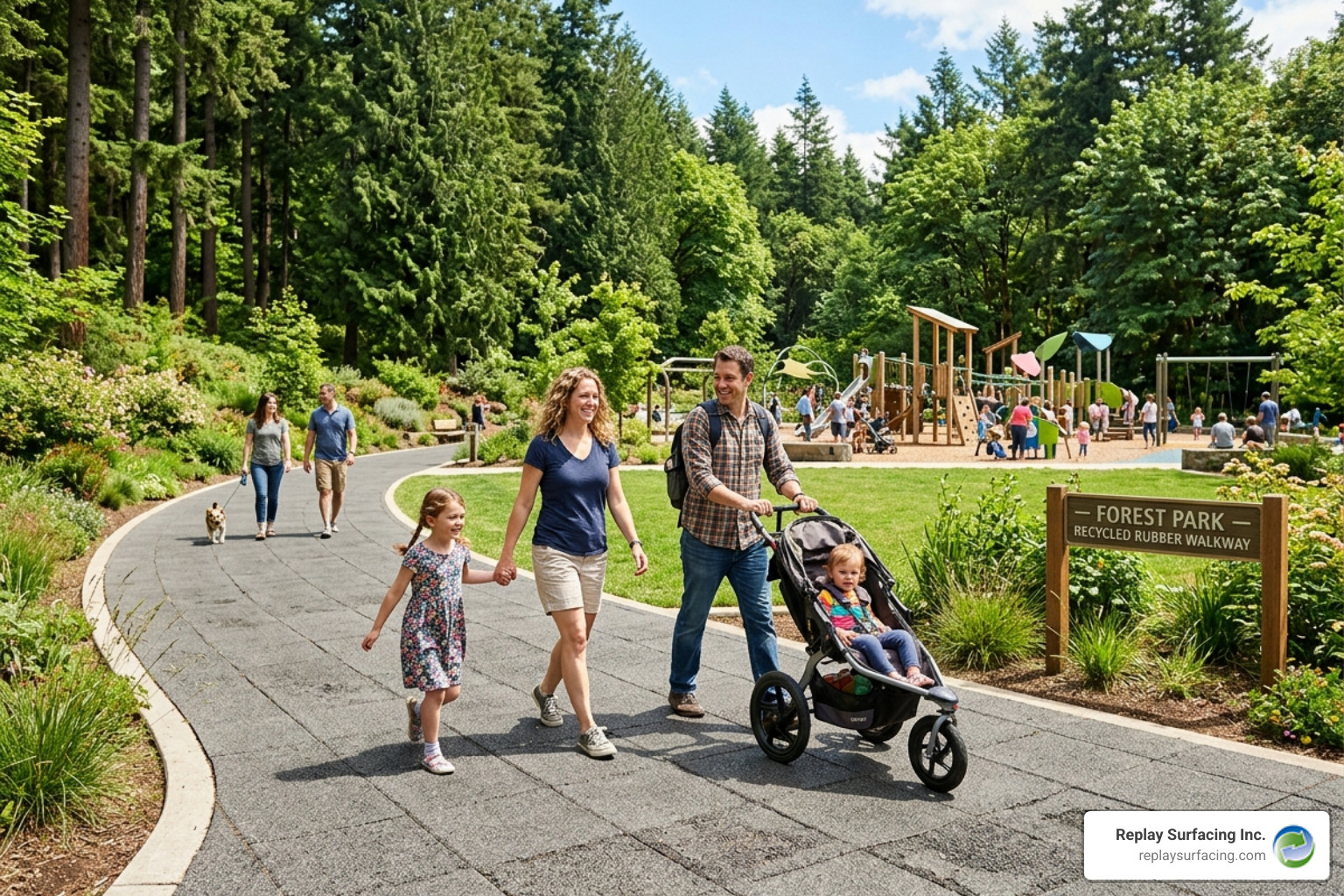
Yes. Accessibility is a primary reason many schools and parks switch to unitary rubber surfaces. Loose-fill materials like wood chips or sand are incredibly difficult for wheelchairs to navigate. Our poured-in-place rubber and recycled rubber walkways provide a firm, stable surface that allows children of all abilities to play together.
What is the typical lifespan of poured-in-place rubber?
On average, you can expect a high-quality installation to last 10 to 15 years, though many of our projects exceed 20 years with basic care. The lifespan depends on UV exposure and foot traffic. We use high-grade UV-stable binders to ensure the Oregon sun doesn’t make the surface brittle. For more tips on longevity, read our guide on poured in place rubber the ultimate playground safety surface.
Conclusion
Choosing sustainable playground surfaces Beaverton is about more than just checking a box for the environment; it’s about creating a legacy of safety and health for the next generation. By diverting tires from landfills and Nike shoes from the waste stream, we are building playgrounds that are as resilient as the kids who play on them.
At Replay Surfacing Inc., we are proud to serve the Beaverton community—from school districts to private HOAs. We believe that every child deserves a safe place to play, and every community deserves a surface that is easy to maintain and kind to the planet.
Are you ready to transform your play space today? Whether you are in Beaverton, Raleigh, or Tucson, we are here to help you design a playground that stands the test of time and weather. Let’s build something amazing together.