
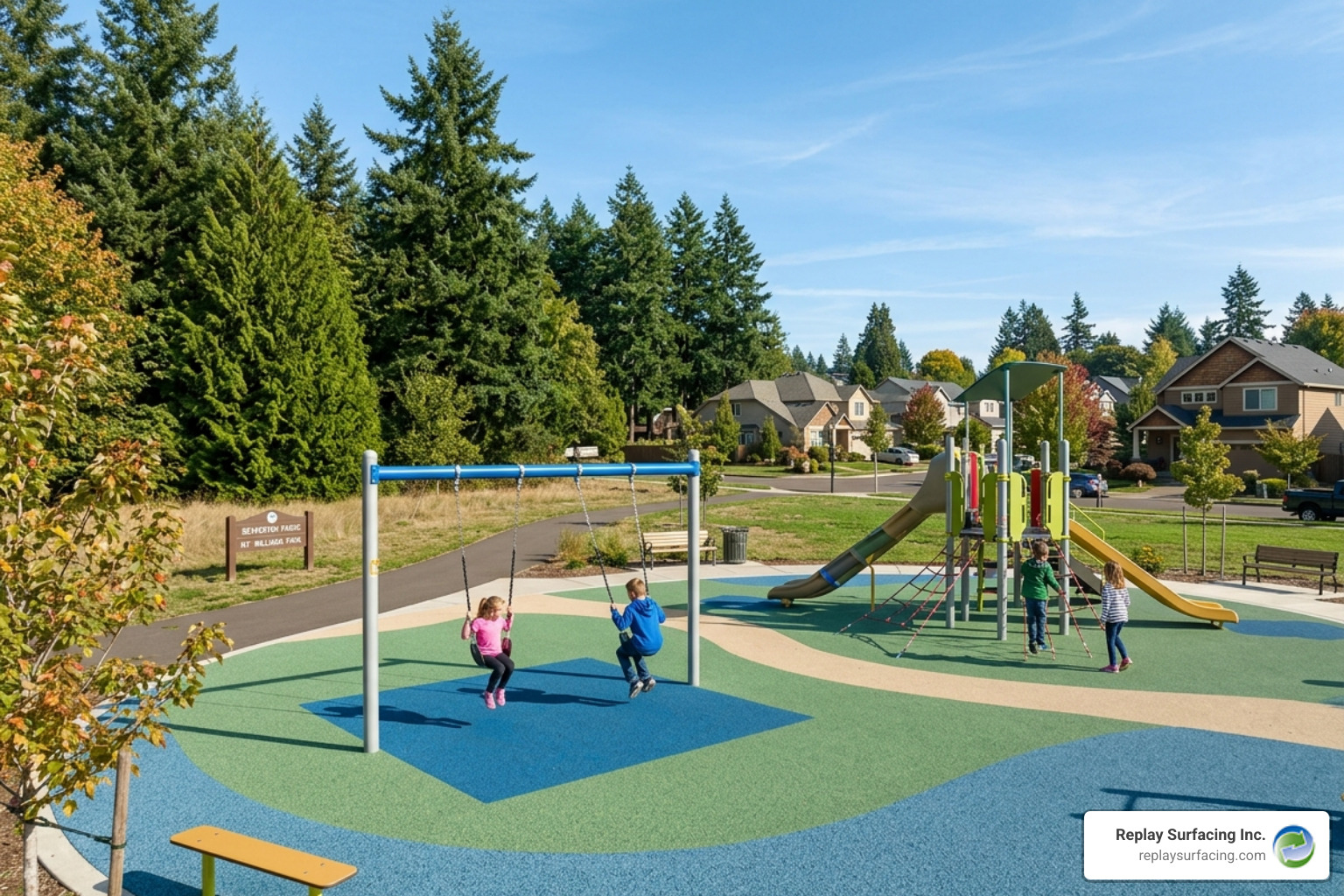
The Critical Role of Playground Surface Maintenance in Beaverton
Playground surface maintenance Beaverton is one of the most important — and most overlooked — responsibilities for anyone managing a local park, school, or community play area.
Here’s what Beaverton playground operators need to know right away:
- Inspect surfaces regularly — at minimum weekly, with professional annual assessments
- Maintain proper depth in loose-fill materials like rubber mulch or engineered wood fiber
- Repair cracks and worn areas in rubber surfaces promptly before they become hazards
- Ensure drainage is clear — especially critical in Beaverton’s rainy Pacific Northwest climate
- Document everything — inspections, repairs, and incidents — to reduce liability
The stakes are real. Every year, U.S. emergency departments treat more than 200,000 children ages 14 and under for playground-related injuries. 79% of those injuries result from falls to the surface. What’s more alarming: three in four playground accidents are linked directly to poor maintenance — meaning most of these injuries are preventable.
A playground surface that looked fine six months ago can quietly degrade into a safety risk. Weather, heavy use, vandalism, and simple age all take their toll faster than most people expect.
I’m Landon Olson, operator of Replay Surfacing and a mechanical engineer with an MBA, and I’ve spent my career applying sustainable engineering to playground surface maintenance challenges — including right here in the Beaverton area. In this guide, I’ll walk you through everything you need to keep your playground surfaces safe, compliant, and long-lasting.
When we talk about playground surface maintenance Beaverton, we aren’t just talking about aesthetics; we are talking about injury prevention. National safety statistics are sobering: out of the 200,000 annual emergency room visits, approximately 15% of playground-related injuries are classified as severe. Furthermore, 39% of these injuries involve fractures, and 22% are lacerations.
The primary job of a playground surface is “fall height attenuation.” This is a technical way of saying the surface must be soft enough to absorb the impact of a falling child. If a surface hardens due to neglect or loses its depth, it loses its ability to protect. We highly recommend reviewing our guide on Safety First Understanding Playground Surface Impact Standards to understand how these physics apply to your local equipment.
Local history shows us how quickly things can change. Take the Beaverton City Park as a case study. Following a major winter storm in January 2024, a tree fell on the play structure. During the recovery and installation of the new pirate-themed playground, the city initially used temporary bark chips. However, they recognized that for long-term safety and accessibility, a permanent safety flooring was required. This led to a scheduled 12-day closure in September to ensure the surfacing was installed and maintained to the highest standards. Resources like industry safety experts provide excellent industry frameworks for managing these types of transitions and ongoing safety audits.
Climate-Specific Playground Surface Maintenance in Beaverton Challenges
In Beaverton, our weather is our biggest maintenance adversary. The Pacific Northwest’s rainy climate creates a unique set of challenges that playground operators in drier climates, like Tucson, AZ, rarely face.
- Drainage and Standing Water: Constant rain can lead to pooling. If the sub-base wasn’t installed with proper sloping, water sits on or under the surface. For poured-in-place rubber, this can lead to delamination (the layers peeling apart).
- Moss and Algae Growth: The damp, shaded areas of Beaverton playgrounds are breeding grounds for moss. Not only does this look unappealing, but it creates a major slip hazard.
- UV Resistance: While we complain about the rain, our summers can be surprisingly hot. UV rays can cause rubber surfaces to become brittle and “chalky” if they aren’t treated with high-quality binders.
- Wet Winters: When moisture gets trapped in loose-fill materials like wood fiber and temperatures drop below 32°F, the material can freeze solid. A frozen playground surface is essentially concrete, offering zero fall protection.
For a deeper dive into how different materials handle these elements, check out our Soft Fall Rubber Flooring Complete Guide.
Implementing a Proactive Playground Surface Maintenance in Beaverton Program
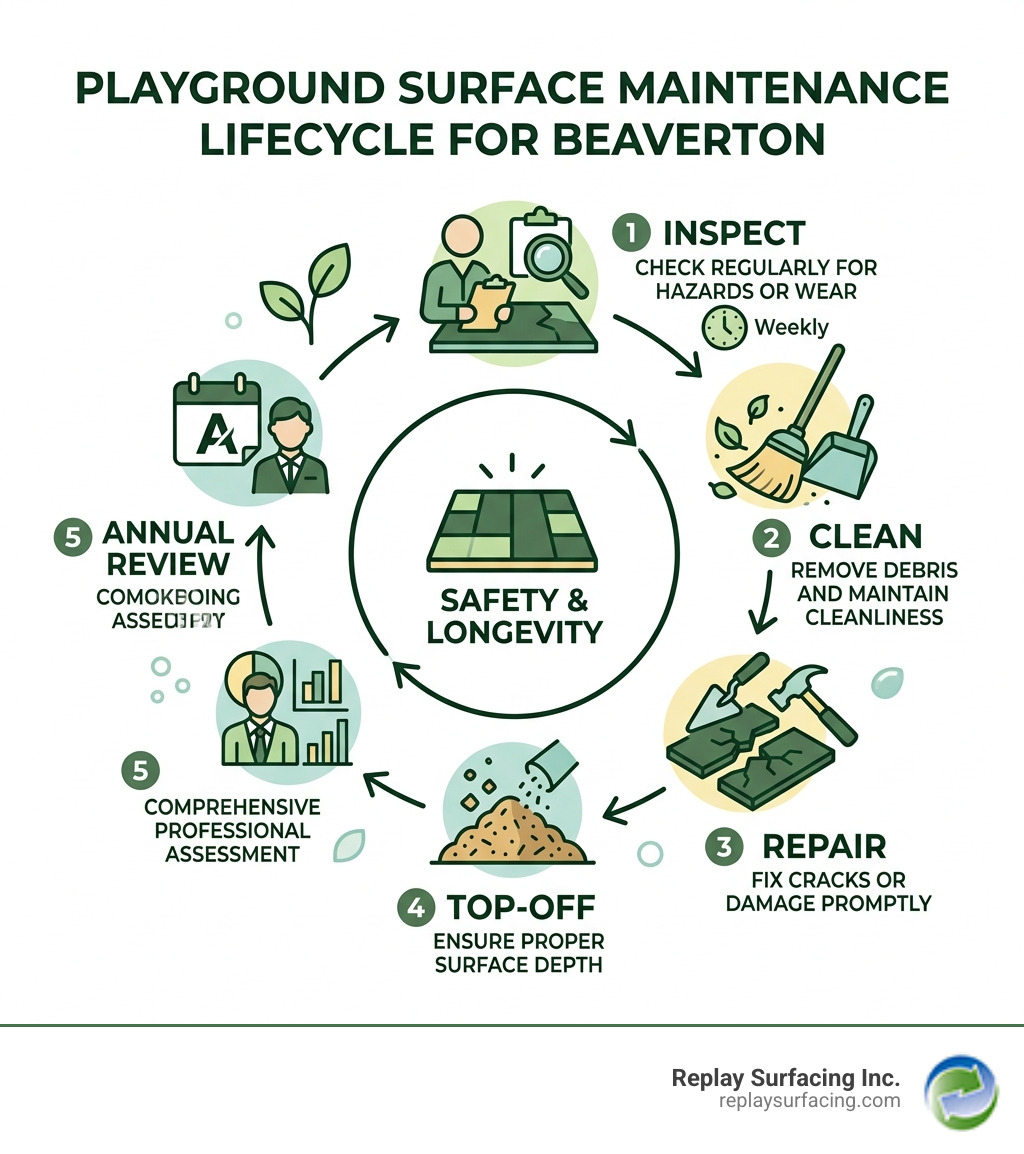
We advocate for a three-step maintenance program to reduce liability and prevent the need for costly full-scale renovations. This proactive approach is standard across various regions, from Nashville, TN to Connecticut.
- Step 1: Routine Maintenance: This includes daily or weekly visual checks. Are there foreign objects like glass or needles? Is there standing water?
- Step 2: Preventative Care: This involves scheduled tasks like pressure washing, moss removal, and applying UV-resistant roll coatings every 12 to 24 months to keep unitary surfaces flexible.
- Step 3: Renovation: When a surface shows signs of significant wear, such as large cracks or “pitting,” a professional repair or “cap” (adding a new top layer) is necessary to restore safety compliance.
Training is the backbone of this program. We recommend that Beaverton maintenance staff pursue NRPA (National Recreation and Park Association) certifications or CPSI (Certified Playground Safety Inspector) status. Having a certified expert on staff ensures that your playground surface maintenance Beaverton meets the rigorous Indiana playground surfacing standards and national benchmarks we follow.
Material-Specific Care and Repair Guidelines
Different surfaces require vastly different “TLC.” Whether you have a Soft Fall Playground or a more traditional wood-chip setup, your maintenance schedule should be tailored to the material.
Unitary Surfaces (Poured-in-Place, Tiles, Turf): These are seamless or interlocking systems that stay in place. They are generally more expensive upfront but offer superior ADA accessibility and lower daily maintenance. Learn more about Poured In Place Rubber The Ultimate Playground Safety Surface.
Loose-Fill Surfaces (Engineered Wood Fiber, Rubber Mulch): These consist of small, unattached particles. They are excellent for shock absorption but require constant “raking” to maintain proper depths in high-impact zones.
| Feature | Unitary (Rubber/Turf) | Loose-Fill (Mulch/EWF) |
|---|---|---|
| Primary Task | Cleaning & Coating | Raking & Topping Off |
| ADA Accessibility | Excellent | Poor to Fair |
| Drainage | Depends on Sub-base | Usually Excellent |
| Lifespan | 10–20 Years | 3–5 Years (EWF) / 20 Years (Rubber Mulch) |
| Climate Risk | UV & Delamination | Freezing & Compaction |
Cleaning and Repairing Unitary Surfaces
For surfaces like poured-in-place rubber or Installing Playground Tiles, cleanliness is safety.
- Pressure Washing: Use a pressure washer but keep it under 1,500 psi. Keep the nozzle at least 12 inches away from the surface to avoid “wand marks” or tearing the rubber granules.
- Debris Removal: Use a leaf blower or a vacuum to remove pine needles and grit. In Beaverton, organic debris left to rot on rubber will quickly turn into a soil layer that invites moss growth.
- Coating: Every 1-2 years, we recommend a “roll coat” or spray coating. This acts like a sunscreen for your playground, replenishing the binders that hold the rubber together and preventing the surface from becoming brittle.
- Patching: If you see a crack or a hole, don’t wait. Small DIY kits are available for minor repairs, but for larger areas, professional patching ensures the new rubber bonds correctly with the old.
Managing Loose-Fill Materials
Loose-fill isn’t “set it and forget it.” In fact, it often requires more frequent labor than rubber.
- The 12-Inch Rule: Most safety standards require at least 12 inches of loose-fill material to protect against falls from typical equipment heights. Over time, kids kick this material away from “kick zones” under swings and at the base of slides.
- Raking: Weekly raking is necessary to move material back into these high-traffic areas.
- Top-Offs: Engineered Wood Fiber (EWF) decomposes. You will likely need to “top off” the playground every year to maintain the required safety depth. Rubber mulch doesn’t decompose, making it a more sustainable long-term choice for Columbia, SC or Beaverton projects.
- Containment: Ensure your containment curbs are in good repair. If the mulch is spilling onto the sidewalk, your fall zone is no longer compliant.
Compliance with National Safety Standards
Compliance isn’t just about avoiding lawsuits; it’s about ensuring a child’s head is protected during a fall. We adhere to several critical standards:
- ASTM F1292: This is the “gold standard” for impact attenuation. It measures the G-max (shock) and Head Injury Criterion (HIC) of a surface.
- CPSC Guidelines: The Consumer Product Safety Commission provides the handbook for public playground safety, which we use as our primary reference for playground surface maintenance Beaverton.
- ADA Accessibility: Under the Americans with Disabilities Act, playground surfaces must allow for wheelchairs and those with mobility aids to navigate the space. Poured rubber and turf are the champions here, whereas loose-fill requires significant effort to remain compliant.
- IPEMA Certification: This third-party certification ensures that the products we use have been independently tested to meet safety claims.
For more details on how we measure success, read our guide on Safety First Understanding Playground Surface Impact Standards.
Inspection Checklists for Beaverton Operators
We recommend a tiered inspection approach to keep your site safe:
- Daily Visual Check: Look for “low spots” in mulch, broken glass, or evidence of vandalism.
- Weekly Hardware Audit: Check that wear mats are still secured. We often suggest Choosing The Best Mats For High Traffic Playground Areas to prevent the “trenching” that happens under swings.
- Monthly Depth Check: Use a probe to ensure your mulch is at the required 9-12 inch depth across the entire fall zone.
- Annual Professional Inspection: Once a year, have a professional team conduct a drop test to ensure the surface still meets ASTM impact standards.
Frequently Asked Questions about Playground Upkeep
What are the immediate signs of playground surfacing failure?
Look for “granule loss”—if you see loose rubber bits everywhere, the binder is failing. Cracking, especially near the edges, indicates shrinkage or sub-base movement. Fading is a sign of UV damage. Most importantly, if water is no longer draining and the surface feels “hard” or “slick,” it is failing. If you see these signs, consider an immediate closure until a repair can be made.
How long do different playground surfaces typically last in Oregon?
In our region, poured-in-place rubber typically lasts 10 to 15 years, though with excellent maintenance (like regular roll-coating), it can exceed 20. Rubber mulch is virtually permanent, often lasting 20+ years, though the color may fade. Engineered wood fiber has the shortest lifespan, often needing significant replacement or topping off every 3 to 5 years due to decomposition in our wet climate.
What certifications should maintenance staff hold?
At a minimum, staff should be trained on the specific manufacturer’s guidelines for the installed surface. However, we highly recommend the CPSI (Certified Playground Safety Inspector) certification offered by the NRPA. This is the industry standard and ensures your team understands the legal and safety nuances of playground management.
Conclusion
At Replay Surfacing, we believe that play is essential, but safety is non-negotiable. By recycling tires into sustainable, durable surfaces, we aren’t just cleaning up the environment; we are building a safer future for Beaverton’s children. Whether you are in Raleigh, NC, Sanford, NC, or right here in Oregon, the principles of playground surface maintenance Beaverton remain the same: inspect often, clean regularly, and repair promptly.
Proper maintenance isn’t just a cost; it’s an investment that extends the life of your playground by a decade or more, saving taxpayer and community dollars in the long run. If you’re unsure about the state of your current surface, don’t wait for an accident to happen.
Keep your Beaverton playground compliant and safe by contacting us for a professional consultation today. Let’s work together to keep our community’s play spaces “safe and sound” for years to come.