
Why Playground Surface Impact Testing Matters for Child Safety
Playground surface impact testing is the process of measuring how well a playground surface absorbs the force of a fall — and it’s one of the most important factors in preventing serious head injuries in children.
Here’s what you need to know at a glance:
- What it measures: How much force a surface transfers to a child’s head during a fall (GMAX) and the risk of brain injury from that impact (HIC)
- Key safety thresholds: GMAX must be 200 or lower; HIC must be 1,000 or lower (per ASTM F1292)
- Who sets the standards: ASTM International and the U.S. Consumer Product Safety Commission (CPSC)
- How it’s done: A weighted headform is dropped from a set height onto the surface; sensors record the impact data
- How often: At least once per year, and always after installation or major repairs
The numbers behind playground injuries are striking. The CPSC estimates over 200,000 children visit emergency rooms each year due to playground injuries — with falls to the surface being a leading cause. Among those, roughly 16,700 involve traumatic brain injuries (TBIs). These aren’t freak accidents. In many cases, they’re the result of surfaces that have degraded, were never properly tested, or simply weren’t up to standard.
A surface that looks fine can still transmit dangerous levels of force during a fall. That’s exactly why surface testing exists — and why it can’t be skipped.
I’m Landon Olson, operator of Replay Surfacing Inc., and with a background in mechanical engineering and years of hands-on experience in safety surfacing, I’ve seen how playground surface impact testing separates surfaces that truly protect children from those that only appear to. In the sections below, we’ll walk through everything you need to know — from the science behind GMAX and HIC, to the standards that govern testing, to what happens when a surface fails.

Basic playground surface impact testing vocab:
- rubber surfacing cost
- is rubber mulch a safe surface for your child’s playground
- eco safety rubber playground surfacing
The Critical Role of Playground Surface Impact Testing
When we talk about playground safety, we aren’t just talking about rounded corners on slides or sturdy railings. The most critical safety component is actually under a child’s feet. Impact attenuation—the ability of a surface to absorb energy—is the difference between a child bouncing back up after a tumble and a trip to the emergency room in Nashville or Charlotte.
Every year, over 210,000 children in the U.S. visit the ER for playground-related injuries. Statistics show that 15% of all injuries and 5% of surface-related injuries are to the head or face, including concussions, internal injuries, and fractures. By utilizing playground surface impact testing, we can quantify exactly how much protection a surface provides. This testing relies on the Standard Specification for Impact Attenuation of Surfacing Materials, which ensures that surfaces meet rigorous safety benchmarks. For those looking to dive deeper into the materials themselves, you can find more info about shock-absorbing playground surfaces to see how different options stack up.
Understanding GMAX and HIC in Playground Surface Impact Testing
To understand the data from a test, you have to know two acronyms: GMAX and HIC.
GMAX measures the maximum acceleration (shock) produced by an impact. Think of it as the “hardness” of the hit. In playground safety, the GMAX value must be 200 or lower. If a surface hits 200g, it is considered a failure because the force of the impact is high enough to cause life-threatening injuries.
HIC, or Head Injury Criterion, is a bit more complex. It measures the severity of the impact by looking at both the magnitude and the duration of the acceleration. It essentially predicts the likelihood of a head injury. The maximum acceptable HIC limit is 1,000. Any score above 1,000 indicates a significant risk of brain trauma.
You can VIEW TRIAX VIDEO HERE to see exactly how these measurements are captured in real-time using industry-standard equipment.
Field vs. Lab Procedures for Playground Surface Impact Testing
There is a big difference between testing a sample in a controlled laboratory and testing the actual ground at a park in Tucson or Raleigh.
- Lab Testing (ASTM F1292): This is usually done by manufacturers before a product hits the market. They test the material at three temperatures: 25°F, 72°F, and 120°F. This establishes the “Critical Fall Height”—the maximum height from which a child can fall and still be protected by the surface.
- Field Testing (ASTM F3313): This is where we come in. Field testing verifies that the surface, as installed and weathered, still performs. Environmental variables like humidity in Lake Charles or the dry heat in Arizona can change how a surface reacts.
On-site verification is the only way to know for sure if your “poured-in-place” (PIP) rubber is still doing its job after years of sun exposure. For more technical details on how these surfaces perform over time, check out more info about fall attenuation in PIP surfaces.
Regulatory Standards and Safety Compliance
Safety isn’t just a suggestion; it’s a regulated requirement. The CPSC provides clear guidelines for “use zones”—the area under and around equipment where a child is likely to land. Within these zones, the surface must meet the critical fall height requirements of the specific equipment installed.
The gold standard for these requirements is ASTM F1292-13. If you are a facility manager in Columbia or Nashville, staying compliant with these standards is your primary defense against liability. Furthermore, the F3313 Standard Test Method for Field Testing allows us to measure the dynamic performance of installed surfaces. When planning a budget for these safety measures, it helps to review more info about playground rubber flooring prices to balance cost with long-term compliance.
Equipment Used for Precise Measurement
We don’t just “guess” if a surface is soft enough by jumping on it. We use precision instruments designed to mimic a human head.
- Triax 2015: This is the industry-standard “ball drop” system. It uses an instrumented hemispherical headform (the “missile”) that is dropped from the equipment’s fall height.
- E-Missile: A specialized version of the headform equipped with a triaxial accelerometer.
- Accelerometer: This sensor inside the headform records the deceleration forces in “G” units.
- Data Logging: The system captures the impact pulse at a high sampling rate (at least 20 kHz) to ensure every millisecond of the impact is analyzed.
- Calibration: These tools must be calibrated every two years to ensure the data is legally defensible and accurate.
Evaluating Performance and Longevity of Compliant Rubber Surfacing
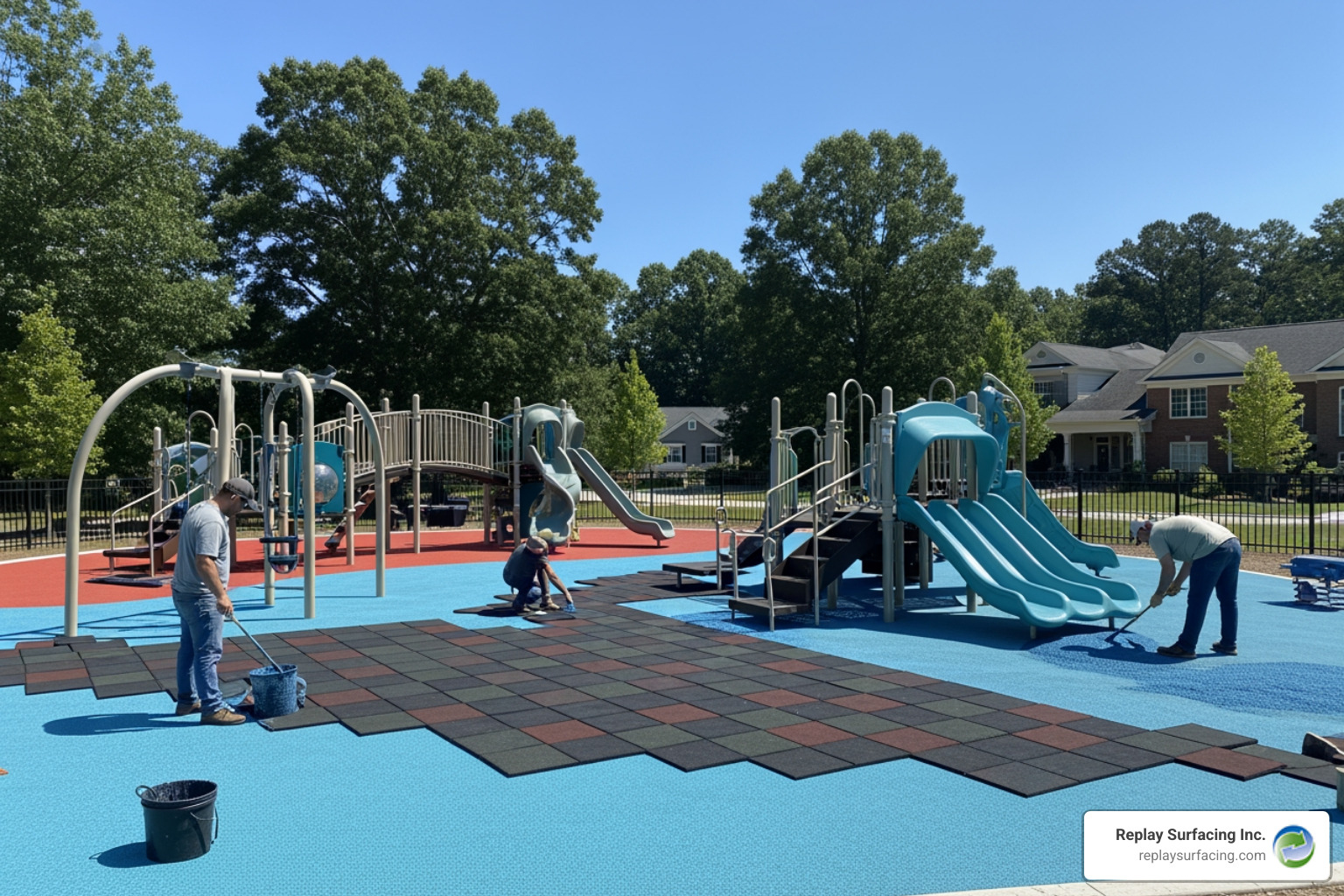
At Replay Surfacing, we specialize in turning recycled tires into high-performance safety flooring. In locations like Charlotte and Sanford, where playgrounds see heavy use, the choice of material significantly impacts how long a surface stays compliant.
Comparing Rubber Surfacing Options
| Surface Type | GMAX Performance | HIC Performance | Maintenance Needs |
|---|---|---|---|
| Poured-in-Place (PIP) | Excellent (Seamless) | Superior | Medium (Needs top-coating) |
| Rubber Tiles | Good (Consistent) | High | High (Check for seam gaps) |
| Engineered Wood Fiber | Good (When fresh) | Variable | Very High (Requires raking) |
| Synthetic Turf | Moderate | Moderate | Low |
For a deeper dive into which material is right for your specific climate—whether the humidity of South Carolina or the winters of Connecticut—see more info about the ultimate guide to playground flooring.
Factors Affecting Surface Degradation
Even the best surface won’t stay compliant forever. Several factors contribute to degradation:
- UV Exposure: The intense sun in Tucson can cause the binders in rubber surfaces to become brittle over time.
- Compaction: Loose-fill materials like wood fiber settle and lose their “fluff,” which is what provides the cushioning.
- Moisture: Poor drainage can lead to “flaking” or delamination in poured rubber.
- Wear Patterns: Areas under swings and at the base of slides lose material faster than anywhere else.
Regular playground surface impact testing catches these issues before they result in an injury. We recommend annual inspections to monitor these changes. You can learn more about the sustainability and durability of these materials in our more info about recycled rubber playground flooring guide.
Balancing Impact Safety with ADA Accessibility
A playground isn’t truly safe unless it’s safe for everyone. In the U.S., there are over 2.8 million school-aged children with disabilities. Ensuring that a surface is soft enough for a fall (ASTM F1292) but firm enough for a wheelchair (ASTM F1951) is a delicate balance.
ASTM F1951 measures the “work” required to move a wheelchair across a surface. If a surface is too soft, it becomes a “sand trap,” making the playground inaccessible. We use a rotational penetrometer to test for firmness and stability on-site. Research, such as A Longitudinal Study of Playground Surfaces to Evaluate Accessibility, shows that many surfaces fail accessibility standards within just 12 months of installation if not properly maintained.
Inclusive design is at the heart of what we do. For those concerned about chemical safety alongside physical safety, we offer more info about non-toxic playground tiles that meet both impact and health standards.
Maintaining Compliance in High-Traffic Regions
We operate across several key regions, each with its own environmental challenges:
- Raleigh & Charlotte, NC: High humidity and frequent rain require surfaces with excellent drainage to prevent slippery conditions and premature binder breakdown.
- Tucson, AZ: Extreme UV levels necessitate the use of high-quality aliphatic binders to prevent the surface from becoming “crumbly” and failing GMAX tests.
- Columbia, SC & Nashville, TN: High-traffic municipal parks require robust safety audits to ensure that heavy use doesn’t lead to “thin spots” in the rubber.
- Sanford, NC: Childcare facilities here often opt for annual testing to meet state licensing requirements and protect their small-business liability.
Frequently Asked Questions about Surface Testing
How often should playground surfaces be tested?
We recommend playground surface impact testing at least once per year. Surfaces degrade due to weather and use, and an annual check provides documented proof of your “standard of care.” You should also test immediately after a new installation to ensure the contractor met the specifications, and after any major repairs or equipment changes.
What happens if a surface fails a GMAX or HIC test?
If a test shows a GMAX over 200 or an HIC over 1,000, the surface is non-compliant and unsafe. In most cases, you don’t have to tear the whole thing out. Remediation might involve a “top-off” of materials or a professional re-coating. However, if the degradation is severe, the use zone should be closed to the public until the surface is replaced.
Can I perform impact testing myself?
While you can buy some basic tools, official compliance testing should be done by certified inspectors. We use specialized Triax technology that requires professional calibration and expertise to interpret. A professional report is a legal document that protects you from liability; a “DIY” check rarely holds up in court.
Conclusion
At the end of the day, playground surface impact testing isn’t about passing a test—it’s about protecting the children in our communities. Whether you are managing a school in Beaverton, a park in Nashville, or a backyard in Connecticut, understanding these standards is the first step toward a safer play environment.
By choosing sustainable, recycled rubber solutions and committing to regular safety audits, you reduce your liability and, more importantly, ensure that every fall is just a minor bump rather than a life-altering event. Replay Surfacing Inc. is here to help you navigate these complex standards and provide the durable, compliant surfaces your community deserves.
Ready to ensure your play area is up to code? Schedule a consultation for compliant playground surfacing with our team today.
Have Questions About Rubber Surfacing?
Whether you’re exploring options or planning a project, Replay Surfacing Inc. is here to help. Contact us today for expert guidance and a free estimate.