
Why Finding the Best Price on Rubber Mulch Can Save You Thousands
The best price on rubber mulch for bulk orders currently ranges from $525 to $749 per 2,000 lb super sack, depending on the supplier, color, and shipping terms. Here’s a quick snapshot of current market pricing trends:
- Direct Bulk Sacks: Often priced between $525 and $749 per ton.
- Retail Pallets: Typically range from $690 to $750 for equivalent weights.
- Shipping: Varies from free shipping offers to calculated freight based on distance from distribution hubs.
Prices are subject to change. Volume discounts and promo codes can lower costs further.
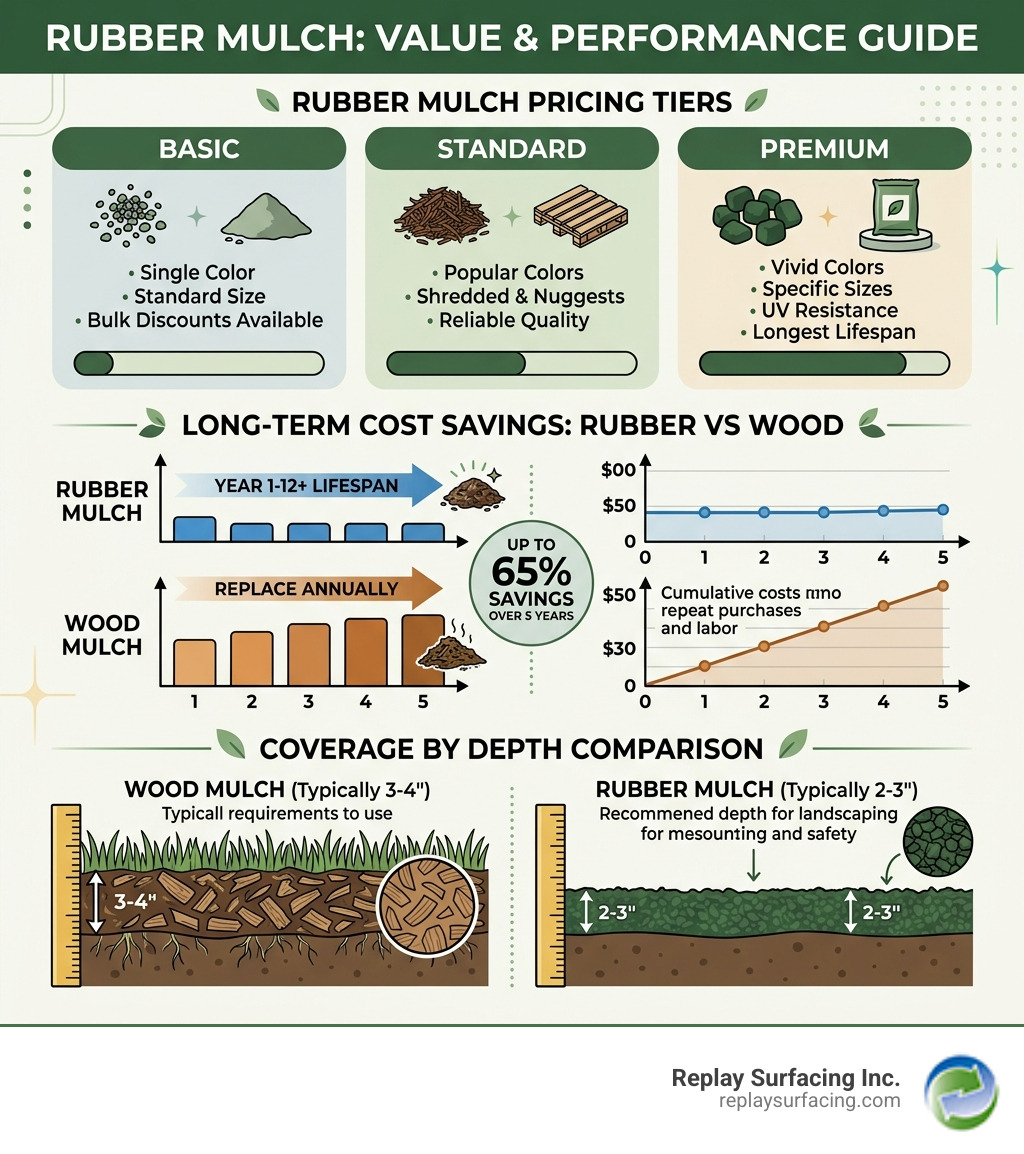
Rubber mulch is one of the smartest long-term investments for playgrounds and landscaping. It lasts 10 to 12+ years and doesn’t need annual replacement like wood mulch does. That means facilities can save up to 65% over five years compared to traditional wood mulch — a significant win for budget-conscious managers.
But with prices varying widely across retailers, knowing where to look matters. Whether you’re covering a school playground in Charlotte, a community park in Raleigh, or a recreational facility in Tucson, or even managing sites in Connecticut and Indiana, the difference between vendors can add up to hundreds of dollars per pallet.
I’m Landon Olson, operator of Replay Surfacing and a mechanical engineer with an MBA, and I’ve spent my career helping facilities find the best price on rubber mulch without sacrificing safety or quality. In this guide, I’ll walk you through exactly what to look for — and where to find the real deals.
Best price on rubber mulch terms you need:
Understanding the Best Price on Rubber Mulch for Bulk Orders
When we talk about securing the best price on rubber mulch, we are almost always talking about bulk orders. For large-scale projects in locations like Nashville, TN or Sanford, NC, buying individual bags at a local hardware store is like buying gas by the gallon at a convenience store—it’s convenient, but you’re paying a premium for that convenience.
The gold standard for bulk purchasing is the 2,000 lb super sack. These massive industrial bags are designed for efficiency. Currently, the market reflects a wide range of “wholesale” rates. You might find a special price as low as $525.00 for a super sack, which is a significant markdown from the regular $592.00 price point. However, other premium suppliers list similar quantities at $749.00.
Why the gap? It often comes down to factory-direct vs. retail pricing. When you buy from a source that ships directly from the processing plant, you bypass the overhead of a brick-and-mortar storefront. For those in Beaverton, OR or Lake Charles, LA, finding the Best Rubber Mulch for Sale means looking for these direct-to-consumer bulk options.
| Unit Type | Weight | Market Price Range | Best Use Case |
|---|---|---|---|
| Individual Bag | 39-40 lbs | $7.50 – $15.00 | Touch-ups, Small beds |
| Half Pallet | 1,000 lbs | $549 – $599 | Residential playsets |
| Super Sack | 2,000 lbs | $525 – $749 | Commercial/Large Res |
Finding the Best Price on Rubber Mulch with Free Shipping
Shipping is the “hidden boss” of rubber mulch pricing. Because rubber is heavy (a single pallet is literally a ton), freight costs can swing the total price by hundreds of dollars. We always recommend looking for “Free Shipping” offers, but read the fine print.
Some vendors bake the shipping cost into a slightly higher pallet price—like $609 with free shipping—while others offer a lower base price ($525) but add freight at checkout. For our clients in Tucson, AZ, Columbia, SC, or those managing projects in Indiana and Connecticut, the proximity to a distribution point is key. Regional distribution hubs allow for lower freight rates or even local pickup options.
A few logistics tips for your local area:
- Liftgate Service: Unless you have a forklift or a loading dock at your school or park, you’ll need a liftgate on the delivery truck. This can sometimes add a small fee ($50-$100) if not included.
- Bulk Freight: If you are ordering more than three pallets (6,000 lbs+), you should never pay standard retail shipping. At this volume, you move into dedicated freight territory where discounts are significant.
- Accessibility: Ensure the delivery truck can actually reach your site. A 53-foot trailer trying to navigate a tight residential street in Raleigh can lead to “failed delivery” fees.
Check out our Recycled Rubber Mulch Near Me Guide to see how geography impacts your final invoice.
Maximizing Your Budget with the Best Price on Rubber Mulch
If you want the absolute best price on rubber mulch, you have to play the volume game. Most major suppliers offer “Volume Tiers.” For example, a single pallet might be $609, but if you order two, it drops to $599, and three or more might hit $589.
We’ve seen volume codes like “VOLUME” provide an additional 10% off for orders over 6,000 lbs. That’s a massive saving when you’re surfacing a large commercial playground. Also, keep an eye on seasonal sales. Much like seasonal retail sales events, late winter and early spring are prime times for discounts as retailers clear out inventory for the new season.
To get the most out of your budget, refer to our Rubber Mulch Cost Guide 2026 which breaks down the five-year ROI of rubber vs. wood.
Factors That Influence Rubber Mulch Pricing
Not all rubber mulch is created equal, and the price often reflects the technology used to create it.
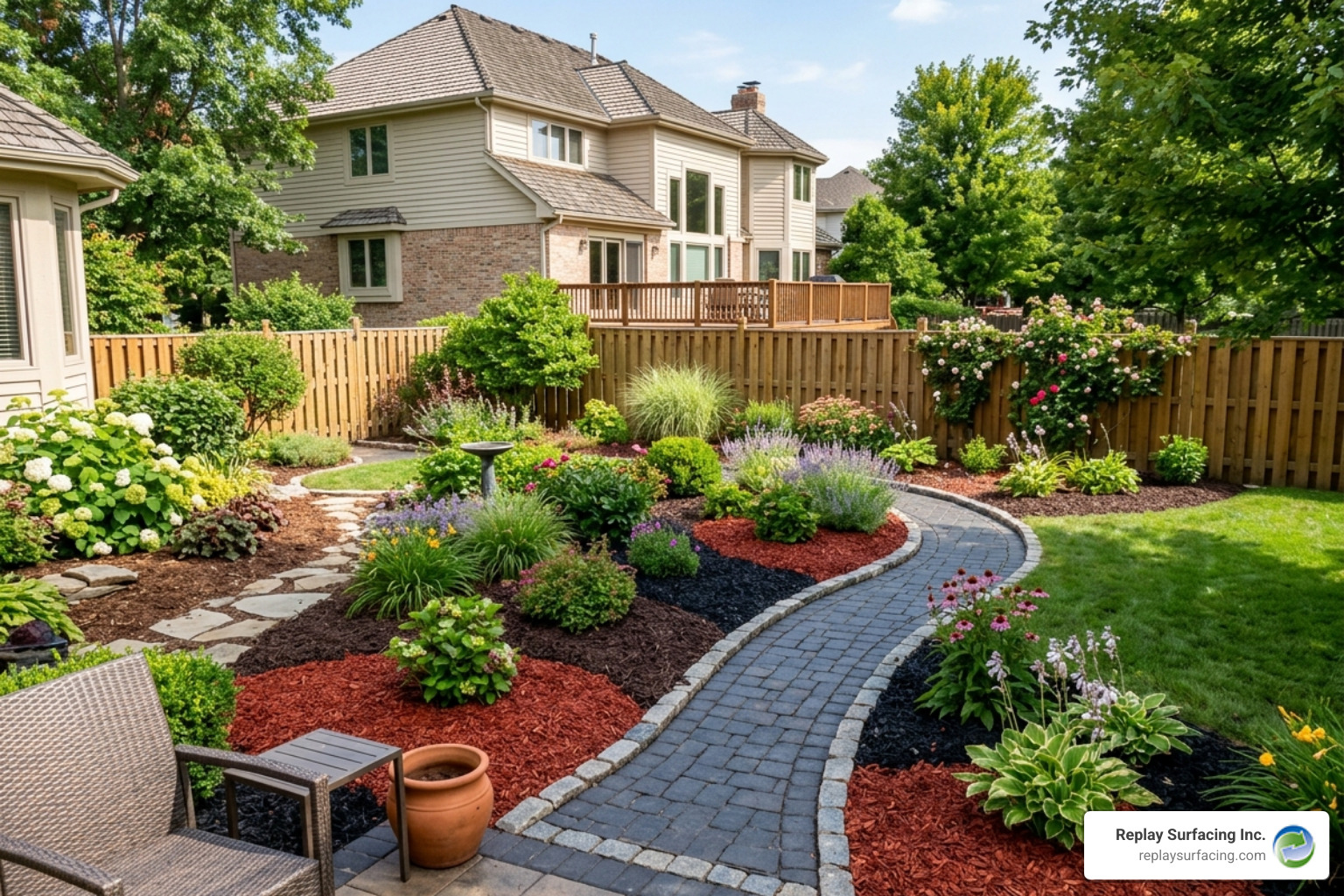
- Color Selection: Standard “uncoated” black mulch is the cheapest. It’s basically raw recycled tire rubber. However, it can leave a black residue on hands and clothes. “Painted” or “Coated” mulch uses non-toxic, high-durability dyes. Premium colors like Blue, Green, or Red typically cost more than Earth-tone Browns or Blacks because the pigments are more expensive and require more UV-stabilizers.
- UV Protection: The best price on rubber mulch isn’t a deal if the color fades in two years. Premium mulch includes a 12-year color guarantee. This is achieved through a 2x UV-coating process that protects the pigment from the harsh sun in places like Tucson or Charlotte.
- Safety Standards: Always check for a Prop 65 Warning(s). While most high-quality rubber mulch is non-toxic and chemically inert, transparency about material sourcing is a sign of a quality vendor.
Playground-Certified vs. Landscaping Grade
This is where many buyers get confused. Landscaping grade mulch is often thinner or may contain more “fines” (small dust-like particles). Playground-certified mulch is a different beast entirely.
To be playground-safe, the mulch must meet:
- ASTM F1292: This measures impact attenuation (how well it cushions a fall).
- IPEMA Certification: This is a third-party seal of approval that the product consistently meets safety standards.
- Wire-Free Guarantee: High-quality playground mulch is 99.9% wire-free. It goes through multiple stages of powerful magnets to ensure no steel belts from the original tires make it into the play area.
Because of these extra processing steps, playground-grade mulch carries a higher price tag than basic landscaping chips. For a deep dive into the types of mulch available, see our guide on Loose Rubber Mulch.
Comparing Costs: Super Sacks vs. Individual Bags
Let’s break down the math. If you buy a 40 lb bag at a retail store for $9.46, you are paying roughly $0.23 per pound.
If you buy a 2,000 lb super sack for $525, your price drops to $0.26 per pound, but wait—retail products often don’t include the same “playground-grade” certifications or the 12-year color warranty found in professional bulk sacks. Furthermore, retail “bulk” deals (like 50 bags for $709) actually come out to $0.47 per pound!
Often, the “cheapest” price on the shelf is the most expensive way to buy.
- Individual Bags: Best for small garden borders or filling in “kick-out” areas under swings.
- Half-Pallets (1,000 lbs): A middle ground for small residential projects in places like Sanford, NC.
- Super Sacks (2,000 lbs): The undisputed winner for value.
For more on weight-to-volume conversions, check out Rubber Mulch Per Ton.
Hidden Costs and Value-Added Features
When calculating the best price on rubber mulch, don’t forget the “supporting cast.” If you just pour rubber mulch onto the grass, it will eventually sink into the soil or wash away.
- Landscape Fabric: This is non-negotiable. You need a heavy-duty, permeable weed barrier to keep the mulch separated from the dirt. This prevents weeds and keeps your mulch clean.
- Borders/Timber: Rubber mulch is “loose fill,” meaning it will migrate if not contained. We recommend plastic or rubber borders to keep your investment where it belongs.
- Wear Mats: Even the best rubber mulch can be displaced in high-traffic areas like the bottom of a slide or under a swing. Wear mats are heavy rubber pads that sit on top of the mulch to prevent “potholes.”
- Warranties: A 12-year color guarantee adds massive value. If you have to repaint or top-off your mulch every 3 years because it turned grey, you haven’t saved any money.
Read our Bonded Rubber Mulch Price Guide for info on permanent, non-loose alternatives.
Frequently Asked Questions about Rubber Mulch Pricing
What are the long-term cost benefits and savings of choosing Replay Surfacing’s rubber mulch?
The primary saving is labor and material replenishment. Wood mulch decomposes, fades, and blows away, requiring a “top-off” every single year. Rubber mulch is inert—it doesn’t rot, it doesn’t attract termites, and it’s too heavy to blow away in a standard storm (it’s 5x heavier than wood). Over a 10-year period, you can expect to save about 65% on total maintenance costs. In cities like Raleigh or Charlotte, and across our service areas in Connecticut and Indiana, where humidity can rot wood mulch quickly, the savings are even more pronounced.
How much rubber mulch do I need for a standard playground?
It depends on the “Critical Fall Height” of your equipment.
- Residential (3-inch depth): Generally safe for falls up to 5-6 feet. One 2,000 lb pallet covers about 300-320 sq. ft.
- Commercial (6-inch depth): Required for public parks and schools to protect against falls up to 10-12 feet. One pallet covers about 150-160 sq. ft.
We always recommend adding a 5% “buffer” to your order to account for settling and uneven subsurfaces. You can use our Rubber Mulch Yard Guide 2026 for more precise calculations.
Does the color of the mulch affect the price?
Yes. Black is the baseline. Earth tones like Dark Brown and Redwood are usually the next tier. Vibrant “designer” colors like Blue, Green, and Caribbean Blue are the most expensive because the pigments required to make rubber look bright blue are significantly more costly and require more UV protection to prevent “bronzing” or fading in the sun.
Conclusion
Finding the best price on rubber mulch requires looking past the initial sticker price and considering shipping, longevity, and safety certifications. Whether you are in Tucson, AZ, or right here in our backyard in Sanford, NC, Replay Surfacing Inc. is dedicated to providing high-quality, sustainable surfacing solutions that protect both your budget and your community.
By recycling tires into durable nuggets, we help transform environmental hazards into safe, beautiful spaces. From Charlotte to Nashville, and across our service areas in Connecticut and Indiana, we serve our local hubs with the expertise needed to ensure your project is a success.
Ready to start your project? Get more info about playground surfacing services and let us help you find the perfect fit for your facility. The best price is the one that provides safety and beauty for the next decade, not just the next season!