Why Tucson Parents Are Rethinking What Goes Under Their Kids’ Feet
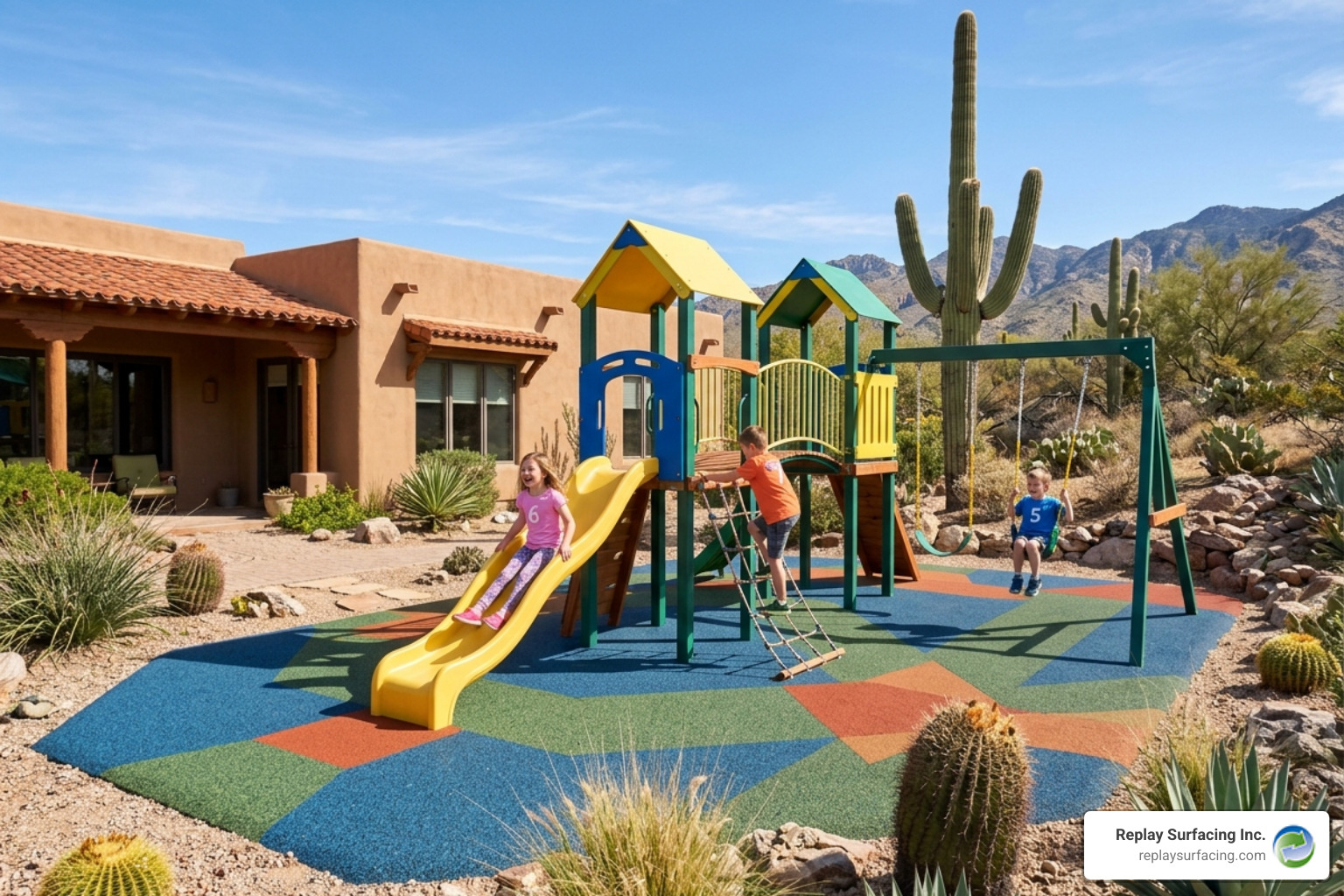
Tucson residential playground flooring is one of the most important — and most overlooked — decisions a homeowner can make when setting up a backyard play area.
Here’s a quick look at your best options:
| Surface Type | Best For | Heat Resistance | Safety Rating | Maintenance |
|---|---|---|---|---|
| Poured-in-Place Rubber | Permanent, seamless areas | Good | Excellent (ASTM F1292) | Very Low |
| Rubber Mulch | Budget-conscious installs | Good | Excellent (up to 16 ft fall height) | Low |
| Artificial Turf | Natural look, low water use | Moderate (cooling tech helps) | Good (IPEMA certified) | Low |
| Wood Chips | Tight budgets | Poor | Moderate (IPEMA certified) | Moderate |
| Natural Grass | Aesthetics | Poor | Low | High |
With nearly 350 days of sunshine per year, Tucson puts outdoor surfaces through some of the harshest conditions in the country. Summer temperatures regularly exceed 100°F. Traditional grass burns out. Sand shifts and gets scorching hot. And bare dirt offers almost no protection when a child falls.
That’s why more Tucson families are making the switch — choosing surfaces built to handle desert heat while keeping kids safe year-round.
The stakes are real. According to national data, nearly 114,000 children visit emergency rooms every year due to playground falls. The surface underneath makes a critical difference in whether those falls result in minor scrapes or serious injuries.
I’m Landon Olson, operator of Replay Surfacing Inc., where I’ve spent my career turning recycled rubber into high-performance Tucson residential playground flooring and other safety surfacing solutions. My background in mechanical engineering and sustainable manufacturing means I look at every backyard project through the lens of both safety science and long-term value. In the sections ahead, we’ll break down exactly which surfaces work best in Tucson’s desert climate — and why rubber is quickly becoming the go-to choice for local parents.
The Best Tucson Residential Playground Flooring Options for Desert Climates
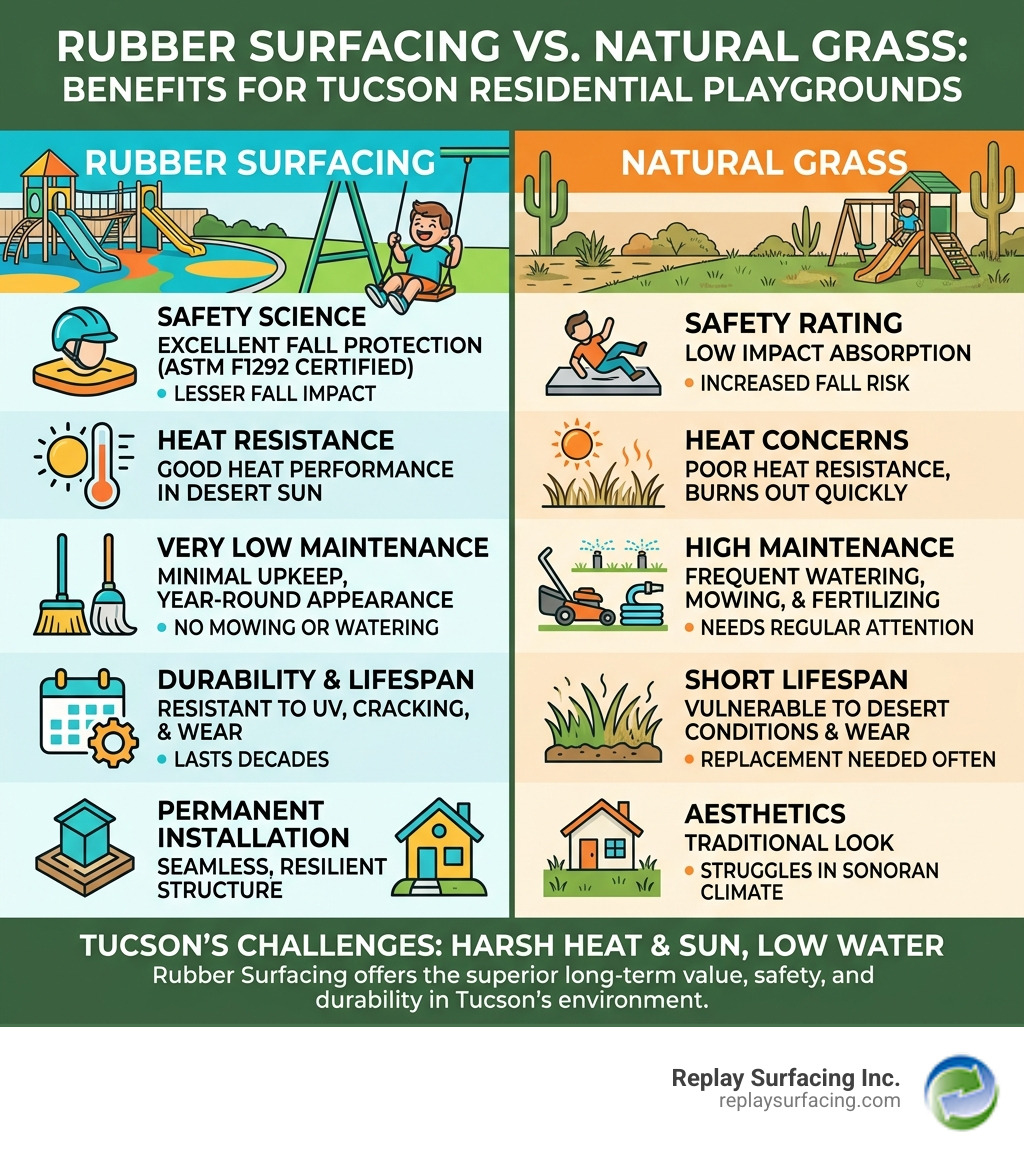
When we talk about the Sonoran Desert, we aren’t just talking about heat; we’re talking about intense UV exposure and arid conditions that turn organic materials like wood mulch into brittle tinder. For homeowners in areas like Oro Valley or Marana, selecting the right material is the difference between a play area that lasts a decade and one that needs replacing in two years.
Poured-in-Place (PIP) Rubber
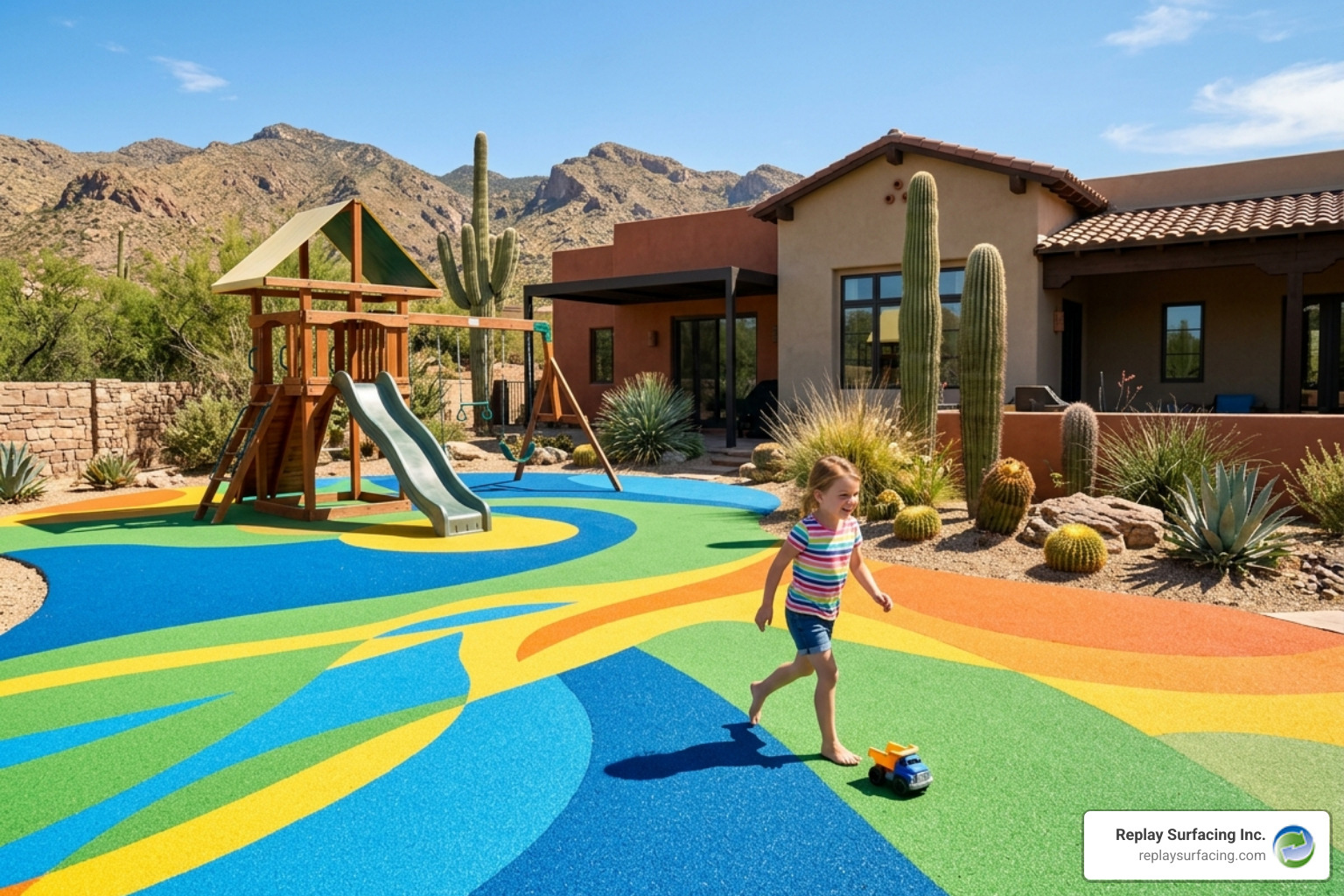
This is the “gold standard” for high-end residential projects. It consists of a two-layer system: a base layer of shock-absorbing rubber and a top “wear layer” of colorful EPDM granules. Because it is mixed and poured on-site, it creates a seamless, unitary surface that is completely accessible for strollers and wheelchairs. Tucson kids love these rubber surfacing options because they provide a “bounce” that makes running and jumping much safer.
Rubber Mulch
For those looking for the highest impact protection on a budget, Tucson, Arizona Playground Surfacing | Mulch, Turf & Rubber often highlights rubber mulch. Made from 100% recycled tires, it looks like traditional wood bark but doesn’t decompose, attract termites, or float away during our intense monsoon downpours in Sahuarita.
Artificial Turf
Synthetic grass has become a staple in Tucson backyards. It provides a lush, green aesthetic without the water bill. When paired with a dedicated safety sub-pad, it becomes a viable playground surface that handles heavy foot traffic while remaining mud-free.
Why Tucson Residential Playground Flooring is the Sustainable Choice
In Pima County, water is our most precious resource. Traditional sod requires thousands of gallons of water to stay green—water that often just evaporates in the 100-degree heat. By choosing Recycled Rubber Playground Flooring, we are effectively “drought-proofing” the play area.
Furthermore, our products at Replay Surfacing are rooted in the circular economy. We take tires—which are significant environmental hazards and breeding grounds for pests—and transform them into playground surfacing that is non-toxic and durable. This keeps waste out of Arizona landfills and provides a surface that doesn’t require pesticides, fertilizers, or mowing.
Cooling Technologies for Arizona Summers
A common concern for parents in the Southwest is surface temperature. Dark surfaces can absorb significant heat under those 350 sunny days. However, modern innovations have changed the game.
For turf installations, technologies like HydroChill can reduce surface temperatures by 30 to 50 degrees when hydrated by a quick sprinkle or morning dew. When it comes to rubber, Tucson Artificial Playground Turf & Recreation Surfaces suggests that lighter color blends (like tans, light greys, and teals) significantly improve thermal performance compared to solid black surfaces. Poured rubber, while it does get warm, does not retain heat with the same intensity as asphalt or concrete, making it a safer choice for little hands and feet.
Safety Standards and Fall Height Protection for Home Play Areas
Safety isn’t just a marketing term; it’s a measurable metric. In the industry, we look at two primary certifications: ASTM F1292 (Standard Specification for Impact Attenuation) and IPEMA (International Play Equipment Manufacturers Association).
When we install Tucson residential playground flooring, we are aiming to lower the “G-Max” score. A lower G-Max means the surface is better at absorbing the shock of a fall, reducing the risk of traumatic brain injuries (TBI). This is calculated alongside the Head Injury Criterion (HIC) to ensure that if a child falls from the highest point of your equipment, the surface will “give” enough to protect them.
Choosing Tucson Residential Playground Flooring Based on Equipment Height
Every backyard set has a “critical fall height”—the height of the highest accessible play component (like the top of a slide or the monkey bars). Your flooring depth must match or exceed this height.
| Material | Depth | Critical Fall Height |
|---|---|---|
| Rubber Mulch | 4 inches | 10 Feet |
| Rubber Mulch | 6 inches | 16 Feet |
| Poured Rubber | 2.5 inches | 6 Feet |
| Poured Rubber | 3.5+ inches | 8-10 Feet |
As noted in our Playground Flooring For Your Backyard Oasis A Comprehensive Guide, loose-fill options like rubber mulch provide incredible protection (up to 16 feet) but require occasional raking to maintain that depth under swings. For more specialized advice, check out Safe And Sound Backyard Play Area Flooring Options For Every Budget.
Comparing Poured-in-Place Rubber vs. Rubber Mulch
Choosing between a “unitary” (solid) surface and a “loose-fill” surface usually comes down to budget and accessibility.
Poured-in-Place (PIP) Rubber:
- Pros: Completely ADA compliant and wheelchair accessible. It offers a seamless look that can include custom designs (like desert suns or blue “water” paths). There are no “displaced” bits of mulch to end up in your pool or house.
- Cons: Higher initial investment and requires professional installation to ensure the chemical binders cure correctly in the Tucson humidity (or lack thereof).
Rubber Mulch:
- Pros: Excellent for residential DIY projects. It offers the best “bang for your buck” regarding fall protection. It’s also excellent for drainage in places like Green Valley or Casa Grande where heavy rain can cause pooling.
- Cons: It can be kicked out of the play area (though rubber mulch is much heavier than wood and stays put better). It is not considered fully “accessible” for those with mobility devices without specific curbing and compaction.
Whether you are looking at Connecticut Playground Surfacing or our local Tucson installs, the consensus is clear: rubber outperforms organic materials in every safety category.
Maintenance and Durability in the Sonoran Desert
One of the biggest “wins” for swapping grass for rubber is the time you get back on your weekends.
Tucson residential playground flooring made of rubber is remarkably low-maintenance. Because it is inorganic, it doesn’t provide a food source for pests like harvester ants or termites. It also inhibits the growth of mold and fungi, which is a major plus for children with seasonal allergies.
For routine cleaning, a leaf blower is your best friend. It easily clears away mesquite pods, leaves, and dust. If the surface gets particularly dusty after a haboob, a quick rinse with a garden hose is all it takes. Unlike wood chips, which decompose and need to be topped off every year, rubber mulch can last up to 20 years. Our rubber flooring for playgrounds often comes with a “color-lock” guarantee, ensuring the vibrant greens and blues don’t fade into a dull grey under the Arizona sun.
Budget-Friendly Solutions and Installation Timelines
We often hear from parents who want a safe space but have a strict budget. If you are looking for options under $5,000, rubber mulch is your best bet. A standard 15′ x 15′ play area can often be covered with high-quality recycled rubber mulch for a fraction of the cost of a poured surface.
For those choosing professional installation, the timeline is surprisingly fast. Most residential projects in Pima County can be completed in 24 to 48 hours.
- Site Prep: Removing existing grass or debris and ensuring proper drainage.
- Base Layer: Installing a compacted stone base or safety pad.
- Top Layer: Pouring the rubber or spreading the mulch.
While we serve many areas, including Sanford, North Carolina Playground Surfacing, our Tucson crews are specifically trained to handle the rapid curing times required in desert heat.
Frequently Asked Questions about Tucson Playground Surfaces
Does rubber surfacing get too hot for Tucson kids?
While any surface in the Arizona sun will get warm, rubber is a poor thermal conductor compared to metal or asphalt. By choosing lighter color blends and utilizing shade structures, the surface remains comfortable for play. Poured rubber also allows for “breathability” that helps dissipate heat more effectively than solid black rubber mats.
Is rubber mulch safe if pets or children ingest it?
High-quality rubber mulch, like what we use for projects/residential, is tested using the EN 71-3 toy safety standard. This ensures that even if a piece is accidentally swallowed, no toxic heavy metals will leach out in stomach acid. Furthermore, it is 99.9% wire-free, removing the risk associated with older, poorly processed recycled rubber.
How long does professional rubber surfacing last in the Arizona sun?
When professionally installed with UV-stable binders, a poured-in-place surface typically lasts 10 to 12 years before needing a “top coat” or “roll coat” to refresh the binder. Rubber mulch, being a loose-fill material, can easily last 20+ years as it does not rely on a chemical bond to stay effective.
Conclusion
At Replay Surfacing Inc., we believe that every child deserves a safe place to play, and every parent deserves peace of mind. By choosing Tucson residential playground flooring made from recycled tires, you aren’t just making a choice for safety—you’re making a choice for sustainability. We take pride in transforming environmental hazards into beautiful, customizable, and incredibly durable backyard oases.
Whether you’re looking for a portfolio categories/residential inspiration or a quote for your own backyard, we’re here to help you navigate the process. Skip the scorched grass and the muddy footprints. Switch to a surface that works as hard as you do to keep your family safe.