
Types of Rubber Flooring for Play Areas
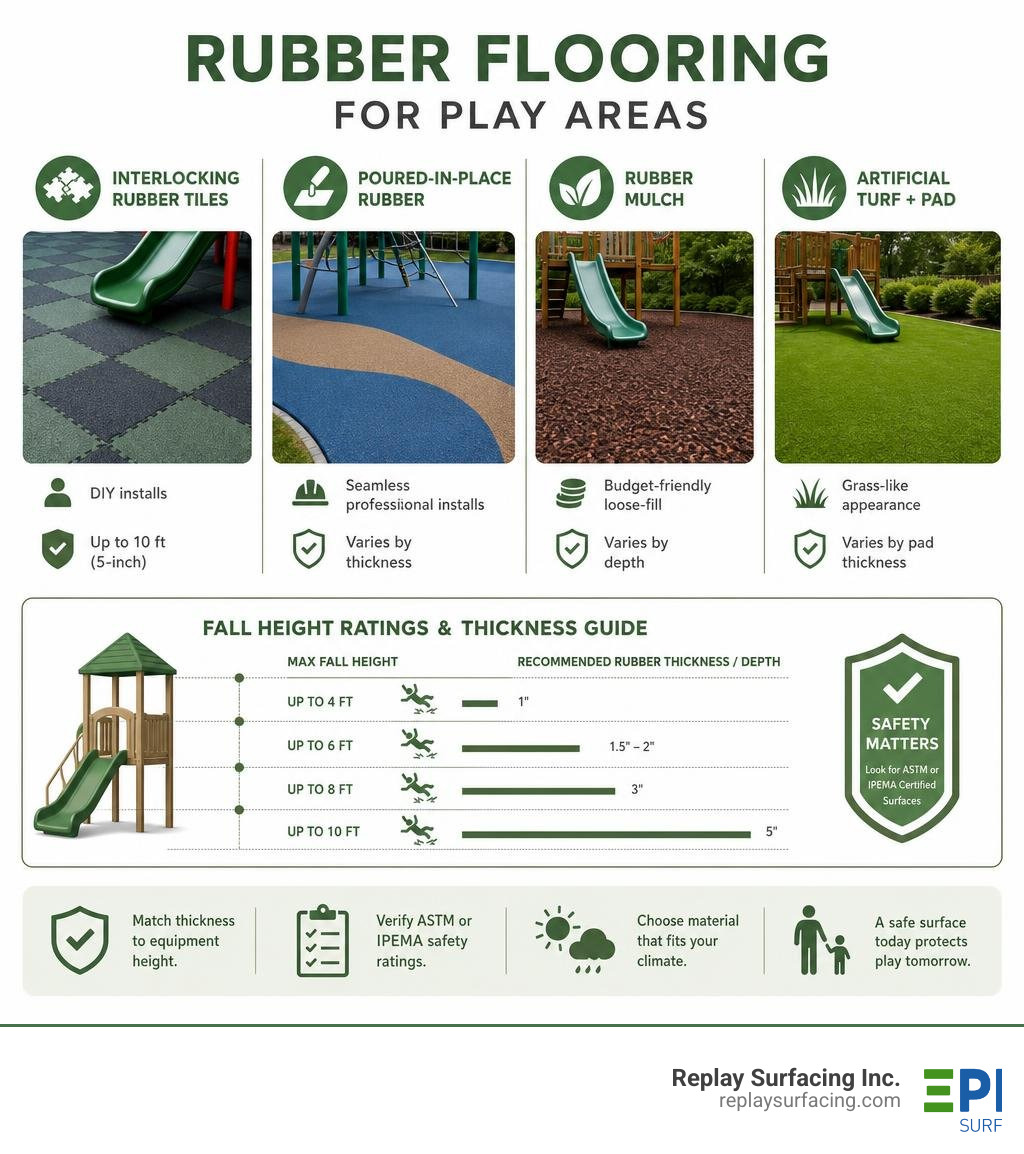
Rubber flooring for play areas comes in four main types, each suited to different budgets, safety needs, and installation preferences:
| Type | Best For | Approx. Cost/sq ft | Fall Height Coverage |
|---|---|---|---|
| Interlocking Rubber Tiles | DIY, residential & commercial | $5 – $8 | Up to 10 ft (5-inch) |
| Poured-in-Place Rubber | Seamless commercial installs | Higher (professional install) | Varies by thickness |
| Rubber Mulch | Budget-friendly loose-fill | Lower upfront cost | Varies by depth |
| Artificial Turf + Pad | Grass-like appearance | $3 – $6 | Varies by pad thickness |
Choosing the right surface means matching thickness to the height of your play equipment, verifying ASTM or IPEMA safety ratings, and picking a material that holds up to your climate and traffic levels.
Every year in the U.S., roughly 290 million scrap tires are generated. Much of that rubber ends up in landfills — unless it gets turned into something useful, like the surface under a child’s swing set.
A safe playground starts at ground level. The surface your kids land on matters just as much as the equipment they play on. Falls happen. The right flooring absorbs the impact before it becomes an injury.
This guide cuts through the noise and helps you find the best rubber flooring for play areas for your specific situation — whether you’re outfitting a backyard swing set or a high-traffic community park.
I’m Landon Olson, operator of Replay Surfacing Inc., where I’ve spent my career recycling millions of pounds of scrap tires into certified, high-performance rubber flooring for play areas used in playgrounds, sports surfaces, and commercial applications across North America. My background in mechanical engineering and sustainability gives me a practical lens on what actually works in the field — and I’ll share that with you throughout this guide.
When selecting the ideal playground surface, understanding your options is the first step. Rubber is highly favored because of its exceptional durability and impact absorption. However, the form it takes can significantly impact your installation process, budget, and maintenance routine.
Most rubber safety surfacing relies on two primary components: Styrene-Butadiene Rubber (SBR), which is typically sourced from recycled truck tires and forms the shock-absorbing base, and Ethylene Propylene Diene Monomer (EPDM), a premium virgin rubber layer used on top to provide vibrant, UV-resistant colors.
Let’s break down the main configurations of rubber flooring for playgrounds to help you determine which one fits your project in Charlotte, Raleigh, or Tucson.
Interlocking Tiles and Modular Systems
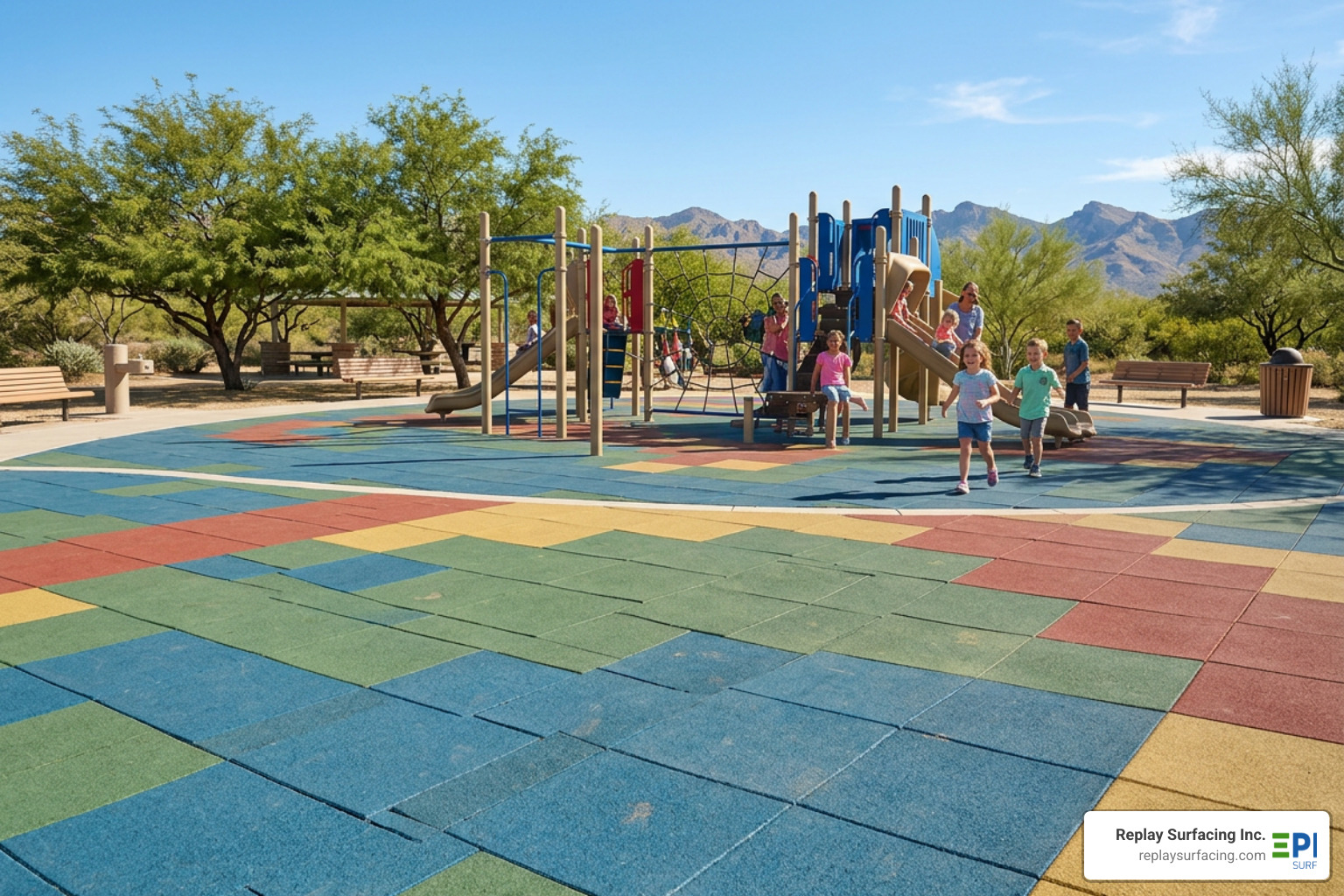
Interlocking rubber tiles are highly popular for both residential backyards and municipal parks. These modular systems are typically manufactured in 2×2 foot squares, with thicknesses ranging from 1.75 inches up to 5 inches.
One of the greatest advantages of tiles is their modularity. If a single tile is damaged—say, by a misplaced lawnmower blade or vandalism—you can easily swap out that individual piece without replacing the entire playground surface. Many modern tiles feature interlocking mechanisms like the Quad Blok connector system, which secures the tiles from underneath. This creates a floating floor that is highly stable but does not require glue-down adhesion over the entire sub-base.
Whether you are looking for premium playground flooring for a schoolyard in Connecticut or setting up a backyard play space in Indiana, interlocking tiles offer a clean, uniform look that stands up to heavy foot traffic.
Poured-in-Place Rubber Flooring for Play Areas
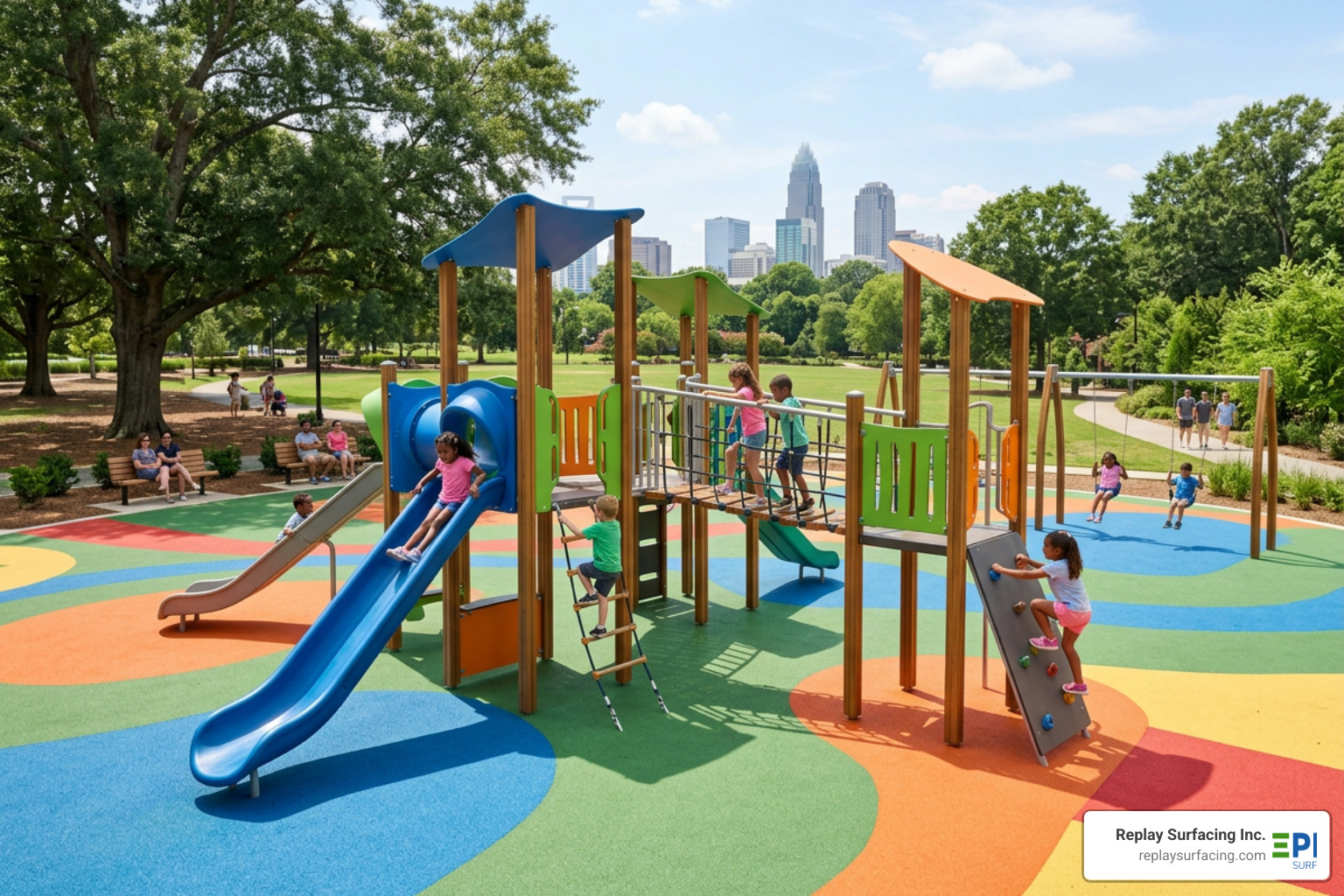
Poured-in-place (PIP) rubber, also known as wet-pour rubber, is the gold standard for commercial playgrounds, schoolyards, and public parks. This system consists of a two-layer application: a thick cushion layer made from recycled SBR tire rubber, followed by a wear layer of colorful EPDM granules mixed with a high-quality polyurethane binder. Because it is mixed and troweled on-site, it creates a completely seamless, joint-free surface.
This seamless design completely eliminates trip hazards caused by shifting tiles or loose mulch. It also offers unparalleled design flexibility. If you want to incorporate colorful educational games, school logos, or custom shapes into your play space, poured-in-place rubber is the way to go.
If you are seeking professional installation for commercial projects, check out our localized resources like Raleigh, North Carolina Playground Surfacing | Mulch, Turf & Rubber or explore specialized services such as Rubber Surfacing & Flooring in Columbia to ensure a flawless, long-lasting application.
Rubber Mulch and Ground Cover Alternatives
If you want the cushion of rubber but prefer a rustic, natural aesthetic, rubber mulch is an excellent loose-fill alternative. Unlike traditional wood mulch, which decays, compacts, and needs to be replenished annually, rubber mulch does not rot, absorb water, or attract pests like termites and wood-boring insects. It also doesn’t absorb animal waste, keeping your play area cleaner.
For those considering this route, we highly recommend reading our beginners guide to safe rubber mulch to understand how to select high-quality, wire-free products. Additionally, you can find tips on sourcing rubber mulch for play areas that actually last to minimize lifetime maintenance.
Safety Standards, Fall Heights, and Base Preparation
No matter which aesthetic you prefer, safety is the single most important factor. In the United States, playground surfacing safety is governed by strict standards, primarily ASTM F1292 (which measures shock attenuation and impact safety) and certifications by the International Play Equipment Manufacturers Association (IPEMA).
When designing a playground, you must ensure that your surface provides adequate protection based on the “critical fall height” of your play equipment. The critical fall height is determined by the highest accessible play point on a structure (such as the top of a slide or the swing crossbar). Your flooring must be rated to cushion a fall from that exact height to prevent severe head injuries.
To achieve a truly soft fall playground, you must carefully select your flooring thickness and prepare a stable, engineered sub-base.
Critical Fall Height Ratings and Thickness Requirements
As a general rule, the thicker the rubber, the higher the fall protection. Here is how standard rubber tiles stack up against critical fall heights:
- 1.75-inch to 2.25-inch tiles: Rated safe for critical falls up to 4 feet. This is ideal for low-profile toddler play structures or indoor sensory rooms.
- 2.5-inch to 3.25-inch tiles: Rated safe for critical falls up to 6 to 8 feet. This is the standard for most elementary school and community park structures.
- 4.25-inch to 5-inch tiles: Rated safe for critical falls up to 10 feet. These heavy-duty options are required under tall climbing walls and high slide platforms.
If your playground features equipment of varying heights, you can save on costs by installing thicker tiles or deeper poured-in-place rubber directly under high-impact zones (like the exit of a slide or under swings) while using thinner profiles in low-impact walking paths. To learn more about how to design these safety zones, refer to our guide on outdoor rubber play surfaces.
Sub-Base Preparation for Concrete, Asphalt, and Grass
A playground surface is only as good as the foundation beneath it. You can purchase the thickest, highest-rated tiles on the market, but if they are laid over uneven, muddy ground, they will quickly shift, separate, and fail.
For the absolute best results, rubber flooring should be installed over a flat, solid, and well-drained sub-base:
- Concrete and Asphalt: This is the ideal substrate. It provides a perfectly level surface that won’t shift over time. When installing over concrete, you can lay the tiles directly on top without an underlayment, though applying a high-quality polyurethane adhesive is highly recommended for outdoor installations to prevent movement.
- Compacted Stone or Gravel: If concrete isn’t an option, a 3-to-4-inch base of compacted crushed stone or gravel (such as MOT Type 1) is an excellent, water-permeable alternative.
- Grass and Dirt: While you can install rubber tiles over grass or dirt, it requires meticulous prep work. You must remove all sod, excavate the area, level the dirt, and compact it thoroughly. We always recommend laying down a heavy-duty weed fabric before installing the tiles to prevent weeds and grass from growing up through the seams.
For detailed, step-by-step instructions on prepping your ground, explore our resource on play area soft flooring.
Cost, Maintenance, and Lifespan Analysis
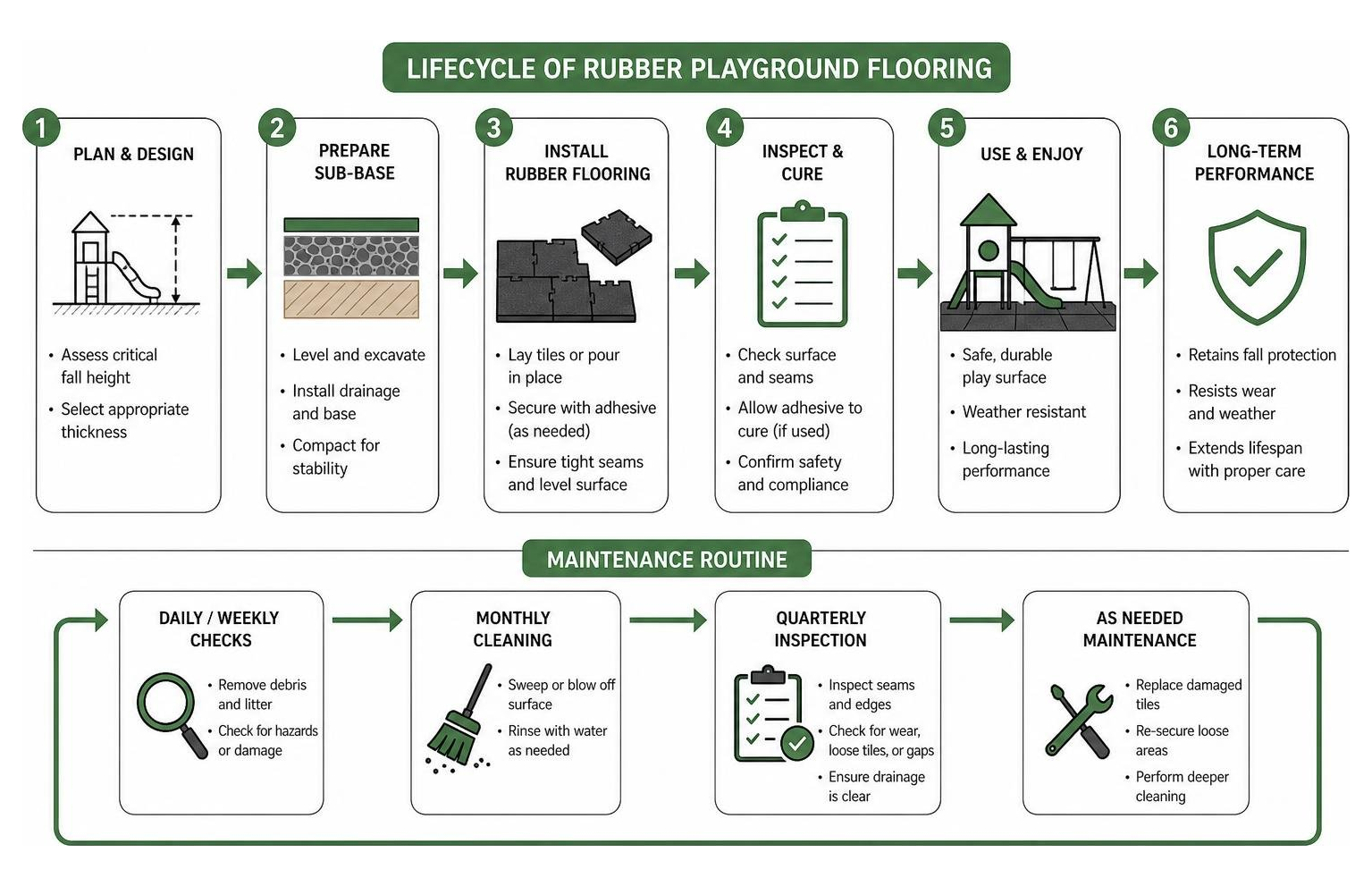
Investing in high-quality playground surfacing requires an upfront financial commitment, but choosing the right material can save you thousands of dollars in long-term maintenance and replacement costs. Let’s look at how different materials compare financially and operationally over their lifespans.
Cost Comparison of Rubber Flooring for Play Areas
While loose-fill materials like wood mulch have a very low upfront cost, they require constant raking, weeding, and annual top-offs. Rubber tiles and poured-in-place systems cost more upfront but boast an incredibly long lifespan with minimal maintenance.
The following table breaks down the average costs you can expect when planning your project:
| Surfacing Material | Upfront Cost per Sq. Ft. | Estimated Lifespan | Maintenance Level |
|---|---|---|---|
| Rubber Playground Tiles | $5.00 – $8.00 (mats/standard tiles) | 10 – 15+ Years | Low (sweep & hose) |
| Poured-in-Place Rubber | Higher (Varies by depth/install) | 10 – 12 Years | Low (occasional roll coat) |
| Rubber Mulch | Lower Upfront Cost | 10+ Years | Medium (periodic raking) |
| Artificial Turf + Pad | $3.00 – $6.00 | 8 – 12 Years | Low to Medium |
For a deeper dive into budgeting, including shipping costs, installation fees, and volume discounts, check out our comprehensive playground rubber flooring price guide.
Long-Term Maintenance and Expected Lifespan
One of the greatest benefits of recycled rubber flooring is its sheer resilience. High-quality rubber tiles are manufactured using 92% recycled rubber from reground automotive tires, which are engineered to withstand extreme heat, freezing temperatures, and heavy friction.
To maximize the 10-to-15-year lifespan of your rubber tiles or poured surface, follow these simple maintenance best practices:
- Weekly Cleaning: Use a leaf blower, broom, or electric sweeper to clear away leaves, pine needles, and dirt.
- Washing: For stubborn dirt or spills, wash the surface with a garden hose. If you are cleaning an indoor play area, vacuuming and damp-mopping with a mild, non-solvent soap (like Dawn or Tide) works beautifully. Avoid any solvent or oil-based cleaners, as they can break down the polyurethane binders holding the rubber together.
- Deep Cleaning: For outdoor installations, a quarterly pressure washing on a low-medium setting with a wide-angle nozzle will keep the surface looking brand new.
- Drainage: Ensure your sub-base allows water to drain freely. Rubber tiles are highly porous, allowing rainwater to pass through the seams and flow away, meaning the playground is dry and ready for use almost immediately after a rainstorm.
Frequently Asked Questions about Playground Surfacing
Are recycled rubber products safe for children and pets?
Yes! High-quality recycled rubber flooring is completely safe for children, pets, and the environment. Because we manufacture our products in North America from American-sourced automotive tires, we maintain strict quality control over the entire composition.
Our rubber tiles contain no toxic chemicals, heavy metals, or BPA. Furthermore, they are manufactured from recycled SBR rubber which does not contain natural latex, making them entirely safe for children with latex allergies. They are also REACH compliant and highly slip-resistant, even when wet. For added peace of mind, look for products that carry IPEMA certification and ASTM safety ratings. You can learn more about finding safe, non-toxic options by reading about playground ground cover rubber mats.
Can rubber tiles be installed directly over grass or dirt?
Yes, they can, but proper site preparation is key. If you lay tiles directly over un-compacted dirt, the ground will settle unevenly over time, causing the tiles to shift and create trip hazards.
To do it right, you should clear the area of grass and debris, level the dirt, compact it firmly, lay down a heavy-duty weed barrier, and secure the tiles using interlocking connectors or edge ramps. For a complete guide on how to prepare your lawn for this type of installation, check out our resource on rubber ground cover for playgrounds.
How do you clean and maintain outdoor rubber tiles?
Cleaning outdoor rubber tiles is incredibly simple. Because they are highly durable and weather-resistant, they do not require heavy scrubbing or specialized chemicals. Regular maintenance simply involves blowing or sweeping off loose debris like leaves and twigs. For mud or sticky spills, a quick spray with a garden hose or a mild mixture of dish soap and water is all it takes.
If you are also considering loose-fill rubber options and want to know how their maintenance and color retention compare to tiles, check out our guide to rubber mulch colors and costs.
Conclusion
Creating a safe, durable, and beautiful play environment doesn’t have to be a guessing game. By opting for high-quality rubber flooring for play areas, you are choosing a solution that protects children from critical falls, minimizes tedious weekend yard work, and diverts scrap tires away from local landfills.
At Replay Surfacing Inc., we are proud to serve communities across our key locations, including Charlotte, Columbia, Raleigh, Sanford, Tucson, Connecticut, Indiana, Nashville, Beaverton, and Lake Charles. Whether you are setting up a commercial sports court, a backyard swing set, or an indoor sensory gym, we have the expertise and localized solutions to help you get the job done right.
Ready to transform your play space into a safe, sustainable haven? Schedule a residential consultation with us today, and let’s build something great together!