
Why Custom Playground Surface Tiles in Beaverton Are the Smarter Choice for Safe, Beautiful Play Areas
Custom playground surface tiles in Beaverton give you full control over safety, design, and durability — all in one modular system. Here’s a quick overview of what they offer:
| Feature | What You Get |
|---|---|
| Safety | Certified fall protection from 4 ft up to 10 ft (ASTM F1292-17A) |
| Customization | Custom colors, logos, patterns, and thickness options |
| Accessibility | ADA-compliant surfaces with transitional ramp edges |
| Material | Recycled rubber (SBR base + EPDM wear layer) |
| Installation | Interlocking DIY-friendly or professionally installed systems |
| Lifespan | ~10 years with low maintenance and individual tile replacement |
Every year, over 200,000 children visit emergency rooms due to playground injuries. The surface underfoot is one of the most critical factors in preventing those injuries — yet it’s often the last thing facility managers think about.
Standard rubber tiles do the job. But custom tiles do it better.
They let you match your brand, meet exact fall height requirements for your equipment, and create play spaces that kids actually want to use. Whether you’re designing a themed schoolyard in Charlotte, an inclusive community park in Columbia, SC, or a rooftop play area in Raleigh, NC — the right surface makes a real difference.
I’m Landon Olson, operator of Replay Surfacing Inc., and I’ve spent my career applying mechanical engineering and sustainable manufacturing principles to turn recycled scrap tires into high-performance custom playground surface tiles in Beaverton. My background spans manufacturing, safety surfacing, and environmental sustainability across multiple industries.
Common custom playground surface tiles vocab:
Designing Bespoke Play Areas with Custom Playground Surface Tiles
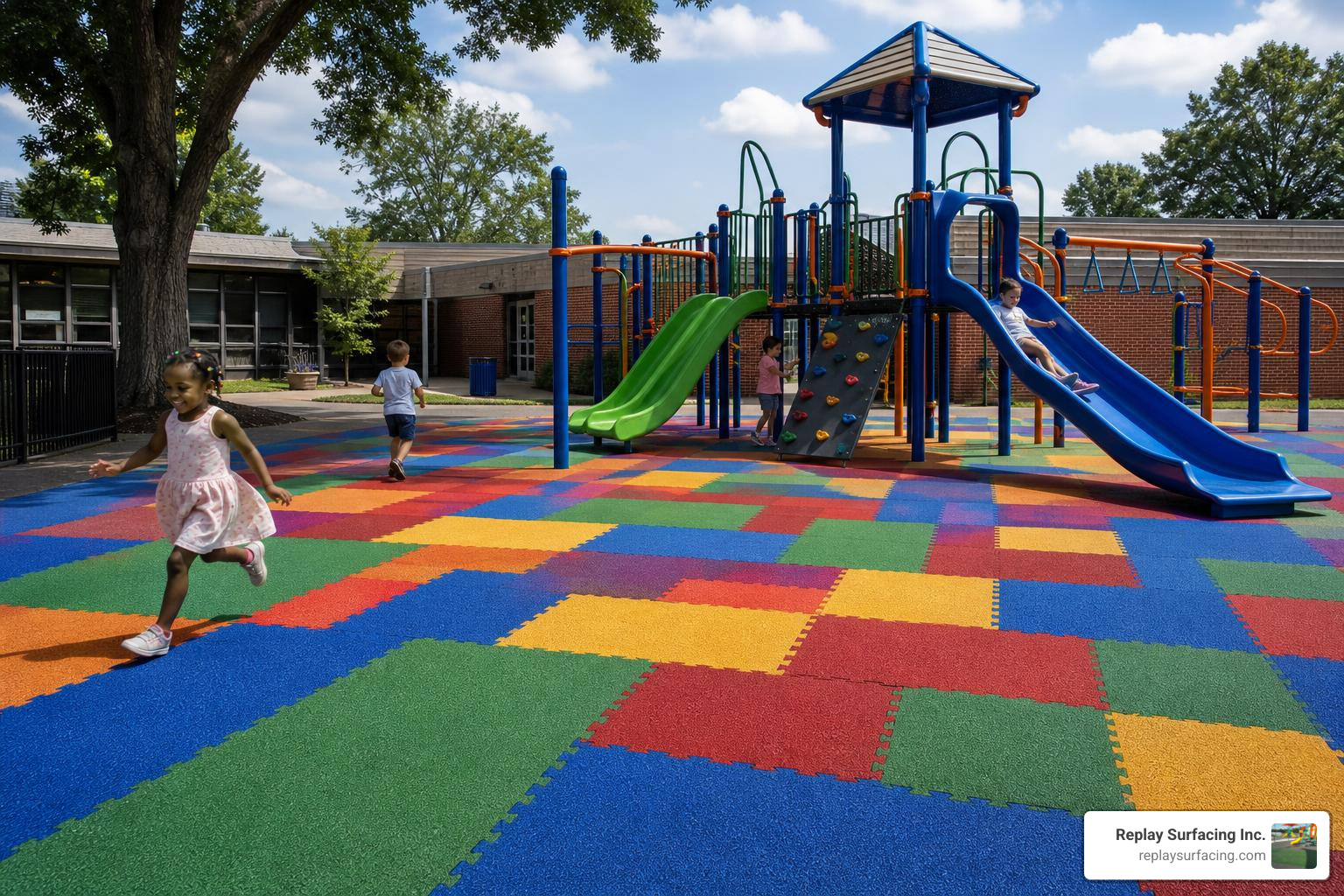
When we talk about designing bespoke play areas, we are talking about moving past the era of gray, industrial-looking safety mats. Modern play areas demand color, energy, and storytelling. Utilizing custom playground surface tiles allows designers, municipalities, and school boards to treat the ground as a canvas.
At Replay Surfacing Inc., we specialize in turning environmental hazards—specifically end-of-life tires—into durable, beautiful, and highly functional safety surfaces. By combining recycled tire rubber (SBR) for the shock-absorbing base and premium EPDM (Ethylene Propylene Diene Monomer) or vulcanized composition rubber (VCR) for the top wear layer, we create tiles that offer unparalleled design flexibility.
These materials are engineered to withstand heavy foot traffic, brutal weather conditions, and intense UV exposure without fading or crumbling. If you are looking to build a space that prioritizes health alongside aesthetics, you can find More info about non-toxic options to ensure your surface is completely free of harmful chemicals and heavy metals.
Standard vs. Custom Playground Surface Tiles
What is the actual difference between standard off-the-shelf tiles and custom solutions?
Standard tiles typically come in a single thickness, a limited palette of basic colors (like black, dark red, or forest green), and basic straight edges. They are utilitarian. Custom tiles, on the other hand, are engineered to order. Here is how they differ across key technical specifications:
- Thickness Options: Custom tiles can be manufactured in precise increments ranging from 1.5 inches up to 5 inches thick. This allows you to match the exact fall height requirements of different play zones on a single playground without paying for unnecessary material where fall heights are low.
- Interlocking Mechanisms: High-quality custom tiles feature advanced interlocking systems, such as patented perimeter locking systems, hidden puzzle joints, or heavy-duty dowel connectors. These systems prevent the tiles from shifting, curling at the corners, or separating over time, which are common issues with cheap, straight-edged standard tiles.
- Beveled Edges & Transitional Ramps: Custom systems include integrated, color-matched beveled edges and ramp tiles. This ensures a smooth transition from the surrounding grass, concrete, or asphalt, eliminating trip hazards and making the area fully accessible.
- Built-In Drainage Channels: The underside of custom tiles is molded with a network of drainage channels. This allows rainwater to pass through the porous tile surface and flow away along the sub-base, preventing puddles and ensuring the playground is ready for use immediately after a heavy rainstorm.
For a deeper dive into how these connection systems work under real-world conditions, read our comprehensive Guide to interlocking outdoor tiles.
Creative Themes and Branding Opportunities
One of the most exciting aspects of working with custom playground surface tiles is the sheer level of design freedom. Because we can cut, mold, and color-mix these tiles to exact specifications, the surface can actively contribute to the play experience.
- Color Customization: You are not limited to solid colors. You can use custom EPDM color mixers to create unique blends—such as a sandy beige for a beach-themed play area, or a vibrant blue-and-gray checkerboard pattern for a school in Sanford, NC.
- Embedded Logos and Graphics: Want to display a school mascot in Charlotte, NC, or a town seal in Indiana? Custom tiles can be precision-cut or factory-molded with high-resolution logos, text, and branding.
- Themed Patterns: You can easily establish distinct play zones. For instance, you can use green and blue tiles to map out “land” and “water” zones, or create a winding yellow path that guides children through an obstacle course.
- Visual Cues and Sensory Play: Incorporating games directly into the tiles—like hopscotch grids, four-square courts, or sensory paths—maximizes the play value of every square foot. Visual cues can also mark safe boundaries around high-motion equipment like swings and slides, letting children know where it is safe to run.
Safety Standards, Fall Heights, and ADA Compliance
Safety is the absolute foundation of everything we do. In the United States, playground safety surfaces must comply with strict testing standards, most notably ASTM F1292-17A (Standard Specification for Impact Attenuation of Surfacing Materials within the Use Zone of Playground Equipment) and the guidelines set by the U.S. Consumer Product Safety Commission (CPSC).
When a child falls, the safety surface must absorb the impact energy to prevent severe head trauma. This is measured by two primary scientific metrics during impact testing:
- G-max: The measure of maximum acceleration (shock) experienced during impact. A lower G-max means a softer landing.
- Head Injury Criterion (HIC): A measure of the impact severity and duration. To meet safety standards, the HIC value must remain below 1,000, and the G-max must remain below 200 at the equipment’s designated fall height.
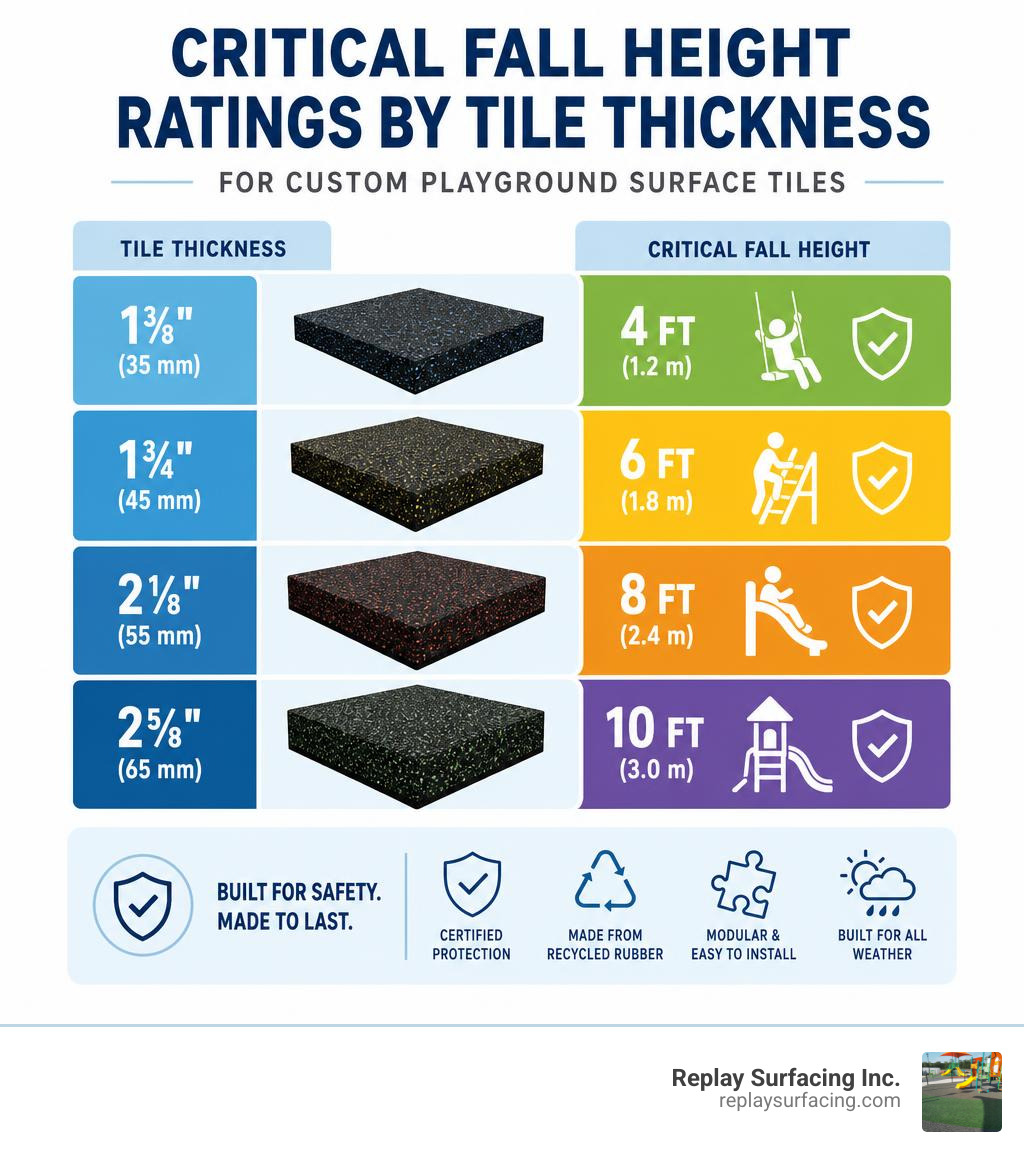
Custom tiles achieve high force reduction (often exceeding 74%) and controlled energy restitution (around 44%) by combining a dense, wear-resistant EPDM top layer with a highly resilient, engineered SBR rubber base cushion.
| Tile Thickness | Certified Critical Fall Height Rating | Common Application / Equipment Type |
|---|---|---|
| 1.5 Inches | 4 Feet | Spring riders, low balance beams, toddler play areas |
| 2.25 to 2.5 Inches | 5 to 6 Feet | Small slides, climbing walls, standard play structures |
| 3.25 Inches | 8 Feet | Large slide decks, overhead ladders, monkey bars |
| 4.25 to 5.0 Inches | 10 Feet | High-climbing nets, double-decker play towers |
Note: Some systems, like lightweight high-impact tiles, can achieve a 6-foot fall height rating at lower thicknesses when paired with specialized 1.5-inch foam shock pads.
Why Choose Custom Playground Surface Tiles for Public Parks in Columbia, SC?
For municipal park directors in Columbia, SC, public safety and inclusive design are top priorities. Loose-fill materials like wood mulch or pea gravel are notoriously difficult for children using wheelchairs, walkers, or strollers to navigate. In fact, loose-fill surfaces quickly degrade, scatter, and develop deep ruts, failing to meet the Americans with Disabilities Act (ADA) requirements for accessibility.
By choosing custom playground surface tiles, municipalities in Columbia can guarantee a stable, firm, and slip-resistant surface that remains fully ADA-compliant year-round. Our custom tiles feature integrated transitional ramps that ensure a seamless transition for wheelchairs. Furthermore, our tiles are engineered to withstand the intense, humid South Carolina summers without warping or cracking, providing long-term peace of mind for city inspectors. To learn more about local municipal requirements, check out the Columbia playground surfacing standards.
Meeting Fall Height Requirements in Regional Climates like Connecticut
In northern climates like Connecticut, playground surfaces face a completely different set of environmental challenges. Freezing temperatures, heavy snowfall, and ice can cause cheap rubber materials to stiffen, drastically reducing their impact-absorbing capabilities when they are needed most.
Custom-engineered tiles solve this problem through material science. By utilizing high-quality polyurethane binders and vulcanized rubber that maintain flexibility even in sub-zero temperatures, these tiles retain their certified fall height ratings throughout the winter. For high-fall-risk zones, we often recommend installing high-density foam underlayment or specialized shock pads beneath the tiles. This dual-layer system provides consistent, year-round protection that meets the strict Connecticut playground safety guidelines.
Installation, Site Prep, and Cost Comparisons
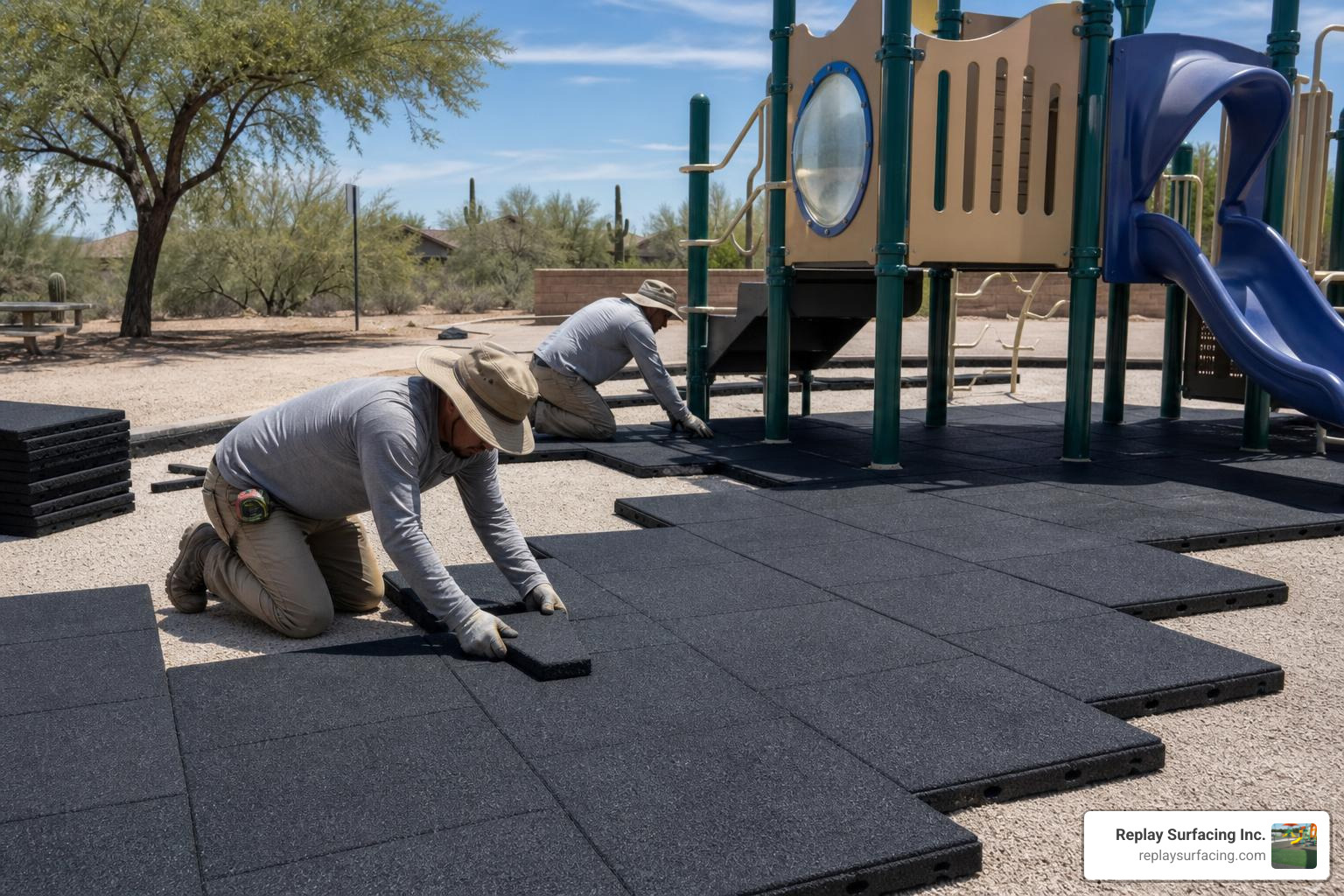
A safety surface is only as good as its installation. To ensure your custom tiles perform to their certified safety ratings for their entire lifespan, proper site preparation is mandatory.
Custom tiles can be installed over three primary sub-bases:
- Concrete (The Gold Standard): Provides a perfectly flat, permanent base. Ideal for urban parks, rooftops, and schools.
- Asphalt: Another excellent, stable option that prevents shifting or sinking.
- Compacted Stone/Aggregate: A cost-effective, porous option. It requires a minimum of 3 to 4 inches of crushed, compacted stone wrapped in geotextile fabric to ensure proper drainage and prevent weed growth.
While some interlocking systems are DIY-friendly, commercial projects in high-traffic areas are best handled by professional installers who can ensure proper sub-base compaction, precise tile alignment, and secure adhesive application. If you are sourced and ready to browse available options, check out our Playground mats for sale.
Step-by-Step Installation of Interlocking Systems
If you are tackling a residential project or a smaller community space in Tucson, AZ, or Nashville, TN, installing an interlocking tile system is highly manageable. Here is the step-by-step process:
- Excavation and Site Prep: Excavate the area to the required depth (accounting for the tile thickness and sub-base). Ensure the ground slopes slightly away from play structures to assist with water runoff.
- Sub-base Installation: Lay down geotextile fabric, then spread and compact your aggregate base (or pour your concrete/asphalt pad). The base must be perfectly level and free of debris.
- Acclimatization: Lay the tiles out near the installation site for at least 24 hours. This allows the rubber to adjust to the local ambient temperature and humidity, preventing gaps or bucking after installation.
- Layout Planning: Start from the center of the playground and work outward, or start along a straight border. Use a half-bond (brick) pattern to offset the seams, which increases the structural integrity of the entire surface.
- Interlocking the Tiles:
- If using puzzle-joint tiles, line up the interlocking tabs and tap them together using a rubber mallet.
- If using dowel systems, insert the plastic connectors into the pre-drilled holes on the side of one tile, then push the adjacent tile onto the dowels.
- If using a built-in alignment foot or perimeter locking system, ensure the locking mechanisms click securely into place to prevent future curling.
- Edge Trimming: Use a heavy-duty utility knife or a jigsaw with a coarse blade to trim the perimeter tiles to fit your border.
- Adhesive Application (Optional but Recommended): For high-traffic areas, apply a high-strength polyurethane adhesive (such as a single-component urethane glue) along the interlocking joints or to the sub-base around the perimeter to lock the system in place.
For a comprehensive breakdown of interlocking safety mats, check out our Interlocking Playground Mats Ultimate Guide and our Playsafe Interlocking Tiles Ultimate Guide.
Cost-Benefit Analysis: Custom Tiles vs. Traditional Loose-Fill Surfacing
When budgeting for a playground, it is easy to suffer from sticker shock when comparing rubber tiles to wood mulch. However, looking only at the upfront cost is a major financial mistake.
Let’s look at how the numbers actually play out over a 10-year period:
| Cost Category | Custom Rubber Tiles | Loose-Fill Wood Mulch | Engineered Wood Fiber (EWF) |
|---|---|---|---|
| Initial Material Cost | High ($7.00 – $15.00+ per sq. ft.) | Low ($1.50 – $3.00 per sq. ft.) | Moderate ($3.00 – $5.00 per sq. ft.) |
| Initial Installation | Moderate to High (Requires prep) | Low (Simple spreading) | Low to Moderate |
| Annual Maintenance | Extremely Low (Blower/Hose) | High (Raking, weeding, filling) | High (Tilling, topping up) |
| Replacement Frequency | None (Spot-replace single tiles) | Annual top-offs required (1-2 inches) | Top-offs required every 2 years |
| 10-Year Total Cost | Highly Cost-Effective | Very High (Accumulated labor + material) | Moderate to High |
| ADA Compliance | Guaranteed 100% of the time | Rarely compliant due to displacement | Requires constant maintenance to stay compliant |
While loose-fill materials are cheap to buy, they are incredibly expensive to maintain. Wood mulch decomposes, blows away in high winds, washes out in heavy rain, and hides dangerous debris like broken glass or animal waste (no one wants wood chips with their Caesar salad, and local cats will treat loose sand or mulch as a giant litter box).
Custom rubber tiles represent a one-time capital investment that pays for itself within 3 to 4 years through eliminated maintenance costs.
Durability and Performance in High-Traffic Municipal Parks in Raleigh, NC
For high-traffic municipal parks in Raleigh, NC, the physical demands on a playground surface are relentless. Hundreds of kids run, jump, pivot, and drag their feet across the surface daily. Under these conditions, loose-fill materials quickly displace, exposing the hard ground beneath slides and swings—creating immediate safety hazards.
Custom playground surface tiles excel in these high-impact zones. If a specific tile under a swing set eventually shows wear after years of heavy use, you don’t have to replace or repave the entire playground. You simply pop out the damaged tile and lock a new one in its place. This modularity saves municipalities thousands of dollars in long-term maintenance and keeps play areas open without costly downtime.
For local assistance, consult our Raleigh playground surfacing options to see how we serve the local community.
Frequently Asked Questions About Custom Playground Tiles
How long do custom rubber playground tiles last?
You can generally expect high-quality custom rubber playground tiles to last around 10 years before you need to begin spot-replacing high-wear areas. Many premium tile systems carry a 10-year limited warranty.
Their actual lifespan depends on installation quality, local weather conditions, and foot traffic. To maximize their longevity, choose tiles with built-in UV stabilizers to prevent color fading and dry rot from sun exposure. For tips on managing wear in busiest zones, see Wear and Tear No More: Choosing the Best Mats for High Traffic Playground Areas.
Are custom rubber tiles safe and non-toxic for children?
Yes, reputable custom rubber tiles are highly safe and non-toxic. At Replay Surfacing Inc., we use premium, cleaned recycled rubber bound with high-quality, non-toxic polyurethane binders.
Unlike cheap imported rubber products that may contain trace heavy metals or strong chemical odors, our tiles are engineered to meet strict environmental and indoor/outdoor air quality standards. The top EPDM wear layer is completely inert and safe for skin contact. For more guidance on choosing safe materials, read The Safe Zone: Everything About Choosing the Right Playground Safety Mats and How to Choose the Perfect Playground Safety Mat.
Can custom tiles be installed over grass or dirt?
While it is technically possible to lay interlocking tiles directly over dirt or grass for temporary residential use, we do not recommend it for permanent or commercial installations.
Over time, the soil beneath the tiles will shift, compress, and wash away, leading to an uneven surface, tripping hazards, and compromised fall protection. For a proper, long-lasting installation, you must excavate the grass, lay down a geotextile fabric to block weeds, and install a compacted aggregate base of crushed stone, or lay the tiles over concrete or asphalt. If you want to explore standard rubber options, browse our resources on Rubber Playground Mats and learn how to Enhance Safety with Rubber Playground Mats.
Conclusion
At Replay Surfacing Inc., we believe that a playground should be a place of endless joy, creative discovery, and absolute safety. By choosing custom playground surface tiles, you are investing in a sustainable, high-performance solution that transforms environmental waste into a beautiful, protective foundation for play.
Whether you are designing a community park in Columbia, SC, updating a schoolyard in Charlotte, NC, or setting up a safe recreational area in Nashville, TN, or Tucson, AZ, our team is here to help you bring your vision to life. From custom color blending and embedded brand logos to precise safety engineering for critical fall heights, we provide the expertise and local support you need.
Ready to design a bespoke play area that stands the test of time? Explore custom playground surfacing solutions and contact us today for a custom design consultation.
Our regional service offices are ready to assist you:
- North Carolina: Charlotte, Raleigh, Sanford
- South Carolina: Columbia
- Tennessee: Nashville
- Arizona: Tucson
- Northeast & Midwest: Connecticut, Indiana
- West Coast & South: Beaverton (OR), Lake Charles (LA)