

Why Facility Managers Are Switching to Rubber Playground Border Edging in Raleigh, NC
Rubber playground border edging in Raleigh, NC is the most durable, low-maintenance way to contain playground surfacing, define play area perimeters, and keep debris out — all while being made from 100% recycled tires.
Here are the best rubber playground border edging options at a glance:
| Product Type | Size | Best For |
|---|---|---|
| 4″ x 4″ x 92″ Rubber Timber | 40 lbs | Residential playgrounds, garden edging |
| 4″ x 6″ x 92″ Rubber Timber | ~60 lbs | Commercial playgrounds, mulch containment |
| 6″ x 8″ x 92″ Rubber Timber | ~102 lbs | Heavy-duty parks, high-traffic areas |
| Flexible Interlocked Border | 4″ H x 4′ L x 3″ W | Curved or serpentine playground layouts |
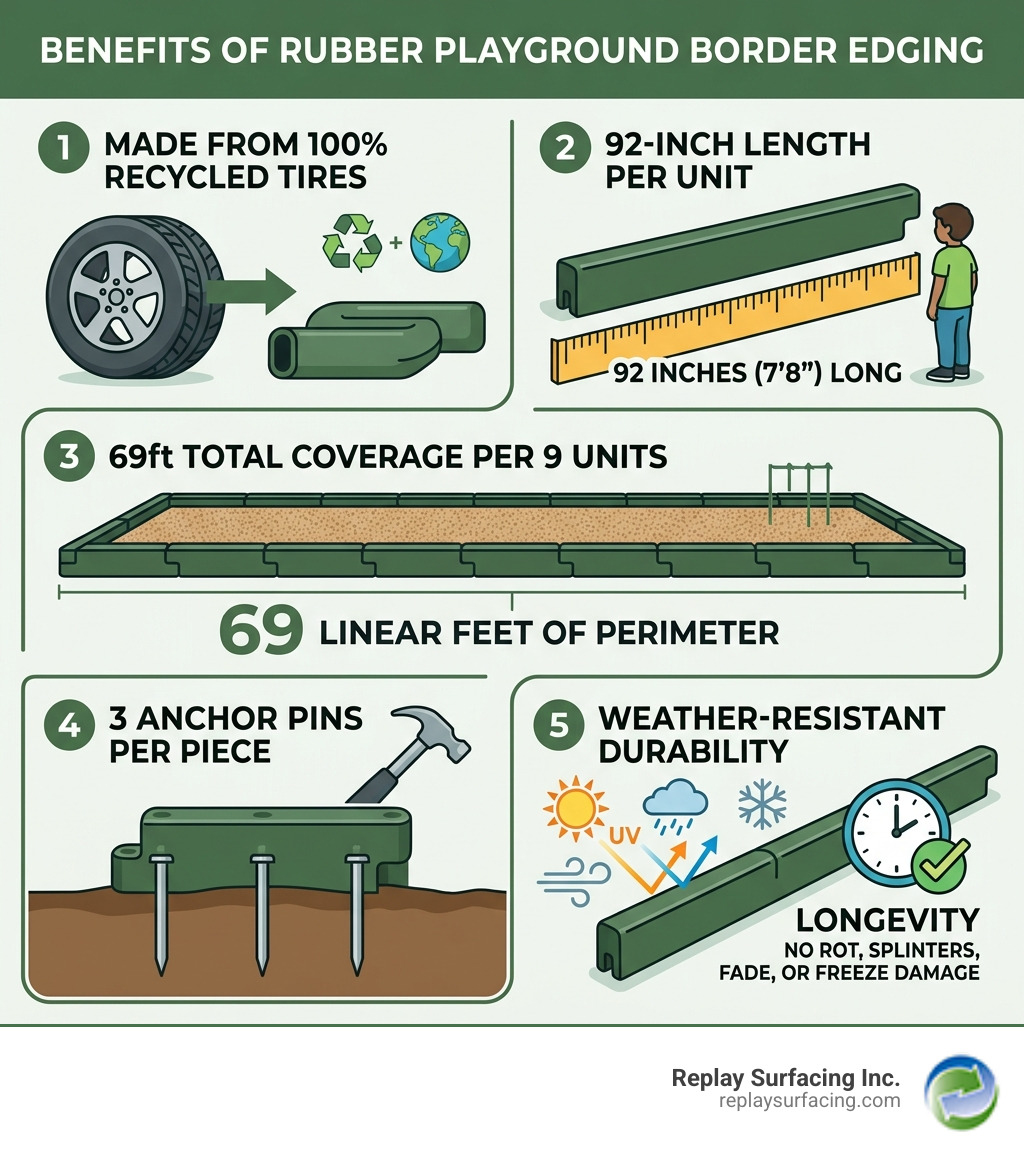
Each section runs 92 inches (7’8″) long, and a standard pack of 9 units covers 69 linear feet of perimeter. Most products include 3 metal anchoring pins per piece for a secure, no-trench installation.
If you manage a park or facility and you’re tired of replacing warped wood timbers or cracked plastic edging every few seasons, rubber borders are worth a serious look. They don’t rot, splinter, freeze, or fade — and they’re built from materials that would otherwise sit in a landfill.
I’m Landon Olson, operator of Replay Surfacing Inc., and with a background in mechanical engineering and years of hands-on experience in safety surfacing, I’ve seen how the right rubber playground border edging in Raleigh, NC transforms both the safety and longevity of a play space. Read on for a full breakdown of the best products, installation tips, and what to look for before you buy.
Why Choose Rubber Playground Border Edging Over Wood?
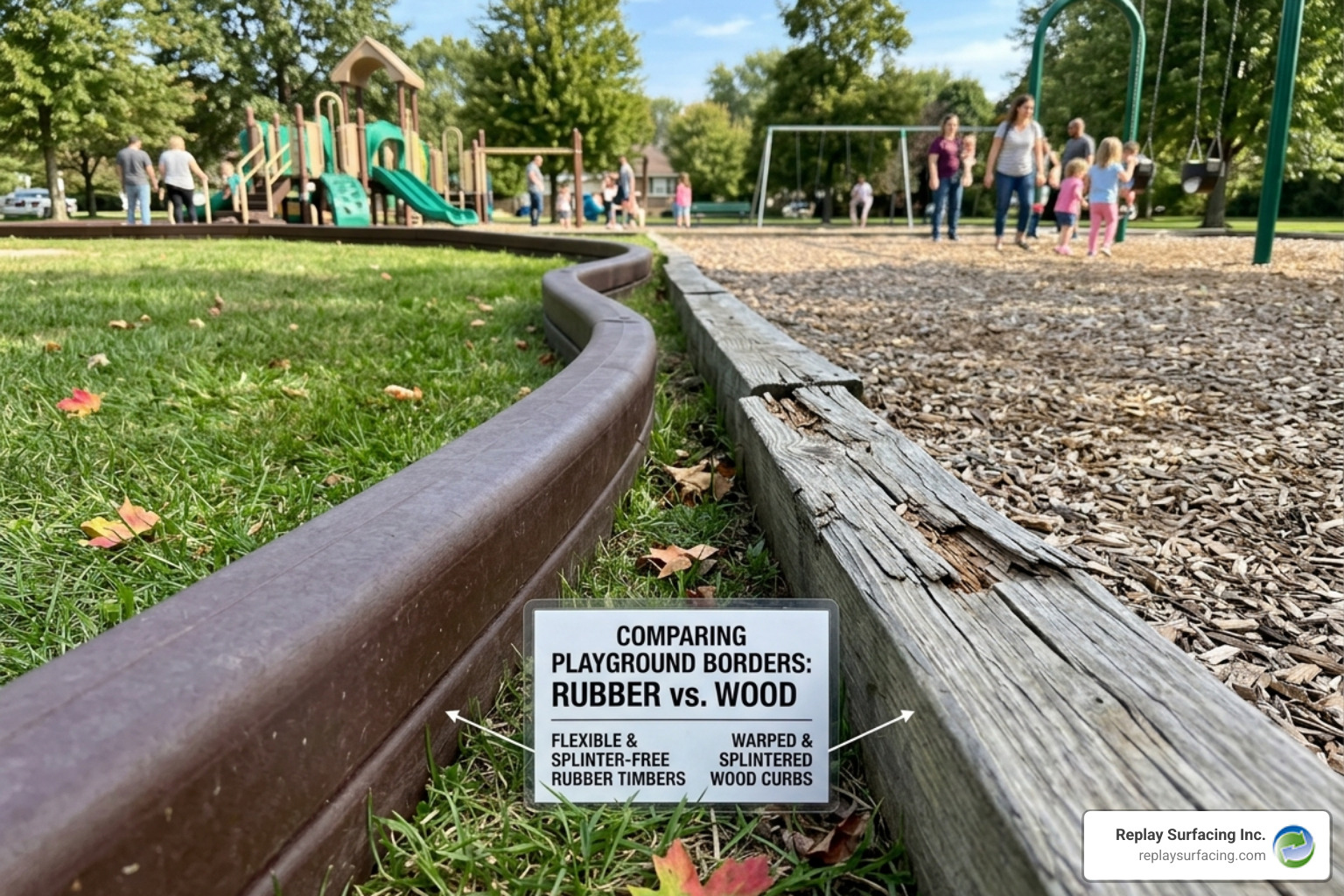
When we talk to park managers in cities like Raleigh, NC, or Nashville, TN, the conversation often turns to the “hidden costs” of traditional wood timbers. While wood might seem cheaper upfront, it carries a heavy burden of maintenance. Over time, wood curbs warp, rot, and—most dangerously—splinter. In a playground environment, splinters are more than just a nuisance; they are a safety hazard for children.
Rubber playground border edging offers a superior alternative. Because these borders are molded from 100% recycled automobile tires, they are inherently weather-resistant. They don’t absorb water, which means they won’t rot or harbor mold. Unlike wood treated with arsenic or other chemicals, recycled rubber is non-toxic and clean.
Furthermore, rubber provides a “give” that wood simply cannot match. If a child trips near the perimeter, hitting a rounded rubber edge is significantly safer than striking the sharp corner of a 4×4 timber. Whether you are looking for specialized commercial surfacing, the move toward rubber is a move toward long-term durability.
Standard Dimensions for rubber playground border edging
One of the most important things to understand before ordering is the scale of these timbers. We aren’t talking about flimsy garden strips; these are heavy-duty structural components.
- Length: The industry standard for a rubber timber is 92 inches, which is exactly 7 feet 8 inches. This length is intentional—it minimizes the number of seams in your perimeter, creating a cleaner look and fewer points of potential failure.
- Weight: Depending on the height and width, a single unit can weigh between 40 lbs (for a 4″x4″ residential timber) and 102 lbs (for a 6″x8″ commercial timber). This weight ensures the border stays exactly where you put it.
- Height Options: Choosing the right height depends on your surfacing depth. If you are using loose-fill mulch, you generally want a border that sits at least 2 inches higher than the mulch level to prevent “kick-out.” For more details on calculating your needs, our Rubber Mulch Yard Guide 2026 is an excellent resource.
Color and Aesthetic Options for Your Park
Gone are the days when recycled rubber only came in “tire black.” Today, we can match the aesthetic of any park from Tucson, AZ, to Raleigh, NC. The most popular colors include:
- Redwood: A deep, warm red that mimics the look of natural wood without the maintenance.
- Earth-tone Brown: Perfect for blending into natural landscapes or wooded park areas.
- Black: Provides a sleek, modern, and high-contrast look that hides dirt exceptionally well.
- Forest Green: Often used in parks with heavy foliage to create a seamless transition between the play area and the grass.
In places like Raleigh, NC, we see many facilities opting for Earth-tone Brown to maintain a classic park feel while enjoying the modern benefits of recycled materials.
Key Specifications and Safety Standards
Safety isn’t just a buzzword; it’s a regulated standard. When we install rubber playground border edging, we ensure it complements the overall safety of the surfacing. The borders themselves often feature a rounded top profile, which eliminates sharp edges.
| Feature | 4-inch Height | 6-inch Height | 8-inch Height |
|---|---|---|---|
| Weight | ~40-44 lbs | ~55-60 lbs | ~102 lbs |
| Best Surfacing | 2-3″ Pour-in-Place | 4″ Loose Fill | 6″ Heavy-Duty Mulch |
| Anchoring | 3 x 14″ Spikes | 3 x 18″ Spikes | 3 x 24″ Spikes |
| Drainage | Built-in Ports | Built-in Ports | Built-in Ports |
These borders are designed to work alongside Playground Rubber Mulch to meet ASTM F-1292 standards for impact attenuation. A critical feature often overlooked is the drain-weep port. These small channels at the bottom of the timber allow water to flow out of the playground area, preventing the “bathtub effect” where water pools under the mulch and creates a muddy mess.
Step-by-Step Installation Guide for Rubber Edging
One of the biggest selling points for our clients in Indiana or Connecticut is that you don’t need a construction crew to install these. In fact, many of our customers treat this as a DIY Playground Flooring project.
- Clear the Perimeter: Lay out your timbers in the desired shape. One of the best things about rubber playground border edging is its flexibility. You can create serpentine curves or “odd” shapes that wood simply can’t handle.
- No Trenching Required: Unlike plastic edging that often requires a 4-inch deep trench, rubber timbers are heavy enough to sit directly on the surface.
- Drilling: Most timbers come pre-drilled, but if yours aren’t (or if you’ve cut a timber to a custom length), you’ll need to drill three 3/8″ holes: one 8 inches from each end and one in the center.
- Secure with Spikes: Insert the 14-inch to 24-inch rebar anchoring pins into the holes.
- The “Recess” Trick: This is the most important safety step. Use a rubber mallet to drive the spike into the ground until the head is at least 1 inch below the surface of the rubber. This prevents the metal head from becoming a trip hazard or a “hot spot” in the summer sun.
Tools Needed for rubber playground border edging Projects
Before you start your project in Beaverton or Lake Charles, make sure you have these essentials on hand:
- Power Drill & 3/8″ Bit: For creating or clearing anchor holes.
- Rubber Mallet: To drive the spikes without damaging the timber surface.
- Reciprocating Saw: If you need to trim a timber to fit a specific dimension or create a mitered corner.
- Tape Measure: To ensure your linear footage matches your order.
If you’re also tackling the floor itself, our guide on DIY Playground Rubber Flooring can help you coordinate the entire installation.
Maintenance and Long-Term Durability
The “set it and forget it” nature of rubber is why so many park directors love it. While wood needs annual staining or replacement of rotted sections, rubber requires almost zero upkeep.
In the dusty environments of Tucson or the pollen-heavy springs of Charlotte, a simple garden hose is usually all you need to keep the borders looking new. For larger debris like leaves or grass clippings from the mower, a leaf blower on a low setting works perfectly.
Because these borders are made from vulcanized rubber, they are immune to the freeze-thaw cycle. In our northern service areas like Indiana or Connecticut, wood often cracks when water enters the grain and freezes. Rubber simply expands and contracts without losing its structural integrity. If you are using these alongside a Mulch Mat Roll, you’ll find the entire system stays clean and contained for years.
Frequently Asked Questions about Rubber Borders
How many borders do I need for my playground perimeter?
This is the most common question we get. Since each timber is 92 inches (7.66 feet), you simply take your total linear footage and divide by 7.66.
- 9 Timbers = 69 linear feet (The standard minimum order for many commercial projects).
- 18 Timbers = 138 linear feet.
- 27 Timbers = 207 linear feet.
That if you have a lot of corners or curves, you might lose a few inches here and there to miter cuts, so we always recommend ordering one extra timber just in case. If you’re using loose-fill, pairing these with Rubber Mulch Mats at high-traffic points (like under swings) will further reduce your maintenance needs.
Can rubber borders be used for garden landscaping?
Absolutely! While they are designed for playgrounds, their durability makes them excellent for flower beds, driveways, and walkways. They are particularly good at containing pebbles or gravel, which tend to spill over traditional plastic edging. Because they can bend into serpentine shapes, they are a favorite for high-end residential landscaping. Some homeowners even use them with a Fake Mulch Mat to create a completely maintenance-free garden bed.
Are there bulk purchasing options for large parks?
Yes. For large-scale municipal projects in cities like Columbia, SC, or Raleigh, NC, buying by the pallet is the most cost-effective way to go.
- Pallet Sizes: A standard pallet can hold up to 35 borders.
- Shipping: These are heavy items! They typically ship via freight with liftgate curbside delivery.
- Minimums: Many commercial-grade borders have a minimum order of 6 to 9 units to qualify for specialized shipping rates.
For those looking to protect specific equipment like swing sets, adding a Playset Rubber Mat to your bulk order can save on total shipping costs.
Conclusion
At Replay Surfacing Inc., we believe that building a better playground starts with better materials. By choosing rubber playground border edging, you aren’t just buying a product; you’re investing in a sustainable cycle that keeps tires out of landfills and keeps children safe on the playground.
Whether you’re in the desert of Tucson, the rolling hills of Nashville, or right here in Raleigh, NC, our team is here to help you transform your facility. We specialize in turning environmental hazards into durable, customizable, and beautiful surfaces that stand the test of time.
Ready to upgrade your park’s perimeter with the best in the industry? Contact our rubber paving company for a quote today, and let’s build something sustainable together.