
Why Invest in Rubber Playground Surfacing Sanford Facilities Need
Rubber playground surfacing gives Sanford schools, parks, and daycare centers a durable, low-maintenance, ADA-accessible safety surface that cushions falls and drains quickly after heavy rain. The most common options are poured-in-place rubber, interlocking rubber tiles, and bonded rubber mulch, each designed to meet ASTM F1292 impact-attenuation standards while reducing the risk of serious head injuries.
Every playground is built for adventure, but scraped knees and hard falls should not be part of the everyday routine. When children climb, swing, and jump, the ground underneath them acts as the primary safety barrier. That is why choosing the right surfacing is the single most critical decision a park director, school principal, or daycare manager will make.
According to national safety data from the U.S. Consumer Product Safety Commission, over 200,000 children are treated in U.S. emergency rooms each year for playground-related injuries, and falls directly to the surface account for the vast majority of these incidents. High-impact collisions with hard surfaces like packed dirt, asphalt, or degraded loose fill can lead to severe fractures and head trauma. Fortunately, high-performance rubber surfacing can reduce the risk of life-threatening head injuries from falls by up to 90% compared to non-impact-absorbing materials.
Meeting safety standards is not just a best practice—it is an engineering discipline. In the playground industry, compliance hinges on ASTM F1292, the standard specification for impact attenuation of surfacing materials within the use zone of playground equipment. This standard measures two critical metrics during impact testing: G-max (peak deceleration) and the Head Injury Criterion (HIC). To pass, a surface must yield a G-max of less than 200 and an HIC score below 1,000 upon impact from a designated height.
This measurement determines the system’s critical fall height—the maximum fall height from which a life-threatening head injury would not be expected. For modern rubber surfacing, the critical fall height typically ranges between 6 and 10 feet, depending on the thickness of the shock-absorbing base pad. For parents and administrators seeking a deeper understanding of these protective metrics, reviewing our parents’ guide to playground surfacing highlights how critical fall height ratings directly correlate with child safety.

At Replay Surfacing, our crew works across our regional hubs in Sanford, Raleigh, and Charlotte, NC, as well as locations like Columbia, SC, Nashville, TN, and Tucson, AZ, to ensure that every safety layer is poured and compacted to exact depth specifications. We leave no room for guesswork when young safety is on the line.
Climate Resilience in Sanford Heat and Rain
Playgrounds face a constant battle against the elements. A surface that performs well in mild conditions can easily break down when subjected to relentless sun, high humidity, and sudden seasonal downpours.
High ultraviolet (UV) exposure can degrade lower-quality binders, turning a once-pliant playground surface brittle, chalky, and faded. To prevent this, our systems utilize premium, UV-stabilized aliphatic polyurethane binders and top-tier EPDM (Ethylene Propylene Diene Monomer) or TPV rubber granules. These compounds resist solar fading and heat oxidation, retaining their flexibility and vivid coloration year after year.
Rain resilience is equally vital. When heavy thunderstorms sweep through, loose-fill surfaces like wood chips or sand quickly float away, wash into storm drains, or turn into soggy, insect-harboring mud pits. In contrast, seamless rubber surfacing systems feature a porous structure that lets water drain through vertically and horizontally toward engineered collection points. The top layer dries rapidly, allowing children to safely return to play shortly after the rain stops, without tracking mud into classrooms or slipping on slick puddles.
Environmental Impact and Tire Recycling
Every year, millions of scrap tires are discarded, creating massive environmental hazards and fire risks in landfills. By engineering high-performance safety surfaces from recycled materials, we convert this environmental liability into durable community assets.
Recycled rubber playground surfacing diverts approximately 100 million pounds of scrap tires from landfills annually across the United States. A single commercial playground installation can repurpose hundreds of end-of-life vehicle tires. Using recycled tire playground flooring allows municipal park systems and school districts to meet stringent sustainability goals while investing in proven impact safety.
The tires undergo a multi-stage shredding, cleaning, and magnetic separation process to remove 100% of the internal steel belts and fiber cords. What remains is clean, consistent, shock-absorbing rubber buffing material that forms the resilient cushion layer beneath the play surface. It is a closed-loop recycling success story that protects both children and the planet.
Evaluating Rubber Playground Surfacing for Sanford Facilities
When municipal planners, facility directors, and school boards evaluate playground surfaces, upfront cost is only one piece of the puzzle. Lifecycle durability, routine maintenance overhead, impact performance over time, and accessibility all determine the true value of an installation.
The table below provides an objective comparison of modern rubber surfacing systems against traditional loose-fill alternatives:
| Surfacing Material | Durability & Lifespan | Ongoing Maintenance Needs | Impact Attenuation (ASTM F1292) | ADA Accessibility |
|---|---|---|---|---|
| Poured-in-Place Rubber (PIP) | 10–15+ Years | Low (occasional wash, periodic topcoat) | Exceptional (customizable depth up to 10+ ft fall height) | Fully Accessible (seamless, firm, stable) |
| Interlocking Rubber Tiles | 8–12 Years | Low to Moderate (inspect seams/edges) | High (factory-molded density ratings) | Fully Accessible (when properly ramped and flush) |
| Poured Rubber Mulch / Bonded | 7–10 Years | Low to Moderate (topical recoating) | High (natural texture with solid cushion) | Highly Accessible (bonded, no loose displacement) |
| Loose Engineered Wood Fiber (EWF) | 1–2 Years (requires constant topping) | High (daily raking, regular replenishing, weed pulling) | Variable (decreases as wood decomposes or displaces) | Poor to Fair (high rolling resistance for wheelchairs) |
| Loose Sand / Pea Gravel | Indefinite (material degrades/compacts) | Very High (raking, debris removal, displacement fixes) | Poor (compacts under moisture, low shock absorbency) | Non-Compliant (inaccessible to mobility devices) |
Investing in poured-in-place rubber or bonded systems eliminates the continuous expense of purchasing, trucking, and raking replacement wood chips every single spring.
Popular Surfacing Options and Installation Requirements
Selecting the right playground surface involves matching the system’s structural strengths to the specific age group, foot traffic levels, and equipment configuration of your site.
Types of Rubber Playground Surfacing Sanford Facilities Utilize
Depending on project scope and design goals, commercial facilities generally choose among three primary rubber systems:
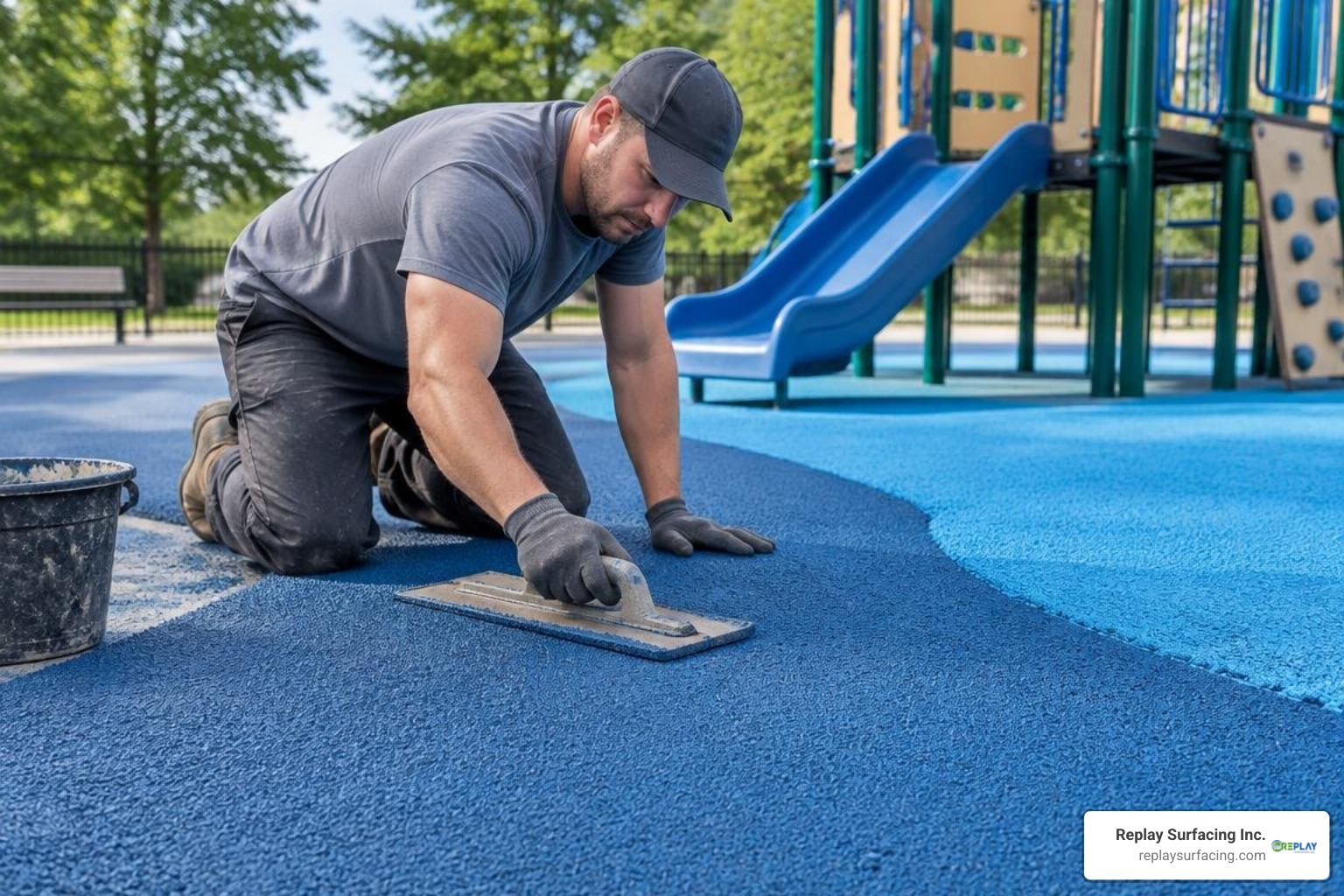
- Poured-in-Place (PIP) Rubber: The gold standard for modern public parks and schools. PIP is a dual-layer system consisting of a thick, shock-absorbing cushion base made from recycled tire rubber, topped with a dense, wear-resistant EPDM or TPV granule cap. Because it is hand-troweled on-site, it is completely seamless, allowing for custom school logos, dynamic color zones, and playful themed patterns. Those interested in the chemistry and application of poured systems can explore wetpour rubber surfacing for technical specifics.
- Interlocking Rubber Tiles: Factory-molded tiles provide uniform thickness and consistent impact attenuation straight out of the box. They are ideal for straight-line play zones, rooftop daycares, or indoor fitness spaces where precision modular installation is required.
- Bonded Rubber Mulch: For sites that desire a rustic, wooded aesthetic without the mess of loose mulch, bonded rubber combines shredded recycled rubber with high-tensile binders. It creates a single, unified, porous mat that stays firmly in place.
Professional Sub-base and Installation Requirements
A playground surface is only as stable as the foundation underneath it. Skipping proper ground preparation is the fastest way to cause surface premature cracking, sinking, and water pooling.
A commercial installation requires strict adherence to site preparation standards:
- Sub-Base Construction: The optimal sub-base is either cured concrete (minimum 4 inches thick) or an open-graded, compacted crushed stone aggregate (minimum 4 to 6 inches deep, compacted to 95% Modified Proctor density). Concrete provides the longest-lasting foundation, especially in high-traffic urban parks.
- Perimeter Containment: A solid concrete curb or beveled sub-surface border must encircle the entire play area to lock the rubber edges in place and prevent perimeter peeling.
- Grading and Drainage: The sub-base must be graded with a 1% to 2% slope toward designated drainage trenches or French drains to ensure water exits freely from the shock pad.
- Environmental Curing Window: Professional polyurethane binders require specific ambient temperature and humidity windows (typically above 40°F with no rain forecasted for 24–48 hours) to cure into an indestructible, flexible bond.
To see step-by-step installation phases in full detail, explore our comprehensive guide to professional rubber playground installation.
Budgeting and Long-Term Value for Local Parks and Districts
While loose-fill wood chips often look cheaper on an initial procurement bid, experienced facility managers know that loose materials are an ongoing operational expense. They blow away, rot, get kicked out under swings, and must be replenished annually. Rubber surfacing represents a strategic capital investment that yields substantial financial and safety returns over its operating lifecycle.
Cost Factors for Rubber Playground Surfacing Sanford Projects
Every playground layout is unique. The overall cost of a commercial rubber installation is governed by several core project parameters:
- Total Surface Area: Larger square footages unlock economies of scale for material shipping and batch mixing.
- System Thickness (Fall Height Requirements): A 10-foot critical fall height requires a significantly thicker impact cushion layer (often 3.5 to 4.5 inches) than a 4-foot fall height (1.5 to 2 inches), which influences the volume of recycled rubber base material required.
- Top Wear Layer Complexity: Custom multi-color graphics, hopscotch patterns, inlaid logos, and 100% color granule blends require extra hand-tooling and detail work compared to standard solid or 50/50 black-and-color speckled mixes.
- Site Access & Ground Prep: Excavation, sub-base leveling, concrete pouring, and tree root mitigation all shape the total project scope.
For a detailed pricing breakdown across different playground sizes and depths, consult our rubber surfacing cost guide.
Maintenance and Lifespan Expectations
A properly installed poured-in-place rubber system delivers a reliable lifespan of 10 to 15 years, even under relentless everyday use. To maximize this lifespan, facilities should follow a simple, preventative maintenance schedule:
- Weekly/Monthly: Blow off loose leaves, twigs, and surface grit using a standard leaf blower.
- Quarterly: Rinse the surface with a gentle power-wash (under 1,500 PSI with a wide fan tip) to keep drainage pores clear of fine dirt.
- Every 3–5 Years: Apply a transparent, roll-on polyurethane rejuvenation topcoat. This UV-protective sealer restores elasticity, locks down top granules, and protects the system against heavy wear.
To learn more about maximizing surface life and preventing premature wear, review our recommendations for choosing long-lasting playground rubber surfaces.
Frequently Asked Questions About Sanford Playground Surfacing
What is the typical lifespan of rubber surfacing in Sanford?
When built with high-density EPDM wear layers and UV-resistant binders, commercial poured rubber surfacing routinely lasts 10 to 15 years in Sanford’s humid subtropical climate. Applying a roll-on binder rejuvenation coat every few years helps protect the surface from intense sun exposure and heavy daily foot traffic.
How does rubber surfacing perform during heavy Sanford rainstorms?
Both the wear layer and the impact base are porous. Rain passes directly through the surface into the compacted aggregate base or sub-surface drain tracks. Water drains away rapidly, preventing standing puddles and allowing playgrounds to reopen shortly after a storm passes.
Is poured-in-place rubber surfacing ADA compliant for public parks?
Yes. Poured-in-place rubber is one of the most accessible surfaces available. Unlike loose wood chips or gravel—which shift under wheels and create high rolling resistance—poured rubber forms a continuous, firm, slip-resistant surface that complies fully with Americans with Disabilities Act (ADA) guidelines, ensuring children and parents using wheelchairs or mobility aids can move freely.
Conclusion
Creating an engaging, vibrant playground is an investment in community well-being, childhood development, and everyday safety. By transitioning from messy, high-maintenance loose-fill materials to advanced rubber safety systems, schools and municipal parks build an inclusive environment where children can play confidently.
At Replay Surfacing Inc., our mission is rooted in performance, durability, and sustainable manufacturing. By diverting post-consumer tires from landfills and engineering them into certified, shock-absorbing playground surfaces, we deliver world-class recreation spaces tailored to communities across all of our service areas—including Sanford, Raleigh, and Charlotte, NC; Columbia, SC; Nashville, TN; Beaverton, OR; Tucson, AZ; Lake Charles, LA; Connecticut; and Indiana.
When you are ready to design, resurface, or upgrade your playground, sport court, or splash pad, our technical engineering team is here to help you select the ideal thickness, color blend, and foundation design for your site. Contact Replay Surfacing today to request a site evaluation, receive detailed CAD specifications, or explore our complete lineup of impact-absorbing safety surfaces and outdoor walkway mats. Together, we can build safer, greener playgrounds for generations to come.