
Why Play Safety Surfacing Can Mean the Difference Between Fun and a Trip to the ER
Play safety surfacing is the protective material installed under and around playground equipment to cushion falls and reduce serious injuries. Here’s what you need to know at a glance:
| Surfacing Type | Best For | ADA Accessible |
|---|---|---|
| Poured-in-Place Rubber | All-ages playgrounds, custom designs | Yes |
| Rubber Tiles | High-traffic zones, easy replacement | Yes |
| Engineered Wood Fiber (EWF) | Budget-conscious installations | Yes (when maintained) |
| Rubber Mulch | Open play areas | Partial |
| Synthetic Turf | Natural look, low maintenance | Yes |
Falls are not a rare event on playgrounds — according to the Consumer Product Safety Commission (CPSC), they account for nearly 70% of all playground injuries. That’s not a small number. And the surface a child lands on makes all the difference between a scraped knee and a serious head injury.
The good news? The right surfacing material, installed at the correct depth and maintained properly, dramatically reduces that risk. Whether you manage a school, a public park, or a community recreational space, understanding your surfacing options is one of the most important safety decisions you’ll make.
I’m Landon Olson, operator of Replay Surfacing Inc., and I’ve spent my career applying engineering principles to play safety surfacing — turning millions of pounds of recycled scrap tires into high-performance, sustainable surfacing solutions. In the sections below, I’ll walk you through everything you need to make a confident, informed choice for your playground.
Play safety surfacing terms at a glance:
Understanding Play Safety Surfacing Standards
When we talk about keeping kids safe in cities like Charlotte, NC or Tucson, AZ, we aren’t just guessing. There is a rigorous science behind every inch of rubber or fiber we install. The gold standard for our industry is ASTM F1292, a specification that establishes the performance requirements for impact attenuation. In simpler terms: how well does the ground “catch” a falling child?
Two primary metrics define this safety: Gmax and Head Injury Criterion (HIC). Gmax measures the maximum acceleration (shock) of an impact, while HIC measures the duration of that impact. If the surface is too hard, the Gmax is too high, and the risk of a life-threatening head injury skyrockets.
Another critical concept is the Critical Fall Height (CFH). This is the maximum height from which a child can fall onto a surface without sustaining a critical head injury. We always match the thickness of our play safety surfacing to the highest accessible part of your playground equipment. For instance, a slide with a 10-foot platform requires a much thicker cushion than a small toddler bouncer.
To ensure these standards are met, we look to the Consumer Product Safety Commission (CPSC) Playground Handbook. This guide is the “bible” for playground safety, recommending that materials like asphalt, concrete, grass, and even packed dirt should never be used under play equipment because they offer zero impact absorption. For added peace of mind, many of our systems carry IPEMA certification, meaning a third-party lab has verified that our products meet these strict ASTM standards.
Critical Fall Height Reference Table
| Material Type | Depth (Uncompressed) | Critical Fall Height |
|---|---|---|
| Engineered Wood Fiber | 12 inches | Up to 12 feet |
| Poured-in-Place Rubber | 2.5 inches | 6 feet |
| Poured-in-Place Rubber | 4.5 inches | 10 feet |
| Rubber Tiles | 2.5 inches | 6 feet |
| Rubber Mulch | 6 inches | 10+ feet |
Unitary vs. Loose-Fill: Choosing the Right Protection
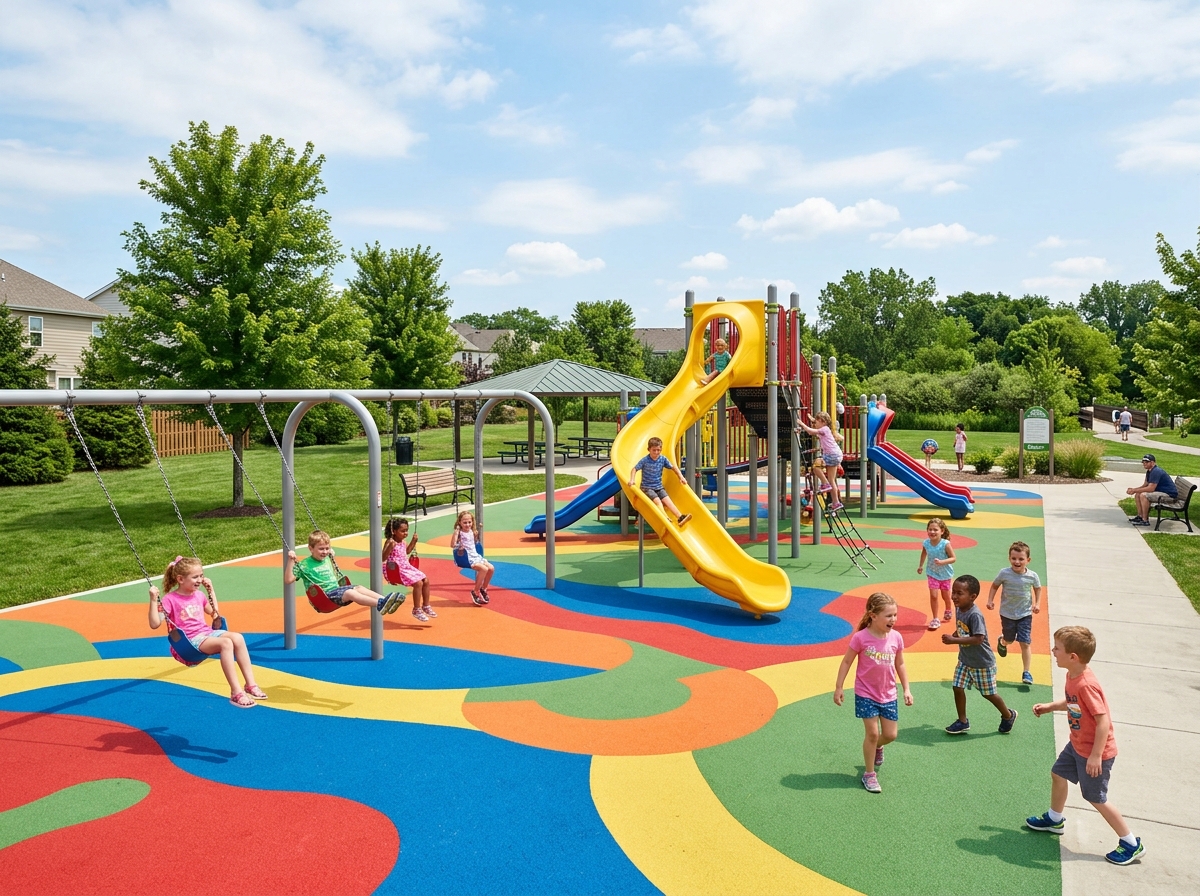
Choosing the right play safety surfacing usually comes down to a choice between two categories: Unitary and Loose-Fill.
Unitary materials are seamless, stayed-in-place surfaces like poured-in-place rubber, rubber tiles, or synthetic turf. These are often the preferred choice for modern parks in Raleigh, NC or Columbia, SC because they offer a consistent level of protection across the entire area. They don’t move, they don’t kick out under swings, and they are incredibly easy for strollers and wheelchairs to navigate.
Loose-fill materials, such as engineered wood fiber (EWF) or rubber mulch, consist of small independent particles. While these are often more affordable upfront, they require more “elbow grease” to keep safe. Because these materials move when kids run and jump, they can thin out in high-traffic areas, leaving the hard sub-base exposed.
A major factor in this decision is the Americans with Disabilities Act (ADA) Standards. Public playgrounds are required by law to be accessible. While some loose-fill materials like EWF can be ADA-compliant if they are professionally installed and frequently compacted, unitary surfaces like poured rubber are the “gold standard” for inclusivity. They allow children using wheelchairs or walkers to join the fun without getting stuck in the “mud” of loose chips. You can find more info about shock-absorbing playground surfaces on our site to see how these materials perform under pressure.
The Benefits of Unitary Play Safety Surfacing
If you’ve ever walked across a playground in Sanford, NC and felt like you were walking on a cloud, you were likely on a unitary surface. We love these systems for several reasons:
- Accessibility: Because the surface is flat and firm, it meets ASTM F1951 standards for wheelchair maneuverability. Everyone gets to play.
- Low Maintenance: You won’t need to rake it every week or “top it off” every year. A simple cleaning now and then is usually enough.
- Visual Appeal: We can create virtually any design. Want a giant blue octopus or a hopscotch grid built right into the floor? Poured rubber makes it possible.
- Durability: Systems like our poured-in-place rubber are designed to withstand heavy foot traffic and the scorching sun of Tucson, AZ without losing their bounce.
- Safety Consistency: Unlike wood chips, which might be 12 inches deep in one corner and 2 inches deep under the swing, unitary surfaces provide the exact same fall protection everywhere.
Maintaining Loose-Fill Play Safety Surfacing
Loose-fill isn’t a “set it and forget it” option, but for many schools in Indiana or Beaverton, OR, it’s a budget-friendly way to get a playground up and running. However, you must stay vigilant.
Research shows that loose-fill materials will compress by at least 25 percent over time due to weathering and use. This is why the industry recommendation is to maintain a 12-inch depth of loose material. We often suggest marking playground posts with a “fill line” so you can see at a glance when it’s time to order more.
Regular maintenance involves:
- Raking: Pushing material back into “kick-out” areas under swings and slide exits.
- Sifting: Removing foreign objects like glass, stones, or animal waste that can hide in the mulch.
- Replenishment: Adding new material annually to account for decomposition (in the case of wood) or compaction.
- Drainage: Ensuring the sub-base allows water to flow away so your wood chips don’t turn into a swamp.
If you’re considering rubber mulch specifically, you might wonder, “Is rubber mulch a safe surface?” The answer is yes, provided it is free of wire contaminants and installed to the correct depth. It offers excellent fall protection and doesn’t rot like wood.
Installation and Customization for Every Community
A great playground starts long before the rubber hits the ground. Proper site preparation is the “invisible” part of play safety surfacing that ensures the longevity of the project. Whether we are working in Nashville, TN or Lake Charles, Louisiana, we begin by ensuring the sub-base—usually compacted stone, concrete, or asphalt—is perfectly leveled and has adequate drainage. Without good drainage, even the best rubber surface can suffer from “bubbling” or premature wear.
This is where professional playground safety surfacing installers become essential. Our teams are trained to mix the EPDM rubber granules and polyurethane binders at the perfect ratio for the local climate. A playground in the humid air of Sanford, NC requires a slightly different approach than one in the dry heat of Arizona.
Customization is where the fun really begins! We believe a playground should tell a story. Using different colors and 3D molding techniques, we can integrate:
- Themed Graphics: Maps, solar systems, or jungle animals.
- Branding: School logos or community colors.
- Interactive Games: Permanent hopscotch, four-square, or “sensory paths.”
- Topography: We can build mounds and hills directly into the surface to add “play value” even without equipment.
Sustainable and Specialized Applications
At Replay Surfacing Inc., our heart is in recycling. We take tires that would otherwise sit in a landfill and transform them into safety. This eco-friendly approach can help your project earn LEED credits, which is a huge plus for municipal projects or “green” school initiatives. By using recycled SBR (Styrene Butadiene Rubber) for our base cushion layers, we provide a second life to millions of pounds of rubber every year.
Our work goes beyond just traditional playgrounds. We also specialize in:
- Splash Pads: Using porous, non-slip rubber that stays cool and provides cushion for wet, slippery feet.
- Walking and Jogging Trails: Providing a joint-friendly surface for seniors and athletes in community parks.
- Daycare and Childcare Centers: Creating soft, hygienic environments for the littlest explorers. You can read more info about daycare and childcare playground surfacing to see how we prioritize health and safety for toddlers.
- Indoor Play Areas: Where flexibility and bright, non-toxic materials are the top priority.
From the rainy corners of Connecticut to the bustling parks of Indiana, we bring the same level of IPEMA-certified excellence to every specialized application.
Frequently Asked Questions about Playground Safety
What is the best surface for wheelchair accessibility?
Poured-in-place rubber and high-quality rubber tiles are the best options. They provide a firm, stable, and slip-resistant surface that meets ADA requirements and allows wheelchairs to roll with minimal resistance.
How often should loose-fill materials be topped off?
Typically, loose-fill like engineered wood fiber should be topped off once a year. However, you should check the depth weekly. If the material has compressed below the 9-inch mark (or your specific equipment’s safety requirement), it needs immediate attention.
Can playground surfacing be installed over concrete or asphalt?
Yes! In fact, concrete and asphalt make excellent sub-bases for unitary surfaces like poured-in-place rubber or tiles because they provide a stable, long-lasting foundation. However, you should never play directly on the concrete itself.
Conclusion
At Replay Surfacing Inc., we believe that every child deserves a safe place to push their limits, and every parent deserves the peace of mind that comes with a soft landing. From our roots in tire recycling to our nationwide reach in locations like Tucson, AZ, Columbia, SC, and Beaverton, OR, we are committed to sustainable, high-performance play safety surfacing.
Whether you are looking for the artistic freedom of poured rubber or the rugged durability of rubber tiles, our team is here to help you navigate the standards, the costs, and the installation process. Don’t leave safety to chance—let’s build something amazing together.