
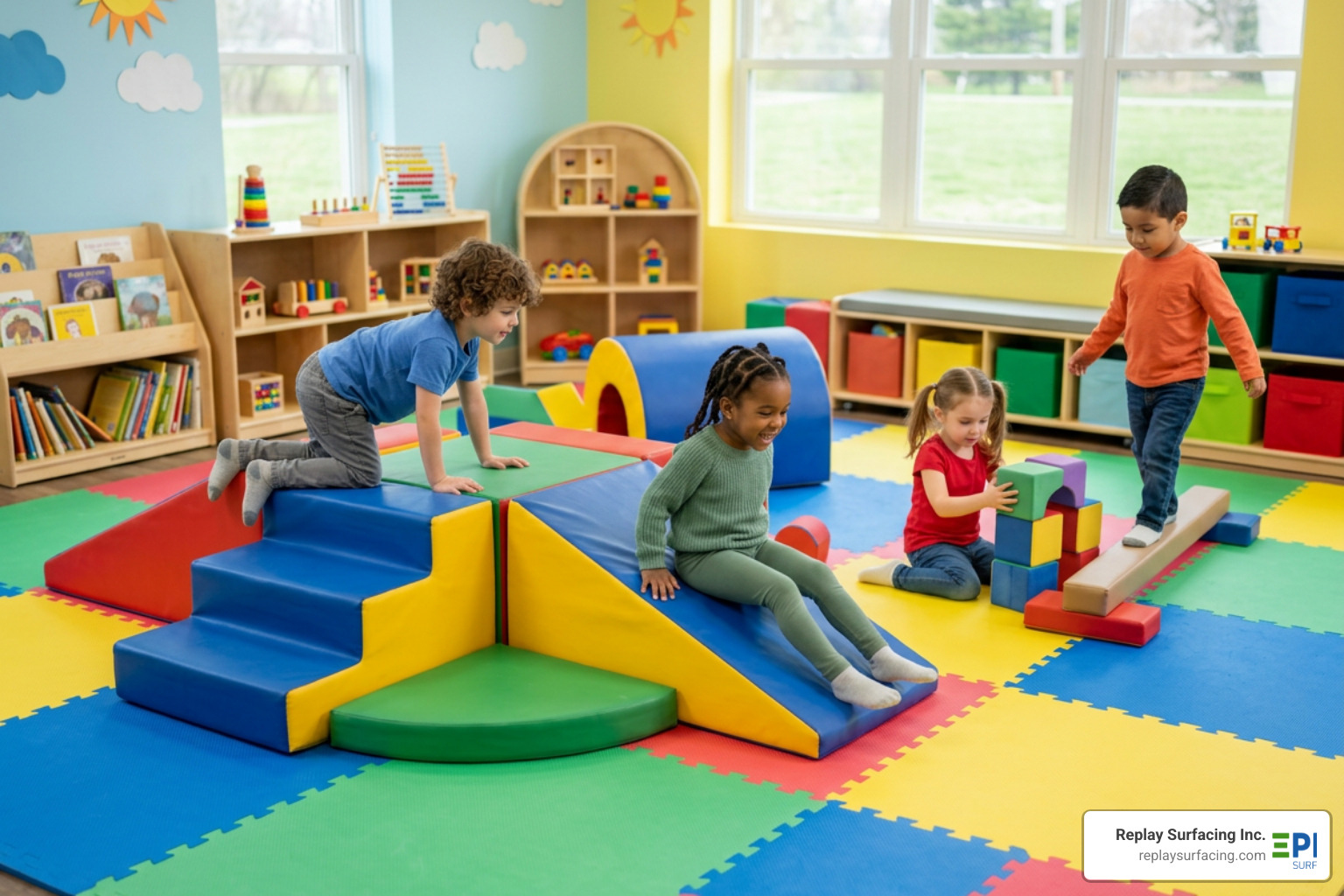
Why Choosing the Right Indoor Playground Mats Matters
Indoor playground mats are one of the most important safety decisions you’ll make for any play space — whether that’s a home playroom, a daycare, a mall play area, or a commercial facility.
Here’s a quick comparison to help you find the right fit fast:
| Mat Type | Best For | Fall Height Rating | Maintenance |
|---|---|---|---|
| Interlocking rubber tiles | Commercial facilities, climbing zones | Up to 10 ft (ASTM F1292) | Low — wipe or hose clean |
| Pour-in-place rubber | Custom shapes, ADA ramps | Varies by thickness | Low — non-porous surface |
| EVA foam tiles | Home playrooms, toddler zones | Up to 4 ft | Easy — wipe clean |
| Carpet/DuraSoft padding | Low-impact indoor play | Up to 4 ft | Moderate — vacuum or spot clean |
| Artificial turf with pad | Multi-use indoor spaces | Varies by pad thickness | Low to moderate |
The stakes are real. Indoor playground surfacing absorbs the energy of hundreds of children falling, running, and jumping every day. The wrong surface wears out fast, costs more to repair, and — most critically — can fail to protect a child when it matters most.
Surfacing requirements also change over time, so if your play area has been in place for a few years, it’s worth reviewing whether your current flooring still meets current safety standards.
I’m Landon Olson, operator of Replay Surfacing Inc., where I’ve spent my career engineering recycled rubber surfacing solutions — including indoor playground mats — that meet rigorous safety standards while reducing environmental waste. My background in mechanical engineering and sustainability gives me a practical, no-nonsense perspective on what actually works in real play environments.
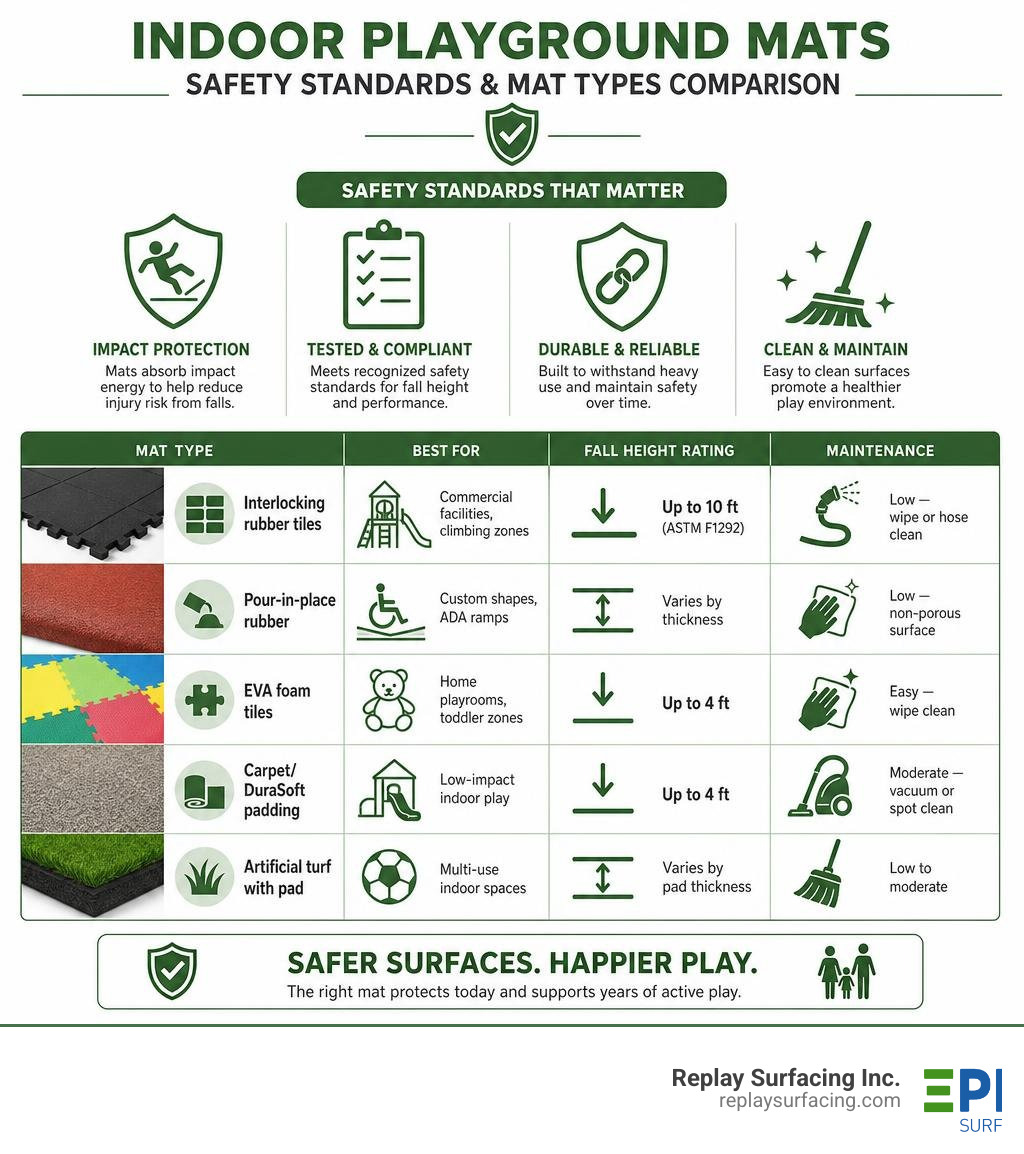
Quick look at indoor playground mats:
Comparing Types of Indoor Playground Mats
When designing an indoor play space, selecting the right surfacing requires balancing safety, durability, and maintenance. Different zones within a facility often require different materials depending on the height of the play equipment and the volume of foot traffic.
Whether we are installing surfaces in a high-traffic commercial play center in Charlotte, NC, a school recreational room in Nashville, TN, or a cozy home basement in Beaverton, OR, we evaluate several primary flooring types:
Rubber Tiles
Interlocking rubber tiles are the gold standard for high-impact indoor play. Manufactured using durable, recycled tire rubber, these tiles provide outstanding shock absorption. They are engineered to absorb impacts from falls up to 10 feet, making them ideal for areas with tall climbing structures. Additionally, rubber tiles are highly slip-resistant and incredibly durable, backed by a 10 Year Limited Warranty. Maintenance is simple, requiring only a broom, a vacuum, or a damp mop.
Pour-in-Place (PIP) Rubber
Pour-in-place rubber consists of a two-layer system: a base cushion layer made of clean, recycled tire rubber and a durable top wear layer. Because it is mixed on-site and troweled flat, it creates a seamless, non-porous surface. This seamless design is highly beneficial for facilities in Sanford, NC, or Columbia, SC, that must accommodate wheelchairs and strollers, as it allows for the seamless integration of ADA-accessible ramps and recessed areas. PIP rubber is exceptionally durable and can be customized with vibrant colors and themed graphics.
Modular Rubber Tiles
Similar to standard rubber tiles, modular rubber tiles use subsurface clips or interlocking keys to create a “floating floor” effect. This design prevents the tiles from lifting, shifting, or curling at the edges, even under heavy foot traffic. A key benefit of modular tiles is their ease of repair: if a single tile is damaged by a spill or physical wear, you can use the subsurface clips to swap out that individual tile without tearing up the entire floor.
For a complete breakdown of how these commercial-grade systems perform under daily wear, explore our Soft Play Surfacing Complete Guide.
EVA Foam Tiles
Lightweight and budget-friendly, EVA foam tiles interlock like puzzle pieces. They are highly popular for toddler zones and residential playrooms. High-quality EVA foam tiles, such as the Foam Kids and Gym Mats Premium 5/8 Inch x 2×2 Ft. (which features 976 reviews) or the Home Sport and Play Mat 3/4 Inch x 2×2 Ft. (with 468 reviews), offer great cushioning for ground-level play. However, they lack the extreme tear resistance of rubber and can be punctured by sharp toys or pet claws.
Carpet and DuraSoft Safety Flooring
Carpet-style safety flooring, such as DuraSoft Safety Flooring, combines a soft carpet top with an engineered foam underlayment. Featuring a standard 1.5-inch pad thickness, it is rated for a 4-foot fall height under ASTM F1292. This system is warm and comfortable underfoot, making it a great choice for preschools and library play corners in Connecticut or Indiana. However, it requires regular vacuuming and prompt spot cleaning to prevent stains and moisture buildup.
Artificial Turf
Indoor synthetic turf paired with a foam safety pad offers a natural, athletic aesthetic. Systems like Play Time Playground Green 1-1/4 Inch Turf with a 2.25 Inch Pad provide robust shock absorption. It is highly durable and slip-resistant, though it requires occasional brushing to keep the fibers upright and clean.

Safety Standards and Certifications for Play Surfacing
Safety is the single most important factor when selecting indoor playground mats. Without verified certifications, a colorful mat is just a piece of foam or rubber that may fail to protect a child during a fall.
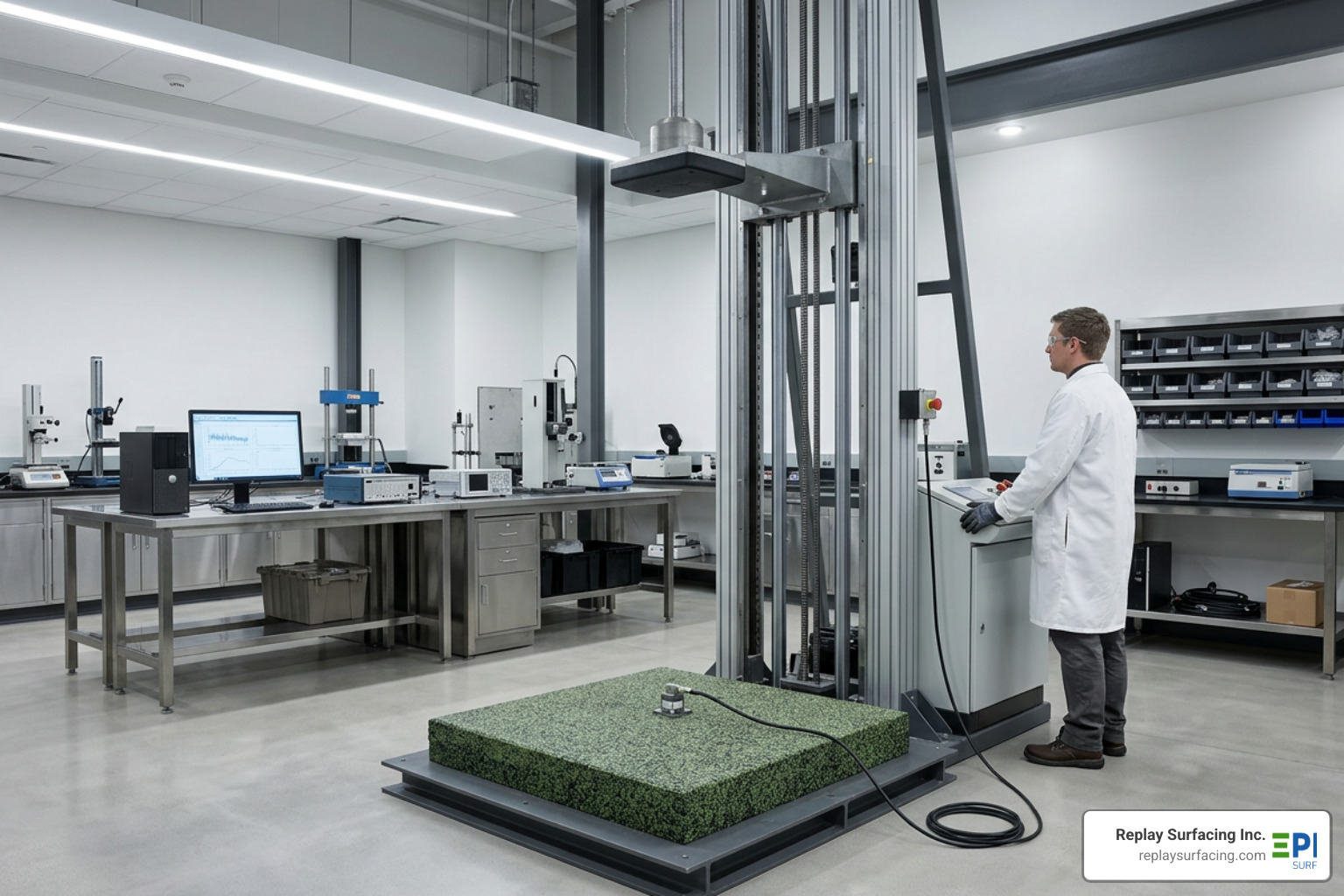
When specifying safety surfaces for commercial spaces in Tucson, AZ, or residential play areas in Lake Charles, LA, we look for several critical standards:
ASTM F1292 (Fall Height Ratings)
This is the benchmark standard for impact attenuation of playground surfacing. It measures the surface’s ability to reduce the severity of head injuries during a fall. The testing measures “G-max” (the maximum acceleration produced by an impact) and “Head Injury Criterion” (HIC).
For example, a 2.25-inch thick rubber tile typically supports a 4-foot fall height, while a thicker 4.25-inch tile can achieve an impact attenuation rating of up to 10 feet. In Europe, compliance with the European Norm EN1177 serves a similar purpose, ensuring that critical fall heights are properly managed.
ADA Accessibility (ASTM F1951)
Indoor playgrounds must be accessible to children of all abilities. Under the Americans with Disabilities Act (ADA), surfacing must meet ASTM F1951, which tests the maneuverability of a wheelchair across the surface. While loose-fill materials fail this test indoors, flat surfaces like pour-in-place rubber and interlocking rubber tiles pass easily, allowing children in wheelchairs to play alongside their peers.
Non-Toxic Materials and Chemical Safety
Children spend a lot of time in direct contact with the floor. Therefore, playground mats must be free of harmful chemical off-gassing, heavy metals, and endocrine disruptors. Look for certifications such as:
- OEKO-TEX Standard 100: Verifies that textile components (like organic cotton covers used on baby play mats) are free from harmful levels of toxic chemicals.
- CertiPUR-US: Ensures that polyurethane foams are made without ozone depleters, PBDE flame retardants, heavy metals, formaldehyde, or phthalates.
- REACH Compliance: A strict European standard regulating chemical substances to protect human health and the environment. You can learn more about these regulations on the official REACH Compliance page.
For a deep dive into selecting chemical-free, high-performance floors, see The Definitive Guide to Non-Toxic Playground Tiles.
Material Science: How Rubber Surfacing Protects Indoor Play Areas
The physical properties of your playground flooring directly impact its cushioning, durability, and cleanliness.
| Material | Cushioning & Spring | Impact Absorption | Ease of Cleaning | Lifespan |
|---|---|---|---|---|
| Recycled Rubber | Firm, high-rebound | Excellent (Up to 10 ft) | Very Easy (Sweep/Mop) | 10+ Years |
| Natural Latex | Soft, springy, breathable | Moderate (Tummy time/Toddlers) | Hand wash cover only | 5–8 Years |
| EVA Foam | Soft, lightweight | Good (Up to 4 ft) | Easy (Wipe clean) | 2–5 Years |
| Vinyl / PVC | Firm, rigid | Poor (Requires foam backing) | Very Easy (Wipe clean) | 5–7 Years |
Cushioning and Impact Absorption
Rubber is a highly resilient elastomer. When a child falls, the rubber compresses, absorbing and dispersing the kinetic energy. This high-impact performance is why heavy-duty rubber tiles are used in high-traffic commercial spaces.
In contrast, materials like natural latex (sourced from rubber tree sap) offer a soft, springy, and highly breathable feel that is perfect for infant tummy time, but they lack the structural density required for commercial play structures.
Ease of Cleaning and Hygiene
In public spaces across Raleigh, NC, and Connecticut, hygiene is a constant battle. Non-porous, high-density rubber surfacing prevents liquids, sweat, and spilled drinks from penetrating the floor. This makes sanitizing the surface easy, preventing the growth of mold, mildew, and bacteria.
Indoor Air Quality and VOC Emissions
Because indoor spaces have limited ventilation compared to outdoor parks, choosing low-VOC (Volatile Organic Compound) flooring is critical. High-quality recycled rubber surfacing undergoes specialized curing processes that wash away residual odors, ensuring excellent indoor air quality.
Heavy-Duty Rubber Indoor Playground Mats for High-Impact Zones
For zones with climbing towers, slides, and obstacles, lightweight foam mats simply cannot handle the physical punishment. These areas require heavy-duty rubber indoor playground mats that offer extreme durability and reliable impact attenuation.
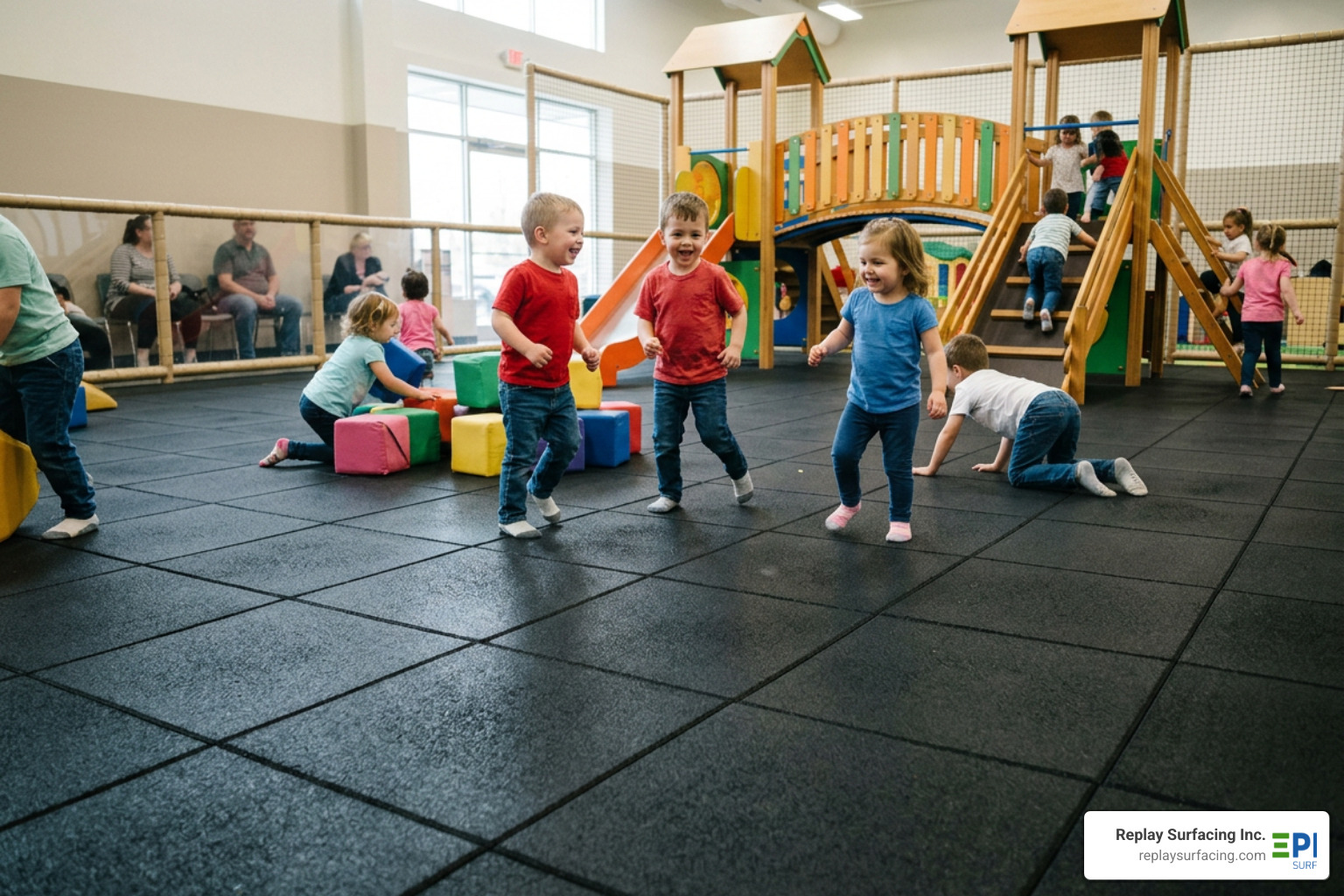
Using premium recycled tire rubber, these heavy-duty tiles provide a dense, slip-resistant surface that remains stable under rapid foot traffic. They cushion joints during high-impact jumps and protect the subfloor from damage.
To learn more about how heavy-duty rubber tiles keep high-impact commercial zones safe, read about our Play Safe Rubber Safety Tiles.
Customizing Rubber Surfacing for Indoor Playrooms and Commercial Spaces
No two play spaces are identical, which is why modern rubber surfacing is highly customizable:
- Thickness Options: Choose the exact thickness needed to match your equipment’s fall height. Standard options range from 2.25 inches (rated for a 4-foot fall) up to 4.25 inches (rated for a 10-foot fall).
- Interlocking Designs: Precision-cut interlocking tabs or subsurface connector pins ensure a tight, seamless fit that prevents dirt from falling between the cracks.
- Waterproofing: Non-porous top layers resist spills and allow for quick sanitization.
- Color and Aesthetic Options: You are no longer limited to basic black. Modern rubber surfacing is available in a wide array of vibrant EPDM colors, custom color blends, and even eco-friendly Nike Grind blends (which incorporate recycled athletic shoes).
Best Practices for Selection and Installation
Selecting the right indoor playground mats is only half the battle; proper installation is what ensures long-term safety and performance.
Home Playroom vs. Commercial Facility
In a private home in Tucson, AZ, or Beaverton, OR, your primary concerns are comfort, aesthetics, and ease of installation. Lightweight, interlocking EVA foam tiles or premium natural latex mats like the Bliss Playmat (measuring 150cm x 210cm x 2.5cm) are excellent choices. They can be laid down quickly without adhesive and easily stored away when not in use.
For a commercial facility in Charlotte, NC, or Sanford, NC, durability and strict ASTM compliance are non-negotiable. These spaces require professional-grade rubber tiles or pour-in-place rubber installed with heavy-duty adhesive (such as SureStick Adhesive Glue) to prevent any shifting under heavy daily foot traffic.
Climbing Equipment vs. Toddler Zones
- Climbing Zones: Always measure the highest accessible play point (the “critical fall height”) and select a rubber tile or pour-in-place thickness that meets or exceeds that rating.
- Toddler Zones: Focus on soft, non-abrasive surfaces. Toddlers spend a lot of time crawling, so smoother, non-textured foam or low-pile carpet tiles are ideal.
For a step-by-step guide on laying out your play area, checking your subfloor, and locking your tiles together perfectly, check out our Interlocking Playground Mats Ultimate Guide.
Frequently Asked Questions about Indoor Play Surfacing
What is the best thickness for indoor playground mats?
The best thickness depends entirely on the height of your play equipment. If you have ground-level play or toddler climbing blocks under 4 feet tall, a thickness of 5/8 inch to 1.5 inches (such as standard foam tiles or DuraSoft carpet mats) is sufficient. For commercial climbing structures, you must match the thickness to the fall height: 2.25 inches for a 4-foot fall, 2.75 inches for a 6-foot fall, and up to 4.25 inches for a 10-foot fall.
Are rubber playground mats safe for indoor air quality?
Yes, provided you purchase high-quality, certified rubber flooring. Premium recycled rubber mats are specifically engineered and cured to minimize VOC emissions and rubber odors, making them perfectly safe for indoor air quality in enclosed spaces. Always look for products that are certified non-toxic and free of heavy metals and formaldehyde.
How do you clean and maintain interlocking play mats?
For daily maintenance, simply sweep or vacuum the surface to remove loose dirt and dust. For deeper cleaning, wipe down the tiles with a damp mop using a mild, non-abrasive soap and warm water. Avoid harsh chemicals, bleach, or solvent-based cleaners, as these can degrade the rubber or foam over time. For non-porous rubber surfaces, a simple water hose or wet-vac can be used for deep cleaning.
Conclusion
Investing in high-quality indoor playground mats is a critical decision that balances child safety with long-term cost savings. While cheap, uncertified mats may save money upfront, they wear out quickly and fail to provide certified impact protection.
By choosing durable, sustainable, and rigorously tested rubber surfacing from Replay Surfacing Inc., you are protecting children from injuries while investing in a floor that will withstand years of active play. From custom-blended interlocking tiles to seamless pour-in-place rubber, we help communities across Charlotte, Tucson, Nashville, and beyond build safe, vibrant, and eco-friendly spaces for kids to explore.
Ready to design a safe, beautiful, and sustainable play space for your home or business? Start Your Residential Project with Replay Surfacing today!