

Why Choosing the Best Flooring for a Garden Play Area in Charlotte, NC Matters More Than You Think
The best flooring for a garden play area in Charlotte, NC is not just about looks — it is about keeping kids safe when they fall, and they will fall.
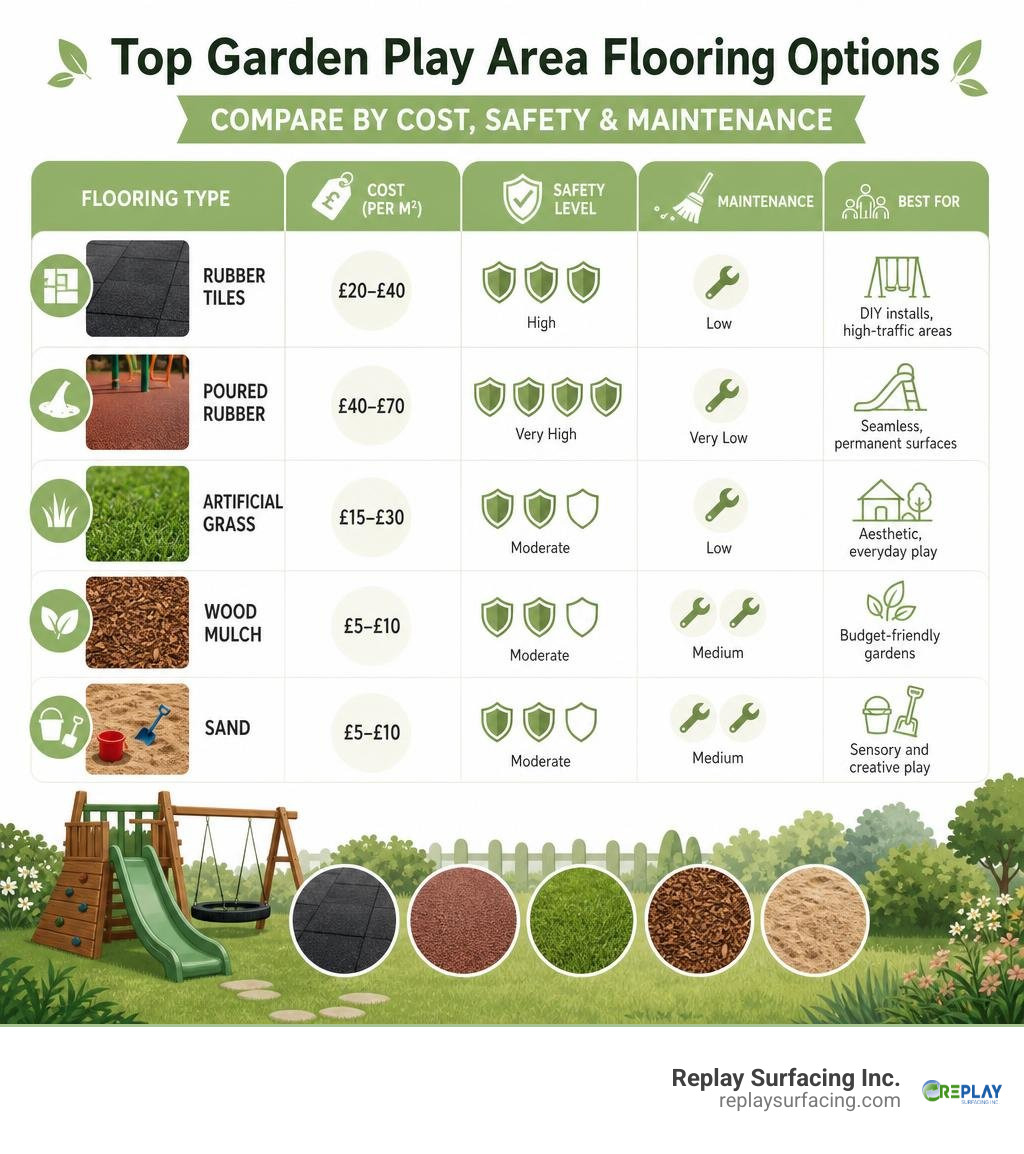
Here is a quick breakdown of the top options to help you decide fast:
| Flooring Type | Cost (per m²) | Safety Level | Maintenance | Best For |
|---|---|---|---|---|
| Rubber Tiles | £20–£40 | High | Low | DIY installs, high-traffic areas |
| Poured Rubber | £40–£70 | Very High | Very Low | Seamless, permanent surfaces |
| Artificial Grass | £15–£30 | Moderate | Low | Aesthetic, everyday play |
| Wood Mulch | £5–£10 | Moderate | Medium | Budget-friendly gardens |
| Sand | £5–£10 | Moderate | Medium | Sensory and creative play |
If you are replacing hard surfaces like concrete or garden tiles that cracked, became slippery, or caused injuries — you are in the right place. Hard, unforgiving surfaces have no place under climbing frames or slides.
I’m Landon Olson, operator of Replay Surfacing Inc., and with a background in mechanical engineering and years of experience in safety surfacing and sustainable rubber manufacturing, I have helped schools, parks, and families find the best flooring for garden play areas in Charlotte, NC that is safe, long-lasting, and kind to the environment. In this guide, I will walk you through every major option so you can make a confident, budget-smart choice.
Evaluating the Best Flooring for Garden Play Area Safety and Fall Protection
When designing an outdoor play haven, safety isn’t just an afterthought—it’s the core foundation. Children burn off endless energy climbing towers, riding swings, and jumping off slides. Without adequate impact absorption beneath them, minor slips can turn into severe injuries. Choosing the best flooring for garden play area spaces means evaluating how well a material cushions landings and mitigates impact forces.
Safety standards like BS EN 1177 in Europe and ASTM requirements across North America established clear protocols for testing playground surfaces. These standards measure “Critical Fall Height” (CFH), which represents the maximum height from which a child could fall onto a surface without suffering a critical head injury. Whether you are installing a swing set in Charlotte, NC, or setting up a climbing frame in Columbia, SC, matching the surfacing thickness to your highest play equipment piece is essential.
Local parents seeking real-world safety inspiration often check out community spaces like the 5 Must-See Padded Outdoor Playgrounds Around Columbia to see how modern shock-absorbing surfaces function in heavy-use environments. If you want a deep dive into playground standards and cushioning dynamics, read our Best Playground Flooring Ultimate Guide.
Understanding Fall Heights and Cushioning Thickness
Every piece of garden play equipment features a critical fall height. A standard monkey bar set might sit 2 metres (around 6.5 feet) off the ground, whereas a small toddler slide might peak at 1 metre. The rule of thumb for safe surfacing is simple: your shock-absorbing depth must meet or exceed the maximum fall height of the equipment installed directly above it.
For unitary rubber materials like tiles or wet-pour, thickness directly correlates with critical fall height protection:
- 25mm to 30mm thickness: Provides protection for fall heights up to approximately 1 metre (3.3 feet).
- 40mm to 50mm thickness: Suitable for fall heights around 1.5 metres to 1.8 metres (5 to 6 feet).
- 75mm to 100mm thickness: Required under taller climbing structures and swing zones with fall heights up to 2.4 metres to 3 metres (8 to 10 feet).
When dealing with loose-fill surfacing materials like wood chips, play sand, or bark mulch, compression and displacement happen continuously as children play. For loose-fill materials, a minimum uncompressed depth of 300mm (12 inches) is mandatory to provide reliable impact protection against fall heights up to 3 metres.
Why Concrete and Hard Garden Tiles Fail
A common mistake homeowners make is installing play equipment over existing concrete pads, flagstone patios, or standard garden pavers. As highlighted in many home renovation discussions, hardscaping fails dramatically in child play zones for three distinct reasons:
- Zero Impact Absorption: Rigid concrete or ceramic tiles offer zero shock absorption. Falling onto a concrete paver from as little as 0.5 metres can result in fractures or severe head trauma.
- Moisture Trapping and Freeze-Thaw Damage: Hard pavers trapped over poorly drained subbases absorb surface moisture into micro-cracks. During winter freeze-thaw cycles—common in locations like Connecticut or Indiana—water expands inside the stone, causing heave, jagged cracking, and dangerous tripping hazards.
- Slippery Organic Growth: Smooth tiles located in shaded garden spots quickly accumulate algae and moss. When wet, these surfaces turn into ice-like skating rinks.
To avoid these costly pitfalls and learn how to replace hardscaping safely, check out our guide on How to Choose the Best Outdoor Play Yard Flooring for Your Garden.
Top Budget-Friendly Garden Play Surfaces Compared
Finding the best flooring for garden play area projects requires balancing up-front budget limits against long-term maintenance demands and product lifespans. Below is an in-depth breakdown comparing the most popular garden surfacing options:
| Material | Cost per m² | Depth / Thickness Required | Primary Pros | Primary Cons | Expected Lifespan |
|---|---|---|---|---|---|
| Wood Mulch | £5 – £10 | 300mm | Natural look, low initial cost | Displaces easily, regular top-ups required | 1 – 3 years |
| Playground Sand | £5 – £10 | 300mm | Extremely affordable, sensory value | Traps moisture, tracks indoors, animal mess | 2 – 4 years |
| Rubber Tiles | £20 – £40 | 25mm – 75mm | Excellent cushioning, easy DIY | Visible seams, requires flat base | 10 – 15+ years |
| Artificial Grass | £15 – £30 | 20mm – 40mm pile | Green year-round, clean, soft | Requires shock pad beneath for high falls | 8 – 12 years |
| Poured Rubber | £40 – £70 | 25mm – 100mm | Seamless, fully customisable, ultra-safe | Higher initial cost, pro installation required | 12 – 15+ years |
Loose-Fill Options: Finding the Best Flooring for Garden Play Area Impact Absorption
Loose-fill materials remain popular for tight initial budgets because they require low upfront material costs. The primary types include engineered wood fiber (EWF), organic bark mulch, playground-grade sand, and shredded rubber mulch.
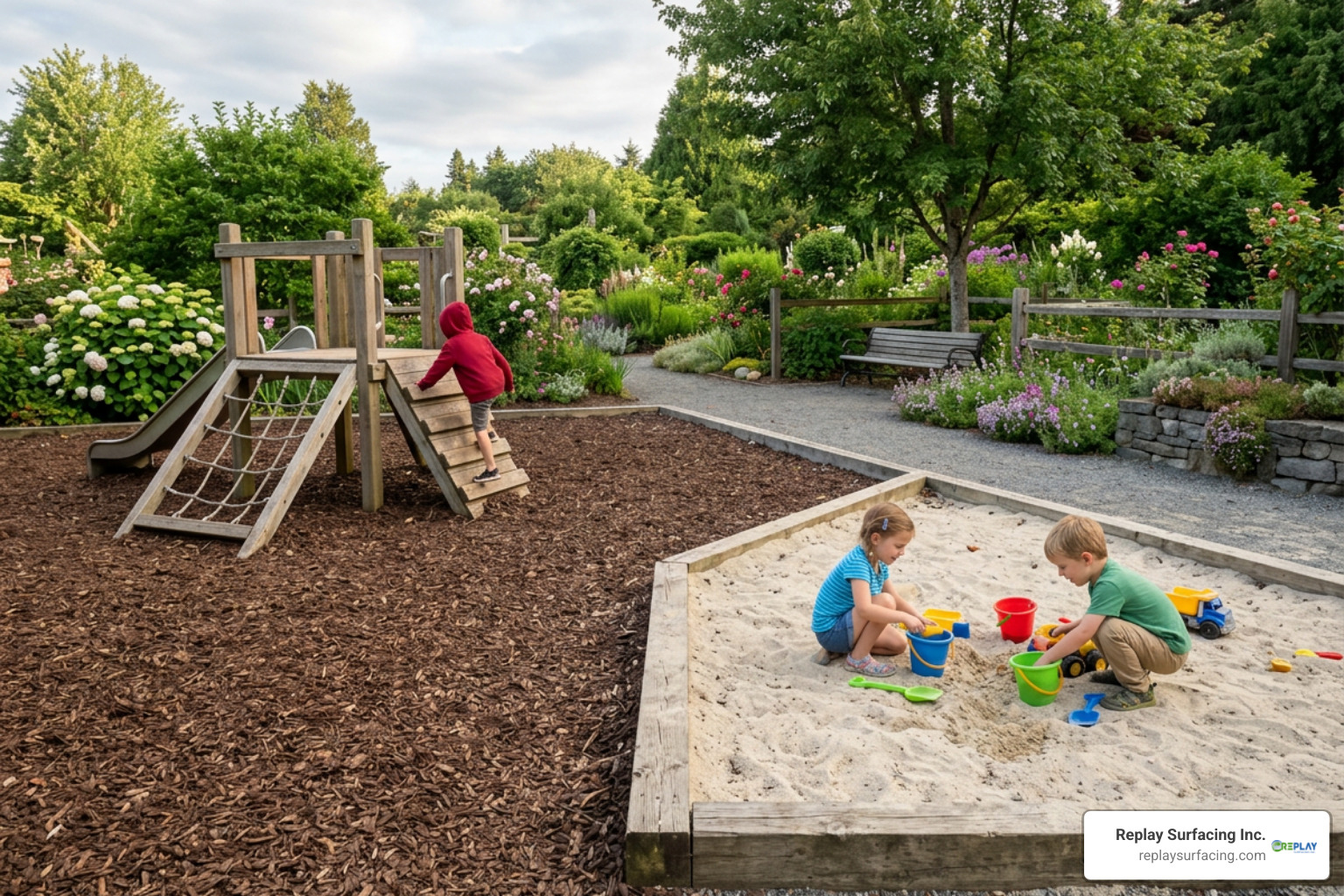
- Engineered Wood Fiber & Bark Mulch: Priced at roughly £5 to £10 per square metre, wood mulch provides a charming rustic garden look. However, to maintain safety standards, you must lay a deep 300mm cushion. Kids kicking off swings cause severe displacement beneath high-impact zones, leading to shallow spots where injuries can occur if not regularly raked back into place.
- Playground Sand: Also running £5 to £10 per square metre, play sand offers wonderful sensory play. However, in rainy climates like Beaverton, OR, or humid zones like Lake Charles, LA, sand retains heavy moisture, compacted over time into a hard surface, and can attract neighborhood pets.
- Shredded Rubber Mulch: Costing £15 to £25 per square metre, rubber mulch doesn’t rot, absorb water, or decompose like wood. It offers high shock absorption at lower depths, though containment borders are required to keep loose nuggets inside the play area.
For a detailed review of loose-fill performance, explore our article on the Best Playground Ground Cover.
Interlocking Tiles: The Best Flooring for Garden Play Area DIY Enthusiasts
For families who want professional safety performance without paying professional labor fees, interlocking rubber tiles represent the ultimate sweet spot. Made largely from recycled tire rubber, these heavy-duty tiles range in thickness from 25mm to 75mm and cost between £20 and £40 per square metre.
Key benefits of interlocking rubber tiles include:
- Built-In Drainage Channels: Engineered channels on the underside allow rainwater to flow freely beneath the tiles toward your garden drainage system.
- High Traction: Textured non-slip surfaces prevent falls even in shaded zones prone to moisture.
- Simple Interlocking Mechanism: Dowels or puzzle-cut edges hold tiles firmly together, preventing shifting under heavy foot traffic.
To explore tile selections and budget setups, read our articles on Top Rated Backyard Playground Flooring Options You Can Buy Today and Safe and Sound Backyard Play Area Flooring Options for Every Budget.
Synthetic Turf and Poured Rubber for Seamless Play
When seamless aesthetic appeal and low maintenance are your top priorities, synthetic turf and poured rubber (wet-pour) stand out as premium options.
- Artificial Lawn Grass: Featuring pile heights between 20mm and 40mm, artificial grass costs between £15 and £30 per square metre. While synthetic turf looks beautiful year-round in sunny climates like Tucson, AZ, turf installed directly over dirt lacks adequate shock absorption for elevated play equipment. Adding an underlying foam shock pad is critical to absorb impacts.
- Poured Rubber (Wet-Pour): Priced from £40 to £70 per square metre, poured rubber combines an impact-absorbing base layer of shredded rubber with a top wear layer of colorful rubber granules. This creates a 100% seamless, continuous surface with zero trip hazards, perfect for custom graphics, hopscotch patterns, and total accessibility for strollers or wheelchairs.
Learn how to integrate these high-end options in your backyard by checking out Playground Flooring for Your Backyard Oasis: A Comprehensive Guide.
Installation, Subbase Preparation, and Weather Resistance
No matter how high the quality of your chosen surfacing material, your playground project will only be as good as the ground underneath it. A poor subbase leads to uneven settling, pooling water, and premature material breakdown.

Here is a step-by-step visual overview of how a standard, durable subbase is constructed:
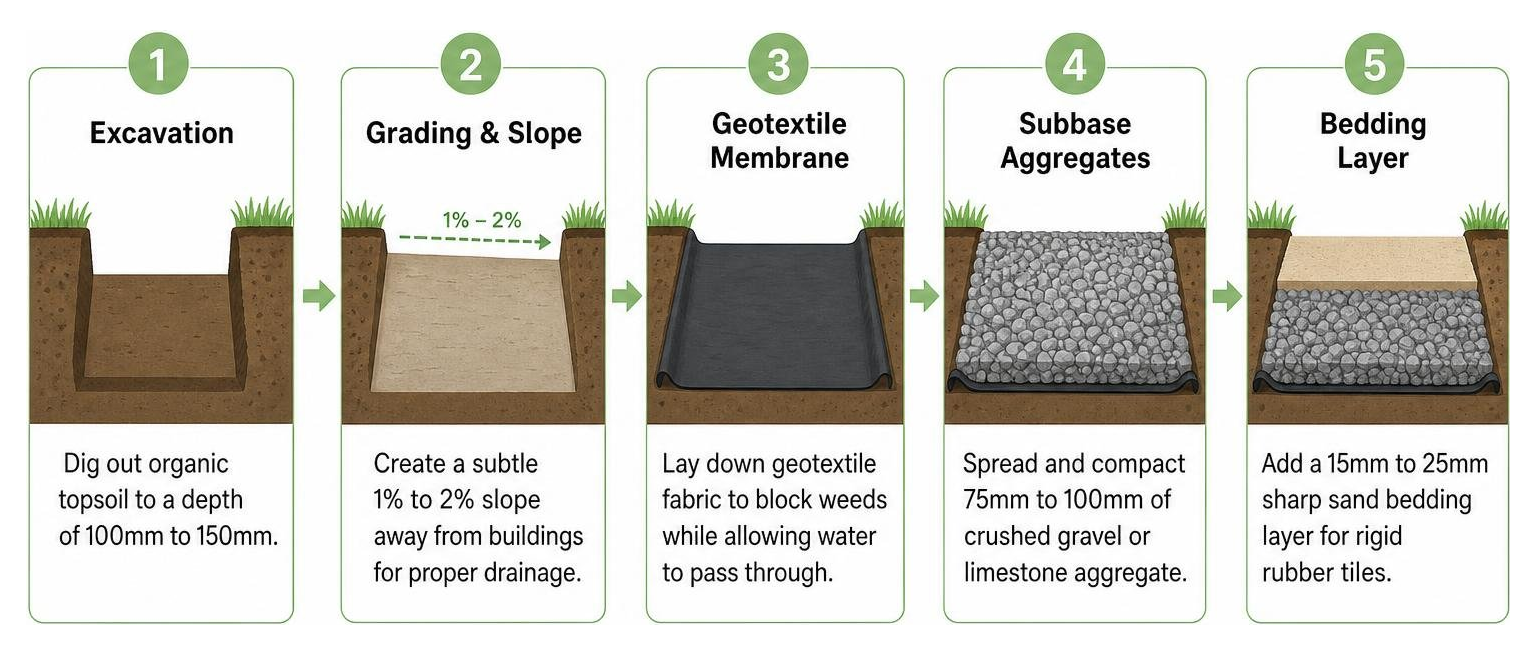
- Excavation: Dig out organic topsoil to a depth of 100mm to 150mm.
- Grading & Slope: Create a subtle 1% to 2% slope sloping away from residential buildings to guarantee smooth water runoff.
- Geotextile Membrane: Lay down a heavy-duty geotextile fabric. This blocks weeds from growing up while allowing water to pass down.
- Subbase Aggregates: Spread and compact 75mm to 100mm of crushed gravel or limestone aggregate using a mechanical plate compactor.
- Bedding Layer: Add a 15mm to 25mm sharp sand bedding layer if installing rigid rubber tiles.
Drainage and Climate Performance
Outdoor playground surfacing faces harsh weather conditions across different regions. Weather durability varies across materials:
- Freeze-Thaw Durability: In northern areas like Connecticut or Indiana, moisture trapped inside rigid materials expands during freeze cycles, cracking solid pavers. Rubber tiles and poured rubber remain flexible down to sub-zero temperatures, absorbing freeze-thaw expansion without structural damage.
- Heavy Rain & Flood Resistance: Coastal or rainy locations such as Lake Charles, LA, or Raleigh, NC, demand excellent water permeability. High-quality porous rubber surfacing and properly pitched subbases prevent standing water puddles, keeping the play zone usable immediately after heavy downpours.
- Heat Management: In hot sunny regions like Tucson, AZ, dark surfaces absorb solar heat. Light-colored poured rubber top coats or specialized UV-resistant synthetic turf fills keep surface temperatures manageable during peak summer afternoon heat.
DIY vs. Professional Installation
Deciding between a weekend DIY project and hiring professional installers comes down to the surfacing material chosen:
- DIY-Friendly Projects: Loose-fill materials (mulch, sand) and interlocking rubber tiles are highly accessible for handy homeowners. You can easily level a small garden footprint, lay fabric, and lock tiles in place over a single weekend.
- Professional Installation Required: Poured rubber (wet-pour) requires precise chemical mixing of rubber granules with polyurethane binders, rapid troweling, and exact temperature management to cure smoothly. Attempting wet-pour as a DIY project often results in uneven curing and premature flaking.
For comprehensive step-by-step DIY guides, check out The Ultimate Guide to Rubber Playground Flooring and DIY Playground Flooring.
Sustainability, Sensory Play, and Long-Term Lifespan
Modern garden play areas do more than just buffer falls—they can also serve as vibrant, environmentally responsible outdoor play spaces that spark childhood imagination.
At Replay Surfacing Inc., our core mission centers around circular recycling innovation. We divert discarded passenger and commercial tires away from landfills, processing them into clean, non-toxic rubber granules and durable surfacing tiles. By choosing recycled rubber surfacing for your garden play space, you are actively helping transform environmental hazards into safe, colorful play solutions.
Beyond environmental sustainability, safety surfacing provides creative sensory play opportunities:
- Custom Themed Designs: Wet-pour rubber allows you to incorporate colorful sea creatures, winding river tracks, splash pad themes, or educational hopscotch games right into the floor.
- Sensory Tactile Comfort: The soft, springy feel of thick rubber underfoot provides an inviting tactile experience for younger toddlers and children with sensory sensitivities.
- Heavy Usage Resilience: Rubber surfacing withstands intense foot traffic, dog paws, and heavy play equipment without crushing or rotting. High-grade rubber tiles and poured surfaces boast continuous lifespans of 10 to 15+ years with minimal upkeep—delivering exceptional long-term ROI compared to loose wood chips that require annual top-ups.
To explore real-life project transformations, check out Durable Backyard Rubber Flooring That Kids and Parents Love and Top Rated Rubber Flooring for Play Areas to Buy Now.
Frequently Asked Questions About Garden Play Surfacing
What is the safest budget flooring option for a garden play area?
Engineered wood fiber or bark mulch represents the most budget-friendly initial option, costing around £5 to £10 per square metre. However, for maximum safety with low long-term maintenance, 40mm–50mm interlocking rubber tiles (£20–£40/m²) offer superior impact protection, non-slip performance, and won’t displace under swings or slides.
How thick should playground flooring be under climbing frames?
The required thickness depends directly on the height of your play structure. Under a climbing frame with a 2-metre (6.5 ft) fall height, you will need either a 50mm to 75mm thick rubber tile surface or a minimum depth of 300mm for loose-fill materials like mulch or sand.
Can I install rubber playground tiles directly over grass or dirt?
It is not recommended to lay rubber tiles directly on raw grass or dirt. Over time, natural ground moves, retains moisture, and settles unevenly, creating raised tile edges and trip hazards. Furthermore, grass and weeds will grow through tile joints. Always excavate topsoil, lay weed barrier fabric, and compact a crushed stone subbase before installing tiles.
Conclusion
Creating a beautiful, safe, and durable backyard play sanctuary doesn’t have to strain your wallet. Whether you choose natural loose-fill mulch, easy-to-install interlocking rubber tiles, or seamless custom poured rubber, selecting the best flooring for garden play area projects comes down to understanding your equipment fall heights, setting up a well-drained subbase, and choosing quality materials built to last.
At Replay Surfacing Inc., we take pride in leading the recycled surfacing industry across our communities in Charlotte, Columbia, Raleigh, Sanford, Tucson, Connecticut, Indiana, Nashville, Beaverton, and Lake Charles. By transforming recycled tire rubber into high-performance, non-toxic surfacing products, we deliver long-term protection, vibrant aesthetics, and peace of mind for your family.
Ready to transform your backyard into an outdoor play oasis? Explore High-Quality Playground Surfacing Solutions today to discover the perfect surface for your project!