

Why Choosing the Right Rubber Mulch for Play Areas in Raleigh Can Prevent Serious Injuries
Rubber mulch for play areas in Raleigh is one of the most effective loose-fill surfacing options available today for reducing fall-related injuries on playgrounds.
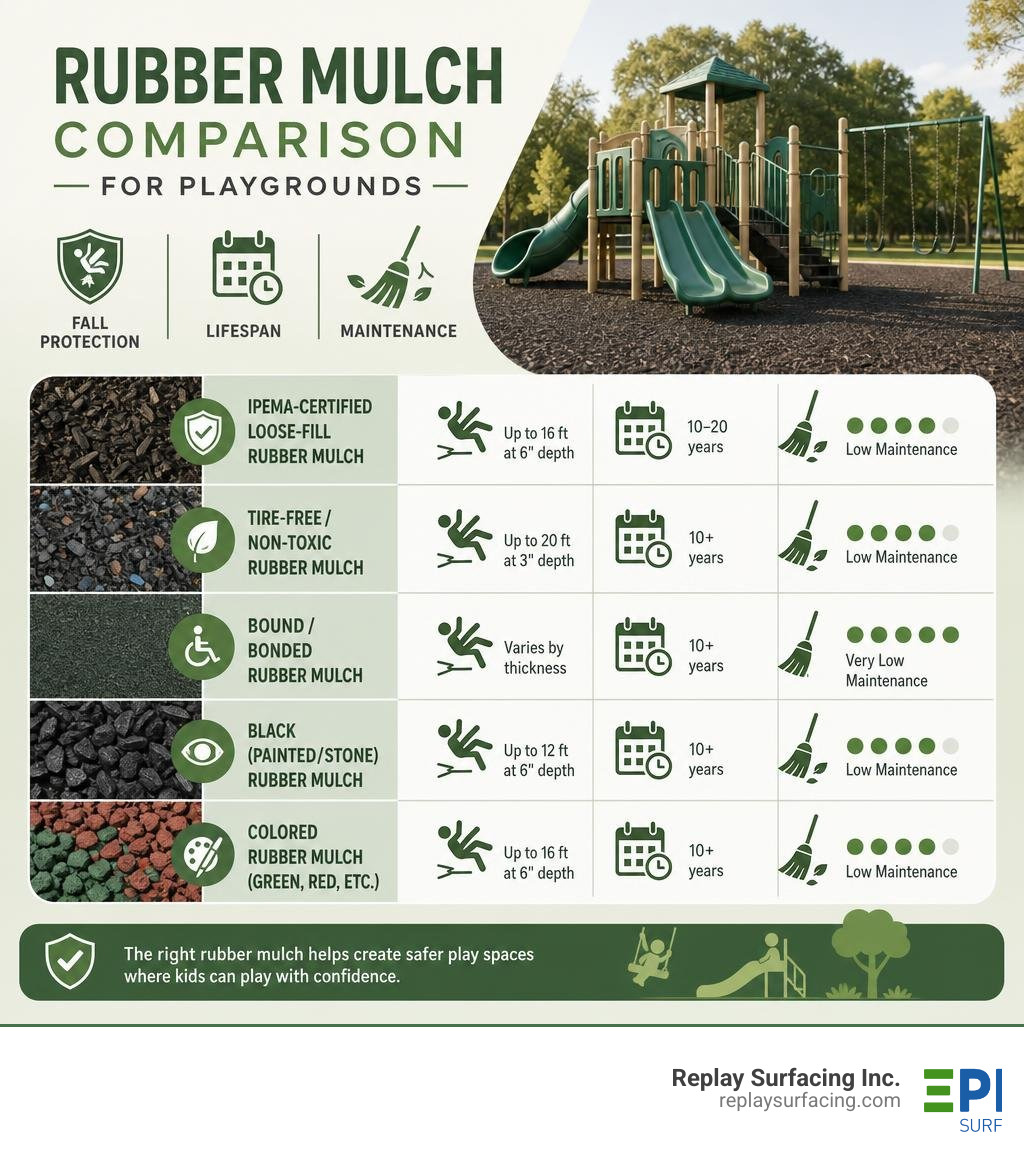
Here is a quick comparison of the most common rubber mulch options to help you choose:
| Product Type | Fall Height Protection | Lifespan | Key Feature |
|---|---|---|---|
| IPEMA-certified loose-fill rubber mulch | Up to 16 ft at 6″ depth | 10-20 years | Best for compliance |
| Tire-free / non-toxic rubber mulch | Up to 20 ft at 3″ depth | 10+ years | No odor or residue |
| Bound / bonded rubber mulch | Varies by thickness | 10+ years | ADA accessible, no displacement |
| Black (painted/stone) rubber mulch | Up to 12 ft at 6″ depth | 10+ years | High contrast for accessibility |
| Colored rubber mulch (green, red, etc.) | Up to 16 ft at 6″ depth | 10+ years | Aesthetic flexibility |
Over 200,000 playground injuries occur every year in the United States. Many of those injuries happen because the surface underneath the equipment simply does not absorb enough impact. The right surfacing material makes a measurable difference — and not all rubber mulch products are equal.
If you manage a school, park, daycare, or community play space, you already know the frustration: traditional wood chips decompose, sand compacts, and both require constant replacement. Rubber mulch addresses all of those pain points — but picking the wrong product can mean wasted money or a surface that falls short of safety standards.
This guide breaks down the top rubber mulch products for play areas so you can compare them side by side and choose with confidence.
I’m Landon Olson, operator of Replay Surfacing Inc., where I’ve spent years recycling millions of pounds of scrap tires into certified rubber mulch for play areas in Raleigh and other sustainable surfacing solutions. My background in mechanical engineering and sustainability gives me a practical, no-nonsense lens for evaluating what actually works.
Easy rubber mulch for play areas in Raleigh glossary:
- Raleigh rubber safety surfacing
- Tucson residential playground flooring
- home rubber playground flooring
What is Rubber Mulch for Play Areas in Raleigh?
At its core, rubber mulch for play areas in Raleigh is a specialized, springy ground cover made primarily from shredded or chunked recycled rubber. Unlike natural wood mulches, which are chopped up from trees and immediately begin their journey toward decay, rubber mulch is built to withstand heavy foot traffic, extreme weather, and the energetic bounds of children playing.
Most high-quality rubber mulch is manufactured using clean, processed tires. During production, the steel wire reinforcement inside the tires is meticulously removed using powerful industrial magnets, leaving behind a material that is 99.9% steel-free. This process yields a highly durable, springy nugget or shred that is ideal for absorbing the shock of hard falls. We specialize in transforming these potential environmental hazards into customizable, sustainable surfaces that keep kids safe.
From the dry, sun-drenched parks of Tucson, Arizona, to the rain-heavy play spaces in Raleigh and Charlotte, North Carolina, rubber mulch adapts beautifully to local climates. For instance, while wood mulch quickly rots in the humid environments of Columbia, South Carolina, or Lake Charles, Louisiana, recycled rubber mulch remains completely unaffected by moisture. It does not absorb water, meaning it won’t harbor mold, mildew, or rot.
Furthermore, because it is rubber mulch made from recycled tires, it is heavy enough to stay put. If you have ever watched traditional wood chips float away down a storm drain after a heavy downpour in Nashville, Tennessee, or Hartford, Connecticut, you will appreciate that rubber mulch is five times heavier than wood chips, keeping your safety surfacing exactly where it belongs.
Benefits, Safety Standards, and Comparisons
When it comes to protecting children from playground falls, the surface material is your most critical line of defense. The primary benefit of rubber mulch is its unparalleled shock absorbency. It is tested to provide fall height protection of at least 12 feet with a 6-inch depth, which is nearly twice the rating of wood chips and more than twice that of playground sand. Under specific testing conditions, certain rubber mulch products can even achieve IPEMA certification for a 16-foot fall height at a 6-inch depth.
But safety isn’t just about impact absorption. It’s also about accessibility. Playgrounds should be welcoming to all children, including those using wheelchairs, crutches, or walkers. When properly installed and compacted, rubber mulch can meet ADA accessibility guidelines, providing a stable yet forgiving surface.
Parents and facility managers often ask us, “is rubber mulch a safe surface for your childs playground?” The answer is a resounding yes, provided you select certified, high-quality products. To help you navigate the process of choosing the right material, we have put together a playground certified rubber mulch complete guide to ensure your installation meets every national safety benchmark.

Comparing Rubber Mulch for Play Areas in Raleigh to Traditional Loose-Fill Materials
To truly understand why rubber mulch has become the premier choice for modern play areas, it helps to compare it directly to traditional loose-fill alternatives like wood chips (engineered wood fiber), sand, and pea gravel.
Traditional materials suffer from several inherent flaws:
- Decomposition: Wood chips rot, splinter, and break down into dusty soil over time, requiring annual top-offs to maintain safety depths.
- Pest Attraction: Organic mulches provide a cozy nesting ground for insects like termites and carpenter ants, and can attract rodents. Sand often becomes an outdoor litter box for neighborhood cats.
- Compaction and Weathering: Sand and pea gravel compact into a hard, concrete-like surface over time, especially when wet or frozen, severely reducing their shock absorbency. Wood chips can freeze solid in cold climates like Connecticut or Indiana.
- Long-Term Cost: While wood chips and sand are cheap to buy initially, the labor and material costs of replacing them every single year quickly add up.
Choosing top rated mulch for playgrounds to keep kids safe and happy means looking past the initial price tag and analyzing the total cost of ownership. When you consider the advantages of playground rubber mulch safety maintenance and durability, rubber mulch wins across almost every category.
Here is how these materials stack up side by side:
| Feature | Rubber Mulch | Wood Chips (EWF) | Playground Sand | Pea Gravel |
|---|---|---|---|---|
| Fall Height Protection (6″ Depth) | 12 to 16 Feet | 5 to 7 Feet | 4 to 5 Feet | 5 to 6 Feet |
| Lifespan | 10 to 20 Years | 1 to 2 Years | Requires constant washing/refilling | Displaces easily, lasts 3-5 years |
| Maintenance Required | Occasional raking | Annual replenishment & tilling | Daily raking, debris removal | Raking, weeding, constant top-offs |
| Pest & Mold Resistance | High | Low | Low | Medium |
| ADA Accessibility | Yes (when compacted) | Yes (when compacted) | No | No |
| Splinters & Scratches | None | High risk | Low risk | High risk |
Safety Standards for Rubber Mulch for Play Areas in Raleigh
Not all rubber ground covers are safe for children. When sourcing rubber mulch, it is vital to verify that the product meets strict national safety standards:
- ASTM F1292: This standard measures impact attenuation, ensuring the surface can sufficiently cushion a child’s head during a fall.
- ASTM F1951: This evaluates wheelchair accessibility, confirming the surface remains firm enough for mobility devices.
- ASTM F3012: This is the specific standard for loose-fill rubber safety surfacing, regulating heavy metal content and physical properties.
In addition to these certifications, you must ensure the product is 99.9% steel-free. Lower-grade landscaping mulches may contain wire fragments that can cause cuts or puncture wounds. High-quality playground-grade rubber mulch undergoes rigorous magnetic separation to eliminate this risk.
Toxicity is another common concern. Certified playground rubber mulch is non-toxic and formulated to prevent chemical leaching. If you want to dive deeper into the science of rubber safety, read our detailed articles on non-toxic rubber mulch and the myths surrounding rubber mulch toxic concerns to put your mind at ease.
Pros, Cons, and Cost Considerations
Like any home or commercial improvement project, choosing rubber mulch involves weighing its benefits against its drawbacks.
The Pros
- Incredible Longevity: It lasts between 10 and 20 years without decomposing.
- Ultra-Low Maintenance: It does not require watering, tilling, or annual top-offs. An occasional raking in high-traffic areas (like under swings) is all it takes.
- Superior Weather Resistance: It won’t freeze in cold Indiana winters, and it won’t wash away during heavy summer storms in South Carolina.
- Pest Deterrent: It does not attract termites, ants, or rodents, making your play area cleaner and safer.
The Cons
- Higher Upfront Cost: The initial purchase price is higher than wood mulch or sand.
- Heat Absorption: In extremely hot climates, such as Tucson, Arizona, dark rubber mulch can absorb solar heat and become hot to the touch. Opting for lighter colors or installing shade sails can easily mitigate this.
- Initial Scent: Freshly installed rubber mulch can have a distinct “new tire” odor. However, this scent typically dissipates within a few days of exposure to outdoor air and sunlight.
Long-Term Cost Analysis
While the initial investment can seem daunting, rubber mulch is highly cost-effective over time. Because organic mulches decompose, you must replenish them by 2 to 3 inches every year. Over a ten-year period, the cost of purchasing, transporting, and spreading fresh wood chips—combined with the labor to remove degraded, compacted material—can easily double or triple the cost of a single rubber mulch installation.
For a complete breakdown of budgeting for your project, explore our rubber mulch cost guide 2026. If you are trying to calculate bulk pricing, check out our guide on the cost of rubber mulch per yard. Additionally, if you prefer a seamless, unified surface rather than loose nuggets, you might want to look into our bonded rubber mulch price guide to compare loose-fill against poured-and-bound alternatives.
Installation, Depth, and Color Options
Installing rubber mulch is a straightforward process, but taking the time to prepare the site correctly will ensure your playground remains safe and beautiful for decades.

Step-by-Step Installation Basics
- Clear the Area: Remove all grass, weeds, rocks, and old surfacing material. Excavate the area to your desired depth.
- Install a Border: Use sturdy timber or rubber borders to keep the loose-fill mulch contained within the play zone.
- Lay Landscape Fabric: Always use a high-quality, commercial-grade geotextile weed barrier. This prevents weeds from growing up through the mulch while allowing rainwater to drain freely into the soil.
- Spread the Mulch: Pour the rubber mulch and rake it evenly to your target safety depth.
Depth Requirements
For residential playsets, a depth of 3 inches is generally sufficient to protect against typical fall heights. For commercial spaces, schools, or public parks, we recommend a depth of 4 to 6 inches to comply with safety standards and accommodate higher commercial play equipment. For a thorough breakdown of these measurements, refer to the definitive guide to rubber mulch depth playground requirements.
Color and Style Options
Rubber mulch doesn’t have to look like a pile of old tires. It is available in a wide variety of vibrant, long-lasting colors. Using advanced, non-toxic polyurethane coatings with color-lock technology, the pigments are fused directly to the rubber, ensuring they won’t rub off on children’s clothes or wash away into the grass.
- Charcoal Black: Offers a clean, modern, stone-like aesthetic. To source this locally, check out North Carolina Black Landscape Rubber Mulch , Connecticut Playground Black Rubber Mulch , or Indiana Playground Black Rubber Mulch .
- Forest Green: Blends seamlessly into natural backyard landscapes. Read our green rubber mulch guide 2026 for design inspiration.
- High-Contrast Options: Mixing colors (like sand and dark brown) can create high-contrast borders that help visually impaired children navigate the play space safely.
For more tips on choosing colors and estimating coverage, check out the ultimate guide to rubber mulch colors costs and coverage.
How long does rubber mulch last?
Because rubber is an inorganic material, it does not rot, decay, or break down. A typical installation of high-quality rubber mulch will last 10 to 20 years with minimal maintenance. While the color coating may gradually fade slightly under intense UV exposure over a decade, the structural integrity of the rubber remains completely intact.
To keep your play area looking pristine, simply use a leaf blower on a low setting to clear away fallen leaves or twigs, and rake the high-traffic areas occasionally to prevent displacement. If you are new to this material, our beginners guide to safe rubber mulch for play areas in Raleigh offers practical maintenance tips to maximize your surface’s lifespan.
Is rubber mulch safe for the environment?
Yes! Every single ton of rubber mulch we produce recycles approximately 134 scrap passenger tires, keeping them out of landfills where they pose significant fire hazards and collect rainwater that breeds mosquitoes. By choosing rubber mulch, you are actively participating in a circular economy that conserves natural resources.
Additionally, because it does not degrade, you do not have to cut down trees every year to replenish your playground surface. If you are curious about the lifecycle of these materials, read our article on sustainable playground rubber mulch and the truth about recycled materials.
How much rubber mulch do I need for a playset?
Calculating your material needs is simple once you know your playground’s square footage and desired depth.
- By the Yard: One cubic yard of rubber mulch covers approximately 100 square feet at a 3-inch depth. You can learn more in our rubber mulch yard guide 2026 and explore purchasing options using our rubber mulch by the yard resource.
- By the Ton: One ton (2,000 lbs) of rubber mulch covers roughly 300 square feet at a 3-inch depth. Check out rubber mulch per ton for bulk weight calculations.
If you are setting up a standard backyard swing set, our guide on rubber mulch for playset installations will walk you through the exact math so you don’t over- or under-order.
Conclusion
Creating a safe, durable, and beautiful play space shouldn’t require a lifetime of exhausting annual maintenance. At Replay Surfacing Inc., we are proud to turn environmental waste into premium, high-performance safety surfaces that protect children and preserve the planet.
Whether you are designing a backyard play area in Raleigh, NC, setting up a school playground in Tucson, AZ, or upgrading a municipal park in Columbia, SC, we have the local expertise and high-quality materials to bring your vision to life.
Ready to build a play area that actually lasts? Explore our Replay Surfacing Residential Solutions today to find the perfect safety surface for your next project, or check out local sourcing options like Raleigh Rubber Mulch Options, Sanford, North Carolina Playground Mulch, and Tucson, Arizona Playground Surfacing to get started!