
Is Poured in Place Surfacing Worth It for Schools? Here’s What You Need to Know
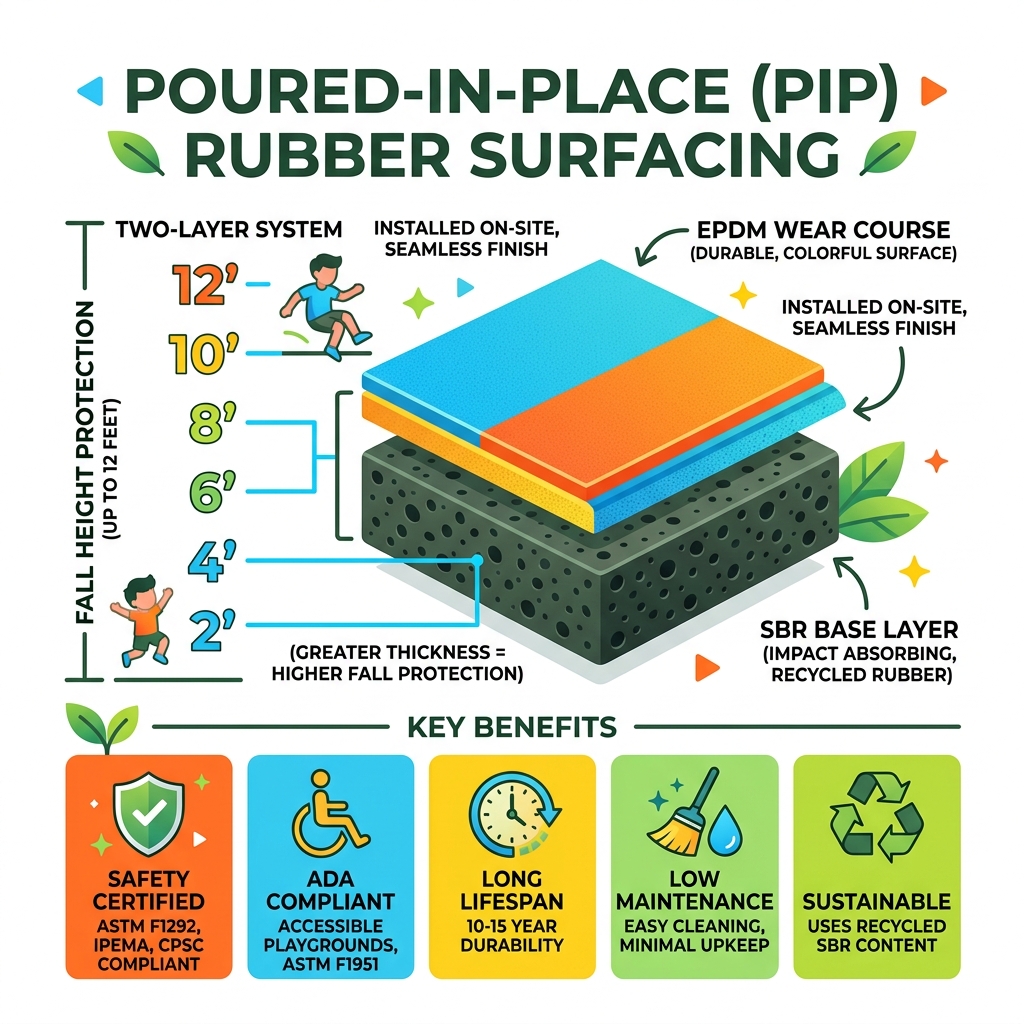
Poured in place surfacing is a two-layer rubber system installed directly on-site, offering seamless fall protection, ADA accessibility, and lasting durability for school playgrounds and recreational areas.
Here’s a quick comparison to help you decide:
| Feature | Poured in Place Surfacing |
|---|---|
| Fall protection | Up to 12 feet |
| ADA compliant | Yes (ASTM F1951) |
| Lifespan | 10-15 years |
| Maintenance | Low |
| Customizable | Yes (colors, logos, games) |
| Recycled content | Yes (SBR base layer) |
| Safety certified | ASTM F1292, IPEMA, CPSC |
For schools specifically, the combination of seamless impact absorption, wheelchair accessibility, and the ability to embed logos and educational patterns makes it one of the most practical long-term investments a facility manager can make.
But cost is a real concern. And not all PIP systems are equal. The materials, binders, thickness, and installer experience all affect what you pay — and what you get.
I’m Landon Olson, operator of Replay Surfacing Inc., where I’ve built my career around turning recycled rubber into high-performance poured in place surfacing solutions for schools, parks, and recreational facilities. My background in mechanical engineering and sustainability gives me a grounded, practical lens for evaluating what actually works in the field.
Poured in place surfacing terms simplified:
Understanding Poured in Place Surfacing: Materials and Construction
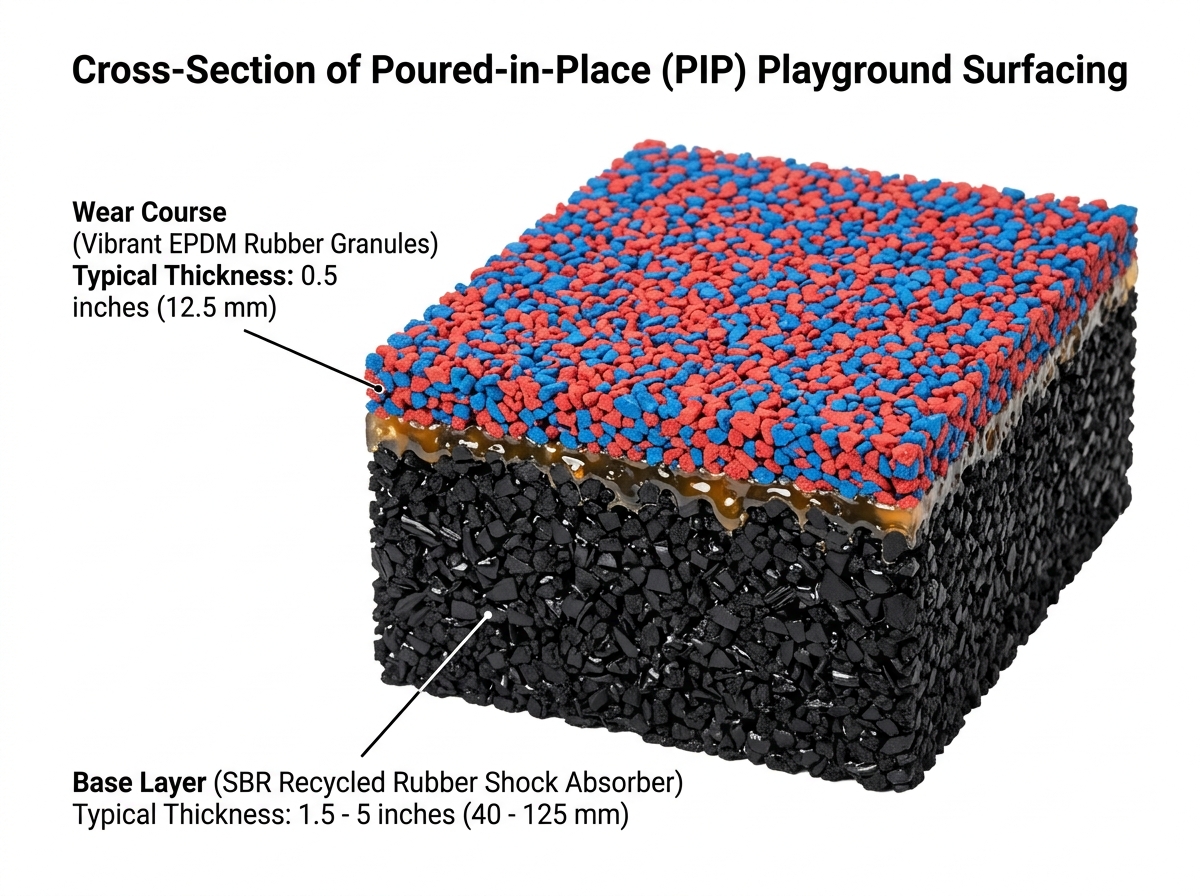
When we talk about poured in place surfacing (often abbreviated as PIP), we are describing a “unitary” surface. Unlike loose-fill materials that move around when kids run, PIP is a solid, seamless floor. We construct it in two distinct layers to balance safety with durability.
The first layer is the base mat or cushion layer. This is typically made from SBR (Styrene-Butadiene Rubber) buffings. These are recycled rubber “noodles” or chunks derived from 100% recycled tires. This layer is the “shock absorber” of the system. Depending on the height of your playground equipment, we adjust the thickness of this layer—usually between 1.5 and 4 inches—to ensure it can cushion a fall effectively.
The second layer is the wear course. This is the colorful top layer that everyone sees. It is usually about 1/2 inch thick and consists of EPDM (Ethylene Propylene Diene Monomer) granules or TPV (Thermoplastic Vulcanizate) technology. While EPDM is a long-standing industry standard, TPV is an advanced alternative known for even better color fastness and UV resistance. Both materials are mixed with a polyurethane binder and hand-troweled to create a smooth, slip-resistant finish.
For more technical details, you can explore more info about poured-in-place-rubber-surfacing to see how these layers work together in different environments.
Aromatic vs. Aliphatic Binders in Poured in Place Surfacing
One of the most important decisions you’ll make for your school’s playground in Nashville, Tennessee, or Charlotte, North Carolina, isn’t just the color of the rubber—it’s the type of “glue” or binder we use to hold it all together.
- Aromatic Binders: These are the industry standard and are more budget-friendly. However, they have a “yellowing” or ambering effect when exposed to UV rays. If you choose a blue or gray surface, an aromatic binder might make it look slightly teal or yellowish for the first few months until the ambering wears off.
- Aliphatic Binders: These are premium, clear binders. They are highly UV-resistant and do not change color over time. While they can cost significantly more than aromatic binders, they offer superior tensile strength and longevity, especially in high-heat areas like Tucson, Arizona.
Choosing the right binder is a classic cost-benefit analysis. If you’re using earth tones like red or beige, aromatic is often fine. For vibrant blues or teals, aliphatic is the way to go. To help plan your project, you can use this PIP calculation cheat sheet to estimate the materials required for your specific square footage.
Customization and Design Versatility
One of the reasons schools in districts from Indiana to Oregon love poured in place surfacing is the sheer level of creativity it allows. Because the material is mixed and poured on-site, we aren’t limited by straight lines or pre-set patterns.
We can incorporate:
- School Logos and Mascots: Build school spirit directly into the ground.
- Educational Patterns: Maps of the US, number grids, or alphabets that turn recess into a learning opportunity.
- Integrated Games: Permanent hopscotch, four-square, or “fever” circles.
- Wayfinding: Colorful paths that guide children from the classroom to the play structure.
If you are looking to tackle a smaller area or a specific repair, check out these ready-to-pour PIP products to see the color possibilities.
Safety Standards and ADA Compliance for Educational Facilities
In a school setting, safety isn’t just a goal; it’s a legal and ethical requirement. Poured in place surfacing is designed specifically to meet and exceed the most rigorous safety standards in the United States.
| Standard | What it Measures | Why it Matters for Schools |
|---|---|---|
| ASTM F1292 | Impact Attenuation | Measures the “shock” of a fall to prevent head injuries. |
| ASTM F1951 | ADA Accessibility | Ensures a wheelchair can navigate the surface easily. |
| ASTM F3351 | Lab Testing | Tests the system’s performance in controlled environments. |
| IPEMA | Third-Party Certification | Provides independent verification that the product meets standards. |
For schools, ADA guidelines are a top priority. Unlike mulch or gravel, which can be nearly impossible for a wheelchair to navigate, PIP is firm, stable, and slip-resistant. This ensures that every child, regardless of mobility, can enjoy the playground. You can also consult the CPSC Standards for general playground safety guidelines or verify IPEMA certification for specific products.
Critical Fall Height Protection with Poured in Place Surfacing
The “Critical Fall Height” (CFH) is the maximum height from which a child could fall onto the surface without sustaining a life-threatening head injury. We measure this using GMAX (shock) and HIC (Head Injury Criterion) scores.
A typical PIP system can protect against falls from 1 foot up to 12 feet. In our installations across Sanford, North Carolina, and Nashville, Tennessee, we customize the thickness of the SBR cushion layer based on the highest point of your play equipment. If you have a 10-foot slide, we ensure the rubber underneath is thick enough to meet that specific 10-foot rating. For a deeper dive into how this works, read about fall attenuation in PIP surfaces.
Environmental and Health Considerations
At Replay Surfacing Inc., we take pride in the fact that our poured in place surfacing is an environmentally friendly choice. By using recycled SBR buffings, we help keep thousands of tires out of landfills in states like Indiana and South Carolina every year.
Beyond being green, the material is:
- Non-Toxic and Latex-Free: Safe for children to touch and play on.
- Permeable: Water drains through the surface rather than pooling on top, which prevents “slip-and-slide” hazards and reduces bacterial growth.
- Antimicrobial: The nature of the polyurethane and rubber mix resists mold and mildew.
- Heat Management: While all outdoor surfaces can get warm, choosing lighter colors can help manage heat retention in sunny climates like Tucson.
Installation Process and Site Requirements
Installing poured in place surfacing is a craft that requires a skilled hand. It isn’t as simple as dumping a bag of mulch; it’s more like finishing a fine concrete floor.
- Site Preparation: The area must be cleared and leveled. We recommend installing over a permanent sub-base like concrete or asphalt for the best longevity. While compacted stone can be used, concrete (cured for 28 days) provides the most stable foundation.
- The Cushion Layer: We mix the SBR buffings with binder in a specialized mixer and pour them onto the site. Our team hand-trowels this layer to the required thickness for your fall height. This layer usually needs to cure overnight.
- The Wear Course: Once the base is set, we mix the colorful EPDM or TPV granules with binder and apply the top layer. This is where the designs, logos, and colors come to life.
- Curing: The entire system needs about 24 to 48 hours to fully cure, depending on the temperature and humidity.
Weather is a major factor. We generally need temperatures between 50°F and 90°F and dry conditions for a successful install. If you’re wondering if you can do this yourself, check out our guide on DIY vs Professional installation.
Beyond Playgrounds: Common Applications
While playgrounds are the most common use, the versatility of this material makes it a great fit for other areas of a school campus or community center:
- Splash Pads: Its slip-resistant and permeable nature makes it perfect for water play.
- Walking and Jogging Tracks: It provides a low-impact surface that is easy on the joints for students and staff.
- Multi-Purpose Courts: Great for hopscotch, four-square, or outdoor fitness zones.
- Pool Decks: Check out our specific page on poured-in-place-rubber-pool-decks for more details.
Why Poured in Place Surfacing is the Superior Choice for Schools
When school boards in places like Raleigh, North Carolina, or Beaverton, Oregon, look at surfacing, they often compare PIP to loose-fill options. While the initial price tag of PIP is higher, it is widely considered the superior choice for several reasons.
First, it is a unitary surface. This means it stays put. You don’t have to worry about students kicking mulch into the grass, or “hidden” hazards like broken glass or animal waste getting buried in the loose fill. It also maintains a consistent depth. With mulch, the “kick-out” areas under swings often become dangerously thin; with PIP, the protection is permanent and uniform.
Second, it significantly reduces maintenance labor. There is no need for annual “top-offs” or daily raking to maintain safety depths. For a busy school janitorial staff, this is a massive win. It also eliminates the “tracking” issue—no more wood chips or rubber nuggets being dragged into the hallways and scratching up the indoor floors.
Finally, it is the gold standard for inclusive play. By providing a seamless surface, you ensure that every student can participate in recess together, fostering a more inclusive school environment. For more on this, read about the ultimate playground safety surface.
Cost Analysis and Long-Term Maintenance for Schools
We won’t sugarcoat it: poured in place surfacing is one of the more expensive options upfront. The cost is driven by the high quality of the raw materials (rubber and polyurethane) and the intensive labor required for a hand-troweled installation.
However, when you look at the lifecycle value, the math changes.
- Initial Investment: Covers site prep, materials, and professional labor.
- Maintenance Savings: You save thousands over 10 years by not purchasing annual mulch refills or paying for the labor to spread them.
- Longevity: A well-maintained PIP surface can last 10 to 15 years.
To keep your surface in top shape, we recommend a simple cleaning routine: sweep or blow off debris weekly and occasionally hose it down. For older surfaces, applying a “roll coat” or “cap coat” of binder every 2 to 3 years can replenish the UV protection and keep the granules locked tight. If a small area gets damaged, we offer easy-to-use repair kits.
Ready to see what a project might cost for your facility? You can fill out a quote form to get started.
Frequently Asked Questions about PIP Surfacing
How long does poured in place surfacing last?
With proper installation and basic maintenance, you can expect your surface to last between 10 and 15 years. Using a premium aliphatic binder can push that lifespan toward the higher end. The “wear course” thickness is also a factor—a full 1/2 inch top layer provides much more durability than thinner, “budget” applications.
Does rubber surfacing get hot in the sun?
Like asphalt or sand, rubber surfacing does absorb heat. In high-temperature areas like Tucson or during a humid Nashville summer, the surface can get hot to the touch. We recommend that children always wear shoes. To mitigate this, you can choose lighter color blends (which stay cooler than black or dark blue) or install shade structures over the play area to significantly drop the surface temperature.
How do you repair damaged rubber surfacing?
Small holes or cracks can be fixed using a DIY patch kit, which includes the granules and binder needed to fill the gap. For larger areas that have worn down over a decade, we can perform a “re-top,” where we apply a fresh wear course over the existing base mat. This is much cheaper than a full replacement. For more tips, check out our tag: Poured in place rubber for maintenance articles.
Conclusion
At Replay Surfacing Inc., we believe that every child deserves a safe, accessible, and vibrant place to play. Whether you are a school administrator in Sanford, North Carolina, a park director in Nashville, Tennessee, or a facility manager in Indiana, poured in place surfacing offers a sustainable and high-performance solution that stands the test of time.
By transforming recycled tires into durable safety surfaces, we aren’t just building playgrounds—we’re helping schools create inclusive environments that require less maintenance and provide better protection.
Ready to transform your school’s recreational space? Explore our options for Playground Surfacing and let’s build something great together.