
How to Choose the Best Playground Flooring in Charlotte, NC
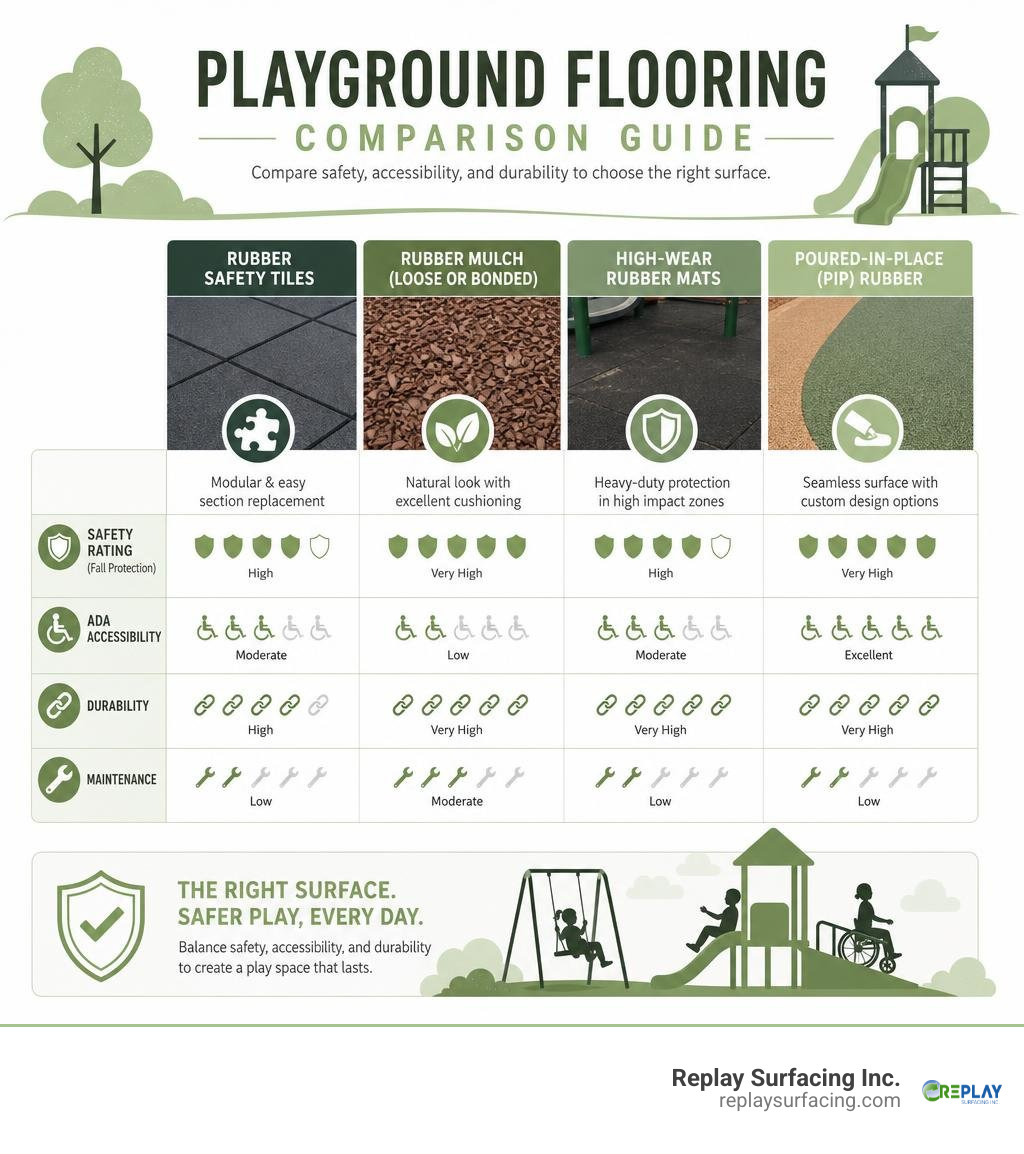
The best playground flooring balances certified fall-height safety (ASTM F1292 compliance), ADA accessibility, and low lifetime maintenance costs. Facility managers choosing surfacing for schools, municipal parks, and daycares typically select between four primary rubber options:
- Rubber Safety Tiles: Modular, easy to install, and ideal for quick section replacements without replacing the entire surface.
- Rubber Mulch (Loose or Bonded): Delivers exceptional shock absorption and natural texture while staying clean and splinter-free.
- High-Wear Rubber Mats: Heavy-duty pads designed to stop erosion and holes under swings and slide exits.
- Poured-in-Place (PIP) Rubber: A seamless, dual-layer surface that offers top-tier wheelchair accessibility and custom design options.
Whether you manage community parks in Raleigh, school districts in Charlotte, or recreation centers in Tucson, picking the right material keeps kids safe through intense summer sun and wet winter freezes.
I’m Landon Olson, a mechanical engineer and operator at Replay Surfacing, where we transform millions of pounds of scrap tires into sustainable safety surfaces. Over the past decade, I have focused on engineering and testing high-performance playground flooring that delivers long-term durability, eco-friendly value, and dependable impact protection.
Comparing Common Playground Flooring Materials
Selecting the right surface involves matching physical material properties to your facility’s daily traffic, safety requirements, and operational budget. Every play space carries distinct demands: an urban schoolyard in Nashville sees nonstop recess activity, while a neighborhood playset in Beaverton needs constant moisture resistance against regular Pacific Northwest rainfall.
By evaluating modular tiles, loose and bonded mulch, wear pads, and seamless poured systems, you can pinpoint the exact balance of cushion, durability, and upkeep your space requires.
Interlocking Rubber Playground Flooring Tiles
Interlocking rubber tiles provide a modular, structured safety system that works exceptionally well over concrete, asphalt, or compacted aggregate bases. These tiles connect tightly using dowels, interlocking tabs, or adhesive seams, preventing shifting during intense play.

Facilities in Columbia, SC, and Lake Charles, Louisiana frequently use interlocking outdoor playground tiles because they deliver predictable factory-controlled thickness. If a single section is damaged or stained, maintenance teams can replace that isolated tile rather than repairing the entire floor. Choosing play safe rubber safety tiles guarantees uniform impact cushioning across the entire play zone while making DIY maintenance fast and straightforward.
Loose-Fill and Bonded Rubber Mulch Systems
Rubber mulch repurposes tire rubber into shredded nuggets or wood-like chips that will not rot, attract pests, or splinter. It comes in two primary forms: loose-fill and bonded systems.
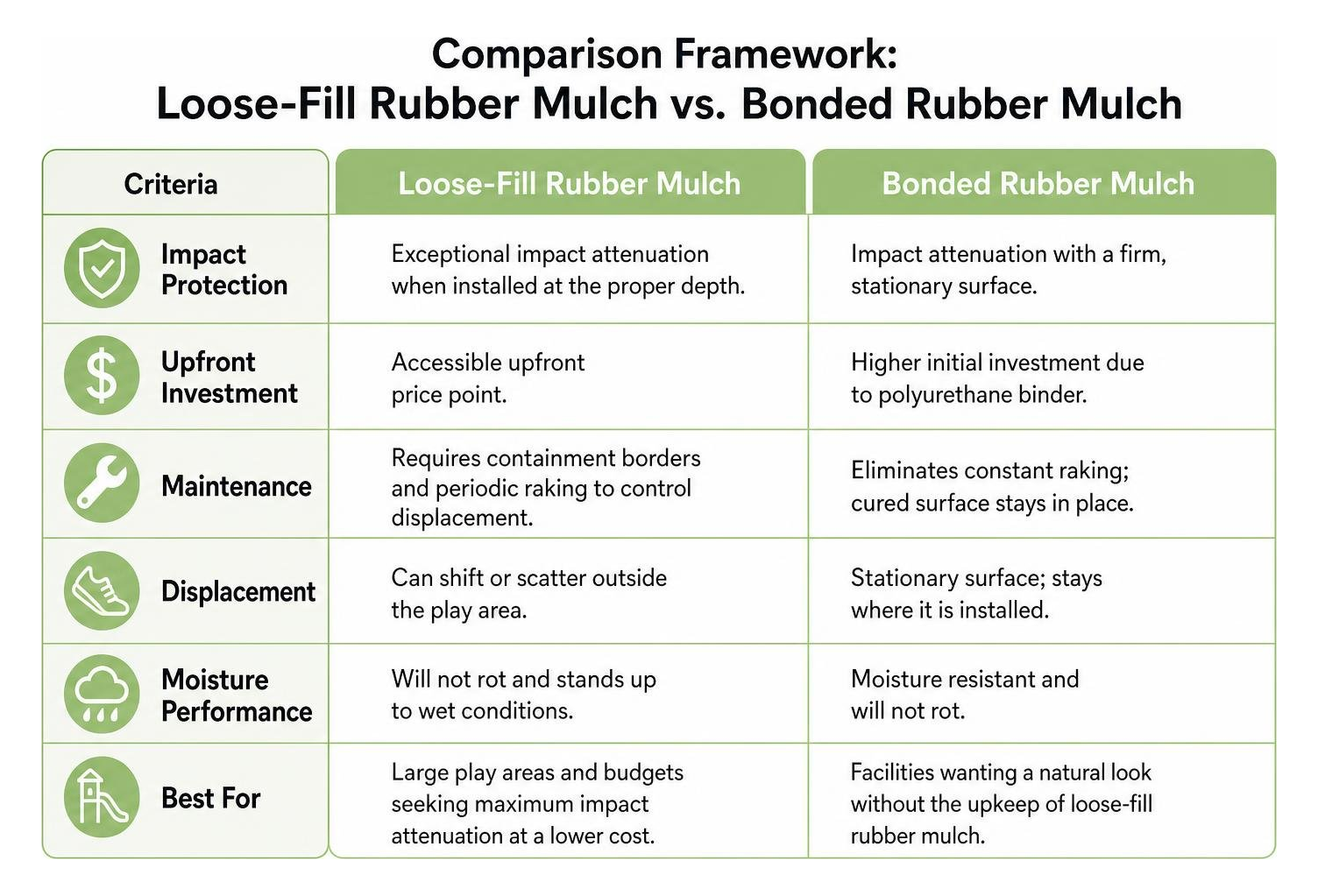
Loose-fill provides exceptional impact attenuation at an accessible upfront price point, making rubber mulch for play areas that actually last a favorite for large municipal play areas in Sanford, NC, and across Indiana. However, loose materials require containment borders and periodic raking to keep displacement under control.
To eliminate constant raking while keeping the natural look of wood bark, many facility managers choose bound rubber mulch. This system coats the rubber nuggets in a high-strength polyurethane binder, curing into a continuous, stationary surface.
Always consult the definitive guide to rubber mulch depth playground requirements to match loose layer depths or bonded thickness to the specific fall heights of your play structures.
High-Traffic Rubber Playground Flooring Mats
High-traffic transition areas—most notably beneath swing bays and at the discharge chutes of slides—experience severe physical gouging and kick-out. Even bonded systems and loose fills wear down fastest in these focused drop zones.
Placing durable playground mats ready for outdoor fun over loose mulch or PIP surfaces stabilizes the sub-base and prevents dangerous ground hollows from forming. Engineered with bevelled safety edges and heavy-duty grip textures, these wear pads protect children from bottoming out on bare soil or concrete. Reviewing wear and tear no more choosing the best mats for high traffic playground areas will help you select the appropriate mat dimensions and weights for high-volume parks.
Seamless Poured-in-Place Rubber Options
Poured-in-place (PIP) rubber is the gold standard for seamless, highly customizable safety surfacing. The installation utilizes a specialized two-layer construction: a thick, shock-absorbing base layer made from recycled tire crumb, followed by a vibrant, UV-resistant top wear layer.
Opting for poured in place rubber surfacing gives designers total creative freedom to integrate games, school logos, and themed color combinations directly into the floor. For detailed specifications on formulating wear layers with premium polymers, explore our epdm wet pour surfacing complete guide. Because it forms a continuous, joint-free plane, PIP eliminates trip hazards and provides barrier-free accessibility for mobility devices across all seasons.
Critical Safety Standards and Fall Height Protection
The primary role of playground surfacing is impact attenuation—the ability of a surface to absorb kinetic energy and reduce the peak deceleration of a child’s head during a fall. In the United States, commercial installations are evaluated against ASTM F1292 (Standard Specification for Impact Attenuation of Surfacing Materials Within the Use Zone of Playground Equipment) and ASTM F2223.

Two critical metrics determine compliance during drop tests:
- G-max: The peak deceleration recorded during impact (must remain below 200 g’s).
- Head Injury Criterion (HIC): A mathematical calculation of head injury risk over time during impact (must remain below 1,000).
Installing certified shock absorbing playground surfaces ensures that a fall from equipment at a specific height will not cause fatal head trauma. For deep technical insights into these certification thresholds, read our breakdown on safety first understanding playground surface impact standards.
| Flooring Type | Critical Fall Height Rating | ADA Compliance Level | Upfront Cost Range (Installed) | Expected Lifespan | Maintenance Demand |
|---|---|---|---|---|---|
| Poured-in-Place (PIP) | 4 ft to 12+ ft (Thickness dependent) | Exceptional (Seamless) | Moderate to High | 10–15+ Years | Low (Occasional wash/top roll) |
| Rubber Safety Tiles | 4 ft to 10 ft (Thickness dependent) | High (Firm, modular) | Moderate | 8–12 Years | Low to Medium (Joint monitoring) |
| Bonded Rubber Mulch | 4 ft to 10 ft (Thickness dependent) | High (Unitary porous) | Moderate | 7–10 Years | Low to Medium (Re-coat binder) |
| Loose Rubber Mulch | 6 ft to 12+ ft (Depth dependent) | Low to Moderate (Requires packing) | Budget-Friendly | 10+ Years (Material does not rot) | Medium to High (Raking & topping) |
| High-Wear Rubber Mats | Auxiliary/Targeted protection | High (Bevelled transitions) | Economical | 5–10 Years | Very Low (Periodic repositioning) |
Accessibility, Weather Durability, and Long-Term Costs
True playground safety extends beyond cushion; it requires universal accessibility and extreme weather durability. Under the Americans with Disabilities Act (ADA) and ASTM F1951 standards, a surface must be sufficiently firm and stable to allow wheelchairs, walkers, and strollers to roll without sinking or tipping. Seamless PIP and interlocking tiles excel in meeting these accessibility criteria effortlessly.
Weather challenges vary significantly across our service regions:
- Southern Heat (Tucson, AZ & Charlotte, NC): High UV exposure can dry out and crack lower-grade materials. High-grade aliphatic binders and heat-resistant EPDM help maintain bright color pigments and prevent surface hardening.
- Freeze-Thaw Cycles (Connecticut & Indiana): Porous sub-structures allow water to drain vertically into aggregate stone bases, preventing ice puddling and winter surface heave.
- High Precipitation (Beaverton, OR & Lake Charles, LA): Water permeability prevents standing puddles, eliminating slick algae blooms and allowing children back on the playground immediately after storms.

When calculating total investment, always factor in labor, routine grooming, and potential repairs. Review how much does playground flooring cost your guide to economical options to align your capital budget with lifetime performance, ensuring you invest in durable playground rubber surfacing that stands the test of time.
Frequently Asked Questions
What is the safest surface material for outdoor playgrounds?
Unitary rubber surfacing systems—such as poured-in-place rubber and interlocking rubber tiles—are widely recognized as the safest surfaces. Unlike loose stone, gravel, or dirt, unitary systems maintain a uniform, measured thickness that never displaces away from high-impact zones. They deliver consistent fall protection, prevent hidden debris hazards, and offer excellent slip resistance in dry and wet conditions. For an in-depth parent-focused breakdown, check out safety first a parents guide to playground surfacing.
How thick should rubber playground surfacing be?
The required thickness depends directly on the “critical fall height” of your highest playground equipment (such as climbing bars or platform decks). Generally, poured rubber thicknesses range from 1.5 inches for a 4-foot fall rating up to 4.5+ inches for equipment reaching 10 to 12 feet. Detailed engineering specs can be reviewed in our guide on fall attenuation in pip surface.
How does weather affect rubber playground surfaces?
Engineered rubber playground surfaces are vulcanized and bound to withstand wide temperature fluctuations without splitting, rotting, or freezing into hard planes. Their open-matrix porosity promotes rapid water drainage, preventing standing water and slip hazards. For a complete look at temperature resilience and year-round weather handling, see our guide on rubber flooring playground surfaces.
Conclusion
Choosing the ideal safety surface transforms your play area into an inviting, inclusive, and secure recreation space for years to come. Whether you are upgrading a private child-care facility in Raleigh, retrofitting a public park in Tucson, or designing a new school yard in Connecticut, matching the right rubber system to your site conditions guarantees optimal fall protection and long-term value.
At Replay Surfacing, we divert hundreds of thousands of scrap tires from landfills annually, transforming them into durable, impact-tested surfacing products tailored to parks, schools, and daycare centers across the country.
Ready to design a safe, custom play space built to last? Contact our team today to explore certified playground surfacing solutions customized to your facility’s exact layout, fall heights, and design vision.