

Concrete Kool Deck in Charlotte, NC — and Is It Right for Your Pool?
Concrete Kool Deck is a colored, textured cement topping applied over a concrete pool deck to lower surface temperatures and improve slip resistance. Here’s a quick overview:
| Feature | Details |
|---|---|
| What it is | Cement-based topping for pool decks, patios, and walkways |
| Invented | 1962 in Tucson, Arizona |
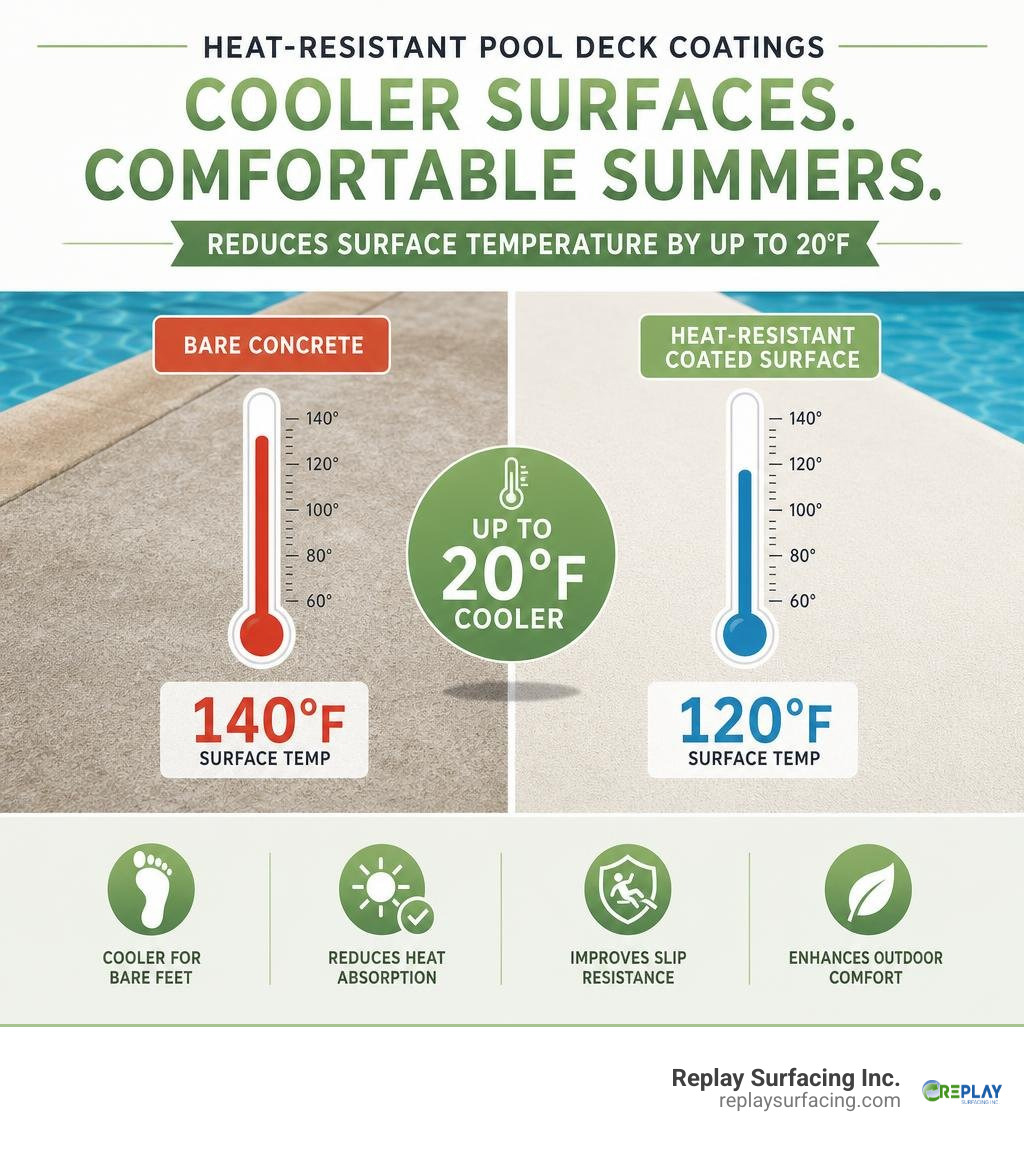
| Temperature reduction | Lowers surface heat by around 20°F vs. bare concrete |
| Applied to | Fresh or existing concrete (with proper prep) |
| Maintenance | Simple soap-and-water cleaning |
| Best for | Hot climates, barefoot comfort, slip resistance |
If you’ve ever sprinted across a sun-baked pool deck in bare feet, you already understand the problem. Plain concrete in summer doesn’t just feel uncomfortable — it can reach temperatures that genuinely burn skin. That’s the exact problem a concrete Kool Deck in Charlotte, NC was built to solve, and it’s been doing so for over six decades.
But the pool deck surfacing world has changed a lot since 1962. Today, homeowners and facility managers have more options than ever — from traditional cementitious coatings to modern recycled rubber surfaces — and picking the right one means understanding what each actually delivers in the real world.
This guide breaks down everything you need to know: how Kool Deck works, how it compares to alternatives, how to install and maintain it, and when a different material might serve you better.
I’m Landon Olson, operator of Replay Surfacing and a mechanical engineer with an MBA, and my work evaluating concrete Kool Deck alongside modern rubber surfacing solutions gives me a practical, unbiased perspective on what actually performs best for pool decks, playgrounds, and high-traffic outdoor spaces. Let’s dig in.
What is a Concrete Kool Deck and How Does It Work?
To understand how a concrete Kool Deck in Charlotte, NC operates, we have to look back to its origins. Invented in 1962 in Tucson, Arizona, this proprietary concrete topping was engineered specifically to withstand the brutal desert heat. In places like Tucson, AZ, and our Southern service areas like Charlotte, NC, Raleigh, NC, Columbia, SC, and Lake Charles, LA, direct summer sunlight can turn standard concrete into a literal frying pan.
Kool Deck is not a paint or a simple topical coating; it is a specialized cementitious overlay. It is formulated using a proprietary mixture of natural substances and synthetic iron oxide pigments.
So, how does it keep things cool? Standard concrete acts like a giant thermal battery, absorbing solar radiation and trapping heat. Kool Deck works by utilizing a textured, porous surface that minimizes the surface area in direct contact with your skin while reflecting a higher percentage of solar energy. Instead of holding onto the heat, it allows the concrete underneath to breathe. Furthermore, it is physically engineered to withstand thermal expansion and contraction better than standard concrete, which helps prevent the surface from cracking when temperatures swing from scorching daytime highs to cooler nights.
If you want to explore the original material specifications, you can check out the official Keystone Kool Deck documentation.
The Benefits of a Concrete Kool Deck
Choosing a concrete Kool Deck for your pool surround comes with several distinct advantages:
- Significant Temperature Reduction: It lowers the surface temperature of concrete by around 20 degrees Fahrenheit. This makes it comfortable to walk, sit, or sunbathe on even during peak summer afternoons.
- Non-Skid Safety: The unique textured finish provides excellent slip resistance, which is vital for wet pool environments.
- Freeze-Thaw Durability: While designed in the desert, Kool Deck is resilient enough to handle freezing temperatures. This makes it highly functional for our customers in Connecticut, Indiana, and Beaverton, OR, where winters can be severe.
- Chemical and Algae Resistance: It holds up well against pool chemicals, saltwater systems, and natural mold or algae growth, provided it is cleaned regularly.
For a deeper dive into consumer benefits, you can view the Kool Deck® product brochure.
Colors and Finishes in the Designer Color Collection
Gone are the days when your only choice was a single, clinical shade of off-white. The modern product lineup features two primary color profiles:
- Classic Pastel Colors: These light, heat-reflective shades (including White, Birch Gray, and Rose Pink) offer the maximum thermal benefit because light colors naturally reflect more solar radiation.
- Designer Color Collection: This collection includes deeper, nature-inspired earth tones like Sedona Tan, Sand Buff, and Aztec Gold. These colors allow you to match your pool deck to your home’s landscaping while still enjoying superior heat resistance compared to un-coated concrete.
Because these colors are mixed using synthetic iron oxide pigments, they resist fading under intense UV exposure. You can review the exact color SKUs and physical weight variations in the Keystone Kool Deck – Technical Data sheet.
Comparing Kool Deck to Rubber Pool Surfacing
While a concrete Kool Deck has been a reliable choice since 1962, modern safety surfacing technology has introduced highly competitive alternatives. At Replay Surfacing, we specialize in recycling tires into high-performance rubber surfacing products.
Let’s look at how these two popular options stack up side-by-side:
| Performance Metric | Concrete Kool Deck | Replay Rubber Surfacing |
|---|---|---|
| Material Base | Cement-based overlay with marble sand | Recycled rubber granules with polyurethane binder |
| Heat Retention | Lowers temperature by ~20°F | Highly breathable; does not trap thermal energy |
| Slip Resistance | Excellent (textured cement) | Superior (natural rubber grip, wet or dry) |
| Impact Absorption | None (hard concrete surface) | Excellent (cushioned, fall-safe impact protection) |
| Durability & Cracking | Can crack over shifting concrete | Flexible; stretches and accommodates base cracks |
| Installation Window | Highly temperature-sensitive (50°F–90°F) | Flexible installation; seamless application |
If you are weighing your options for a complete deck overhaul, check out our comprehensive guide on Pool Deck Surfaces.
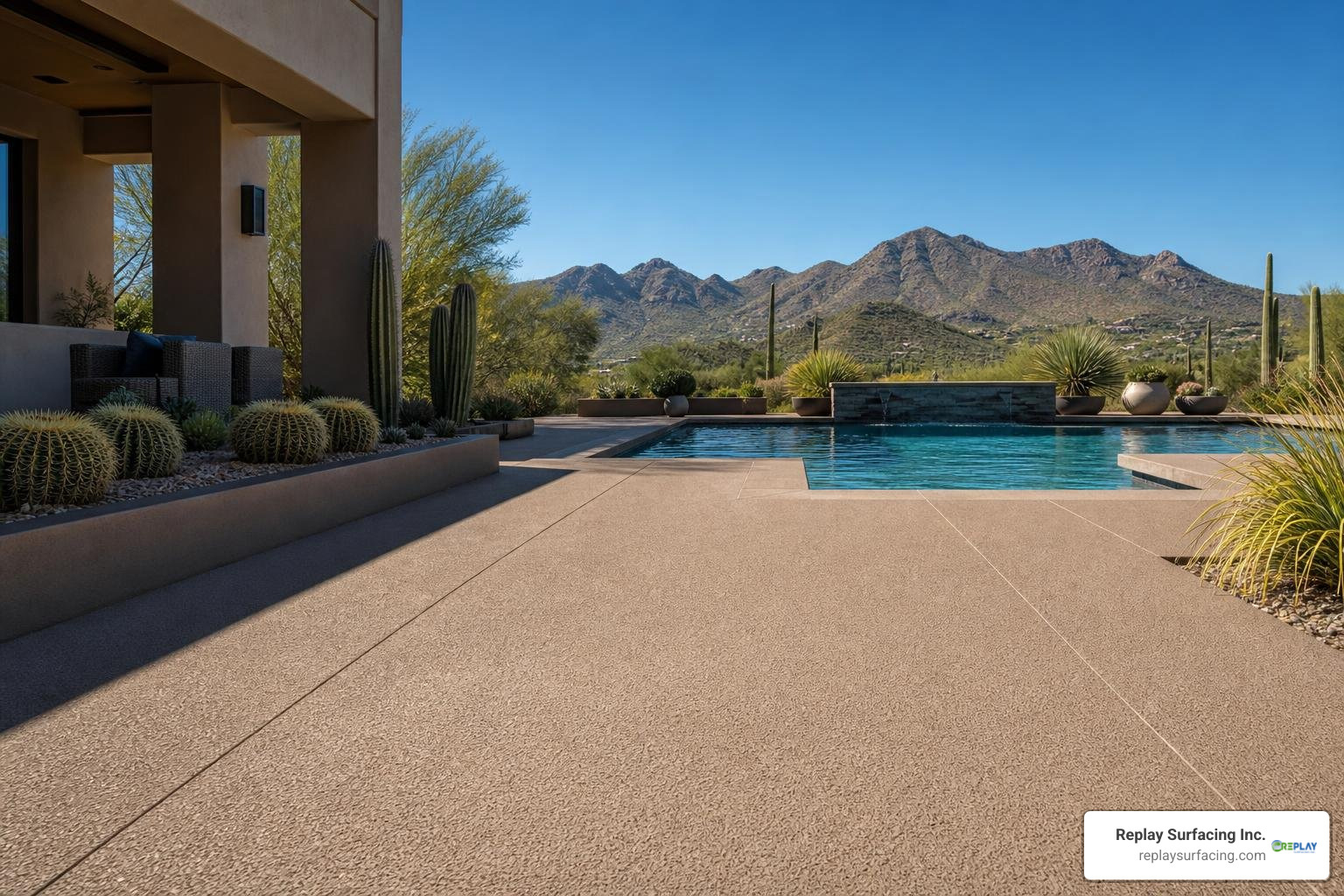
Kool Deck vs. Rubber Surfacing: Key Differences
When evaluating these materials for your home or commercial facility, the differences boil down to three main categories:
- Safety and Impact Absorption: Kool Deck is slip-resistant but still rock-hard. If a child trips and falls on a cementitious deck, they are going to get scraped or bruised. Rubber surfacing, on the other hand, provides true impact absorption. This is why we install it heavily on splash pads, playgrounds, and pool surrounds across our locations in Sanford, NC, Nashville, TN, and beyond.
- Flexibility and Cracking: Concrete decks inevitably shift and crack over time due to ground settling. While Kool Deck handles thermal expansion well, it will still telegraph structural cracks that form in the underlying concrete slab. Rubber surfacing is highly flexible; it stretches and bridges minor cracks without tearing.
- Heat Dissipation: Both surfaces perform exceptionally well in the heat. While Kool Deck reflects solar rays to keep temperatures down, rubber surfacing is porous and highly breathable, ensuring it never becomes a hot plate for bare feet.
For a detailed breakdown of all your resurfacing choices, read our Pool Deck Resurfacing Options Guide.
Modern Alternatives: Rubber Pool Decking Surfaces
For property owners looking to modernize their outdoor spaces, recycled rubber represents the cutting edge of pool deck safety. It creates a seamless, porous, and highly durable safety surface that stands up to heavy foot traffic, pool chemicals, and intense UV rays.
Whether you are managing a community splash pad in Charlotte or a backyard pool in Beaverton, rubber safety surfacing turns a hard, hazardous concrete deck into a soft, slip-resistant oasis. You can read more about how this works on our Rubber Pool Decking Surfaces page and learn about maximizing safety with Non-Slip Pool Deck Surfaces.
Installation and Preparation: Can You Apply It to Existing Concrete?
A common question we hear is: Can you apply Kool Deck to an existing pool deck, or does it have to be poured on brand-new concrete?
The answer is yes, you can apply it to existing concrete, but the preparation process is incredibly demanding. While Kool Deck was originally designed to be applied to freshly poured, wet concrete, specialized bonding agents now make retrofitting possible. However, if your concrete has major structural cracks, active water leaks, or poor drainage, an overlay will not fix the underlying issues.
To ensure proper adhesion, the existing concrete must undergo a rigorous preparation sequence:
- Deep Cleaning: The slab must be completely free of dirt, oil, paint, sealers, and organic matter.
- Acid Washing: You must acid wash the concrete using a muriatic acid solution (typically a 1:1 ratio of water to acid for older concrete, or 1:4 for newer concrete). This etches the surface, opening up the concrete’s pores so the topping can grab hold.
- Pressure Washing: After the acid stops bubbling, the deck must be thoroughly pressure washed at 3000 psi to remove all loosened concrete dust and chemical residue.
- PTA Bonding Agent: A proprietary polymer bonding agent must be applied to the damp concrete immediately before splashing the topping.
For the exact technical specifications of this prep work, you can reference the official Application Instructions for Keystone Kool Deckon Existing Concrete .
The Step-by-Step Application Process
Installing a concrete Kool Deck is a highly coordinated team effort. Because the material sets quickly, it requires a skilled crew of 4 to 5 people working in harmony.
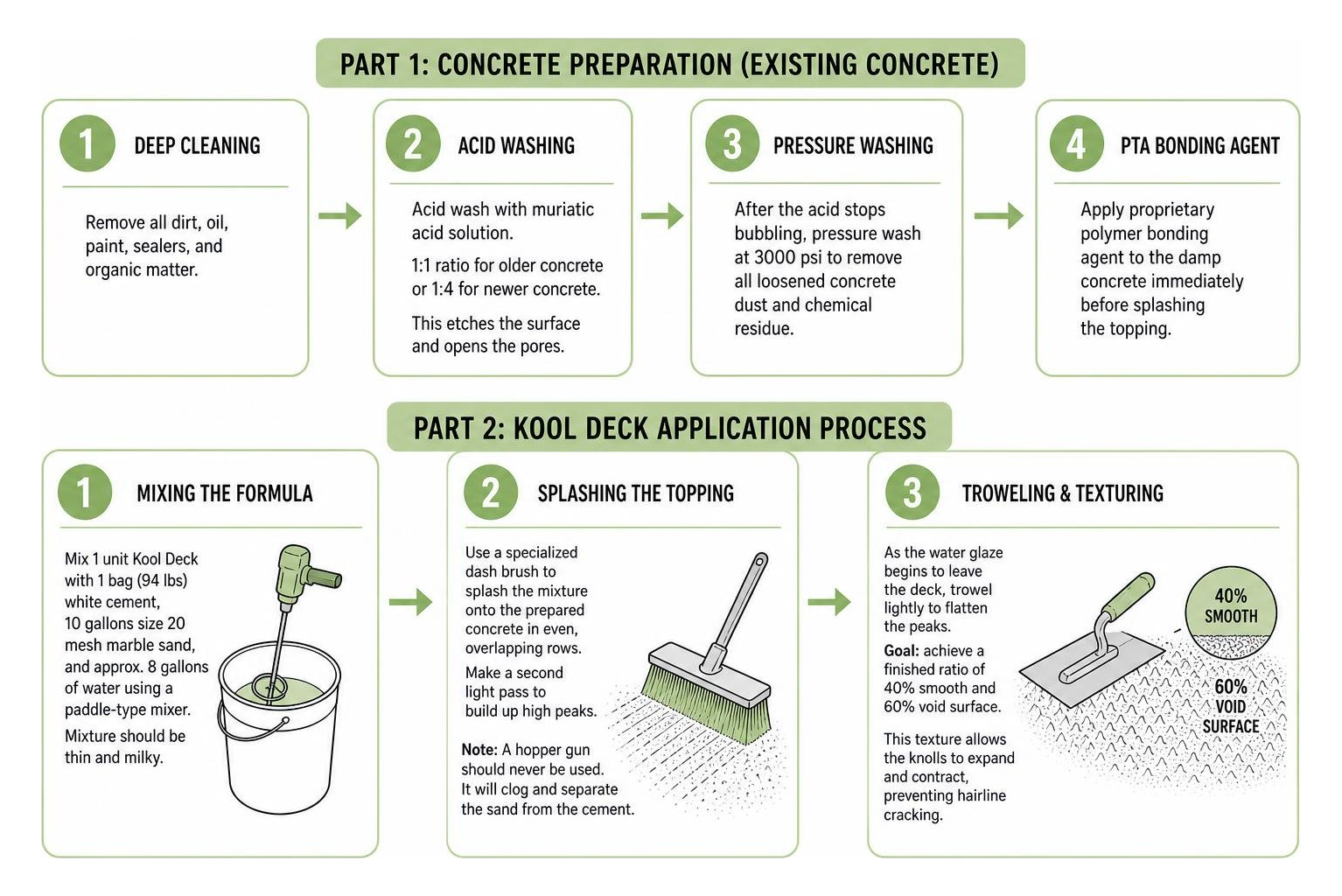
Here is how the physical installation unfolds:
- Step 1: Mixing the Formula. The crew mixes 1 unit of Kool Deck with 1 bag (94 lbs) of white cement, 10 gallons of size 20 mesh marble sand, and approximately 8 gallons of water using a paddle-type mixer. The mixture must reach a thin, milky consistency.
- Step 2: Splashing the Topping. Using a specialized dash brush, the installers splash the mixture onto the prepared concrete in even, overlapping rows. They make a second light pass to build up high peaks. Note: A hopper gun should never be used, as it will clog and separate the sand from the cement.
- Step 3: Troweling and Texturing. As the water glaze begins to leave the deck, a troweler lightly flattens the peaks. The goal is to achieve a finished ratio of 40% smooth and 60% void surface. This specific texture is what allows the knolls to expand and contract, preventing hairline cracking.
- Step 4: Curing. The freshly troweled surface must be covered with 2 mil clear plastic immediately to protect it and lock in moisture. The plastic must remain in place for exactly two days. The surface then requires roughly 21 to 28 days to fully cure before you can place heavy patio furniture on it.
You can find the detailed contractor mixing ratios and application steps in the Kool Deck® guide.
Common Mistakes to Avoid During Installation
Because cement chemistry is highly sensitive to environmental factors, DIY installations frequently run into trouble. Here are the most common pitfalls to avoid:
- Using Concrete Additives: Never use standard concrete additives or curing agents in the base concrete mix, as they will prevent the Kool Deck from bonding.
- Dry Acid Washing: Always wet the deck thoroughly before applying muriatic acid. Applying acid to dry concrete can cause uneven etching and ruin the bond.
- Using TSP (Trisodium Phosphate): Never use TSP or other neutralizers after acid washing. They leave an invisible film on the deck that breaks the bond with your new topping.
- Ignoring Temperature Limits: Only apply the topping when ambient temperatures are between 50°F and 90°F and rising. If it is too hot, the mixture will dry before it can cure, leading to flaking and cracking.
Maintenance, Repairs, and Longevity
When properly installed and maintained, a concrete Kool Deck can easily last 15 to 20 years. However, its lifespan is heavily dependent on how you care for it. Because it is a porous cement product, it can catch dirt, leaf stains, and mineral deposits if left neglected.
If you are looking for creative ways to restore an aging deck, check out our Pool Deck Resurfacing Ideas.
How to Maintain Your Concrete Kool Deck
Keeping your deck looking pristine doesn’t require harsh chemicals. In fact, simple maintenance is the best maintenance:
- Regular Rinsing: Use a standard garden hose to spray off dirt and pool water regularly.
- Soap and Water Cleaning: For general dirt buildup, scrub the deck with a nylon brush and a simple solution of mild soap and warm water.
- Stain Removal: For tough stains (like organic leaf stains or food spills), dilute a granular electric dishwasher detergent in warm water, scrub the area, and rinse thoroughly. Wear rubber gloves when handling heavy cleansers.
- Removing Mineral Deposits: Near pool steps or diving boards, repeated water evaporation can leave gray mineral rings. You can remove these using a floor scrubber equipped with a light stripping pad.
- Avoid High-Pressure Washing: While a light rinse is fine, hitting a cementitious overlay with a high-psi pressure washer up close can erode the textured peaks and cause the topping to delaminate.
For more on maintaining safe, slip-resistant pool decks, check out The Importance of Having an Anti-Slip Rubber Surface for Pools and Patios.
Frequently Asked Questions About Concrete Kool Decks
Can Kool Deck be repaired or patched if it cracks?
Yes. If your deck develops hairline cracks or minor chips, you can purchase specialized patching compounds designed specifically for cementitious overlays. However, achieving an exact color match can be incredibly difficult, especially if your deck has faded slightly under the sun over several years. For structural cracks caused by ground shifting, a patch is only a temporary band-aid; the crack will likely return unless the underlying concrete movement is addressed.
Is Kool Deck suitable for cold climates with freeze-thaw cycles?
Yes. Because Kool Deck is engineered with a textured, void-rich surface (the 40% smooth, 60% void ratio), it actually accommodates thermal expansion and contraction better than standard concrete. This makes it highly durable in cold climates like Connecticut and Indiana. However, you must avoid using metal snow shovels or harsh chemical deicers on the surface during winter, as these can physically chip or chemically erode the cement topping.
How much does a Kool Deck installation cost compared to other options?
Generally speaking, a traditional concrete Kool Deck is highly cost-effective when applied to fresh concrete, often running between $4 and $8 per square foot for materials and labor. However, if you are retrofitting it over existing concrete, the extensive prep work (acid washing, patching, bonding agents) can double those costs.
By comparison, high-end pavers or natural stone can cost $15 to $30+ per square foot. Seamless rubber safety surfacing sits in a highly competitive middle-to-high tier, offering vastly superior safety, impact absorption, and durability that easily offsets the initial investment over time. You can view a detailed breakdown on our Rubber Pool Deck Cost page.
Conclusion
Whether you choose a classic concrete Kool Deck or a modern, impact-absorbing rubber safety surface, protecting your family’s feet from summer heat is a smart investment.
While cementitious overlays offer a time-tested, budget-friendly cooling solution, they lack the fall protection, flexibility, and crack-bridging capabilities of modern rubber. At Replay Surfacing Inc., we are proud to transform environmental hazards into beautiful, sustainable, and highly durable safety surfaces.
From the hot sun of Tucson, AZ, Charlotte, NC, Raleigh, NC, Columbia, SC, and Lake Charles, LA, to the freezing winters of Connecticut, Indiana, and Beaverton, OR, we help homeowners and commercial facilities build safer, cooler, and more comfortable outdoor spaces.
Ready to explore your pool deck options? Discover how we can transform your pool surround, playground, or patio by visiting our Pool Deck Surfaces page today!