Why Non-Toxic Playground Surfacing in Connecticut Matters More Than You Think
If you’re choosing non-toxic playground surfacing in Connecticut, here are the safest options available right now:
| Surfacing Type | Toxicity Risk | ADA Accessible | Heat Risk | Best For |
|---|---|---|---|---|
| Engineered Wood Fiber (EWF) | Low (if CCA-free) | Yes | Low | Budget-conscious schools |
| Cork Pour-in-Place | Very Low | Yes | Low-Moderate | Eco-focused municipalities |
| Rubber Mulch (recycled tire) | Moderate-High | Yes | High | Not recommended for children |
| Pour-in-Place Rubber (EPDM/TPE) | Moderate | Yes | Very High | High-traffic areas with shade |
| Sand | Low (if silica-free) | Limited | Low | Smaller play zones |
| Concrete / Asphalt | N/A | N/A | High | Not approved by CPSC |
Playground surfacing does more than cushion a fall. It affects what chemicals children touch, breathe, and accidentally ingest every time they play. And the risks are not always obvious.
Consider this: a parents’ group in Massachusetts measured a pour-in-place rubber playground surface at over 170°F on a day when the air temperature was just 75°F. That is hot enough to cause serious thermal burns — on a mild, partly cloudy afternoon.
Connecticut municipalities, school districts, and facility managers are increasingly asking harder questions about what their playground surfaces are actually made of. The answers are not always reassuring.
Recycled rubber surfaces — one of the most widely installed options — can contain polyaromatic hydrocarbons (PAHs), volatile organic compounds (VOCs), heavy metals like lead and zinc, and other chemicals of concern. Even the U.S. Consumer Product Safety Commission (CPSC) has issued precautions around playground rubber made from recycled tires.
Choosing safer surfacing is not just a health decision. It is a long-term financial and environmental one too.
I’m Landon Olson, operator of Replay Surfacing Inc., with a background in mechanical engineering and an MBA focused on sustainable manufacturing — experience I apply directly to helping Connecticut communities navigate non-toxic playground surfacing in Connecticut with confidence. In the sections below, I’ll walk you through everything you need to evaluate your options clearly and make the right call for your community.
Know your non-toxic playground surfacing Connecticut terms:
Evaluating Non-Toxic Playground Surfacing Connecticut Options
When we design public spaces in Hartford, New Haven, or Stamford, safety is always our primary driver. But traditional municipal projects often run into a conflict between physical impact safety and chemical safety.
To choose the best playground surface, we must look beyond basic cushioning. Truly non-toxic playground surfacing in Connecticut must balance impact attenuation, thermal performance, chemical emission standards, and long-term environmental sustainability.
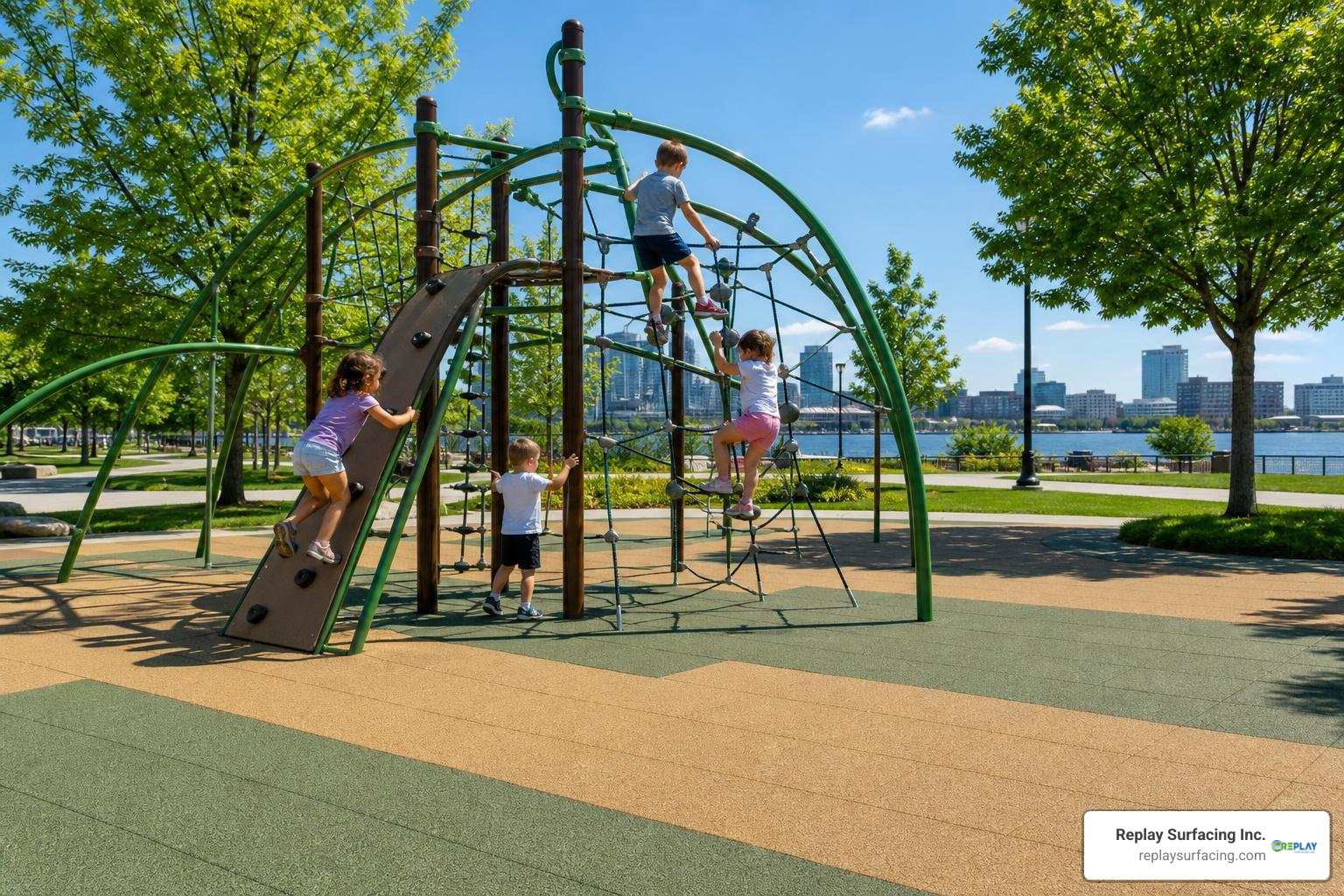
In our comprehensive playground surfaces guide, we emphasize that no single material is a magic bullet, but some options are significantly healthier than others. For communities committed to avoiding synthetic chemicals, loose-fill wood products (like engineered wood fiber) that are certified free of chromated copper arsenate (CCA) represent the safest loose-fill choices. For unitary (solid) surfaces, cork pour-in-place (PIP) offers a highly natural, low-toxicity profile compared to traditional petroleum-based polymers.
Why Non-Toxic Playground Surfacing Connecticut Standards Matter for Schools
Schools in Waterbury and Bridgeport serve thousands of children daily. Because young children have developing immune systems, higher respiration rates, and a habit of putting their hands in their mouths, their exposure to environmental toxins is magnified.
When schools install traditional recycled tire products, they may unknowingly introduce complex chemical mixtures to the play area. Many parents and school boards are asking: is rubber mulch a safe surface for your childs playground?
The concern is real. Runoff from synthetic surfaces can carry microplastics and chemical additives into local Connecticut waterways, while the volatile organic compounds (VOCs) released on hot summer days can degrade local air quality right where children are breathing heavily. Selecting non-toxic materials ensures we protect both children’s developing bodies and our local environment.
Comparing Loose-Fill Rubber Mulch to Unitary Rubber Surfacing Systems
To make an informed choice, it helps to understand the physical formats of playground surfacing. We generally divide rubber-based surfacing into loose-fill materials and unitary systems:
| Surfacing Format | Description | ADA Compliance | Maintenance Needs |
|---|---|---|---|
| Loose-Fill Rubber Mulch | Shredded tire or synthetic rubber chunks spread across the play area. | Requires frequent raking to maintain accessible pathways. | High; easily displaced under swings and slides. |
| Poured-in-Place (PIP) Rubber | A dual-layer system consisting of a cushion layer and a wear layer bound with polyurethane. | Excellent; seamless and highly accessible for wheelchairs. | Moderate; requires periodic resealing to prevent cracking. |
| Unitary Rubber Tiles | Interlocking, pre-molded tiles manufactured in a controlled factory setting. | Excellent; provides consistent, durable accessibility. | Low; individual tiles can be replaced if damaged. |
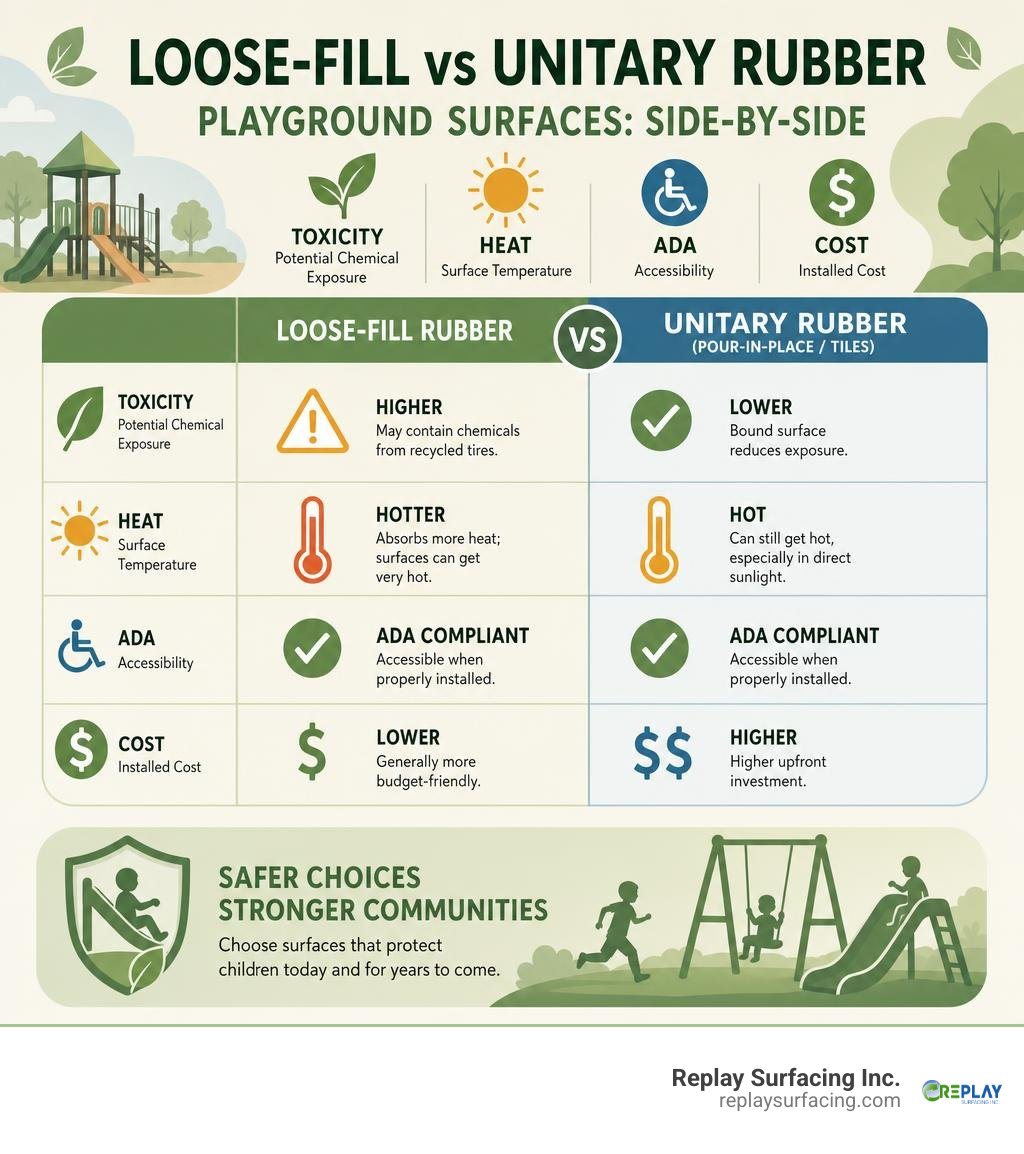
According to extensive chemical evaluations, such as those published in the TURI Playground Surfacing Report, loose-fill synthetic options present high exposure risks because children can easily handle, throw, or accidentally ingest the loose particles. Unitary systems like poured-in-place rubber or premium interlocking tiles contain these materials within a bound matrix, which significantly limits direct dermal contact and ingestion, though they still require careful specification to minimize chemical off-gassing.
Chemical Concerns and Heat Hazards in Playground Surfacing
Specifying non-toxic playground surfacing in Connecticut requires us to look closely at what is actually inside these materials.
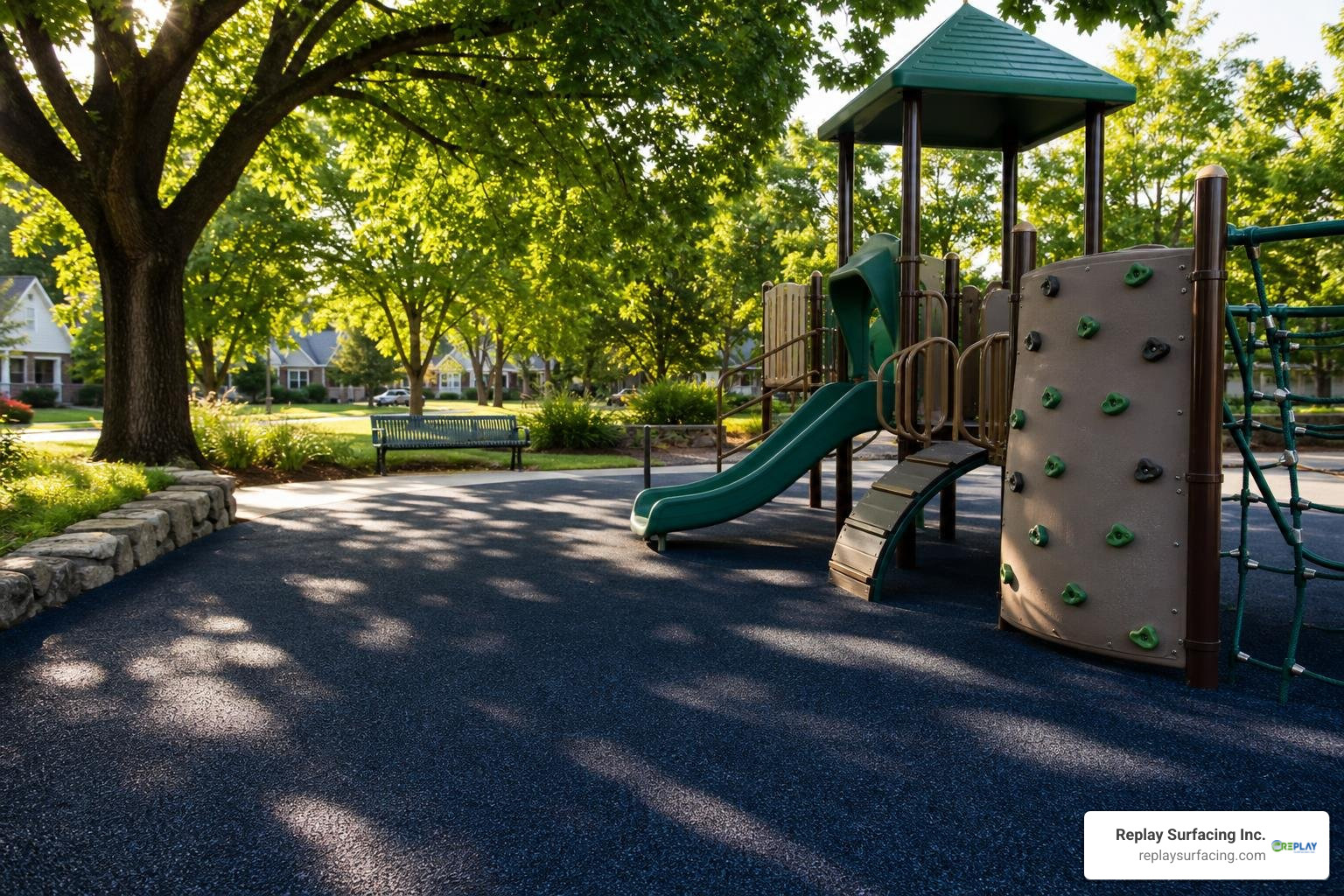
Many traditional synthetic surfaces are made from recycled passenger tires. While recycling tires is a great goal for the circular economy, placing them directly under our children’s feet introduces a cocktail of industrial compounds into the play environment.
Ensuring Safety and Non-Toxicity in Recycled Rubber Surfacing
Shredded tire mulch and standard recycled rubber products contain a variety of hazardous chemicals. These include:
- Polyaromatic Hydrocarbons (PAHs): Known carcinogens that can be absorbed through skin contact or inhalation of dust.
- Heavy Metals: Lead, zinc, and cadmium are frequently present in recycled tire formulations.
- 6PPD: An anti-degradant chemical used in tires that has raised significant environmental concern due to its toxicity to aquatic life.
- Volatile Organic Compounds (VOCs): Chemicals that off-gas into the air, particularly when heated by the sun.
Because of these chemical risks, we often discuss whether standard rubber mulch toxic properties outweigh its physical benefits.
To mitigate these risks, the CPSC Public Playground Safety Handbook recommends five specific precautions when using recycled tire materials:
- Avoid mouth contact with playground rubber.
- Wash hands thoroughly with soap and water before eating.
- Clean hands and change clothes after visiting the playground to prevent tracking tire dust indoors.
- Limit play on hot days when chemical off-gassing is highest.
- Ensure adequate ventilation if the surfacing is used in semi-enclosed spaces.
For communities that want to avoid these exposure precautions entirely, seeking out virgin synthetic polymers (like EPDM or TPE) with full chemical disclosure, or opting for natural cork and wood fiber, is the safest path forward. Learn more about these considerations in our guide on recycled tyres for playgrounds and other safety concerns.
Thermal Burn Risks and Heat Mitigation
Chemical toxicity isn’t the only hazard. The physical properties of synthetic surfaces can create dangerous microclimates. Unshaded rubber and synthetic turf surfaces absorb solar radiation rapidly, acting as thermal heat sinks.
In Norwalk and Danbury, where summer temperatures regularly climb into the 80s and 90s, unshaded rubber playground surfaces can easily exceed 160°F to 170°F. The CPSC has documented numerous cases of severe thermal burns to children’s hands and feet from contact with hot playground safety mats and poured rubber.
To protect children from these high temperatures, we recommend a multi-layered heat mitigation strategy:
- Incorporate Shade Structures: Installing fabric sail shades or planting mature trees can reduce surface temperatures by up to 40°F.
- Select Lighter Pigments: Light grays, beige, and soft green pigments absorb significantly less heat than dark red, blue, or black.
- Integrate Natural Elements: Blending rubber safety zones with natural wood or cork surfaces helps break up the heat island effect across the play area.
For detailed strategies on designing thermal-safe play areas, see our guide on the safe zone everything about choosing the right playground safety mats.
Fall Heights, ADA Compliance, and Installation Standards
While chemical and thermal safety are critical, a playground surface’s primary job is to protect children from head injuries during falls.
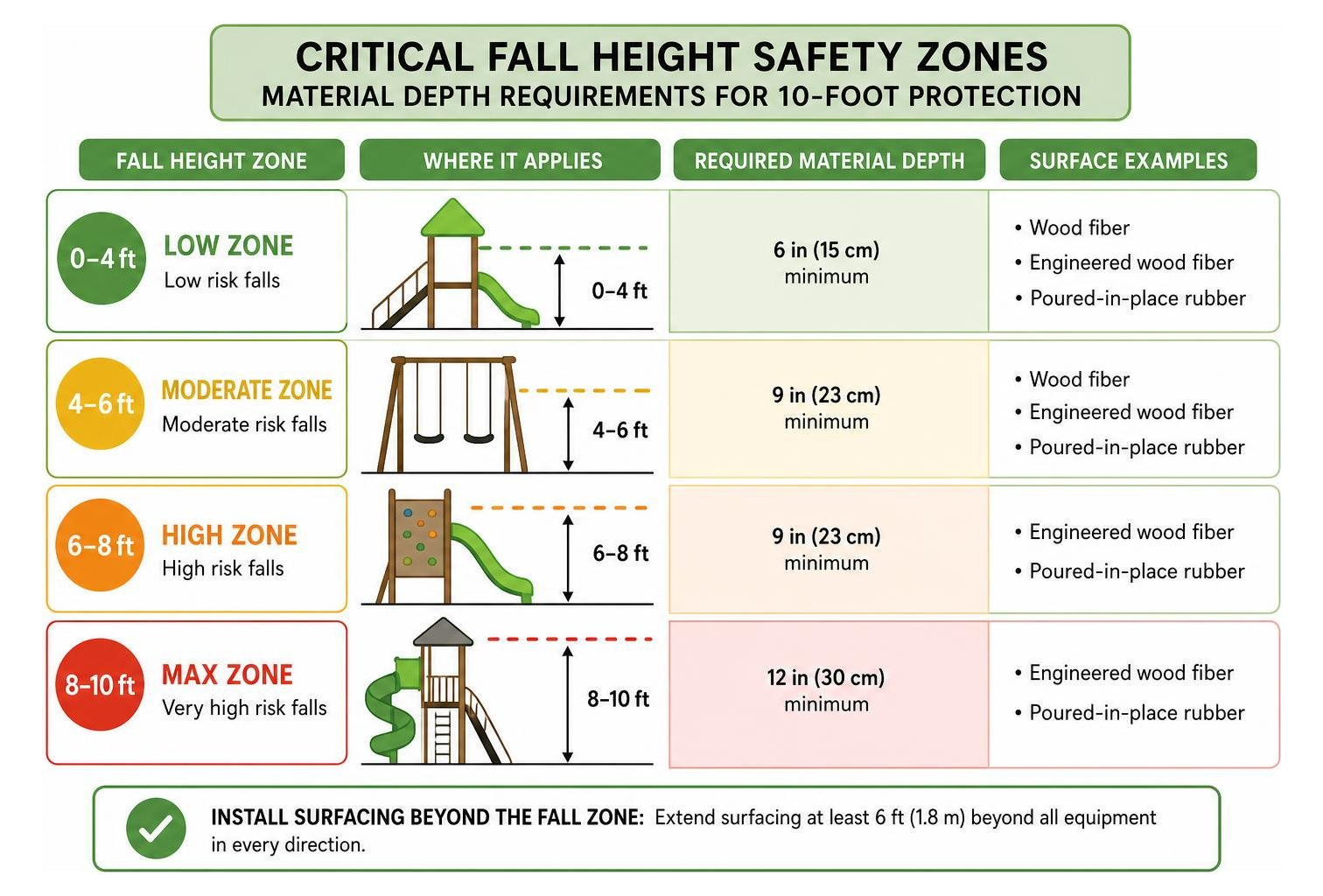
In Connecticut, municipal and school play areas must comply with strict ASTM standards to ensure adequate impact attenuation and universal accessibility.
Critical Fall Height Ratings and Impact Performance
The “critical fall height” of a playground surface represents the maximum fall height from which a life-threatening head injury would not be expected to occur.
Different materials require different depths to achieve the same level of fall protection:
- Engineered Wood Fiber (EWF): Requires a compressed depth of 9 inches to safely protect against falls from a maximum height of 10 feet.
- Shredded Tire Mulch: Provides 10 feet of fall protection at a compressed depth of 6 inches.
- Sand: Requires a compressed depth of 9 inches but only protects up to a 4-foot fall height, making it unsuitable for tall play structures.
To maintain these safety ratings over time, communities must perform regular impact testing. While synthetic surfaces do not compress or wash away as easily as wood fiber, they can harden over time due to UV exposure and wear.
Our safety first understanding playground surface impact standards article breaks down how to perform these checks, and our playground certified rubber mulch complete guide outlines how to maintain loose-fill systems to keep their fall ratings intact.
ADA Accessibility and Wheelchair Navigation
Universal design is a legal and moral requirement for public play spaces. Under the Americans with Disabilities Act (ADA), playground surfaces must comply with ASTM 1951 standards for wheelchair accessibility.
While poured-in-place rubber and unitary non-toxic playground tiles offer the most seamless, low-resistance pathways for wheelchair users, engineered wood fiber can also be ADA-compliant if properly installed and maintained. EWF is designed to “knit” together when compacted, forming a stable surface. However, high-traffic areas under swings and slides are prone to displacement. In these zones, installing durable wear mats over the loose-fill material is essential to prevent ruts and maintain a continuous, accessible route.
Lifecycle, Maintenance, and Disposal in Connecticut
When evaluating non-toxic playground surfacing in Connecticut, we must look at the entire lifecycle of the material—from the day it is installed to the day it must be replaced.
Cost vs. Safety: Investing in Non-Toxic Playground Surfacing Connecticut Communities Trust
Initial installation costs can be deceptive. School boards and municipal managers in Connecticut must look at the total cost of ownership over a 10-to-15-year period.
- Engineered Wood Fiber (EWF): For a standard 2,500 square-foot playground, initial material and installation costs range from $5,600 to $12,500. However, EWF requires annual “topping-off” to replace displaced and decomposed material, along with regular raking to maintain depth and ADA compliance.
- Recycled Rubber Mulch: Initial material installation for the same size area ranges from $5,800 to $15,000. While it does not decompose, it still requires raking to prevent displacement.
- Unitary Synthetic Systems (PIP and Tiles): These systems have a significantly higher upfront cost, often ranging from $25,000 to over $50,000 for a 2,500 square-foot area. However, they require minimal daily maintenance and provide reliable ADA accessibility for years.
For a helpful comparison of long-term operational costs, check out our recycled rubber mulch near me guide.
End-of-Life Disposal and Recycling Options
The environmental impact of our playground choices doesn’t end when the equipment wears out. When a playground is decommissioned or renovated, the disposal of the surfacing material presents very different challenges:
- Natural Wood Materials: EWF and natural wood chips can be composted onsite or processed through local Connecticut composting services, often at no cost.
- Shredded Tire Mulch & Unitary Rubber: Because of the chemical binders, adhesives, and heavy metals used in their construction, unitary synthetic rubber surfaces and tire mulch are generally not recyclable at the end of their life. They must be shipped to specialized hazardous waste facilities for a fee or sent directly to a municipal landfill, adding a significant hidden cost to the backend of your project.
We dive deeper into these environmental realities in our article on sustainable playground rubber mulch and the truth about recycled materials.
Frequently Asked Questions about Safe Playground Surfacing
What is the safest playground surfacing for schools?
For schools prioritizing chemical safety, engineered wood fiber (certified free of CCA) and natural cork pour-in-place systems are the safest options. If your school requires a unitary, highly durable surface for heavy traffic, high-quality, virgin-polymer non-toxic playground tiles provide excellent impact protection with significantly lower chemical risks than recycled tire alternatives.
How do you prevent rubber playground surfaces from getting too hot?
To keep rubber surfaces cool enough for safe play, we recommend installing overhead fabric shade sails, choosing light-colored pigments (such as beige, light gray, or cream), and planting deciduous trees around the perimeter of the play area. Some schools also spray the surface with water on exceptionally hot days to temporarily lower temperatures through evaporative cooling. For more tips, read our beginners guide to safe rubber mulch for play areas.
How do rubber playground surfaces ensure ADA compliance?
Poured-in-place rubber and rubber tiles naturally provide a firm, stable, and slip-resistant surface that allows wheelchairs to navigate without sinking. For loose-fill rubber or wood systems, compliance is achieved by compacting the material to meet ASTM 1951 standards and installing solid wear mats in high-use areas to prevent displacement. Learn more in our guide on why recycled tire mulch a durable solution for modern landscaping requires careful installation to remain accessible.
Conclusion
Creating a playground that is physically safe, universally accessible, and chemically non-toxic requires careful planning and the right materials. At Replay Surfacing Inc., we are committed to helping communities across Connecticut—from Hartford to Stamford—design play spaces that protect both our children and our environment. By asking the right questions about chemical content, heat performance, and lifecycle costs, you can build a beautiful, sustainable play area that your community can trust for decades.
Ready to plan your next project? More info about playground surfacing is available on our main site, where you can explore our non-toxic, sustainable surfacing solutions tailored for Connecticut communities.