
Choose Safer, Non-Toxic Playground Surfaces in Charlotte
For Charlotte safe playground surfaces, start with a material that matches the equipment’s fall height, drains well after rain, and is tested for safety. For many daycares and schools, non-toxic rubber mulch, poured-in-place rubber, and rubber tiles are practical options because they can provide impact protection, resist heavy use, and avoid the mud, mowing, and chemical treatments tied to natural grass.
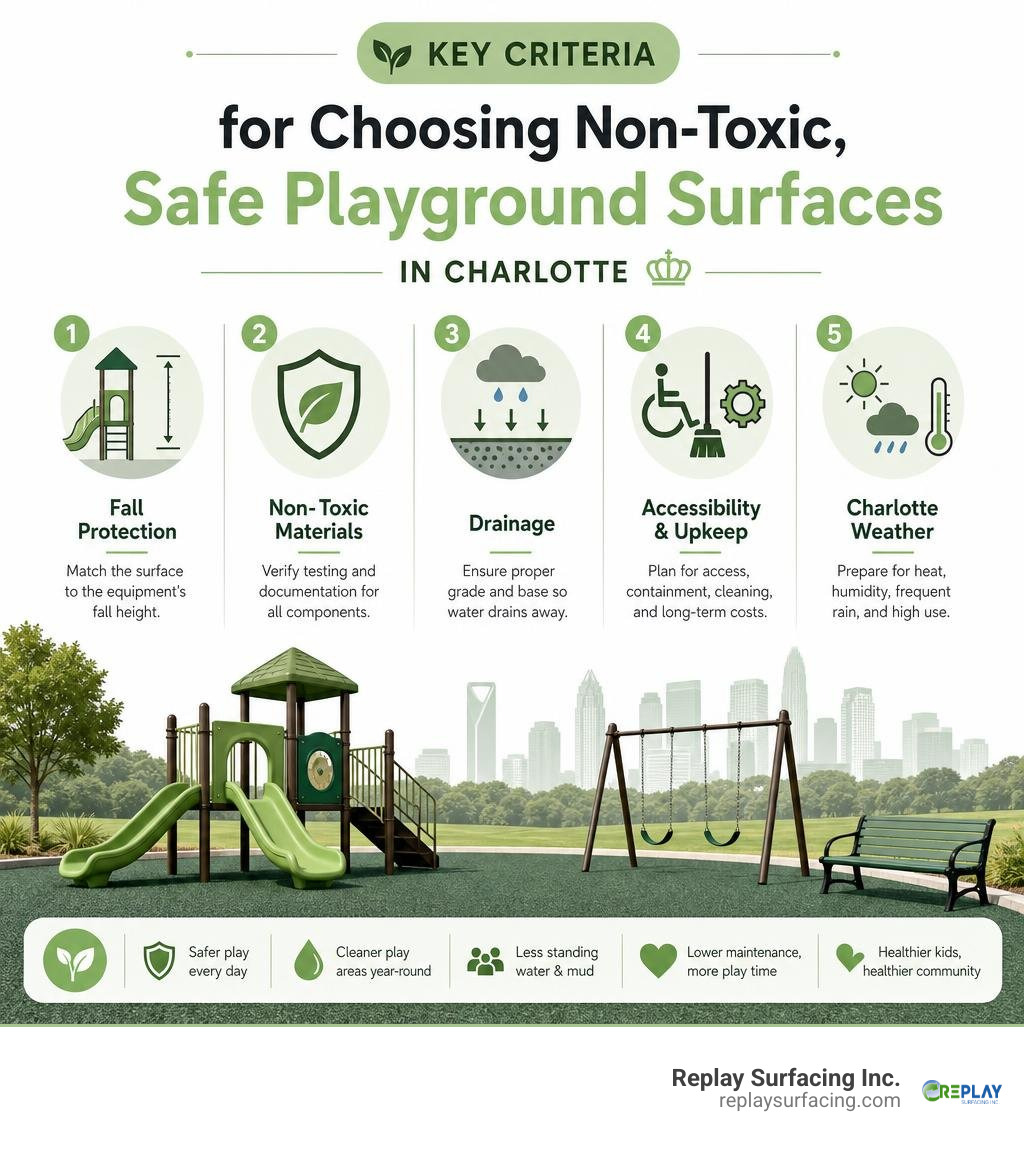
Before choosing a surface, check these essentials:
- Fall protection: Select a system designed and tested for the critical fall height of the play equipment.
- Non-toxic materials: Ask for product testing and documentation for rubber, binders, pigments, and infill.
- Drainage: Use a properly graded, stable base so rain moves through or away from the surface rather than creating puddles.
- Accessibility and upkeep: Consider wheelchair access, loose-material containment, cleaning needs, and long-term repair costs.
- Charlotte weather: Plan for summer heat, humidity, frequent rain, and high daily traffic from active children.
A well-built surface can help keep play areas cleaner year-round. It can also reduce muddy shoe traffic indoors, limit standing water, and cut the recurring work of mowing, watering, reseeding, and applying lawn chemicals.
I’m Landon Olson, an engineer and sustainability professional who has worked across manufacturing, recycled-rubber products, and safety surfacing. At Replay Surfacing Inc., I apply that experience to help facilities evaluate durable, practical Charlotte safe playground surfaces that support child safety and environmental goals.
Learn more about Charlotte safe playground surfaces:
Key Standards for Charlotte Safe Playground Surfaces
When designing safe outdoor play environments in the Queen City, adhering to established safety benchmarks is non-negotiable. Whether operating a commercial daycare in Uptown Charlotte, a public park in Raleigh, or a community center in Columbia, SC, playground operators must balance impact attenuation with long-term usability.
The primary benchmark governing impact safety is ASTM F1292. This standard specifies test methods to establish the impact attenuation of playground surfacing systems beneath and around play equipment. Surfacing materials must reduce peak decelerations (G-max) and Head Injury Criterion (HIC) scores during simulated falls. A surface failing to meet these thresholds dramatically increases the risk of severe head trauma, concussions, and long-term injuries.
For complete compliance, facilities must reference Safety First Understanding Playground Surface Impact Standards alongside local North Carolina child care licensing rules and the Americans with Disabilities Act (ADA) accessibility requirements.
| Surfacing Type | Typical Impact Fall Height | ADA Accessibility | Routine Maintenance Level | Weather & Mud Resistance |
|---|---|---|---|---|
| Poured-in-Place Rubber | Up to 12+ Feet (Custom Thickness) | High (Seamless / Wheelchair Friendly) | Low (Occasional power washing) | Excellent (Zero mud, rapid drainage) |
| Interlocking Rubber Tiles | Up to 10 Feet (Factory Engineered) | High (Firm, level unitary joints) | Low to Medium (Joint inspection) | Excellent (Rapid vertical/horizontal drainage) |
| Non-Toxic Rubber Mulch | Up to 12+ Feet (At 6″ Depth) | Medium (Requires regular raking/leveling) | Medium (Raking high-use zones) | High (Does not rot, decompose, or hold mud) |
| Engineered Wood Fiber (EWF) | Up to 8–10 Feet (Compacted) | Low to Medium (Deteriorates when wet) | High (Constant top-offs and raking) | Poor (Breaks down, holds moisture, creates mud) |
| Natural Grass / Dirt | Less than 2–3 Feet | Non-Compliant | Extremely High (Mowing, reseeding, chemicals) | Very Poor (Compacts into hard dirt, heavy mud) |
Impact Ratings for Charlotte Safe Playground Surfaces
Achieving verifiable impact ratings depends directly on matching the play equipment’s Critical Fall Height (CFH) with the proper surfacing depth and base engineering. Critical Fall Height represents the maximum fall height at which a surface will yield an acceptable level of head injury prevention.
A jungle gym with an eight-foot deck requires surfacing rated and certified for at least an eight-foot fall. We frequently point childcare administrators to How To Choose Fall Rated Surfacing For Charlotte Playgrounds to help them calculate exact sub-base padding requirements.
In addition to fall protection, public and commercial spaces must comply with ASTM F1951, which measures wheelchair workability and surface firmness. Unitary systems like poured-in-place rubber and tiles excel here because they provide seamless rollability, whereas loose fills shift over time. Implementing fully rated Shock Absorbing Playground Surfaces ensures both universal physical accessibility and dependable energy absorption during active play.
Non-Toxic Rubber Mulch and Chemical Safety Standards
Environmental safety and chemical cleanliness are just as critical as fall protection. Traditional tire dumps pose environmental hazards, but modern recycling engineering transforms scrap tires into ultra-pure, high-performance surfacing products.
High-grade Non Toxic Rubber Mulch undergoes intensive magnetic separation processes to remove 99.9% of wire contaminants. It also undergoes heavy metal testing to confirm zero hazardous leaching into surrounding soil or groundwater. Premium rubber mulch is certified by the International Play Equipment Manufacturers Association (IPEMA), ensuring it meets strict safety metrics without toxic off-gassing, even under the intense southern sun in regions like Sanford, NC, or Tucson, AZ.
Daycare directors must also account for loose-fill displacement. Because children displace loose surfacing around swing exits and slide bases, understanding The Definitive Guide To Rubber Mulch Depth Playground Requirements helps maintenance staff maintain required depths (typically 4 to 6 inches) to preserve certified impact ratings year-round.
Best Materials for Daycare and School Play Areas
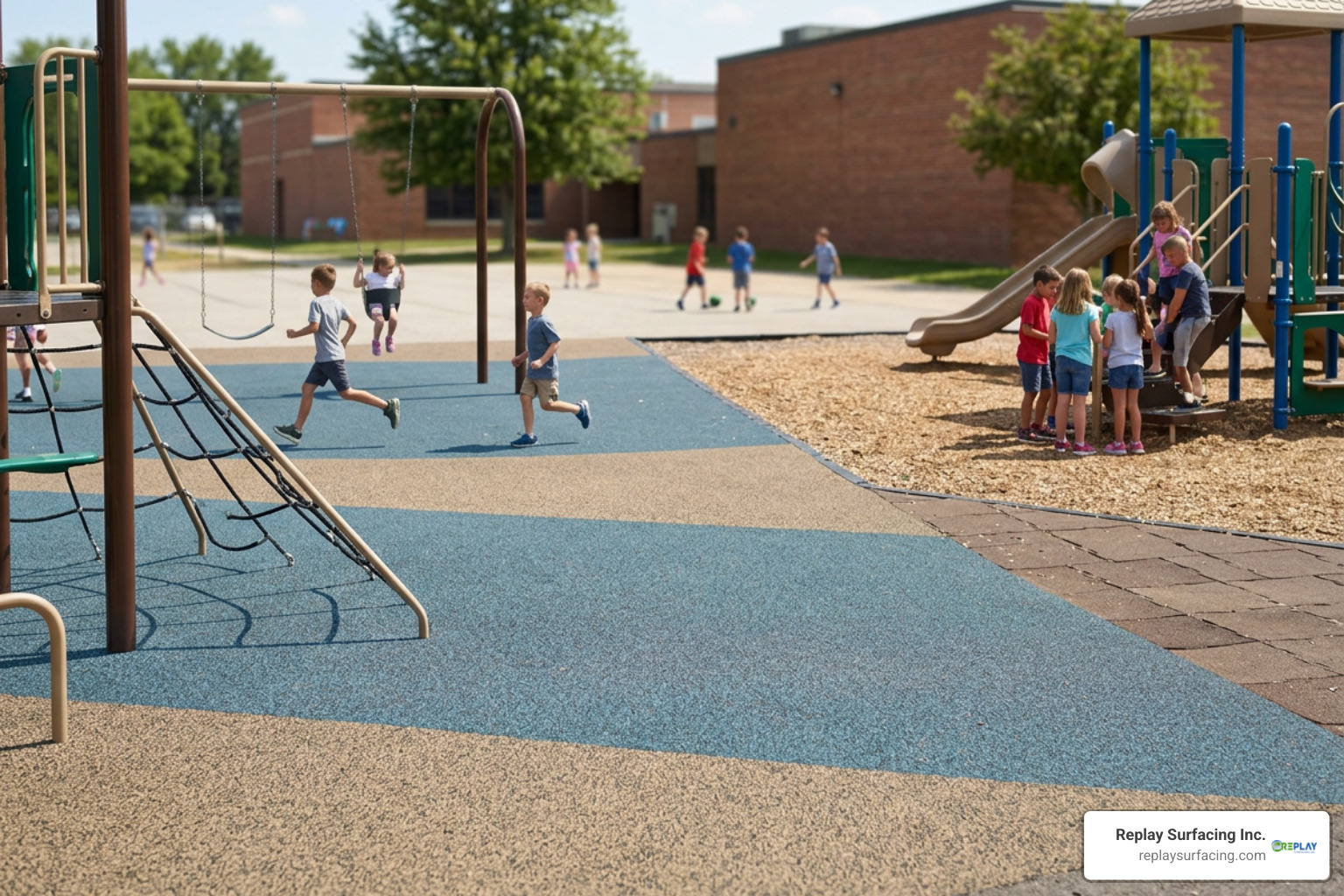
Commercial educational facilities experience relentless foot traffic. Selecting surfacing materials requires evaluating durability, daily cleaning protocols, slip resistance, and allergen control. Natural turf often fails in daycare environments because constant stomping wears grass down to hard-packed red clay, which quickly transforms into mud puddles after a Charlotte downpour.
Facilities in high-density areas from Charlotte and Raleigh to Nashville, TN, increasingly replace natural turf with recycled rubber systems and synthetic play turf. Reviewing Poured In Place Surfacing Costs And Benefits For Schools illustrates how eliminating lawn mowing, irrigation, weed management, and pesticide applications generates significant operational savings over a 10-to-15-year lifecycle.
Comparing Poured-in-Place, Rubber Tiles, and Rubber Mulch
Every facility has unique site contours, equipment arrangements, and budget frameworks. Here is how the top three safety surfacing formats compare:
- Poured-in-Place (PIP) Rubber: A two-layer system consisting of a shock-absorbing base layer derived from recycled tire rubber and a durable, wear-resistant top layer of synthetic granules. PIP creates a seamless, fully accessible surface ideal for complex site layouts, sloped areas, and vibrant custom safety designs (including hopscotch games, school logos, and themed patterns).
- Interlocking Rubber Tiles: Factory-molded tiles, such as Non Toxic Playground Tiles, offer precise quality control, uniform thickness, and pre-tested impact ratings. They are particularly well-suited for rectangular play areas, rooftops, and facilities requiring modular maintenance where individual high-wear tiles can be swapped out quickly.
- Rubber Mulch: An economical, highly effective loose-fill option that provides exceptional fall protection. Unlike wood mulch, recycled rubber mulch does not rot, attract insects, harbor mold spores, or cause wood splinters.
Drainage and Heat Mitigation for Charlotte Safe Playground Surfaces
The Charlotte climate is known for high summer humidity, intense thermal radiation, and rapid afternoon thunderstorms. Conventional blacktop or unshaded surfaces can become uncomfortably hot, while poorly drained dirt patches remain soggy for days.
Advanced safety surfacing systems incorporate specialized aggregate sub-bases and porous binder matrices that drain water vertically and horizontally at rates exceeding 30 inches per hour. This rapid percolation prevents standing puddles and eliminates mud tracking into classrooms.
To combat thermal buildup, modern surfacing configurations can utilize specialized heat-reduction coatings and antimicrobial technologies like built-in Microban® protection and Envirofill infills. These components actively inhibit the growth of bacteria, algae, and mold while reducing surface temperatures compared to standard untreated materials. This ensures a clean, sanitary, and cool play environment across all seasons.
Step-by-Step Installation and Site Preparation

A safety surface is only as durable as the ground beneath it. A flawless installation prevents surface settling, rutting, tripping edges, and premature wear.
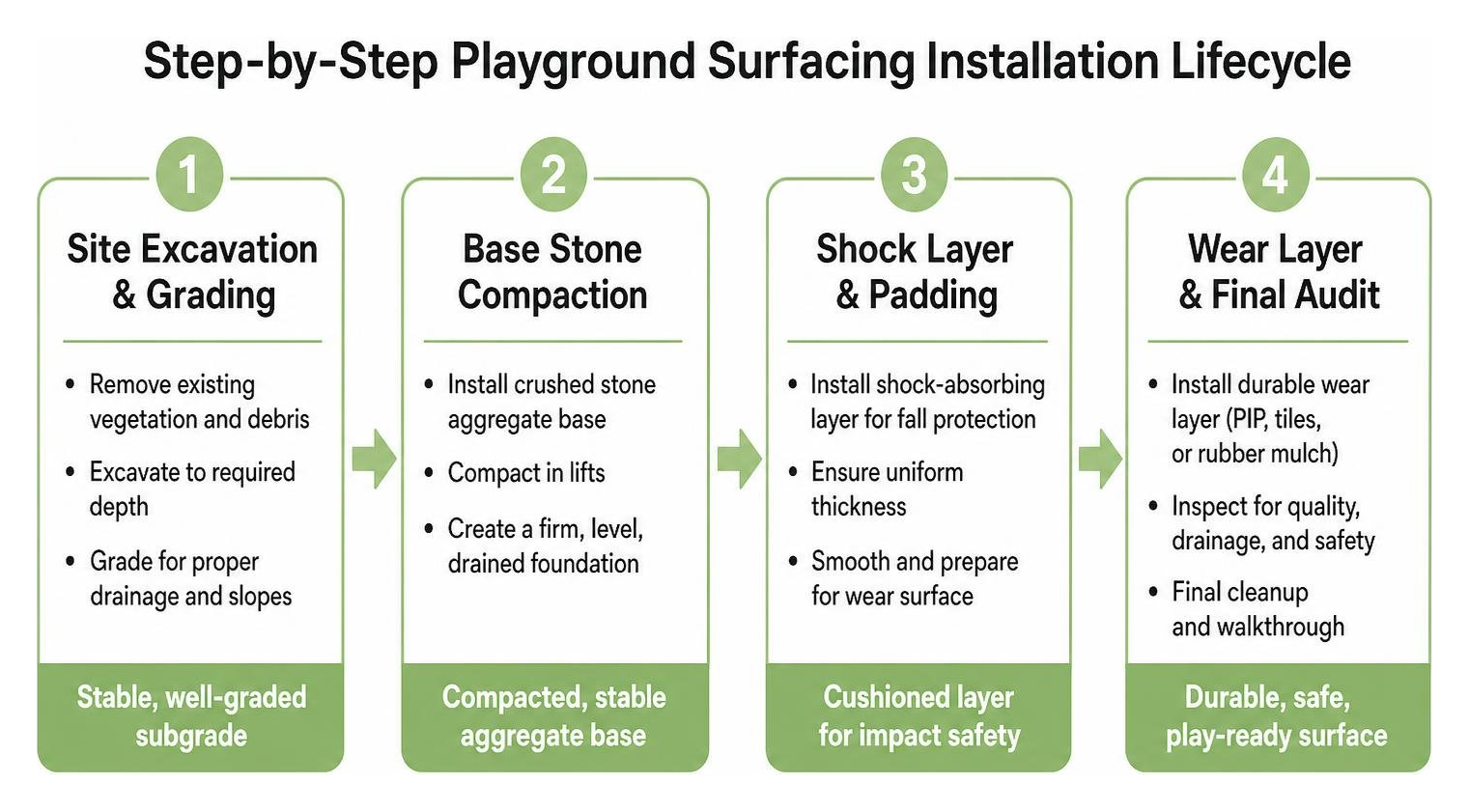
The complete engineering process follows a structured sequence:
Ground Excavation, Grading, and Base Layering
The first phase of installation requires thorough site preparation:
- Clearing and Excavation: Excavate the target footprint to remove turf, roots, organic topsoil, and unstable debris.
- Grading and Slope Optimization: Grade the native subgrade to establish a positive slope (typically 1% to 2%) toward designated drainage outlets or swales.
- Geotextile Separation: Lay heavy-duty, permeable geotextile fabric across the cleared dirt. This prevents the stone base from sinking into the subgrade while blocking weed intrusion.
- Crushed Stone Base Installation: Install an aggregate base of clean, angular crushed stone (such as #57 stone or dynamic stone dust). Compact the base in lifts using a mechanical vibratory roller to achieve a minimum 95% Standard Proctor density. A solid stone base ensures long-term stability and unobstructed water percolation.
Surface Edging, Infill Application, and Final Safety Audits
Once the base is stable, the safety system is installed:
- Perimeter Containment: Secure heavy-duty concrete borders, beveled transitions, or timber containment curbs around the perimeter to eliminate trip hazards and secure surface edges.
- Shock Pad & Wear Layer Application: For unitary systems, hand-trowel the base shock pad followed by the customized wear layer. For synthetic turf systems, roll out safety padding and mechanically seam the turf panels.
- Infill Distribution: When installing safety turf systems, power-brush non-toxic, antimicrobial infill (such as coated rounded quartz infill) deep into the fibers. The infill keeps the turf blades standing upright, adds ballast, and enhances shock attenuation.
- Final Inspection and Drop Testing: Conduct comprehensive drop testing and seam inspections before handing over the playground. This verifies compliance with ASTM impact standards and ensures the space is fully play-ready.
Frequently Asked Questions About Charlotte Playground Surfacing
How does rubber surfacing prevent mud and water pooling?
Rubber surfacing systems—including porous poured-in-place rubber, interlocking tiles, and loose rubber mulch—are engineered with open-pore structural permeability. Rainwater flows directly through the surfacing matrix into the underlying open-graded crushed stone base layer.
The aggregate sub-base temporarily holds and disperses runoff into the ground or guides it toward designated perimeter drainage outlets. Because the surface completely covers bare soil, it eliminates dirt compaction, eradicates standing water, and permanently stops children from tracking red clay mud into school corridors.
What fall height rating is required for daycare play equipment in North Carolina?
In North Carolina, childcare licensing guidelines and state building codes mandate that protective surfacing under commercial playground equipment match or exceed the highest designated play surface (the deck, climber, or slide transition).
For example, if a play structure has a maximum fall height of 6 feet, the surrounding surface must be laboratory- and field-certified to absorb impacts from at least 6 feet per ASTM F1292. Using adequate safety surfacing padding ensures full compliance with local regulatory inspections across Charlotte, Raleigh, and surrounding municipalities.
How do antimicrobial treatments protect children on outdoor playground surfaces?
Outdoor play environments are exposed to organic debris, spilled drinks, bird droppings, and hundreds of hands daily. In warm, humid climates, untreated surfaces can foster bacterial growth and mildew odors.
Antimicrobial additives (such as integrated Microban® technology) and non-toxic coated infills disrupt the cellular membranes of microbes on contact. This prevents bacteria, fungi, algae, and mold from colonizing the surface fibers or rubber granules. The result is an outdoor surface that stays cleaner, controls odors, resists biological degradation, and provides a hygienic setting for toddlers and young children.
Conclusion
Creating a safe, resilient outdoor space requires balancing impact attenuation, clean materials, weather durability, and reliable drainage. By replacing high-maintenance grass or deteriorating wood mulch with engineered, non-toxic recycled rubber systems, schools and daycares eliminate mud, reduce recurring maintenance expenses, and protect active children against fall injuries.
At Replay Surfacing Inc., we divert discarded tires from landfills and turn environmental challenges into sustainable, durable, and fully customizable play surfaces. Whether you are upgrading a daycare facility in Charlotte, NC, expanding a schoolyard in Raleigh or Sanford, or constructing community parks in Columbia, Tucson, Beaverton, Nashville, Connecticut, Indiana, or Lake Charles, our team delivers safety-certified surfaces tailored to your local environment.
Explore our comprehensive range of Playground Surfaces to design an impact-rated, non-toxic, and long-lasting play space for your facility today.