
Why the Right Playground Safety Rubber Surface in North Carolina Can Prevent Serious Injuries
A playground safety rubber surface in North Carolina is one of the most important decisions you’ll make for any play area. Here’s a quick overview of your main options and what they protect against:
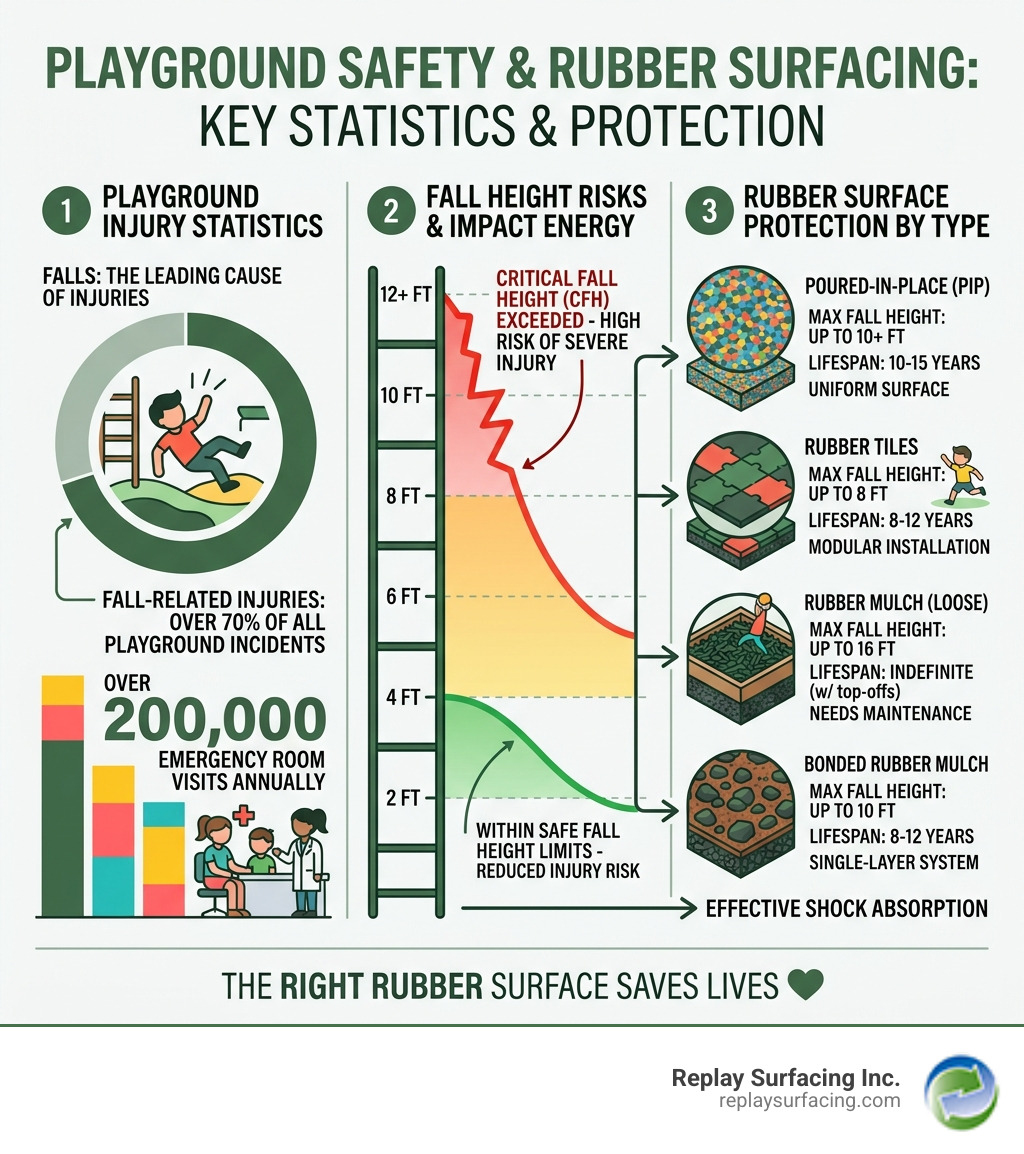
| Surface Type | Typical Cost (per sq ft) | Max Fall Height | Lifespan |
|---|---|---|---|
| Poured-in-Place (PIP) | $15 – $25 installed | Up to 10+ ft | 10 – 15 years |
| Rubber Tiles | $8 – $15 | Up to 8 ft | 8 – 12 years |
| Rubber Mulch (loose) | $3 – $8 | Up to 16 ft | Indefinite (with top-offs) |
| Bonded Rubber Mulch | $8 – $14 | Up to 10 ft | 8 – 12 years |
Falls cause over 70% of playground injuries, sending more than 200,000 children to emergency rooms every year. The surface beneath the equipment is often the deciding factor between a minor scrape and a serious head injury or fracture.
Not every rubber surface performs the same. Thickness, material quality, base preparation, and proper installation all determine whether a surface actually meets safety standards — or just looks like it does.
This guide walks you through everything you need to know to choose, install, and maintain a rubber playground surface that is safe, durable, and built to last.
I’m Landon Olson, operator of Replay Surfacing and a mechanical engineer with an MBA, and I’ve spent my career turning recycled scrap tires into high-performance playground safety rubber surfaces in North Carolina that meet rigorous safety and environmental standards. In the sections below, I’ll share what I’ve learned across years of real-world installations so you can make a confident, informed choice.
Understanding Playground Safety Rubber Surface Options
When you begin researching the best way to protect children in your community—whether you are in Raleigh, NC, or Charlotte, NC—you’ll quickly realize that not all rubber is created equal. A high-quality playground safety rubber surface is generally categorized as a “unitary” surface, meaning it is a bound, seamless, or interlocking system that stays in place.
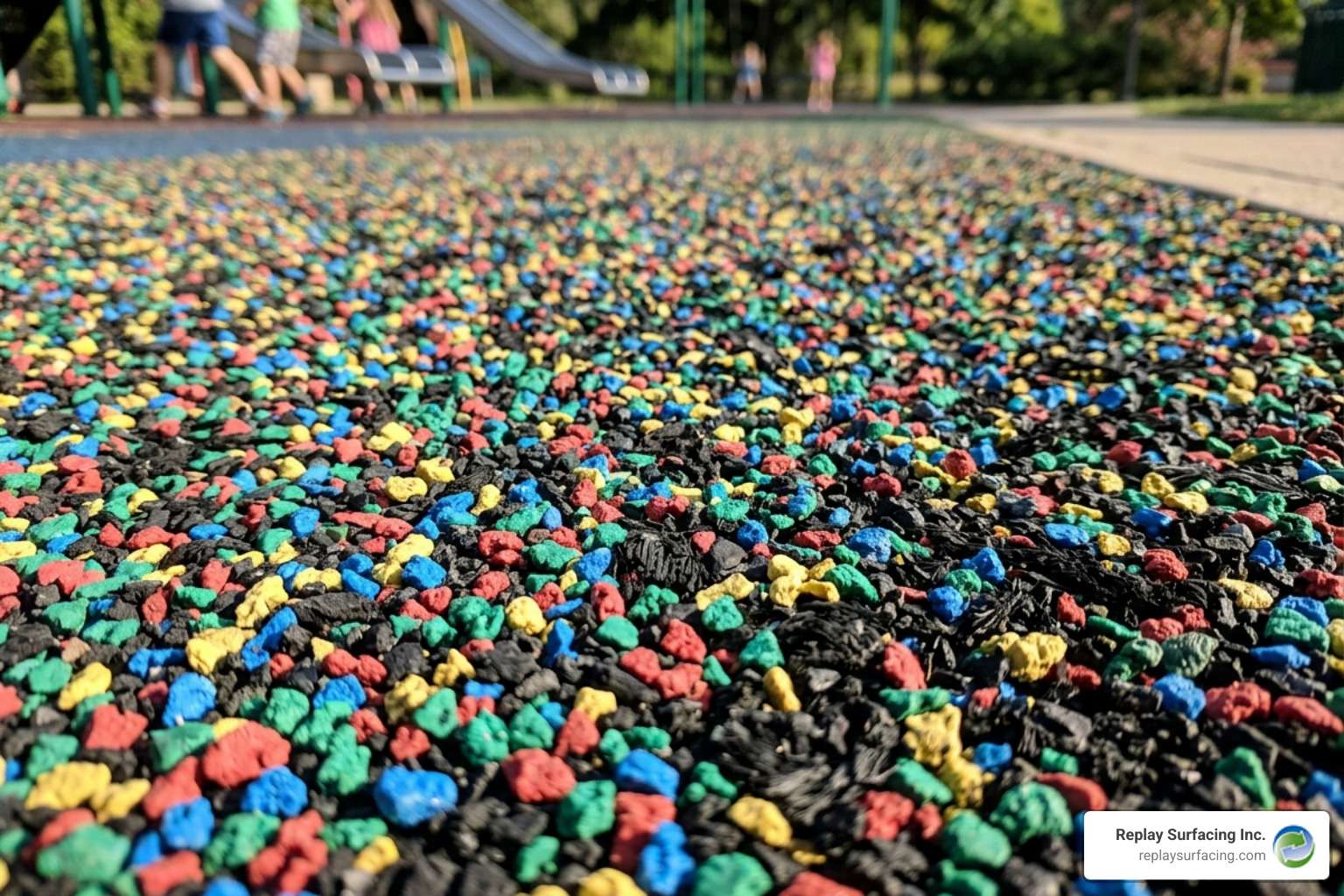
The two primary components we work with are EPDM (Ethylene Propylene Diene Monomer) granules and SBR (Styrene-Butadiene Rubber) buffings. SBR is typically the “shock absorber” layer made from recycled tires, while EPDM is the colorful, UV-resistant top layer that provides durability and aesthetic appeal. Choosing between these materials often depends on your specific needs for Rubber Surfacing and long-term performance. For a deeper dive into the technical differences, our Playground Surfaces Guide/ offers a comprehensive breakdown of how these materials interact.
The Science of Impact Absorption and Fall Heights
As a mechanical engineer, this is the part I find most fascinating—and it’s the most critical for child safety. The primary goal of a playground safety rubber surface is impact attenuation. This is the surface’s ability to absorb the kinetic energy of a falling child, deforming the rubber rather than the child’s bones or skull.
We measure this using two main metrics: G-max (the maximum acceleration during impact) and HIC (Head Injury Criterion). To meet safety standards, a surface must have a G-max of less than 200 and an HIC score below 1,000. You can find more technical details on Playground surfacing standards and how we test them in our article on Safety First Understanding Playground Surface Impact Standards/.
Determining the Right Thickness for a Playground Safety Rubber Surface
The required depth of your rubber surface is determined by the “Critical Fall Height” of your equipment—which is the height of the highest accessible part of the play structure. For example, if your tallest platform is 8 feet high, your rubber surface must be certified to protect against an 8-foot fall.
According to ASTM F1292 standards, just 4.5 inches of poured rubber can provide a safe landing for a 10-foot fall. However, if your equipment is lower, say 4 feet, you might only need a 2-inch cushion layer. Getting this measurement right is non-negotiable. Our resource on The Safe Zone Everything About Choosing The Right Playground Safety Mats/ helps you calculate the exact thickness needed for your specific equipment.
Certified Rubber Mulch and Loose Fill
While we love the seamless look of PIP, loose-fill rubber mulch is a powerhouse for fall protection. In fact, certified rubber mulch can provide fall protection for heights up to 16 feet when installed to the recommended depths (usually 6 to 12 inches).
Unlike wood mulch, rubber mulch is 5x heavier, meaning it stays in place during a storm in Sanford, NC, or a windy day in Tucson. It also doesn’t rot, attract insects, or absorb water. For a complete look at this cost-effective option, see our Playground Certified Rubber Mulch Complete Guide/.
Comparing Performance, Longevity, and Costs
Choosing a playground safety rubber surface in 2026 requires balancing your immediate budget with the “Total Cost of Ownership.” While some surfaces cost more upfront, they save thousands in maintenance and replacement costs over a decade.
Cost-Benefit Analysis of a Playground Safety Rubber Surface
Poured-in-Place rubber might cost $15 to $25 per square foot installed, but it typically lasts 10 to 15 years with minimal upkeep. Compare that to engineered wood fiber (EWF), which is cheap to install but requires annual “top-offs” and constant raking to maintain safety depths. Over 10 years, the labor and material costs of EWF often exceed the one-time investment of a high-quality rubber surface.
In our experience serving areas like Columbia, South Carolina and Raleigh, North Carolina, municipalities and schools increasingly opt for rubber because of the long-term reliability. For more on making the financial case for rubber, our Best Playground Flooring Ultimate Guide/ breaks down the numbers.
Regional Durability and Climate Factors
Geography plays a huge role in how your surface ages. In Tucson, Arizona, the intense UV rays can cause cheaper aromatic binders to “amber” or turn yellow, and eventually make the rubber brittle. In these high-heat areas, we recommend aliphatic binders, which are UV-stable and keep the colors vibrant for years.
Conversely, in places like Indiana or Connecticut, the concern is the freeze-thaw cycle. If water gets trapped under the surface and freezes, it can cause the rubber to heave or crack. Proper drainage and a solid subbase are essential in these climates to ensure your investment doesn’t literally crack under pressure.
Installation Best Practices and Maintenance
A playground safety rubber surface is only as good as its installation. We have seen many DIY projects fail because the installer didn’t account for humidity or temperature—two factors that drastically affect how the polyurethane binder cures.
Site Preparation and Drainage
The most common cause of surface failure isn’t the rubber itself—it’s what’s underneath it. Poured-in-Place rubber should ideally be installed over a 4-inch base of compacted stone, or better yet, cured concrete or asphalt.
Installing over crushed stone is possible, but it must be perfectly compacted and graded for drainage. In wet regions like Connecticut, we ensure a 2% slope to prevent water from pooling. If you are in Sanford, North Carolina, you know how heavy rain can be; without proper drainage, your playground can become a pond. Learn more about professional site requirements at our Playground Surfacing/ page.
Long-Term Maintenance and Compliance
While rubber is “low maintenance,” it is not “no maintenance.” To keep your surface compliant and safe for its full 15-year lifespan, we recommend:
- Weekly Visual Inspections: Check for “potholes” or loose granules, especially under swings.
- Monthly Cleaning: Use a leaf blower or a gentle hosing to remove debris that can act as an abrasive.
- Annual Power Washing: Use a low-pressure setting to remove deep-seated dirt and maintain slip resistance.
- Re-binding: Every few years, applying a “top coat” of binder can rejuvenate the surface and prevent granulation.
Always look for IPEMA (International Play Equipment Manufacturers Association) certification to ensure your materials meet the highest standards. We go into more detail on this in our guide to choosing a Playground Safety Surfacing Company/.
Accessibility and Environmental Sustainability
One of the proudest aspects of our work at Replay Surfacing is making playgrounds inclusive. Unitary rubber surfaces are the gold standard for ADA (Americans with Disabilities Act) compliance. Unlike sand or wood chips, a playground safety rubber surface is firm and stable, allowing children (and parents) in wheelchairs to navigate the entire play area without getting stuck.
Recycled Materials and LEED Credits
We believe in a circular economy. By recycling tires into playground surfacing, we divert thousands of pounds of waste from landfills in our service areas like Raleigh and Charlotte, NC. Not only is this good for the planet, but it can also help your project qualify for LEED credits or state environmental grants.
Is it safe? Absolutely. Extensive research from the EPA and state agencies has shown that recycled rubber is non-toxic and safe for children. We address these questions head-on in our Eco Safety Rubber Playground Surfacing Guide/ and our article on Is Rubber Mulch A Safe Surface For Your Childs Playground/.
Frequently Asked Questions about Rubber Surfacing
Is rubber playground surfacing toxic for children?
No. Leading health organizations and environmental agencies have concluded that the chemicals in recycled rubber are well below levels that would pose a risk to children. Reputable manufacturers (like us!) use high-quality, lead-free EPDM and SBR materials.
How long does a poured-in-place rubber surface last?
With proper maintenance and professional installation, a PIP surface typically lasts 10 to 12 years. If you use premium aliphatic binders and perform regular “top-off” maintenance, you can push that lifespan to 15 years or more.
Can rubber tiles be installed over existing concrete?
Yes! In fact, concrete is an ideal subbase for rubber tiles and PIP. It provides a stable, flat surface that won’t shift over time. Just ensure the concrete is clean and has proper drainage so water doesn’t sit between the concrete and the rubber.
Conclusion
Choosing the right playground safety rubber surface is about more than just picking a color; it’s about engineering a safe environment where children can push their limits without the risk of life-altering injuries. At Replay Surfacing Inc., we are dedicated to transforming recycled tires into the durable, sustainable, and customizable foundations of your community’s play spaces.
Whether you are building a new park in Raleigh, NC, or updating a school in Tucson, AZ, we are here to help you navigate the technical standards and installation best practices. For more information on how we can help your next project succeed, check out our rubber paving company services and let’s build something safe together.