
Why Choosing the Best Playground Tiles in Charlotte, NC Matters More Than You Think
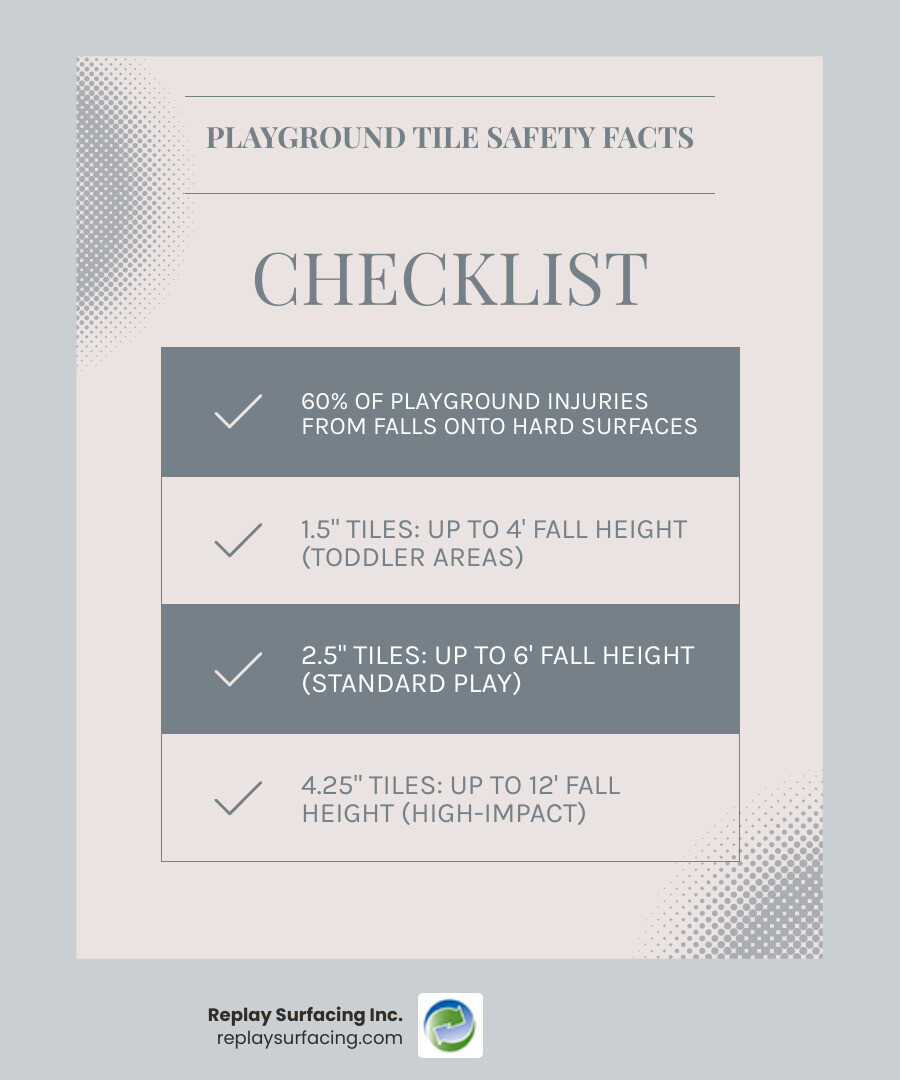
The best playground tiles in Charlotte, NC are recycled rubber interlocking tiles rated for your equipment’s fall height. Here’s a quick comparison to help you decide fast:
| Tile Thickness | Certified Fall Height | Best For |
|---|---|---|
| 1.5″ | Up to 4′ | Low equipment, toddler areas |
| 2.25″ – 2.5″ | Up to 6′ | Standard residential/commercial play |
| 3.25″ | Up to 8′ | Taller climbing structures |
| 4.25″ | Up to 10’–12′ | High-impact commercial playgrounds |
Top picks at a glance:
- Best overall: 2.5″ interlocking recycled rubber tiles (6′ fall height, ASTM F1292, CPSC, IPEMA certified)
- Best for tight budgets: 1.5″ rubber tiles paired with foam padding underlayer
- Best for high equipment: 4.25″ thick tiles rated up to 10′ fall height
- Best for DIY install: Interlocking tiles with QuadBlock or X-Connector systems (no adhesive needed)
About 60% of playground injuries happen when children fall off equipment onto a hard surface. That single statistic reframes the whole conversation. The ground under a playground isn’t an afterthought — it’s the last line of defense between a fun afternoon and a trip to the emergency room.
Facility managers and parents in North Carolina are increasingly moving away from wood mulch, sand, and bare concrete. Not because those materials are new — but because better options now exist. Recycled rubber tiles, in particular, have become the go-to surfacing choice across schools, parks, and backyard playsets for good reason: they’re durable, certified safe, and designed to absorb the impact that hard surfaces simply can’t.
But not all rubber tiles are created equal. Thickness, certification standards, sub-surface compatibility, and fall height ratings all vary — sometimes dramatically — between products. Picking the wrong tile for your equipment height isn’t just a waste of money. It could mean your surface fails to protect when it matters most.
I’m Landon Olson, operator of Replay Surfacing Inc., and with a background in mechanical engineering and years of hands-on experience manufacturing recycled rubber surfacing products, I’ve spent my career helping facilities find the best playground tiles in Charlotte, NC for their specific safety and sustainability needs. Let’s break down your top options so you can make a confident, well-informed choice.
Glossary for best playground tiles:
The Science of Safety: Why Recycled Rubber Leads the Charlotte Market
When we talk about the best playground tiles in Charlotte, NC, we are almost always talking about recycled rubber. At Replay Surfacing, we specialize in transforming what were once environmental hazards—scrap tires—into high-performance safety surfaces. But why is rubber the gold standard in cities like Charlotte, NC, and Tucson, AZ?
It comes down to physics. Rubber is a unique material that acts as both a shock and vibration absorber. It possesses elastic properties that allow it to compress under impact and then return to its original shape. This “give” is what saves a child’s limbs or head during a fall. Most modern tiles are made from SBR (Styrene Butadiene Rubber) derived from recycled tires, often topped with a layer of EPDM (Ethylene Propylene Diene Monomer) granules for vibrant, UV-resistant color.
Understanding the Certifications
To ensure you are getting a truly safe product, look for these specific standards:
- ASTM F1292: This is the big one. It measures the shock-attenuation performance of surfacing.
- CPSC Compliance: Ensures the product meets the U.S. Consumer Product Safety Commission’s guidelines for public playgrounds.
- IPEMA Certification: A third-party certification that validates the manufacturer’s claims regarding fall height.
- EN 1177: The European standard for impact-attenuating playground surfacing, often used for international quality benchmarks.
Beyond impact protection, non-toxic playground tiles are a priority. High-quality tiles are manufactured to be free of lead, heavy metals, and BPA. They are also engineered for slip resistance, even when wet, making them ideal for the humid afternoons in Columbia, SC, or the rainy seasons in Beaverton, OR. You can review the technical details in this Spec Sheet to see how these materials hold up against fire (ASTM E108) and extreme weather. For a deeper dive into why this material is so effective, check out our recycled rubber mats playgrounds guide.
Comparing the Best Playground Tiles in Charlotte for Every Fall Height
Selecting the best playground tiles in Charlotte, NC isn’t just about picking a color you like; it’s about matching the tile’s thickness to the “critical fall height” of your equipment. The critical fall height is the highest point from which a child could reasonably fall.
| Thickness | Fall Height Protection | Common Applications |
|---|---|---|
| 1.5″ | 4 Feet | Toddler play areas, spring riders |
| 2.25″ – 2.5″ | 6 Feet | Standard slides and small climbing domes |
| 3.0″ | 7 Feet | Medium-sized commercial playsets |
| 3.25″ | 8 Feet | Large jungle gyms |
| 4.25″ | 10+ Feet | High-impact commercial equipment |
If you are looking for play-safe rubber safety tiles, you’ll notice that as the thickness increases, so does the weight and the impact resilience. For example, a 2.5″ tile typically weighs around 24 lbs, providing a sturdy, immovable surface once installed.
One of the greatest advantages of interlocking outdoor playground tiles is their water permeability. Unlike concrete or solid rubber mats, these tiles often feature a “pedestal” or egg-carton underside. This design allows water to drain through the seams and flow underneath the floor to the nearest drain, preventing puddles and allowing kids in Nashville or Raleigh to get back to playing quickly after a storm. For more technical specifications on drainage and density, refer to this SolidPlay Spec Sheet.
Choosing the best playground tiles for High-Impact Zones
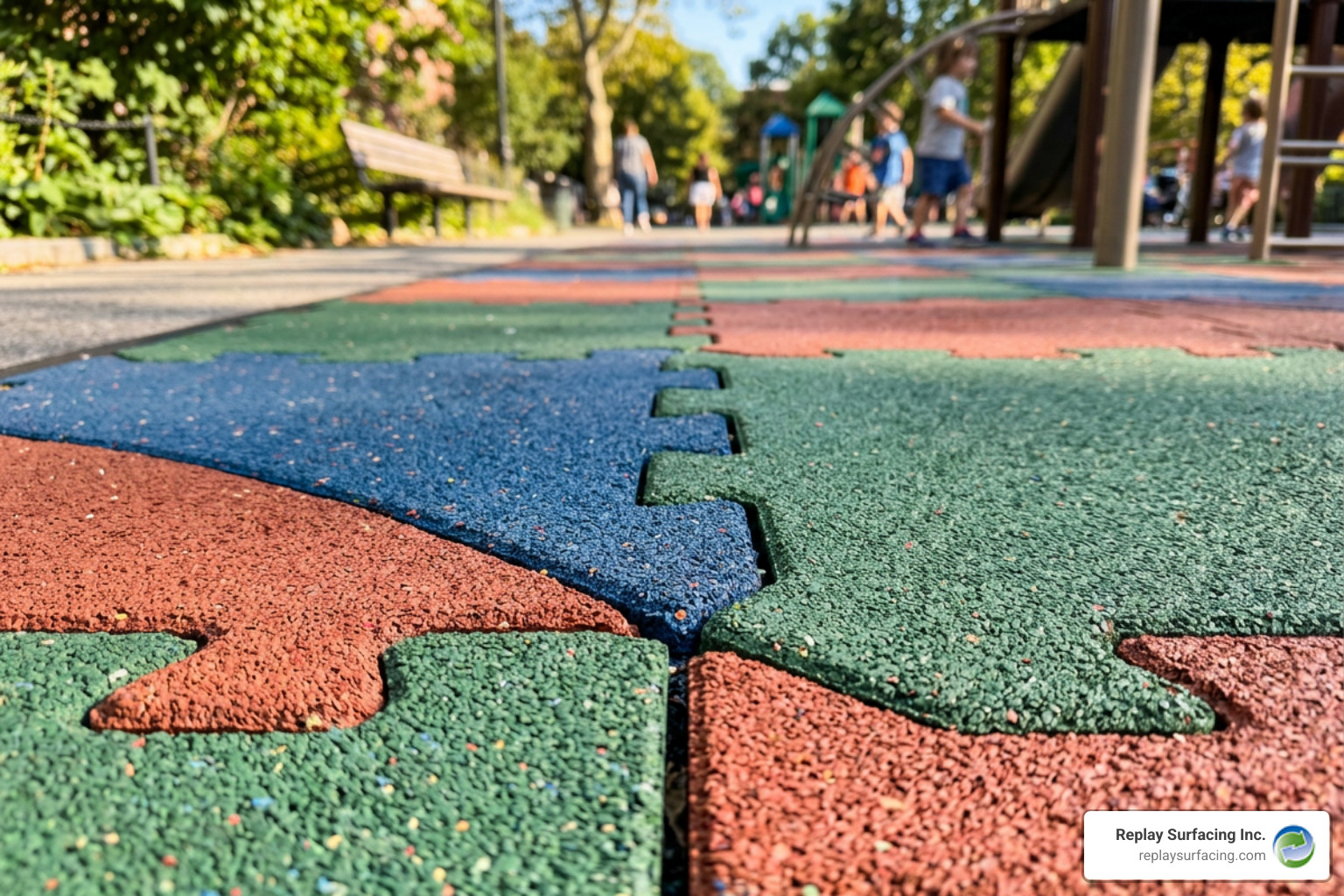
High-impact zones, such as the bottom of a slide or under a swing set, require extra attention. These “fall zones” should typically extend at least 6 feet in all directions from the equipment. In these areas, we often recommend soft-fall rubber mats or thicker tiles to handle the repetitive stress of landings.
To enhance safety with rubber playground mats, some systems allow you to pair a standard tile with a foam “shock pad” or “play pad” underneath. This can take a tile with a 3-foot rating and boost it to a 6-foot rating without needing a massive, heavy rubber block. This modularity is key for inclusive play and ADA compliance, ensuring that wheelchairs can roll smoothly across the surface while still providing maximum cushion for falls.
Installation Guide for Charlotte: From Concrete to Compacted Dirt
Whether you are a DIY-savvy parent in Sanford, NC, or a contractor in Charlotte, the best playground tiles are designed for straightforward installation.
Sub-Surface Preparation
The longevity of your floor depends entirely on what’s underneath it.
- Concrete or Asphalt: These are the ideal bases. They are flat, stable, and won’t shift. Tiles can be “loose-laid” using interlocking connectors or glued down for permanent public use.
- Compacted Gravel/Dirt: If you aren’t pouring a slab, you need a “free-draining” sub-base. This usually involves removing the grass, laying a weed barrier, and adding 3-4 inches of compacted crushed stone.
- Grass: While possible for temporary residential setups, we generally advise against it for long-term use as the ground will inevitably settle, causing the tiles to become uneven.
Connection Systems
Most interlocking playground mats use one of two systems:
- QuadBlock/X-Connectors: These are plastic pieces that fit into pre-drilled holes in the corners or sides of the tiles. They keep the tiles aligned without the need for messy adhesives.
- Puzzle Joints: These look like giant jigsaw pieces. They offer great mechanical stability but show visible seams.
For detailed steps on the process, visit our guide on installing playground tiles. If the project feels too big to handle alone, Replay Surfacing provides professional installation services across our service areas, including Charlotte, Raleigh, and Nashville.
How to Maintain the best playground tiles for Longevity
One reason rubber tiles are the best playground tiles for busy parks is their low maintenance. Unlike wood mulch, which needs to be raked weekly and topped off annually, rubber tiles are “set it and forget it.”
- Daily/Weekly: Use a leaf blower to remove pine needles, leaves, and debris.
- Monthly: Use a garden hose to wash away dust or mud.
- Deep Cleaning: A mild detergent (like Dawn or Tide) and a soft-bristle broom can remove stubborn stains. Avoid petroleum-based cleaners, as they can break down the rubber.
Most high-quality tiles come with a 15-year limited warranty, covering manufacturing defects and ensuring the tear strength and abrasion resistance remain intact through years of sun and snow. Check out our tips on keeping playground mats ready for outdoor fun.
Frequently Asked Questions about Playground Surfacing in North Carolina
Can playground tiles be installed over existing grass?
We get this question a lot from homeowners in the Raleigh and Charlotte areas. Technically, yes, but with caveats. You cannot simply throw tiles onto a lawn. You must first scalp the grass, install a heavy-duty weed barrier, and ideally, a thin layer of leveling sand or fine gravel. If the ground isn’t perfectly level, the interlocking seams will “trip” or pop up over time. For more on this, read our rubber mats play yards ultimate guide.
How do rubber tiles compare to rubber mulch for safety?
While both are excellent for safety, they serve different needs. Rubber mulch is often cheaper per square foot and is great for a “natural” look. However, mulch can be displaced by running feet (especially under swings), requiring regular raking to maintain the proper safety depth. Tiles provide a consistent, “fixed” safety depth that never moves. Plus, tiles are much easier to clean—you can’t exactly use a leaf blower on mulch without blowing the floor away! You can see our current playground mats for sale to compare pricing.
Do rubber playground tiles get too hot in the sun?
In places like Tucson, AZ, or Lake Charles, LA, heat is a real concern. Like any outdoor surface (including sand or asphalt), rubber tiles will absorb heat. Black tiles are the hottest. To keep the surface safe for bare feet, we recommend choosing lighter colors like “Sandcastle” or “Terra Cotta.” These lighter pigments can stay significantly cooler. If the tiles do get hot, a quick spray with a garden hose will cool them down almost instantly. For areas with high sun exposure, consider our black playground mats only for shaded zones.
Conclusion
At Replay Surfacing Inc., we believe that a playground should be a place of pure joy, not a source of worry for parents and administrators. By choosing the best playground tiles in Charlotte, NC, you are investing in a sustainable future—literally turning old tires into a safety net for the next generation.
Our products are engineered for the unique climates of our service areas, from the humid summers of Sanford, NC, and the varied terrain of Indiana to the desert heat of Tucson. Whether you need a customizable design for a community park or a durable, DIY-friendly solution for a backyard in Nashville or Farmington, we have the expertise to guide you.
Ready to transform your play area into a certified safe zone? Ready to secure your play area? Explore our professional playground solutions.