

Heavy Duty Outdoor Rubber Matting in Charlotte, NC: Key Types and Materials
Selecting the right material determines how your surface holds up under foot traffic, weathering, and mechanical stress. Outdoor environments demand formulations that do not crack under severe temperature shifts or break down when exposed to moisture and oils.
- Recycled Tire Rubber (SBR): Made by processing post-consumer tires, this material offers impact resistance, natural grip, and shock absorption. We use this approach at Replay Surfacing to divert end-of-life tires from landfills, converting them into resilient surfacing for high-traffic facilities across Charlotte, NC, Raleigh, NC, and Indianapolis, Indiana.
- Natural Rubber (NR): Sourced from organic latex, natural rubber delivers elasticity, tensile strength, and cold-weather flexibility. It conforms well to uneven terrain, making it popular for modular walkways across commercial properties in Beaverton, OR and Sanford, NC.
- Nitrile Rubber (NBR): A synthetic polymer engineered for chemical, grease, and oil resistance. If you are outfitting industrial loading bays or commercial kitchen entries in Lake Charles, Louisiana, nitrile prevents degradation caused by petroleum products and animal fats.
- High-Density Polyethylene (HDPE): While technically a thermoplastic rather than an elastomer, rigid HDPE panels serve as extreme heavy-duty ground protection mats for construction equipment and heavy vehicles.
| Material Type | Primary Outdoor Strengths | Common Thickness Range | Best Application |
|---|---|---|---|
| Recycled Tire Rubber (SBR) | High impact cushioning, wear resistance, eco-friendly | 9.5 mm to 20 mm (3/8″ to 3/4″) | Playgrounds, walkways, fitness yards, fitness facilities |
| Natural Rubber (NR) | Thermal insulation, surface traction, flexible | 15 mm to 23 mm | High-traffic public entrances, mud control, ramps |
| Nitrile Rubber (NBR) | Oil, fuel, and chemical resistance; grease stability | 4.5 mm to 6 mm | Industrial entrances, commercial workshops |
| HDPE Composite | Extreme load capacity (up to 400 tons), rigid bridging | 50 mm to 100 mm (2″ to 4″) | Temporary roads, crane staging, utility access |
For demanding walkways that must withstand continuous foot traffic without shifting or wearing thin, investing in tough-as-nails outdoor rubber mats that wont quit ensures your property stays safe and accessible year-round. The same principles apply to rubber matting used in commercial and industrial settings, where material selection directly affects long-term performance.
Thickness, Weight, and Load-Bearing Capacity
Thickness directly influences weight, tear resistance, and load-bearing performance. Thinner mats (3 mm to 6 mm) provide low-profile slip prevention for doorways, but lack the self-weight required to remain stationary under windy conditions or heavy cart traffic.
Heavier mats measuring 12.7 mm (1/2″) to 23 mm (approx. 7/8″ to 1″) weigh significantly more per square foot, providing anchored stability without the need for chemical adhesives. For heavy industrial applications, rigid panels engineered with solid-core HDPE achieve a compressional strength of up to 828 psi (58 kg/cm²), supporting loads of up to 400 tons for vehicle staging and utility work.

Weather Resistance, UV Stability, and Thermal Tolerances
Outdoor matting must withstand direct solar radiation, torrential downpours, and freezing cycles without warping or curling at the edges.
- UV Stability: Extended sun exposure can break down low-grade polymers, causing them to fade, turn brittle, and chalk. Quality rubber compounds incorporate carbon black and specialized UV stabilizers to prevent degradation in sunny climates like Tucson, AZ and Columbia, SC.
- Thermal Tolerance: Outdoor mats engineered for commercial use maintain their elasticity across extreme temperature bands, from -20°C (-4°F) up to +80°C (176°F). Specialty heavy-duty panels can operate from -29°F to +120°F without losing their structural integrity.
- Freeze-Thaw Durability: Porous and open-ring mats prevent pooling water from freezing into solid sheets of surface ice, allowing moisture to drain freely beneath the standing level during freeze-thaw cycles in Indiana and Connecticut.
To dive deeper into how different polymer formulations resist cracking in challenging outdoor climates, explore The Ultimate Guide To Durable Outdoor Rubber Matting.
Design Patterns, Traction, and Drainage Mechanisms
Surface texture dictates how effectively a mat removes contaminants from footwear and prevents hydroplaning in wet weather.
Textured profiles like diamond-plate, cobblestone, broad ribs, and open-ring honeycomb patterns channel water away from the shoe sole. Wear resistance is measured via the DIN abrasion standard, where a lower volume loss indicates a longer lifespan. Industrial-grade rubber walkway mats consistently achieve DIN abrasion ratings between 250 and 300 mm³, ensuring the traction profile does not grind smooth after months of heavy pedestrian or cart traffic.
Property owners looking to safeguard outdoor surfaces can learn how to protect high traffic patios and walkways with heavy duty rubber mats while maintaining reliable traction during wet weather.
Design Features in Heavy Duty Outdoor Rubber Matting for Mud and Drainage
Different environments present unique soil, debris, and moisture conditions:
- Honeycomb and Ring Drainage: Open-cell mats (often 22 mm to 23 mm thick) feature geometric cutouts that allow water, snow, and mud to drop below the walking surface. This prevents puddling and cleans boots in one step.
- Bi-Level Dirt Scraping: Premium nitrile entrance mats utilize molded rubber nubs that scrape mud from shoe treads while trapping moisture in a lower reservoir, capturing up to 95% of incoming debris.
- Broad Ribbed Surfaces: Continuous parallel grooves run the length of the mat, directing liquid runoff away from the center while providing an anti-slip rating of 4/5 or R9/R10 compliance for sloped entry ramps.
Understanding why heavy duty rubber outdoor mats keep entrances clean and safe helps facility managers choose the right surface profile for their building layout and regional precipitation levels.
Modular and Interlocking Walkway Systems
For long paths, pedestrian corridors, or broad warehouse aprons, single-piece mats can shift or leave tripping hazards at the seams. Interlocking rubber systems solve this through built-in puzzle connectors or heavy-duty connector tabs.
These systems allow you to assemble custom runs quickly over concrete, asphalt, or packed gravel. Facilities in humid or rainy areas like Nashville, TN, Sanford, NC, and Beaverton, OR rely on modular installations to maintain safe walkways across outdoor courtyards and municipal spaces.
To configure continuous pathways across parks and commercial properties, consider utilizing outdoor interlocking rubber pathway materials or wide-format recycled rubber outdoor walkways that lock together securely without shifting.
Commercial, Industrial, and Agricultural Applications Across Regional Facilities
Heavy-duty outdoor rubber mats serve distinct functional roles across different industries and regional climates:
- Commercial Building Entrances: Heavy scraper mats placed outside retail centers and schools across Charlotte, NC and Raleigh, NC remove coarse dirt, road salt, and water before visitors step inside, protecting interior floors and reducing slip-and-fall claims.
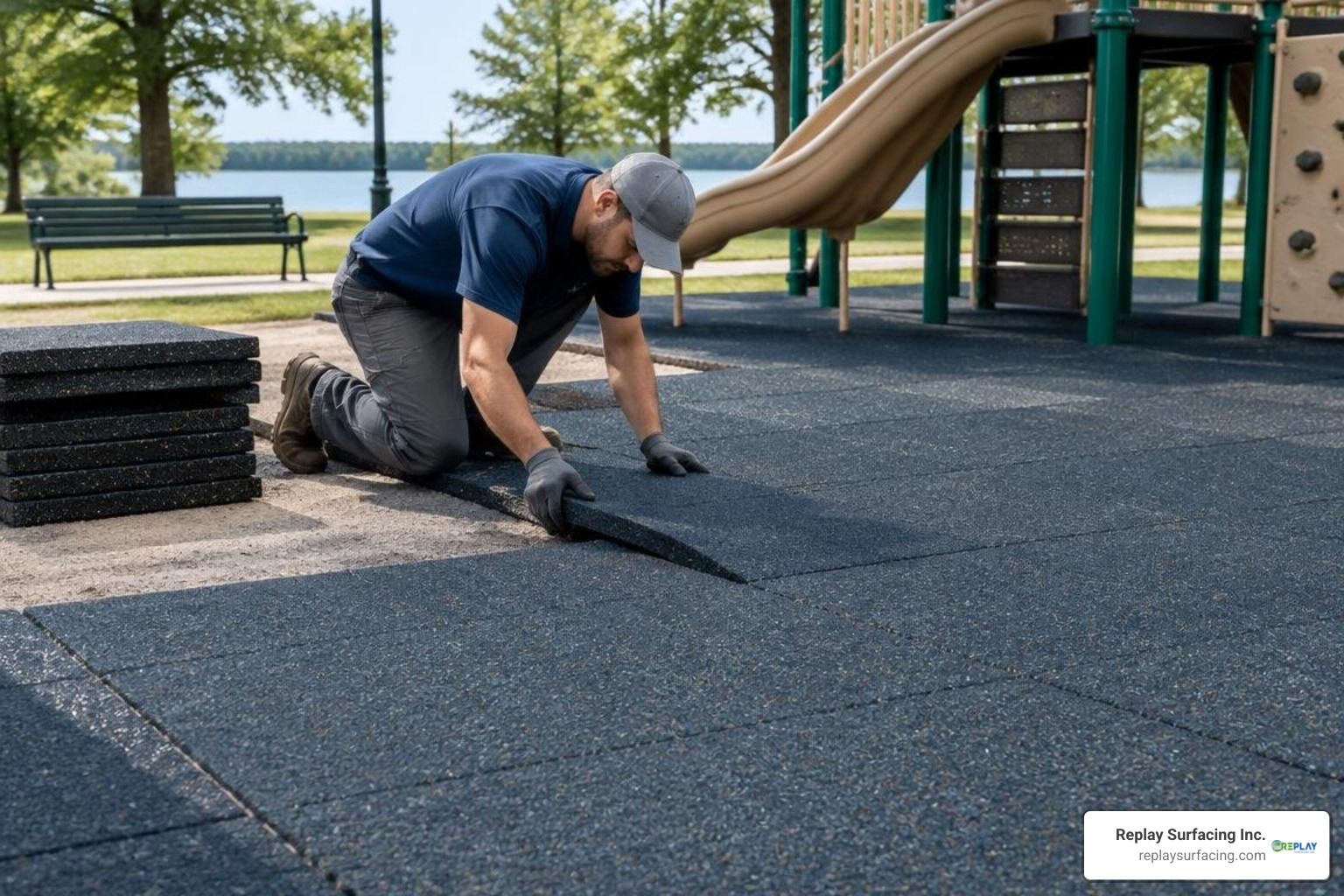
- Playgrounds and Recreation Areas: Impact-absorbing rubber tiles and mats provide critical fall-height protection beneath swings and climbing structures in municipal parks throughout Nashville, TN and Beaverton, OR, maintaining clean play areas even after heavy rains.
- Equine and Livestock Stalls: Solid 3/4-inch vulcanized rubber mats cushion animal joints against cold concrete across rural facilities in Indiana and Connecticut, resist ammonia from urine, and streamline daily mucking.
- Industrial Workstations and Wash Bays: Anti-fatigue rubber mats reduce joint stress for workers standing for long periods outside in industrial yards in Columbia, SC and Lake Charles, LA, while perforated drainage holes keep standing water off wash-bay floors.
For landscaping and broad structural protection across public spaces, integrating protective rubber ground cover and modular rubber pavers provides a durable, shock-absorbing base that resists rutting and soil erosion.
Selecting Heavy Duty Outdoor Rubber Matting for High-Load Applications
Standard pedestrian rubber mats cannot support the axle weights of vehicles, skid steers, or aerial lifts. Selecting the right matting for high-load environments requires matching the material’s compressive strength to the expected traffic:
- Pedestrian & Light Cart Traffic (Up to 1,000 lbs): Use 1/2″ to 3/4″ flexible recycled rubber mats or rolled broad-ribbed rubber.
- Service Vehicles & Turf Maintenance (1,000 to 10,000 lbs): Deploy thick, interlocking modular rubber tiles over a compacted aggregate base.
- Heavy Machinery, Cranes, & Haul Trucks (Up to 400 Tons): Install rigid, solid-core HDPE ground protection mats featuring bolt connectors and sloped overlap edges.
When designing designated pedestrian routes alongside equipment lanes, laying structured recycled rubber walkway systems keeps workers safe and prevents foot traffic from straying into vehicle paths.
Safety Standards, Compliance, and Certifications
To ensure long-term safety and regulatory compliance, evaluate outdoor matting against recognized industry benchmarks:
- Slip Resistance: Look for mats meeting DIN 51130 ratings (R9 through R12) or ASTM C1028 standards to ensure traction in wet and greasy conditions.
- Chemical & Environmental Safety: European REACH compliance confirms the rubber compound is free from harmful substances such as heavy metals and high concentrations of polycyclic aromatic hydrocarbons (PAHs).
- Fire Safety: Nitrile and specialty vulcanized rubber products should pass commercial flammability tests (e.g., DOC FF 1-70 or EN 13501-1) for public facility entrances.
- Static Dissipation: In environments with sensitive electronic machinery or fuel storage, anti-static and static-dissipative rubber formulations prevent dangerous electrical discharge.
Installation, Custom Cutting, and Long-Term Maintenance
Proper installation ensures your outdoor mats stay flat, functional, and secure across various climate zones:
- Subfloor Preparation: Clear the installation area of large rocks, roots, and loose debris. While flexible rubber mats can conform to minor undulations, a smooth base of packed crushed stone, asphalt, or concrete prevents premature wear.
- Acclimatization: Unroll or lay the mats flat on-site for 24 to 48 hours before final cutting or securing. This allows the rubber to relax and reach thermal equilibrium with ambient temperatures in your regional climate, such as the seasonal shifts experienced in Indianapolis, IN or Raleigh, NC.
- Expansion Gaps: If installing mats wall-to-wall or in recessed entrance wells in hotter climates like Tucson, AZ or Lake Charles, LA, leave a 3 mm to 5 mm gap around the perimeter to accommodate natural thermal expansion during hot summer months.
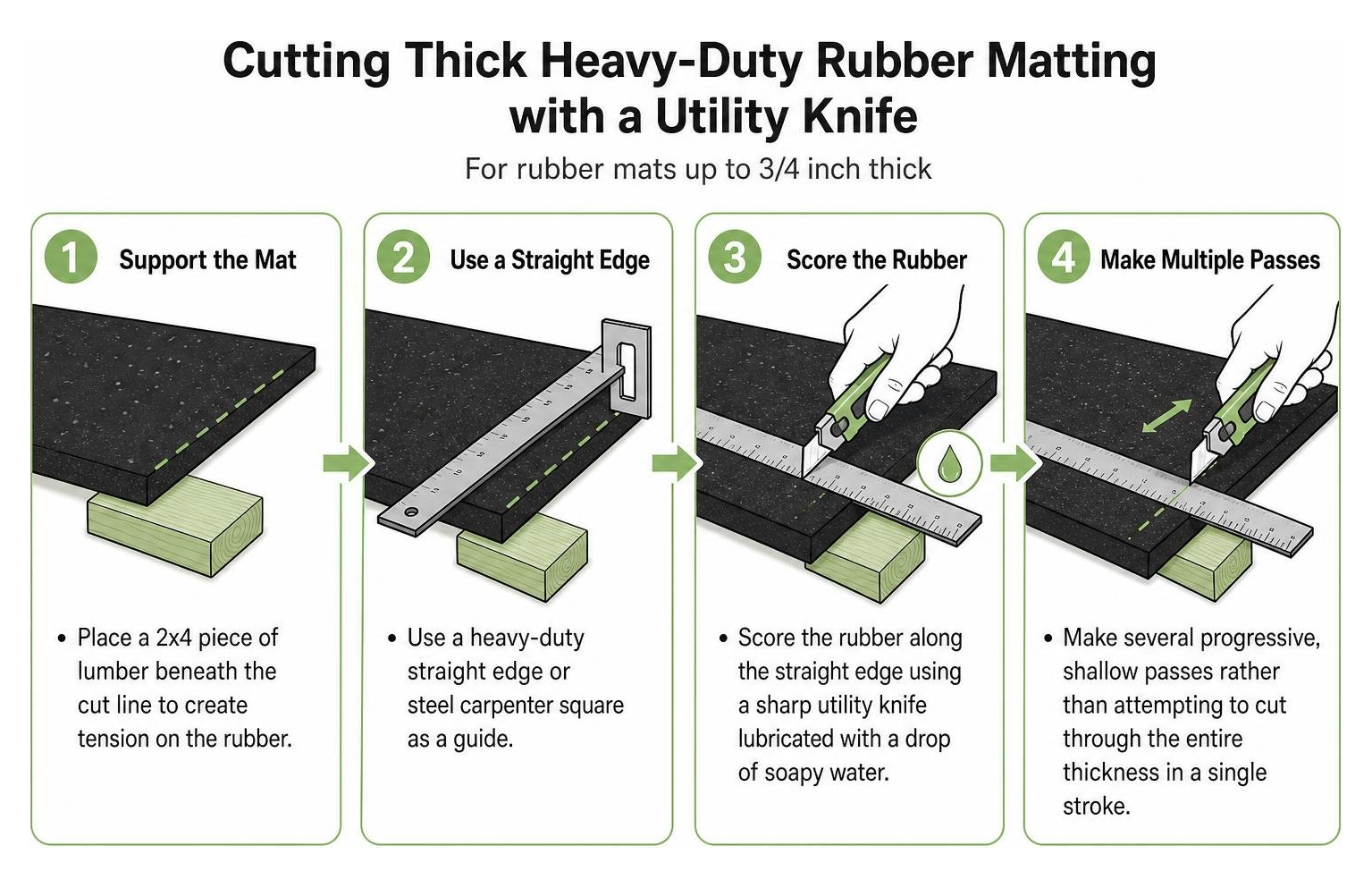
To cut thick rubber mats (up to 3/4 inch) cleanly on-site:
- Place a 2×4 piece of lumber beneath the cut line to create tension on the rubber.
- Use a heavy-duty straight edge or steel carpenter square as a guide.
- Score the rubber along the straight edge using a sharp utility knife lubricated with a drop of soapy water.
- Make several progressive, shallow passes rather than attempting to cut through the entire thickness in a single stroke.
For ongoing maintenance, sweep or vacuum loose dirt weekly. For deeper cleaning, spray the mats with a pressure washer using cold or warm water and a neutral pH detergent. Avoid harsh petroleum-based solvents or high-acid chemicals on natural and recycled SBR rubber, as they can soften and degrade the compound over time.
Lifecycle Cost Analysis: Budget vs. Premium Options
While budget rubber mats may offer a lower upfront purchase price, commercial facility operators must evaluate the total cost of ownership over time.
Investing in heavy-duty vulcanized or recycled tire rubber products reduces long-term replacement cycles, prevents slip-and-fall liabilities, and lowers facility maintenance overhead.
Frequently Asked Questions About Outdoor Rubber Matting
How do I clean and remove odors from outdoor rubber mats?
Clean mats by sweeping away loose dirt and washing with a pressure washer or garden hose using a neutral pH soap solution. To eliminate the natural sulfur scent of new vulcanized rubber, wash both sides thoroughly, allow the mat to air-dry completely, and let it sit outdoors in a ventilated, sunny location for several days.
Can heavy-duty rubber matting support vehicle traffic and heavy machinery?
Standard rubber entrance and stall mats are designed for pedestrian, livestock, and light cart traffic. For heavy machinery, utility trucks, and construction equipment, deploy solid-core high-density polyethylene (HDPE) ground protection panels, which offer a compressive strength of up to 828 psi and can support axle weights up to 400 tons over graded ground.
What is the best way to cut and customize thick rubber mats?
To cut heavy-duty mats up to 3/4-inch thick, position a straight edge along your cut line and support the cut point over a piece of dimensional lumber (such as a 2×4). Score along the line using a heavy-duty utility knife with a fresh blade dipped in soapy water. Bend the mat slightly along the score line to open the cut, and complete the separation with two to three shallow, controlled passes.
Conclusion
Heavy-duty outdoor rubber matting provides traction, surface protection, and mud control across commercial, industrial, municipal, and agricultural facilities. Matching your material composition, thickness, and drainage profile to your specific foot or vehicle traffic ensures a safer, cleaner property in any weather.
At Replay Surfacing Inc., we are committed to turning scrap tires into long-lasting, high-performance surfacing solutions. From municipal recreational areas in Connecticut and Indiana to athletic installations in Columbia, SC, and Tucson, AZ, our products deliver durable performance while keeping rubber waste out of landfills. If you are planning an athletic or recreational project, discover how our outdoor rubber flooring for basketball courts provides shock absorption, weather resistance, and traction for your facility. Contact our team today to find the right rubber surfacing solution for your property.